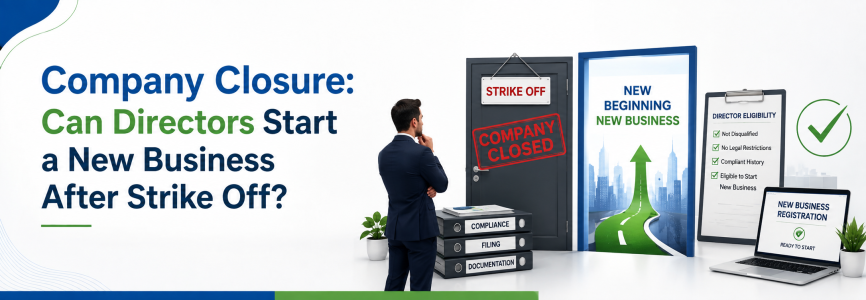



Closing a company does not necessarily mean the end of an entrepreneur’s business journey. Businesses may be closed because they have become inactive, their original purpose has been completed, market conditions have changed, or the promoters simply want to move on to another venture. One of the most common questions directors ask after a company has been struck off is: “Can I start another company or business?”
In most cases, the answer is yes—but subject to an important condition: the individual must not be disqualified from acting as a director or otherwise restricted under applicable law.
The strike-off of a company and the disqualification of its directors are two separate legal concepts under the Companies Act, 2013. A company can be struck off without its directors becoming disqualified. On the other hand, directors of a company that has committed certain serious or continuing statutory defaults may become disqualified under Section 164. Therefore, before starting another company after strike-off, a director should check the reason for the closure, the status of their Director Identification Number (DIN), any disqualification under Section 164, outstanding liabilities and pending regulatory proceedings.
What Does Strike Off of a Company Mean?
Strike-off is a legal process through which the name of a company is removed from the Register of Companies. Section 248 of the Companies Act, 2013 authorises the Registrar of Companies (ROC) to remove the name of a company in specified circumstances. A company may also voluntarily apply for removal of its name under Section 248(2). For a voluntary application, the company must first extinguish its liabilities and obtain the required approval of its members. MCA's current Form STK-2 instruction kit states that an application for removal of name is made under Section 248(2) read with the Companies (Removal of Names of Companies from the Register of Companies) Rules, 2016 and is processed through the Centre for Processing Accelerated Corporate Exit (C-PACE). Once the ROC publishes the prescribed notice in the Official Gazette under Section 248(5), the company stands dissolved.
What Happens to the Company After Strike Off?
Once a company is struck off and dissolved, it normally ceases to operate as a company. Section 250 of the Companies Act provides that a company dissolved under Section 248 ceases to operate as a company from the date specified in the dissolution notice, and its Certificate of Incorporation is treated as cancelled. An exception exists for matters relating to realisation of amounts due to the company and payment or discharge of existing liabilities and obligations. This means the old company cannot simply continue carrying on normal business after being struck off. However, dissolution of the company does not automatically prevent its former directors or shareholders from undertaking a different business through another eligible entity.
Can a Director Start a New Company After Strike Off?
Yes, generally a director of a struck-off company can incorporate or become a director of another company if the person has not incurred a statutory disqualification.
This distinction is critical.
Strike-off relates to the legal existence of the company. Director disqualification relates to the eligibility of the individual to hold the office of director. Merely because Company A has been legally closed through a proper strike-off procedure does not automatically mean that its director cannot establish Company B.
For example, suppose a private limited company has stopped operations, settled all liabilities, completed the required closure formalities and voluntarily applied for strike-off. If its directors have complied with applicable requirements and have not incurred any disqualification, they may generally proceed with another business or company. The situation becomes different where the director has been disqualified under Section 164.
Understanding Director Disqualification Under Section 164
Section 164 of the Companies Act, 2013 specifies circumstances in which an individual becomes ineligible for appointment as a director.
Section 164(1) contains several personal grounds of disqualification, including specified circumstances relating to insolvency, certain criminal convictions, court or Tribunal orders, non-payment of calls on shares and other statutory matters.
Section 164(2) is particularly relevant when dealing with directors of companies that have become inactive or non-compliant.
A person who is or has been a director of a company that:
- has not filed financial statements or annual returns for a continuous period of three financial years; or
- has committed specified continuing defaults relating to deposits, debentures or declared dividends,
may become ineligible to be reappointed in that company or appointed as director in another company for five years from the date specified under the provision. Therefore, the real question is not merely whether the earlier company has been struck off. The director must determine whether the circumstances leading to or preceding the strike-off resulted in disqualification.
Strike Off Does Not Automatically Mean Director Disqualification
This is one of the most common areas of confusion.
Consider two situations.
Situation 1: Proper voluntary closure
A company stops business, completes necessary filings, settles liabilities and voluntarily applies for strike-off. Its directors do not have any Section 164 disqualification. In this situation, the former directors can generally move ahead with another eligible business venture.
Situation 2: Company remained non-compliant for several years
A company stopped operations but its management did not file annual returns and financial statements for three continuous financial years. The ROC subsequently struck off the company. Here, the director may independently incur disqualification under Section 164(2) because of the continuous filing default. The problem is therefore not the strike-off itself but the statutory default associated with the company.
What Happens When a Director Is Disqualified?
Where a person incurs disqualification under Section 164(2), the Companies Act restricts that person from being reappointed as director of the defaulting company or being appointed as a director in another company for the prescribed five-year period. Section 167 also deals with vacation of office when a director incurs specified disqualifications. In relation to a Section 164(2) disqualification, the Act provides for vacation of office in companies other than the company that committed the relevant default. Consequently, a disqualified director should not attempt to incorporate a new company by simply ignoring the disqualification status. The individual's DIN and MCA records should be reviewed before proceeding.
Check DIN Status Before Starting a New Company
A person intending to become a director of a new company should ensure that their Director Identification Number (DIN) is in order. It is important to distinguish statutory director disqualification from administrative DIN-related issues.
For example, a DIN may become subject to administrative restrictions because prescribed DIN KYC requirements have not been completed. Such a situation is different from a five-year disqualification under Section 164(2).
Before incorporating another company, a former director should therefore check:
- DIN status;
- director-disqualification status;
- pending DIN KYC requirements;
- MCA master data;
- outstanding filing defaults connected with existing companies;
- court or Tribunal orders, if any.
Resolving these issues in advance can prevent rejection or complications during incorporation.
Can a Disqualified Director Start Any Kind of Business?
Director disqualification primarily affects a person's eligibility to hold the office of director of a company. It does not necessarily amount to a complete prohibition on undertaking every form of commercial activity. Depending on the circumstances and other applicable laws, an individual may potentially carry on business in another permissible structure, such as a proprietorship or another legally available arrangement. However, this should not be used as a mechanism to evade old liabilities, regulatory proceedings, creditor claims or legal restrictions. If the person wants to become a director of a newly incorporated company, the Section 164 eligibility requirements must be satisfied. Similarly, LLPs and other structures have their own eligibility, identification and compliance requirements, which should be independently reviewed.
Can the Former Director Become a Shareholder in Another Company?
The restrictions under Section 164 principally concern appointment as a director. Being a shareholder and being a director are legally different positions. A shareholder owns shares in a company, whereas directors participate in the management and governance of the company. Accordingly, a director's disqualification does not, merely by itself under Section 164, operate in the same manner as a general prohibition on holding shares. However, any separate court order, regulatory restriction, insolvency proceeding or other legal limitation applicable to the individual must also be considered.
Does Strike Off Remove Old Liabilities of Directors?
No. Company strike-off should never be viewed as a method for making existing liabilities automatically disappear. Section 248(7) expressly provides that the liability, if any, of every director, manager or other officer exercising management powers, as well as every member of the dissolved company, continues and may be enforced as if the company had not been dissolved. This does not mean that every company liability automatically becomes the personal liability of every director. Rather, liability that was otherwise legally enforceable against the relevant person is not wiped out merely because the company's name has been removed. Section 248(6) also requires the Registrar, before striking off, to be satisfied regarding adequate provision for realising amounts due to the company and paying or discharging liabilities and obligations. The provision further recognises that company assets remain available for discharging liabilities even after removal of its name. Therefore, starting a new company does not erase obligations connected with the previous company.
Can Creditors Proceed After the Company Is Struck Off?
Strike-off does not necessarily defeat legitimate claims relating to liabilities that existed before dissolution. The Companies Act specifically preserves liabilities in the manner provided under Section 248(6) and 248(7). Consequently, directors should resolve creditor, tax, employee, contractual and statutory matters before treating company closure as complete. A director should also avoid transferring assets or operations to a new entity with the intention of defeating creditors or avoiding lawful obligations. The new business should genuinely be a new venture rather than an artificial mechanism designed to escape liabilities of the old entity.
Can the Same Business Be Started Through a New Company?
A former director may generally establish another company for a lawful business activity if legally eligible to do so. However, several matters require consideration. Intellectual property, customer contracts, licences, assets and liabilities belonging to the old company do not automatically become property of the new company. They must be legally transferred where transfer is permissible. Sectoral registrations may also have to be obtained afresh in the name of the new entity. Similarly, existing contracts should not simply be treated as continuing with the new company unless they have been appropriately assigned, novated or replaced.
Can the Same Company Name Be Used?
Entrepreneurs sometimes want to close an old company and incorporate another entity using exactly the same name. This may not be possible. Under the Companies (Incorporation) Rules, a proposed name identical to the name of a company struck off under Section 248 is not permitted before the expiry of twenty years from the date of publication of the strike-off in the Official Gazette. Accordingly, the promoter may need to choose another available company name when establishing the new entity. This restriction is also relevant because a struck-off company may, in appropriate circumstances, be restored.
Can a Struck-Off Company Be Restored?
Yes, the Companies Act contains a restoration mechanism.
Under Section 252(1), a person aggrieved by an ROC order notifying a company as dissolved may appeal to the National Company Law Tribunal within three years from the date of the Registrar's order in the circumstances covered by that subsection.
Separately, Section 252(3) allows the company, a member, creditor or workman to seek restoration before expiry of twenty years from publication of the Section 248(5) notice where the statutory requirements for restoration are satisfied.
Therefore, if a company was carrying on business when struck off, had assets requiring protection or there is some other just basis, restoration may sometimes be more appropriate than starting an entirely new company.
Should Directors Start Fresh or Restore the Old Company?
The answer depends on the circumstances. Starting a fresh company may be appropriate where the earlier entity was properly and intentionally closed and the entrepreneur now wants to undertake a genuinely new venture.
Restoration may require consideration where:
- the company was wrongly struck off;
- valuable assets remain in the company;
- litigation is pending;
- contracts or property remain registered in its name;
- creditors require restoration;
- the business was actually operating when struck off.
A professional review should therefore be carried out before deciding that incorporating a new entity is the easiest solution.
Practical Checklist Before Starting a New Company
A former director planning another business should check the following:
- Confirm that the previous company is actually shown as struck off or dissolved.
- Verify the individual's DIN status.
- Check whether Section 164 disqualification applies.
- Confirm that DIN KYC and other individual filings are updated.
- Review outstanding liabilities of the old company.
- Check pending tax, GST, PF, ESI or other statutory matters.
- Verify whether any court, NCLT or regulatory proceeding remains pending.
- Identify whether assets belonging to the old company still exist.
- Ensure intellectual property and contracts are legally dealt with.
- Choose a legally available new company name.
- Obtain fresh licences and registrations required for the new business.
- Maintain a clear separation between transactions of the old company and new company.
This due diligence can prevent the new venture from inheriting unnecessary legal complications.
Why Responsible Closure Matters for Future Entrepreneurship
Entrepreneurs often focus heavily on incorporating a new company but underestimate the importance of properly closing an old one. A poorly managed closure can create problems years later through director disqualification, unpaid statutory dues, creditor claims or unresolved regulatory records. A properly planned closure, in contrast, allows an entrepreneur to move forward with greater certainty. This is why company strike-off should be viewed as part of the business lifecycle rather than merely the end of an unsuccessful venture. Responsible entrepreneurs ensure that one company is properly concluded before beginning another.
Conclusion
Directors can generally start a new business after their previous company has been struck off, provided they remain legally eligible and have not incurred a director disqualification or another applicable restriction.
The strike-off of a company under Section 248 does not, by itself, create an automatic prohibition against future entrepreneurship. The major issue is whether the director has incurred disqualification under Section 164, particularly because the previous company failed to file financial statements or annual returns for three continuous financial years or committed other specified defaults.
Directors should also remember that company closure does not erase existing legal liabilities. Section 248 expressly preserves applicable liabilities even after dissolution. Before incorporating a new company, former directors should therefore check their DIN and disqualification status, resolve outstanding liabilities, review regulatory records and ensure that assets or obligations belonging to the previous company are dealt with appropriately. A properly completed company closure can provide a clean legal exit and enable entrepreneurs to concentrate on new opportunities. The objective should not simply be to abandon one entity and form another, but to close responsibly, comply completely and start the next venture on a stronger legal foundation.
FAQs
Q1. Can a director incorporate another company after the previous company is struck off?
Ans. Yes. A former director can generally incorporate or become a director of another company if there is no disqualification under Section 164 or other legal restriction. Strike-off of the previous company does not automatically prohibit the director from starting another company.
Q2. Does company strike-off automatically disqualify its directors?
Ans. No. Strike-off and director disqualification are separate matters. However, if the company failed to file its financial statements or annual returns for three continuous financial years, its directors may incur disqualification under Section 164(2).
Q3. How long does disqualification under Section 164(2) last?
Ans. Section 164(2) provides that an affected person cannot be reappointed in the defaulting company or appointed in another company for a period of five years from the date on which the relevant company incurs the specified default.
Q4. Can a disqualified director run a proprietorship business?
Ans. Section 164 primarily restricts appointment as a director of a company. It does not itself create a universal prohibition on every form of business activity. However, the individual should consider other applicable legal, insolvency, regulatory or court-imposed restrictions before starting another business.
Q5. Does strike-off cancel the liabilities of directors?
Ans. No. Section 248(7) provides that the liability, if any, of directors, managers, relevant officers and members continues and may be enforced notwithstanding dissolution. Strike-off therefore cannot be used simply to escape legally enforceable liabilities.
Q6. Can directors use the same company name for their new company?
Ans. Generally, an identical name of a company struck off under Section 248 is restricted under the Companies (Incorporation) Rules for twenty years from publication of the strike-off in the Official Gazette. A different available name may therefore be required.
Q7. Can the previous company's assets simply be transferred to the new company?
Ans. No. Assets continue to be governed by the legal rights and obligations of the old company and cannot simply be treated as belonging to the new entity. Any permitted transfer should be properly documented and should not prejudice creditors or statutory liabilities.
Q8. Can a struck-off company be restored instead of incorporating a new company?
Ans. Yes. Section 252 provides mechanisms for seeking restoration through the NCLT. An aggrieved person may appeal under Section 252(1) within three years in applicable circumstances, while specified stakeholders may seek restoration under Section 252(3) within twenty years subject to statutory conditions.
Q9. What should a director check before incorporating another company?
Ans. The director should verify DIN status, Section 164 disqualification, DIN KYC compliance, outstanding liabilities, pending regulatory proceedings and the status of other directorships. The previous company's assets, registrations, taxes, contracts and creditor matters should also be reviewed before starting afresh.
Q10. Is starting another company immediately after strike-off legally risky?
Ans. Not necessarily, provided the earlier closure was lawful and the directors remain eligible. Risk arises where a new company is used to avoid creditors, statutory liabilities, litigation or director disqualification. The new entity should be established as a genuine and legally compliant venture.


_crop10_thumb.jpg)


_crop10_thumb.jpg)


-Form_crop10_thumb.jpg)

_crop10_thumb.jpg)


_learn_crop10_thumb.jpeg)


_crop10_thumb.jpg)

_crop10_thumb.jpg)


_crop10_thumb.jpg)




_for_Foreign_Directors_learn_crop10_thumb.jpeg)


_Act,_2015_learn_crop10_thumb.jpg)







_learn_crop10_thumb.jpg)




















_crop10_thumb.jpg)
_crop10_thumb.jpg)

_(1)_crop10_thumb.jpg)







_crop10_thumb.png)










_crop10_thumb.jpg)


_crop10_thumb.jpg)






_crop10_thumb.png)
_crop10_thumb.jpg)







_crop10_thumb.png)