



A Practical Legal and Compliance Guide for Indian Exporters
For an Indian business planning to enter international markets, having a good product and finding overseas buyers are only part of the export journey. The business must also understand India’s foreign trade framework, obtain the appropriate registrations and ensure that the product being exported falls under the correct Export Promotion Council (EPC).
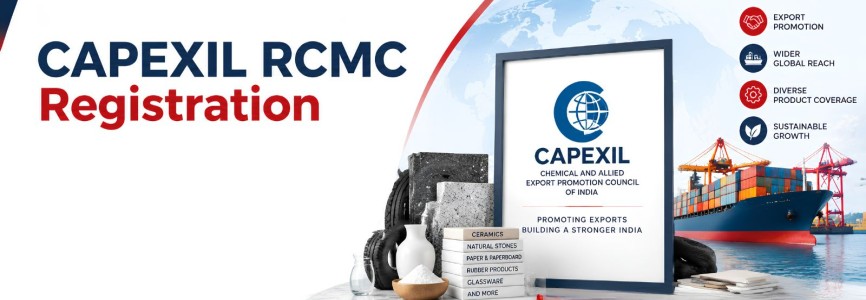
This is where CAPEXIL RCMC Registration becomes relevant. CAPEXIL — the Chemical and Allied Export Promotion Council of India — is an Export Promotion Council sponsored by the Ministry of Commerce & Industry, Government of India. Established in 1958, CAPEXIL today covers products across 16 panels, including ceramics, natural stones, rubber products, paper and paperboard, glassware, plywood, processed minerals, paints and printing inks, books and publications, animal by-products and several other categories.
For exporters whose main line of business falls within CAPEXIL's notified product coverage, obtaining the appropriate Registration-Cum-Membership Certificate (RCMC) establishes their registration with the Council and can be important for accessing benefits or concessions under India's Foreign Trade Policy.
This guide explains the legal framework, eligibility, registration procedure, validity, documents, fees, amendments and important recent clarifications that exporters should understand before applying.
What Is CAPEXIL RCMC Registration?
Understanding the Registration-Cum-Membership Certificate
Under the Foreign Trade Policy (FTP) 2023, an RCMC means a certificate of registration and membership granted by an Export Promotion Council, Commodity Board, Development Authority or another competent authority prescribed under the FTP or Handbook of Procedures.
In practical terms, a CAPEXIL RCMC confirms that an exporter dealing in products falling within CAPEXIL's jurisdiction has registered with the relevant Export Promotion Council.
An RCMC should not be confused with an Importer Exporter Code (IEC). The IEC is the fundamental identification required for undertaking import/export activities, subject to the exceptions prescribed by DGFT, whereas the RCMC connects an exporter with the appropriate Export Promotion Council and the FTP benefit framework.
Rules and Regulations Applicable to RCMC Registration
Foreign Trade Policy 2023 and Handbook of Procedures
The principal regulatory framework comes from the Foreign Trade (Development and Regulation) Act, 1992, the Foreign Trade Policy 2023 and the Handbook of Procedures (HBP) issued by the Directorate General of Foreign Trade. Paragraph 2.77 of the HBP 2023 recognizes a "Registering Authority" as a body notified by DGFT to register importers/exporters as members by issuing an RCMC. The notified Registering Authorities are listed in Appendix 2T.
Paragraph 2.79 provides the basic mechanism for RCMC. An exporter may apply in the prescribed ANF 2C to register and become a member of the concerned EPC. Once admitted to membership, the exporter is granted an RCMC in the prescribed format. Where registration as a manufacturer exporter is sought, evidence supporting that status must be furnished. Prospective or potential exporters may also apply to become associate members of an EPC.
Therefore, CAPEXIL RCMC is not simply a private membership certificate. It operates within the formal framework created by India's Foreign Trade Policy and DGFT procedures.
Is RCMC Mandatory for Every Exporter?
The Answer Depends on What You Are Claiming
This is one of the most misunderstood areas of export compliance.
Paragraph 2.57 of FTP 2023 deals with the RCMC requirement in connection with specified authorisations, benefits and concessions under the Foreign Trade Policy. However, DGFT issued an important clarification through Trade Notice No. 19/2024-25 dated 4 October 2024 because exporters were uncertain whether RCMC was also compulsory for post-export remission schemes.
DGFT clarified that RCMC is required under Para 2.57 for exporters applying for an authorisation to import/export under the FTP, subject to the applicable exception, or applying for another benefit or concession under the FTP. At the same time, DGFT distinguished post-export remission-based schemes such as Duty Drawback, RoSCTL and RoDTEP from such benefits.
This distinction is important. Businesses should therefore avoid making the broad statement that "every exporter must obtain an RCMC before making any export." The requirement must be examined according to the product, applicable EPC and the particular FTP authorisation, benefit or concession being sought.
Who Should Apply for CAPEXIL RCMC?
Start With Your Main Line of Business
Paragraph 2.80 of the HBP contains one of the most important rules for choosing an Export Promotion Council. While applying for RCMC, an exporter must declare its main line of business and obtain the RCMC from the Council concerned with the product constituting that main line of business.
Therefore, an exporter should not select CAPEXIL simply because its name appears familiar or because another exporter has obtained CAPEXIL membership.
The first question should always be:
Does my principal export product fall within CAPEXIL's product jurisdiction?
CAPEXIL currently displays product coverage across 16 panels, including Auto Tyres and Tubes, Ceramics and Allied Products, Bulk Minerals and Ores, Processed Minerals, Ossein and Gelatine Products, Cement, Clinkers & Asbestos Products, Graphite, Explosives and Accessories, Natural Stones and Products, Miscellaneous Products, Paper and Paper Board Products, Plywood and Allied Products, Rubber Products, Glass and Glassware Products, Animal By-Products, Paints and Printing Ink and Allied Products, and Books, Publications and Printing.
The HS Code of the proposed export product should therefore be checked against CAPEXIL's current product coverage before an application is made.
What If Your Product Does Not Fall Under CAPEXIL?
Do Not Choose an EPC Arbitrarily
If an export product is not covered by any Export Promotion Council or Commodity Board, HBP Para 2.80 provides for obtaining an RCMC from the Federation of Indian Export Organisations (FIEO). It also gives an option to certain multi-product exporters whose main line of business has not yet been settled to obtain an RCMC from FIEO.
This makes product classification one of the most important pre-application exercises. An incorrect EPC selection may create queries, delay registration and lead to difficulties when the exporter later tries to establish eligibility for an FTP benefit.
CAPEXIL Registration for Manufacturer and Merchant Exporters
Understand Your Exporter Status Before Applying
An applicant should correctly declare its exporter category and business profile.
Historically, separate classifications and additional charges could arise for manufacturer and merchant exporter categories. CAPEXIL's current fee guidance, however, specifically states that no Dual RCMC fee will be charged because the Manufacturer and Merchant categories have been merged together for this purpose.
This is a useful current compliance point because older online articles may still reproduce outdated CAPEXIL fee structures or refer to the earlier dual-RCMC charge.
Where an applicant seeks recognition based on manufacturing status, supporting evidence should be kept ready because HBP Para 2.79 expressly permits the registering authority to require evidence for manufacturer-exporter status.
Documents Required for CAPEXIL RCMC
Keep Your Business and Export Records Consistent
For CAPEXIL RCMC Registration, maintaining accurate and consistent business records is one of the most important compliance requirements. The documents required may vary depending on the applicant’s business structure, product category, export profile, turnover details, manufacturing status, and the requirements mentioned in the current CAPEXIL/DGFT application process. Therefore, exporters should always refer to the latest official requirements instead of relying on outdated document checklists. Before submitting the application, businesses should ensure that all details provided in the application match with their official records. Any mismatch between registrations, business details, or export information may lead to queries, delays, or additional verification requirements. Export turnover details play an important role in CAPEXIL’s current fee structure and membership assessment. Exporters are generally required to submit a self-certified export turnover statement based on FOB value in INR. The turnover statement should be prepared on the company’s letterhead and must be duly signed and stamped by an authorised person such as: The financial year considered for export turnover submission depends on the date of application: Maintaining proper turnover records and submitting the correct financial year details helps avoid unnecessary queries and ensures a smoother CAPEXIL RCMC registration process.Important Records and Documents to Keep Ready:
The Importer Exporter Code (IEC) details and DGFT profile should be updated and consistent with the applicant’s current business information.
PAN information, GST registration details, and other tax-related records should match with the details submitted for RCMC registration.
Applicants should maintain relevant incorporation or registration documents such as Company Incorporation Certificate, LLP Agreement, Partnership Deed, or Proprietorship proof, as applicable.
The registered office address, communication details, and authorised person information should be accurate and updated across all records.
Exporters should keep valid bank details and authorised signatory information ready for verification purposes.
Correct product classification and HS Code details are essential because RCMC eligibility depends on the exporter’s main line of business and product category.
If the exporter claims manufacturer status or MSME benefits, supporting documents should be maintained and submitted wherever required.Export Turnover Proof Requirement
Applicable Financial Year for Turnover Submission
Export turnover of the financial year previous to the immediately preceding financial year is considered.
Export turnover of the immediately preceding financial year is required to be submitted.
Step-by-Step Process for CAPEXIL RCMC Registration
Step 1: Obtain and Update the IEC
Before moving to RCMC, the exporter should ensure that its Importer Exporter Code and DGFT profile contain correct and current business information. The legal name, PAN-linked information, registered address and other core details should correspond with supporting records. A mismatch at the foundation stage can result in avoidable clarification requirements later.
Step 2: Identify the Correct HS Code
The applicant should identify the appropriate ITC(HS)/HS classification for the product proposed to be exported. This should not be treated as a clerical exercise. Product classification determines which Export Promotion Council has jurisdiction and may also affect export policy conditions, authorisations and other regulatory requirements. CAPEXIL provides a product-panel structure through which exporters can examine the products falling within its coverage.
Step 3: Confirm CAPEXIL Jurisdiction
After identifying the HS Code, confirm that the product falls within CAPEXIL's notified coverage. If CAPEXIL is the appropriate Council for the exporter's main line of business, the applicant can proceed with CAPEXIL RCMC. Where products fall across different areas, the main-line-of-business rule under Para 2.80 of HBP should be considered carefully.
Step 4: Prepare the Application
The RCMC framework under HBP refers to application in ANF 2C. The DGFT e-RCMC system captures information such as basic applicant details, the selected Export Promotion Council or Commodity Board, exporter category, membership period, financial information, MSME status, export performance, main line of business, attachments and declarations. The applicant should make sure that every declaration corresponds with its IEC, GST and business records.
Step 5: Select CAPEXIL and the Correct Product Panel
Selecting CAPEXIL is only one part of the application. The relevant product/panel information must also be identified correctly. CAPEXIL presently operates across 16 product panels, so applicants exporting multiple covered products should determine whether additional panels are required. CAPEXIL's current fee page states that an additional panel attracts ?1,000 plus GST.
Step 6: Upload Supporting Documents
The required supporting records should be uploaded in clear and complete form. Names, addresses, IEC information, turnover declarations and product details should match across documents. Where manufacturing or other special status is declared, the appropriate supporting evidence should also be furnished. Incomplete or inconsistent documentation is one of the easiest ways to turn a straightforward registration into a query-driven process.
Step 7: Pay the Applicable CAPEXIL Fee
CAPEXIL's current published fee structure should be checked at the time of filing rather than relying on older fee tables available online.
CAPEXIL currently states that the admission fee is ?3,000 plus GST for members having turnover between ?0–25 lakh and ?5,000 plus GST for members having turnover above ?25 lakh. It further states that from 1 April 2024 onward, the RCMC fee is charged in multiplication of the number of membership years applied for.
CAPEXIL also specifies ?1,000 plus GST for each additional panel. For institutions and non-CAPEXIL HSN Code membership, its published fee page states a flat membership subscription of ?50,000 plus GST per annum, irrespective of turnover. Because fees and membership rules can change, the live fee schedule should always be verified immediately before payment.
Step 8: Submit and Respond to Queries
After payment and submission, the application is examined by the concerned registering authority. If a clarification, correction or additional document is sought, it should be responded to accurately and within the available workflow. Businesses should avoid uploading contradictory records merely to close a query quickly. A response to an RCMC query becomes part of the compliance trail and should remain consistent with the exporter's actual business position.
Step 9: Download and Maintain the RCMC
After approval, the exporter should retain the electronic certificate and related payment/registration records. CAPEXIL has moved away from relying on hard-copy issuance and provides online membership-related facilities, including export-return filing, membership renewal/endorsement and access to member information.
How Long Is an RCMC Valid?
Five-Year FTP Validity Rule
Under Para 2.81 of HBP 2023, an RCMC is deemed valid from 1 April of the licensing year in which it is issued and remains valid for five years ending on 31 March of the licensing year, unless otherwise specified. However, exporters should not interpret the five-year certificate period as meaning that there are no annual membership obligations.
CAPEXIL's current rules require relevant documents to be submitted every year and require adjustment/payment of the fee difference based on the new turnover where applicable. Its fee guidance also addresses members who have paid membership subscription for multiple years and the balance payable under the revised structure. Accordingly, RCMC validity and annual membership compliance should be treated as related but distinct issues.
What Happens When Business Details Change?
One-Month Intimation Requirement
A particularly important provision is Para 2.82 of HBP 2023. Where there is a change in the ownership, constitution, name or address of an RCMC holder, the exporter is required to intimate the registering authority within one month from the date of the change. The registering authority may condone delay on merits.
This provision becomes relevant during events such as conversion of the business structure, change of registered office, change of business name or ownership restructuring. Exporters should therefore not update only GST, MCA or IEC records and assume that the RCMC automatically reflects the change. The EPC/RCMC record should also be reviewed and amended wherever necessary.
Annual Compliance After CAPEXIL Registration
Registration Is Not the End of the Process
A common misconception is that once CAPEXIL RCMC is issued, nothing further needs to be done until the certificate expires. CAPEXIL's current membership system includes facilities for filing export returns, renewal or endorsement of membership, viewing circulars and participating in Council activities.
More importantly, CAPEXIL's current fee guidance states that members must submit the necessary documents every year together with any difference in fees arising from the updated turnover. It also specifically requires annual self-certified export-turnover information for the products for which RCMC has been applied. Businesses should therefore maintain an annual CAPEXIL compliance calendar rather than treating RCMC as a certificate to be filed away for five years.
Recent RCMC Development Exporters Should Know
DGFT Clarification on RoDTEP, RoSCTL and Duty Drawback
One of the most relevant recent policy clarifications affecting RCMC interpretation came through DGFT Trade Notice No. 19/2024-25 dated 4 October 2024. DGFT addressed confusion over whether RCMC was compulsory for post-export remission-based schemes. The notice distinguished schemes such as Duty Drawback, RoSCTL and RoDTEP, which remit duties or taxes associated with exported goods, from other FTP authorisations, benefits and concessions to which the RCMC requirement under Para 2.57 applies.
For exporters, this clarification is significant because it prevents an overly broad interpretation that an RCMC is invariably required merely to claim every export-related remission. As of September 2026, exporters should still verify the latest DGFT notifications, public notices, trade notices and CAPEXIL circulars before filing, because the FTP framework and EPC procedures can be amended from time to time.
Common Mistakes in CAPEXIL RCMC Applications
Many registration delays are caused not by complex legal issues but by basic inconsistencies. An exporter may select CAPEXIL without first verifying the HS Code. Another may declare a product that actually belongs to a different EPC. Businesses may also submit turnover information for the wrong financial year, overlook an additional product panel, fail to support manufacturer status or leave outdated IEC and GST information unchanged.
Another mistake is relying on old CAPEXIL fee information. CAPEXIL's archived pages contain historical fee structures, while its current fee page reflects newer rules, including turnover-based admission fees, the post-1 April 2024 treatment of RCMC fees and removal of the earlier dual-RCMC charge for manufacturer/merchant categories. The safer approach is simple: classify first, verify the Council, reconcile the documents and only then submit the application.
Benefits of CAPEXIL Membership
CAPEXIL's role extends beyond issuance of an RCMC. The Council provides export-related information and facilitates activities intended to support its member exporters. Its membership infrastructure includes export-return filing, circulars and event information, while CAPEXIL's broader activities include export promotion initiatives and interaction with industry. For a serious exporter, EPC membership can therefore serve both a regulatory and industry-development function.
Final Thoughts
Getting CAPEXIL RCMC Registration in India is not simply about filling out an online form. The real compliance work starts before the application — identifying the correct HS Code, confirming CAPEXIL's jurisdiction, establishing the main line of business, reconciling IEC and business records, determining the correct product panel and understanding the applicable membership obligations.
The legal foundation comes from the Foreign Trade Policy 2023 and its Handbook of Procedures. In particular, exporters should understand Paras 2.57, 2.77, 2.79, 2.80, 2.81 and 2.82, together with Appendix 2T and the applicable ANF/RCMC framework. CAPEXIL's own current membership and fee requirements must then be applied to the individual exporter.
Most importantly, businesses should not view CAPEXIL RCMC as a one-time certificate. Export turnover reporting, membership requirements, amendments following changes in business particulars and evolving DGFT/CAPEXIL instructions should remain part of the exporter's ongoing compliance system.
For businesses planning to scale internationally, getting the registration right from the beginning can prevent avoidable delays when an export opportunity, authorisation or FTP benefit actually arises.
Frequently Asked Questions (FAQs)
Q1. What is CAPEXIL RCMC Registration?
Ans: CAPEXIL RCMC is a Registration-Cum-Membership Certificate for exporters dealing in products covered by CAPEXIL.
It establishes the exporter’s membership with the relevant Export Promotion Council.
It may also be required for specified benefits, concessions, or authorisations under the Foreign Trade Policy.
Q2. Who should apply for CAPEXIL RCMC?
Ans: Exporters whose main line of business falls under product categories covered by CAPEXIL should consider registration.
This can include eligible merchant exporters as well as manufacturer exporters.
The applicable Export Promotion Council should be determined based on the exporter’s products and main line of business.
Q3. Is CAPEXIL RCMC mandatory for every exporter?
Ans: No, RCMC should not be treated as universally mandatory merely for making every export.
Its requirement depends on the applicable FTP authorisation, benefit, concession, and relevant product council.
Exporters should check their specific activity and DGFT requirements before applying.
Q4. What is the validity of CAPEXIL RCMC?
Ans: Under the Handbook of Procedures, an RCMC is generally valid for five years.
Its validity runs from 1 April of the licensing year in which it is issued.
It normally ends on 31 March of the fifth licensing year, unless otherwise specified.
Q5. What documents are required for CAPEXIL Registration?
Ans: Applicants generally need IEC/business details, PAN, GST information, product details, and relevant supporting documents.
Export turnover and manufacturing-related evidence may also be required depending on the application.
All information should remain consistent across DGFT, GST, and business records.
Q6. How can I apply for CAPEXIL RCMC online?
Ans: The applicant should first identify the correct product classification and confirm CAPEXIL jurisdiction.
The RCMC application is then completed through the applicable DGFT e-RCMC process with supporting documents.
After scrutiny, payment, and approval, the RCMC can be issued electronically.
Q7. Can a merchant exporter obtain CAPEXIL RCMC?
Ans: Yes, eligible merchant exporters dealing in products covered by CAPEXIL can apply for membership.
The applicant must correctly disclose its business and exporter details during registration.
CAPEXIL’s current membership rules should be checked before submitting the application.
Q8. What if my business details change after registration?
Ans: Changes in ownership, constitution, name, or address should be reported to the registering authority.
HBP 2023 generally requires such changes to be intimated within one month.
The RCMC record should be updated so that it remains consistent with the exporter’s current business details.
Q9. Is CAPEXIL Registration the same as IEC?
Ans: No. IEC and CAPEXIL RCMC serve different purposes within India's export framework.
IEC is the primary importer-exporter identification, subject to prescribed exceptions.
RCMC establishes registration or membership with the relevant Export Promotion Council.
Q10. How do I know whether CAPEXIL is the correct EPC?
Ans: Start by checking your product, HS Code, and the main line of your export business.
Compare these details with CAPEXIL’s notified product panels and current coverage.
Choosing the correct EPC before filing can help prevent queries, rejection, or compliance complications.


_crop10_thumb.jpg)


_crop10_thumb.jpg)


-Form_crop10_thumb.jpg)

_crop10_thumb.jpg)


_learn_crop10_thumb.jpeg)


_crop10_thumb.jpg)

_crop10_thumb.jpg)


_crop10_thumb.jpg)





_for_Foreign_Directors_learn_crop10_thumb.jpeg)


_Act,_2015_learn_crop10_thumb.jpg)










_learn_crop10_thumb.jpg)








































_crop10_thumb.jpg)


_crop10_thumb.jpg)

_(1)_crop10_thumb.jpg)













_crop10_thumb.png)












_crop10_thumb.jpg)

_crop10_thumb.jpg)







_crop10_thumb.png)

_crop10_thumb.jpg)