
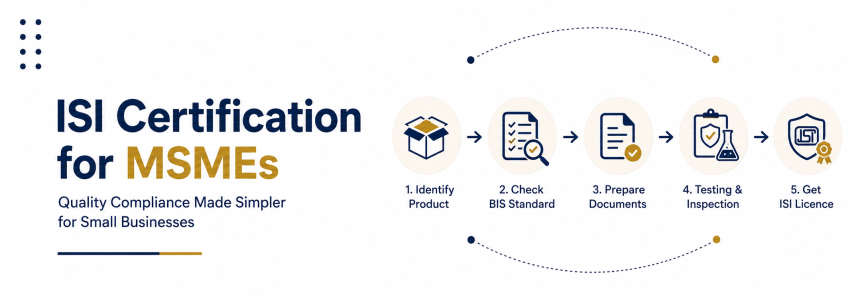



For MSMEs in India, quality is no longer just a business advantage; it is becoming a legal and market requirement. Whether a small manufacturer deals in electrical goods, cement, footwear, furniture, pressure cookers, steel products, food-contact items or other regulated goods, compliance with Indian Standards can directly affect its ability to sell in the market.
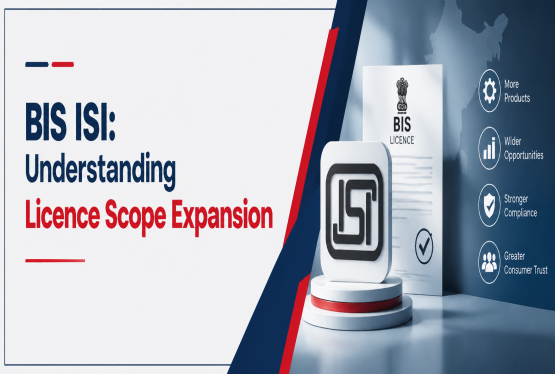
ISI Certification, granted by the Bureau of Indian Standards, helps manufacturers prove that their products meet the prescribed Indian Standard. The ISI mark is one of the most trusted quality marks in India and is used on products that conform to relevant standards under the BIS product certification scheme. BIS states that its certification scheme is generally voluntary, but several products are brought under compulsory certification through Quality Control Orders issued by the Central Government. For MSMEs, ISI Certification can appear complex because it involves testing, documentation, factory inspection, quality control and regular compliance. However, once understood properly, it can become a strong growth tool for small businesses.
What Is ISI Certification?
ISI Certification is a product certification system under which BIS grants a licence to a manufacturer to use the Standard Mark, commonly known as the ISI mark, on a certified product. This licence is granted only after BIS assesses the manufacturer’s production process, testing facilities, quality control system and product conformity with the applicable Indian Standard. In simple terms, ISI Certification means that the product has been manufactured as per the prescribed quality, safety and performance requirements. The mark gives confidence to customers, government buyers, distributors and regulators that the product is compliant with Indian standards.
Why ISI Certification Is Important for MSMEs
MSMEs often compete with large manufacturers, imported goods and unorganised market players. In such a situation, ISI Certification helps small businesses build credibility. It allows them to show that their product is not merely low-cost but also quality-compliant. For many products, ISI Certification is not optional. If a product is covered under a mandatory Quality Control Order, the manufacturer cannot legally manufacture, sell, distribute or import that product without a valid BIS licence and standard mark. BIS explains that compulsory use of the Standard Mark is notified for certain products through QCOs in public interest, health, safety, environmental protection and other policy considerations. For MSMEs, non-compliance may result in market restrictions, product seizure, penalties, rejection by buyers and loss of business opportunities. On the other hand, certification can open doors to government tenders, institutional sales, export-linked supply chains and better customer trust.
Legal Framework of ISI Certification
The key legal framework for ISI Certification includes the Bureau of Indian Standards Act, 2016, the BIS Rules, the BIS Conformity Assessment Regulations, 2018, and product-specific Quality Control Orders. Under Scheme-I of the BIS Conformity Assessment Regulations, manufacturers may obtain a licence to use the ISI mark on products conforming to the relevant Indian Standard. BIS provides product certification procedures, product manuals and application guidance through its official portal. The important point for MSMEs is that compliance depends on the product. Each product has a specific Indian Standard number, testing requirement, marking requirement and inspection requirement. Therefore, before applying, an MSME must first confirm whether its product is covered under voluntary certification or mandatory certification.
Products for Which ISI Certification May Be Required
ISI Certification may apply to several product categories such as electrical appliances, cement, steel products, pressure cookers, footwear, toys, helmets, household items, pipes, cables, food-contact products, chemicals, and many other notified goods. The list of compulsory products keeps changing because new Quality Control Orders are issued from time to time. BIS maintains an official list of products under compulsory certification, and MSMEs should always verify the applicable status before starting manufacturing or selling a product. This is especially important for businesses that supply to e-commerce platforms, government departments, large retailers, builders, industrial buyers or export-oriented manufacturers.
ISI Certification Process for MSMEs
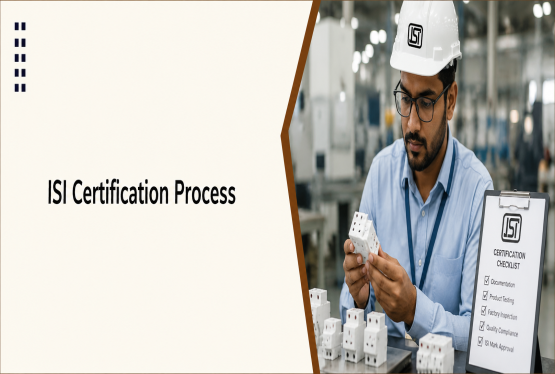
The ISI Certification process generally starts with identifying the applicable Indian Standard for the product. After that, the MSME must prepare technical documents, arrange testing facilities, implement quality control systems and apply to BIS through the official process. The usual steps include product standard identification, application filing, document submission, factory inspection, sample testing, review of test reports and grant of licence. BIS may inspect the manufacturing unit to verify production capability, in-house testing arrangements, raw material control, quality records and compliance with the relevant standard. Once the licence is granted, the MSME can use the ISI mark on the certified product as per the marking guidelines. However, certification does not end with licence approval. The manufacturer must continue maintaining quality records, follow the scheme of inspection and testing, use the mark correctly and renew the licence on time.
Documents Required for ISI Certification
The documents may vary depending on the product, but generally include business registration documents, factory address proof, manufacturing process flow chart, list of machinery, list of testing equipment, details of raw materials, product specification, test reports, quality control documents, undertaking and authorization documents. MSMEs may also need to provide details of technical personnel, calibration certificates, factory layout, brand details, marking label and product manual compliance. BIS FAQs also guide applicants to check product manuals and product-specific guidelines before applying. Proper documentation is important because incomplete or incorrect documents can delay the application or result in queries from BIS.
Benefits of ISI Certification for MSMEs
The biggest benefit of ISI Certification is legal compliance. If the product is covered under mandatory certification, ISI Certification allows the MSME to legally manufacture and sell the product in India.
The second benefit is customer trust. Consumers often associate ISI-marked products with safety and reliability. This can help MSMEs compete with larger brands.
The third benefit is better business opportunities. Many government departments, institutional buyers and large companies prefer or require BIS-certified products. Certification can therefore support vendor registration, tender participation and B2B sales.
The fourth benefit is quality improvement. During the certification process, MSMEs improve their production systems, testing facilities and documentation practices. This reduces defects, complaints and product rejection.
Common Challenges Faced by MSMEs
Many MSMEs face challenges because they are not aware whether their product requires compulsory ISI Certification. Some apply late, after receiving buyer pressure or regulatory notice. Others face difficulty in arranging testing equipment, preparing technical documents or understanding product manuals. Another common issue is incorrect marking. An ISI mark must be used only after licence approval and only in the manner permitted by BIS. Use of a fake or unauthorized ISI mark can invite enforcement action. BIS has also highlighted enforcement against misuse of the Standard Mark and sale of mandatory goods without valid BIS licence.
Renewal and Ongoing Compliance
After obtaining the licence, the MSME must comply with the inspection and testing requirements prescribed by BIS. The licence must be renewed within the prescribed time. Any change in product design, manufacturing location, brand, raw material source or production process may require intimation or approval depending on BIS requirements. MSMEs should maintain proper quality records, test reports, calibration records, complaint records and production details. Regular compliance helps avoid suspension, cancellation or market disruption.
Conclusion
ISI Certification is not just a regulatory approval; it is a quality passport for MSMEs. It helps small manufacturers build trust, comply with legal requirements and access bigger markets. As more products come under Quality Control Orders, MSMEs must stay alert and check whether their products require BIS certification.
For any MSME manufacturing regulated goods, the right approach is to identify the applicable Indian Standard, prepare documents, strengthen testing facilities and apply for BIS licence before entering the market. A compliant product not only avoids penalties but also creates long-term business credibility.
FAQs
Q1. What is ISI Certification?
Ans. ISI Certification is a product certification granted by BIS that allows a manufacturer to use the ISI mark on products conforming to the relevant Indian Standard.
Q2. Is ISI Certification mandatory for all MSMEs?
Ans. No, it is not mandatory for all MSMEs. It is mandatory only for products notified under compulsory certification through Quality Control Orders.
Q3. Who grants ISI Certification in India?
Ans. ISI Certification is granted by the Bureau of Indian Standards, which is the national standards body of India.
Q4. Can an MSME sell products without ISI Certification?
Ans. If the product is not under mandatory certification, it may be sold without ISI Certification. However, if the product is covered under a QCO, selling without BIS licence and ISI mark is not permitted.
Q5. What is the first step for ISI Certification?
Ans. The first step is to identify the applicable Indian Standard and check whether the product falls under mandatory BIS certification.
Q6. Is factory inspection required?
Ans. Yes, in most cases BIS assesses the manufacturing unit, testing capability and quality control system before granting the licence.
Q7. Can the ISI mark be used before licence approval?
Ans. No. A manufacturer can use the ISI mark only after receiving a valid BIS licence for the specific product.
Q8. What documents are required for MSMEs?
Ans. Common documents include business registration proof, factory details, machinery list, testing equipment list, manufacturing process, product details, quality control records and test reports.
Q9. Does ISI Certification help in government tenders?
Ans. Yes, many government and institutional buyers prefer or require BIS-certified products, especially where quality and safety standards are important.
Q10. What happens if an MSME misuses the ISI mark?
Ans. Misuse of the ISI mark or selling mandatory products without a valid BIS licence may lead to enforcement action, penalties, product seizure or business restrictions.


_crop10_thumb.jpg)


_crop10_thumb.jpg)


-Form_crop10_thumb.jpg)

_crop10_thumb.jpg)


_learn_crop10_thumb.jpeg)


_crop10_thumb.jpg)

_crop10_thumb.jpg)


_crop10_thumb.jpg)




_for_Foreign_Directors_learn_crop10_thumb.jpeg)


_Act,_2015_learn_crop10_thumb.jpg)










_learn_crop10_thumb.jpg)

























_crop10_thumb.jpg)
_crop10_thumb.jpg)
_(1)_crop10_thumb.jpg)





_crop10_thumb.png)


_crop10_thumb.jpg)

_crop10_thumb.jpg)




_crop10_thumb.png)
_crop10_thumb.jpg)





_crop10_thumb.png)








_crop10_thumb.jpg)
