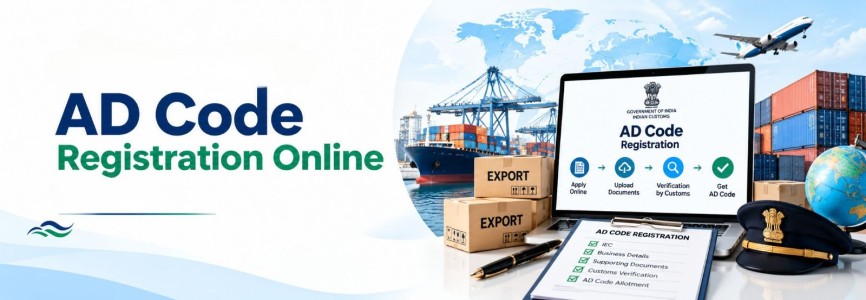



AD Code Registration is an important compliance requirement for businesses engaged in exporting goods from India. As international trade becomes increasingly digitised, exporters must ensure that their banking information is accurately registered with the Indian Customs Electronic Gateway (ICEGATE). This registration facilitates the identification of the authorised bank handling export transactions and supports the proper processing of shipping bills, foreign exchange transactions and export-related benefits.
In 2026, AD Code Registration continues to play an important role in India's customs and foreign exchange compliance framework. Exporters are required to coordinate with their authorised dealer banks and ensure that the relevant banking details are correctly reflected in the customs system. The ICEGATE portal provides an online facility for registering and modifying foreign remittance accounts, making the process more accessible to businesses.
The Central Board of Indirect Taxes and Customs (CBIC) has also continued updating the ICEGATE platform. Notably, an updated Bank Account Management User Manual, Version 1.01, was published on 28 July 2026, providing guidance on the relevant online functionalities.
icegate
+1
This article explains how to apply for AD Code Registration online in 2026, including its meaning, eligibility, required documents, applicable laws, application procedure, fees, processing time, recent updates and important compliance considerations.
What Is AD Code Registration?
An Authorised Dealer Code, commonly known as an AD Code, is a bank identification code associated with a bank branch authorised to deal in foreign exchange transactions. In the export process, the AD Code identifies the bank through which the exporter intends to handle export-related foreign exchange transactions.
The code is generally a 14-digit numerical identifier issued or confirmed by the authorised dealer bank. Exporters use the bank-issued code while registering their foreign remittance account details with Customs through ICEGATE.
AD Code Registration is the process of linking the relevant authorised dealer bank details with the exporter's Importer Exporter Code (IEC) and customs location within the customs electronic system.
For example, if a company exports textile products from India, it must ensure that its relevant authorised dealer banking information is correctly registered for customs processing. The registered information helps Customs identify the bank associated with the export transaction.
It is important to distinguish between obtaining an AD Code from a bank and registering that code on ICEGATE. The bank provides the code, while ICEGATE facilitates the customs-side registration of the corresponding banking details.
Why Is AD Code Registration Important for Exporters?
AD Code Registration helps establish a reliable connection between exporters, Customs and authorised dealer banks. This connection is important because export transactions involve shipping documentation, foreign exchange reporting, payment realisation and, where applicable, export incentives.
The registration helps ensure that bank details are correctly captured in the customs system and that the exporter's declared banking arrangements can be verified during customs processing.
Another important aspect is the connection between customs information and foreign exchange monitoring. The Reserve Bank of India (RBI) operates the Export Data Processing and Monitoring System (EDPMS), through which authorised dealer banks monitor export transactions and the realisation of export proceeds.
RBI directions recognise the electronic exchange of shipping bill information for monitoring export transactions. Accurate bank information therefore helps prevent reconciliation difficulties between exporters, banks and regulatory systems.
AD Code Registration should not, however, be confused with registration of an export incentive or refund account. ICEGATE provides distinct facilities for Foreign Remittance Accounts and Refund/Incentive Accounts. Exporters must ensure that the appropriate account details are registered for the relevant purpose.
Legal Framework Governing AD Code Registration in India
AD Code Registration operates within a broader legal framework covering customs procedures, international trade regulation and foreign exchange management. There is no single standalone legislation called the AD Code Registration Act. Instead, its regulatory foundation is derived from several statutes, rules and administrative procedures.
1. Customs Act, 1962
The Customs Act, 1962, governs the clearance of goods imported into and exported from India. Section 50 deals with the entry of goods for exportation and requires the exporter to make the prescribed declaration through a shipping bill or bill of export, as applicable.
Section 51 provides for the clearance of goods for exportation when the proper officer is satisfied that the goods are not prohibited and applicable statutory requirements have been fulfilled.
Section 157 empowers the CBIC to make regulations consistent with the Act, including provisions concerning customs documentation and electronic procedures.
These provisions form part of the legal framework supporting electronic export declarations and customs processing. However, Sections 50 and 51 do not independently prescribe the procedure for obtaining a 14-digit AD Code from a bank.
India Code
2. Foreign Exchange Management Act, 1999
The Foreign Exchange Management Act, 1999 (FEMA), regulates foreign exchange transactions in India and provides an important legal foundation for export payment compliance.
Section 7 deals with exports of goods and services and requires exporters to furnish prescribed declarations containing true and correct particulars, including information relevant to export proceeds.
Section 8 concerns the realisation and repatriation of foreign exchange in accordance with applicable regulatory requirements.
Section 10 governs the authorisation of persons dealing in foreign exchange, including authorised dealer banks. Section 11 empowers the RBI to issue directions to authorised persons.
Section 13 provides for penalties in cases involving contraventions of FEMA, subject to the statutory conditions.
Together, these provisions explain the legal importance of maintaining proper authorised banking arrangements for international trade.
India Code
+1
3. Foreign Trade (Development and Regulation) Act, 1992
The Foreign Trade (Development and Regulation) Act, 1992, provides the framework for regulating and facilitating India's foreign trade.
Under Section 7, an Importer Exporter Code is ordinarily required for undertaking imports and exports, subject to prescribed exemptions.
The Act also empowers the Central Government to formulate and implement India's Foreign Trade Policy.
An IEC is therefore an important prerequisite for exporters who need to register their AD Code details with Customs.
4. Foreign Trade Policy 2023 and Applicable Amendments
Paragraph 2.05 of the Foreign Trade Policy 2023 provides that an IEC is generally mandatory for import and export activities unless an exemption applies.
The policy also requires IEC holders to update or confirm their IEC details electronically during the April–June period each year.
Paragraph 2.06 identifies the principal documents required for exporting goods, including the transport document, commercial invoice-cum-packing list and shipping bill or bill of export.
These provisions remain relevant to exporters applying for AD Code Registration in 2026, subject to subsequent amendments and notifications.
DGFT Content
+1
Who Needs AD Code Registration in 2026?
Businesses exporting goods through Indian customs locations ordinarily need to ensure that their authorised dealer bank details are registered wherever required by the relevant customs procedures.
The requirement commonly applies to proprietorship firms, partnership firms, Limited Liability Partnerships, private limited companies, public limited companies and other eligible entities engaged in commercial exports.
Merchant exporters and manufacturer exporters may also require the registration for their export operations.
Exporters operating through multiple customs locations should verify that the relevant authorised dealer information is available and correctly mapped for each location where it is needed.
Businesses exporting services without a physical customs shipping bill generally do not follow the same AD Code Registration procedure merely because they receive payments from overseas. Their foreign exchange transactions remain subject to applicable FEMA and RBI requirements.
Accordingly, the applicability of customs-side AD Code Registration depends primarily on the nature of the export transaction and the customs process involved.
Documents Required for AD Code Registration in 2026
Before starting the application, exporters should collect the necessary business, banking and supporting documents.
The most important document is the AD Code letter or certificate issued by the authorised dealer bank. It should clearly identify the bank, relevant branch and AD Code. The exporter should ensure that the bank details correspond with the account intended for export transactions.
A valid IEC issued by the Directorate General of Foreign Trade is generally required. The exporter should also keep its PAN details, business registration documents and GST registration information available, wherever applicable.
A cancelled cheque or recent bank statement may be required to establish the account details. Depending on the bank and customs verification process, additional supporting documents may include a bank certificate, authorisation letter, identity proof of the authorised representative or proof of business constitution.
Where supporting documents must be referenced through e-SANCHIT, the exporter should keep the relevant Image Reference Number (IRN) available.
The ICEGATE advisory specifically identifies fields such as bank name, branch name, AD Code, bank account number, customs location, document type, IRN and supporting proof for the registration process.
Icegate
+1
Document requirements can vary with the type of application, verification route and customs location. Exporters should therefore follow the documents displayed in the current ICEGATE workflow rather than assuming that every application requires an identical set of attachments.
How to Apply for AD Code Registration Online in 2026?
The online application is ordinarily completed through the official ICEGATE portal after obtaining the relevant code and supporting confirmation from the authorised dealer bank.
Step 1: Obtain the AD Code From Your Bank
The first step is to approach the bank branch handling the exporter's foreign exchange transactions.
The exporter should request an AD Code certificate or letter for customs registration. The bank may require IEC details, PAN, account information, business KYC documents and an application or request letter.
After examining the request and completing the necessary verification, the bank provides or confirms the applicable AD Code.
Exporters should verify the accuracy of the bank name, account details and code before proceeding.
Step 2: Visit the Official ICEGATE Portal
After receiving the bank-issued AD Code, visit www.icegate.gov.in.
ICEGATE is the Indian Customs National Trade Portal and provides electronic services for customs-related activities.
Exporters who are already registered can log in using their existing credentials. New users must complete the relevant ICEGATE registration process before accessing the account management facilities.
Step 3: Log In to the ICEGATE Account
Enter the registered ICEGATE user ID and password.
The ICEGATE login process incorporates two-factor authentication. Users must complete the required One-Time Password verification through the registered authentication channel before accessing the dashboard.
ICEGATE's January 2026 login guidance confirms mobile OTP authentication by default and provides an option for configuring email OTP preferences.
Login and Dashboard_V1.02.pdf
+1
Step 4: Open the Bank Account Management Section
After successfully logging in, locate the Bank Account or Bank Account Management facility.
Select the option relating to Foreign Remittance Account (Authorised Dealer Code).
This is the appropriate category for declaring the banking information used in connection with foreign remittance transactions.
The separate Refund/Incentive Account facility should be used for the relevant incentive or refund account registration requirements.
Step 5: Select Add New Bank Account
Choose the option to add a new bank account.
The system will display the relevant form for entering the authorised dealer bank information.
The exporter should select the appropriate customs location and enter the required banking details carefully.
Depending on the available functionality and validation process, the portal may require the exporter to identify the bank branch and supporting documentation associated with the AD Code.
Step 6: Enter AD Code and Banking Information
The exporter must enter the requested details accurately.
These commonly include the name of the authorised dealer bank, bank branch, AD Code, bank account number, customs location and relevant supporting document particulars.
Information appearing in the ICEGATE application should correspond with the details available in the bank's records.
Incorrect or inconsistent entries can create validation errors and delay approval.
Step 7: Upload Supporting Documents
Upload the required supporting proof or provide the applicable e-SANCHIT document reference, depending on the current filing workflow.
Where an IRN is required, the exporter should ensure that the document has been uploaded correctly and that the reference is valid.
The uploaded document must be legible and should establish the relationship between the exporter, bank account and authorised dealer code.
Step 8: Verify and Submit the Application
After completing the form, review all entered information.
Use the available verification facility to validate the relevant bank and AD Code details.
Once verification is successful, submit the application electronically.
The official ICEGATE AD Code advisory describes a process involving entry of banking details, verification and subsequent submission.
Icegate
Step 9: Track the Application Status
After submission, the exporter should monitor the application's status through the relevant ICEGATE dashboard or account management functionality.
An application may require further verification or correction, depending on the system and banking arrangements.
A successful submission message should not automatically be treated as proof that the bank details are fully available for customs processing.
Exporters should confirm the final status before using the registered details for export transactions.
AD Code Registration Fees in 2026
There is generally no separately prescribed Central Government application fee for adding AD Code bank account details through the standard ICEGATE registration functionality.
However, banks may impose their own administrative charges for issuing certificates or processing related requests, depending on their policies.
Where exporters engage a customs broker, legal consultant or professional service provider, professional charges may also apply.
These charges are separate from any official government fee.
Therefore, exporters should confirm the bank's applicable charges and obtain a clear professional fee quotation before initiating the process.
Processing Time for AD Code Registration
There is no universally guaranteed statutory processing period applicable to every AD Code Registration request.
The actual time depends on the bank's processing, accuracy of submitted information, customs verification requirements and availability of electronic validation services.
Straightforward applications may be processed within a few working days, while applications requiring additional documents, corrections or manual intervention can take longer.
Exporters should apply sufficiently in advance of their planned shipment date rather than relying on an assumed approval timeline.
Important AD Code Registration Updates in 2026
The ICEGATE system has continued evolving to improve electronic customs services and exporter account management.
An important 2026 development was the publication of the updated Bank Account Management User Manual, Version 1.01, dated 28 July 2026. Exporters should refer to this updated guidance for the latest documented account management workflow.
icegate
+1
Another significant development was the strengthening of the ICEGATE login process through two-factor authentication guidance issued in January 2026. This reinforces the importance of keeping the registered mobile number and other contact information updated.
Operational advisories during September 2026 also highlighted the possibility of bank-specific and system-related interruptions. ICEGATE displayed notices concerning temporary difficulties involving certain bank AD Code services, including IndusInd Bank and Union Bank, and advised manual processing in the specified circumstances.
ICEGATE additionally reported a temporary interruption in data exchange with RBI systems during 24–30 September 2026 because of RBI system migration. These were operational notices, not announcements abolishing the AD Code Registration requirement.
icegate
+1
Exporters facing similar difficulties should check the current ICEGATE notices and contact their bank or the relevant customs authorities for the applicable alternative procedure.
Is Separate AD Code Registration Required for Every Port?
Exporters should distinguish between obtaining an AD Code and registering banking details against the relevant customs locations.
A bank-issued AD Code is not necessarily a separate code for every export port. However, customs-side registration or mapping requirements may depend on the customs location and applicable ICEGATE procedures.
The ICEGATE account management workflow includes a customs location field, making accurate location selection important.
An exporter using different ports, airports or inland container depots should verify whether the authorised dealer details have been properly registered for the locations concerned.
It is advisable to complete the required mapping before filing shipping bills for exports from a new customs location.
Difference Between AD Code Registration and IEC Registration
AD Code Registration and IEC Registration perform different functions under India's export compliance system.
An Importer Exporter Code is issued by the DGFT and serves as the principal identification number for entities undertaking imports and exports, subject to exemptions.
An AD Code identifies the authorised dealer bank associated with relevant foreign exchange transactions.
IEC registration establishes the exporter's identity for foreign trade purposes, whereas AD Code Registration provides the necessary customs-side banking information.
Obtaining an IEC does not automatically mean that the relevant AD Code details have been registered at the required customs locations.
Exporters must examine both requirements separately.
AD Code Registration and GST Export Benefits
AD Code Registration is also relevant to exporters managing customs transactions alongside GST-related export benefits.
Under Section 16 of the Integrated Goods and Services Tax Act, 2017, exports of goods and services are treated as zero-rated supplies, subject to applicable statutory provisions.
Exporters may follow the permitted route for exporting under a Letter of Undertaking or bond without payment of integrated tax and claiming a refund of eligible unutilised input tax credit, or another legally available route under the prevailing provisions.
For export-related IGST refunds, the customs and GST systems interact through shipping bill and export data.
However, AD Code Registration alone does not establish eligibility for an IGST refund, duty drawback, RoDTEP benefit or any other export incentive. Each benefit is governed by its own eligibility conditions, declarations and procedural requirements.
Exporters should separately verify the relevant refund or incentive bank account registration and ensure that their customs and GST details are consistent.
Common Problems During AD Code Registration
Exporters may encounter application difficulties because of incorrect banking information, mismatched IEC details, invalid document references or selection of an incorrect customs location.
An AD Code entered against the wrong bank or branch can result in verification failure. Similarly, a mismatch between the bank certificate and the account particulars entered on ICEGATE may delay the process.
Errors involving e-SANCHIT references can also create documentation problems.
Technical issues may arise when bank validation services or portal facilities are temporarily unavailable.
To reduce these risks, exporters should verify their IEC details, obtain an accurate bank certificate, review all entries before submission and maintain copies of the supporting documents.
Where a problem cannot be resolved through the portal, the exporter should raise a support request or coordinate with the relevant bank and customs authorities.
Modification or Updating of AD Code Details
A business may need to update its registered banking details when it changes its authorised dealer bank, shifts to a different bank branch, closes an existing account or changes the account used for export transactions.
ICEGATE provides functionality for modifying previously registered bank account information.
The exporter should access the relevant bank account management section, select the registered account requiring modification and follow the applicable procedure for submitting the revised details.
Depending on the type of change, a fresh bank certificate or additional supporting documentation may be necessary.
Changes should be completed promptly so that future export transactions are processed using the appropriate banking information.
Penalty for Non-Compliance With AD Code Requirements
There is no universal standalone monetary penalty prescribed merely for failing to complete an AD Code Registration entry on ICEGATE.
However, missing or inaccurate banking information may prevent the processing of relevant export documentation, create reconciliation difficulties or delay the use of customs facilities.
Where an exporter separately contravenes provisions of the Customs Act, FEMA or other applicable legislation, the relevant statutory consequences may arise.
For example, Section 13 of FEMA provides a penalty framework for contraventions of that Act, while the Customs Act contains provisions dealing with improper exports, false declarations and related violations.
These consequences must be assessed according to the actual statutory contravention. It would be incorrect to assume that every AD Code Registration error automatically attracts a FEMA penalty.
Conclusion
AD Code Registration is an essential practical component of customs and foreign exchange compliance for businesses exporting goods from India. It enables exporters to register their authorised dealer banking details in the customs system and supports the proper identification of banks handling export-related transactions.
In 2026, the online ICEGATE process provides exporters with facilities for adding, verifying and modifying their banking information. Businesses should first obtain the correct AD Code from their bank, maintain an active IEC, prepare the required supporting documents and follow the prescribed ICEGATE account management procedure.
Exporters must also distinguish AD Code Registration from IEC Registration, GST refund account registration and other export incentive requirements.
Proper coordination with the authorised dealer bank, timely verification of registered details and adherence to applicable Customs, FEMA, DGFT and RBI requirements can help businesses avoid preventable delays in international trade operations.
For businesses that require professional assistance, Compliance Calendar LLP can help with AD Code Registration documentation, ICEGATE-related procedures and associated import-export compliance requirements.
Frequently Asked Questions (FAQs)
1. Is AD Code Registration mandatory for exporters in India?
AD Code Registration is generally required for exporters of goods where the applicable customs process requires authorised dealer bank details. It helps Customs identify the bank associated with export transactions. The precise requirement depends on the mode of export and the relevant customs procedures.
2. How can I register my AD Code online in 2026?
First, obtain the AD Code certificate from your authorised dealer bank. Then log in to ICEGATE, access Bank Account Management, select Foreign Remittance Account, enter the required details and complete verification. Submit the application and check the status through the portal.
3. What is the government fee for AD Code Registration?
The standard ICEGATE AD Code bank account registration facility generally does not involve a separately prescribed government application fee. However, banks may charge administrative fees, and professional consultants may charge service fees. These expenses depend on the service provider and circumstances.
4. How long does AD Code Registration take?
The processing time depends on bank verification, application accuracy and the applicable customs procedures. Simple cases may be completed within a few working days, while applications requiring manual verification or correction may take longer. No universal approval period should be assumed.
5. Can one AD Code be used for multiple ports?
The same bank-issued AD Code may be associated with export operations through multiple customs locations, subject to applicable mapping and registration requirements. Exporters should verify that the relevant bank details are correctly registered for each customs location they intend to use.
6. Can AD Code details be changed after registration?
Yes. ICEGATE provides bank account modification functionality. Exporters may need to update their details when changing banks, branches or account information. Supporting documents and verification may be required depending on the nature of the amendment.
7. Is AD Code Registration required for service exporters?
Businesses exporting services without filing customs shipping bills generally do not require the same customs-side AD Code Registration merely for receiving overseas payments. Nevertheless, service exporters remain subject to relevant banking, FEMA, RBI and other applicable compliance requirements.
8. Is AD Code Registration sufficient to claim export incentives?
No. AD Code Registration identifies relevant authorised dealer banking information but does not independently establish eligibility for export incentives. Refunds, duty drawback and other benefits are subject to separate statutory conditions, declarations, account registrations and verification requirements.
9. What happens if incorrect AD Code details are submitted?
Incorrect banking details may result in validation failure, application queries or delays in customs processing. Exporters should review the application and correct the information through the available modification procedure or applicable support channel before proceeding with affected export transactions.
10. Does AD Code Registration have an expiry date?
AD Code Registration generally does not operate as a licence with a standard annual expiry date. However, registered details must remain accurate and valid. If the underlying bank account or authorised dealer arrangements change, the exporter should complete the necessary updates.
Legal and procedural position reviewed as of 8 October 2026. The article reflects the official ICEGATE guidance, Foreign Trade Policy and statutory provisions identified above. Portal procedures and bank-specific validation arrangements may change; exporters should verify current notices before filing.