


India’s electronics and technology sector has witnessed remarkable growth in recent years. With increasing demand for smartphones, laptops, LED products, smart devices, IT equipment, and other electronic goods, manufacturers are continuously expanding their production capabilities. To meet growing market demand, businesses often establish additional manufacturing facilities across different locations. However, for manufacturers registered under the Compulsory Registration Scheme (CRS) of the Bureau of Indian Standards (BIS), adding a new manufacturing location requires careful compliance planning.
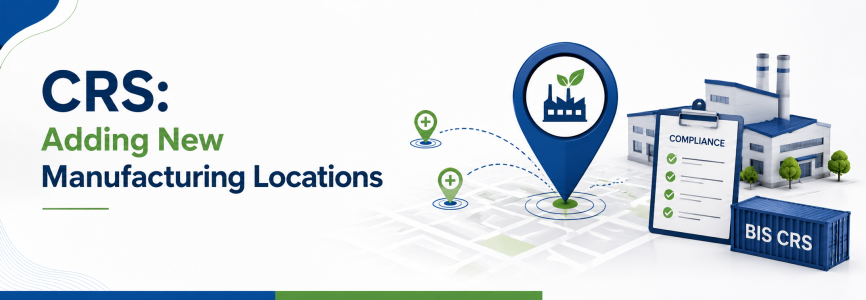
A common misconception among businesses is that once a CRS Registration is obtained, the same registration can be used for all manufacturing locations. However, CRS registration is linked with specific manufacturing locations, and manufacturers need to follow the prescribed process when expanding production facilities. Understanding CRS requirements before setting up a new manufacturing unit helps businesses avoid delays, compliance issues, and disruption in product supply.
What Is CRS?
The Compulsory Registration Scheme (CRS) is a BIS registration framework applicable to certain electronic and IT products notified by the Ministry of Electronics and Information Technology (MeitY) and other relevant authorities. Under CRS, manufacturers of notified products must ensure that their products comply with applicable Indian Standards and obtain BIS registration before manufacturing, importing, selling, or distributing such products in India. The scheme operates under Scheme II of the BIS (Conformity Assessment) Regulations, 2018. Manufacturers are required to get their products tested through BIS-recognised laboratories and apply for registration with the required documents.
Products covered under CRS include various electronic and IT goods such as:
- Mobile phones
- Laptops and notebooks
- Tablets
- LED products
- Power adaptors
- Smart devices
- Other notified electronic products
Why Do Businesses Add New Manufacturing Locations?
Businesses expand their manufacturing footprint for several reasons:
1. Increasing Production Capacity
Growing demand often requires companies to establish additional factories to increase production volumes and meet customer requirements.
2. Regional Manufacturing Advantages
Companies may establish factories in different states to benefit from:
- Better infrastructure
- Availability of skilled labour
- Logistics advantages
- Government incentives
3. Supply Chain Optimisation
Multiple manufacturing locations help businesses reduce dependency on a single facility and improve supply chain efficiency.
4. Expansion of Product Portfolio
When businesses introduce new products, they may establish specialised facilities equipped for manufacturing specific product categories. However, every new manufacturing location must be evaluated from a CRS compliance perspective.
Is Existing CRS Registration Valid for a New Factory Location?
One of the most important points for manufacturers to understand is that CRS registration is location-specific. A manufacturer cannot automatically use an existing CRS registration for products manufactured at a different factory location. The CRS guidelines require manufacturers to apply for separate registration numbers for products manufactured at different locations.
For example: Company ABC Electronics has a CRS registration for manufacturing LED products at its Delhi factory. If the same company starts manufacturing the same LED products at a new factory in Gujarat, the company cannot simply use the Delhi factory registration for the Gujarat facility. The new manufacturing location must undergo the required CRS registration process.
Understanding the Relationship Between Product, Brand and Location
CRS compliance depends on multiple factors:
Manufacturer + Manufacturing Location + Product + Brand
Businesses must carefully evaluate these elements before expansion.
For example:
Same Manufacturer + Same Product + New Location
A new CRS registration may be required.
Same Location + New Product
The manufacturer may need to include the new product/model according to applicable CRS requirements.
Same Location + Different Brand
Separate requirements may apply depending on the circumstances and CRS guidelines. Manufacturers should review their specific situation before starting production.
Process for Adding a New Manufacturing Location Under CRS
Step 1: Identify CRS Applicability
Before setting up production, businesses should confirm whether the product falls under CRS requirements. The product must match the notified category and applicable Indian Standard.
Manufacturers should verify:
- Product category
- Applicable Indian Standard
- Testing requirements
- Registration requirements
Step 2: Establish Manufacturing Capability
The new manufacturing location should have the necessary infrastructure and quality control systems.
Manufacturers must ensure:
- Proper manufacturing facilities
- Testing arrangements
- Quality control procedures
- Compliance with applicable standards
BIS evaluates manufacturing capability and conformity requirements while granting certification/registration.
Step 3: Product Testing Through BIS Recognised Laboratory
The product manufactured at the new location must undergo testing through an authorised BIS-recognised laboratory. The test report should establish compliance with the applicable Indian Standard.
Manufacturers should ensure:
- Correct product specifications
- Correct model details
- Correct brand information
- Valid test reports
Step 4: Submit CRS Application
The manufacturer must submit the CRS application through the BIS online portal with required documents.
Generally, the application process includes:
- Manufacturer details
- Factory details
- Product information
- Test reports
- Undertakings and declarations
- Supporting documents
CRS applications are submitted online, and BIS scrutinises the application before granting registration.
Step 5: BIS Review and Grant of Registration
After submission, BIS reviews the application and supporting documents. If all requirements are fulfilled, BIS grants registration for the new manufacturing location. The manufacturer can then manufacture and market products under the approved CRS registration.
Documents Required for Adding a New Manufacturing Location
The documentation requirement may vary depending on the product and circumstances. However, businesses generally need documents such as:
- Manufacturer details
- Factory address proof
- Manufacturing unit documents
- Test reports from BIS-recognised laboratories
- Product details
- Brand details
- Technical documents
- Authorisation documents (if applicable)
- Undertakings and declarations
For foreign manufacturers without a liaison office or branch office in India, an Authorized Indian Representative (AIR) may be required according to BIS guidelines.
Challenges Businesses Face While Adding New Locations
1. Assuming Existing Registration Covers All Factories
This is one of the most common mistakes. Manufacturers often begin production at a new location assuming their existing CRS registration is sufficient. This can lead to compliance risks.
2. Incorrect Factory Information
The manufacturing address mentioned in CRS documents must accurately reflect the actual production location. Any mismatch can create issues during verification.
3. Delay in Testing and Documentation
Testing requirements and documentation preparation can affect timelines. Businesses should plan CRS compliance before starting commercial production.
4. Managing Multiple Manufacturing Locations
Large companies operating multiple factories need proper systems to track:
- CRS registrations
- Product approvals
- Factory locations
- Brand details
- Renewal timelines
Benefits of Proper CRS Compliance During Expansion
Following CRS requirements while adding new locations provides several advantages:
Smooth Market Operations
A valid CRS registration allows businesses to manufacture and sell products without regulatory interruptions.
Better Brand Reputation
Compliance demonstrates commitment to product quality and consumer safety.
Easier Business Expansion
Proper documentation helps businesses scale operations across multiple locations.
Reduced Regulatory Risk
Early compliance planning reduces the possibility of penalties, delays, or market restrictions.
CRS and Manufacturing Growth in India
India is becoming a major electronics manufacturing hub. Government initiatives and increasing domestic demand are encouraging businesses to expand production facilities. However, manufacturing growth must be supported by quality compliance. CRS ensures that electronic products entering the Indian market meet defined safety and performance standards. For manufacturers, CRS should not be viewed only as a regulatory requirement but as an important part of building consumer trust.
Best Practices for Businesses Expanding Manufacturing Locations
Businesses planning expansion should follow these practices:
Plan Compliance Before Production
CRS requirements should be considered during factory expansion planning.
Maintain Accurate Records
Keep updated records of:
- Factory details
- Product approvals
- Test reports
- Registration certificates
Review Regulatory Updates
BIS and concerned authorities regularly update standards and requirements.
Seek Professional Guidance
Complex manufacturing structures may require expert compliance support to avoid mistakes.
Conclusion
Adding a new manufacturing location is an important growth milestone for any electronics business. However, expansion must be supported by proper CRS compliance. Manufacturers should understand that CRS registration is linked with specific manufacturing locations and cannot automatically cover additional factories. A new location requires appropriate evaluation, testing, documentation, and registration procedures.
By planning CRS compliance in advance, businesses can expand confidently, maintain product quality, and continue serving the Indian market without regulatory challenges. In a rapidly growing digital economy, successful manufacturers are not only those who increase production capacity but also those who maintain strong compliance foundations.
FAQs
Q1. Can one CRS registration cover multiple manufacturing locations?
Ans. No. CRS registration is linked to specific manufacturing locations. Manufacturers generally need separate registration numbers for products manufactured at different locations.
Q2. If the product and brand are the same, do I need a new CRS registration for another factory?
Ans. Yes. Even if the product and brand remain the same, a different manufacturing location requires separate CRS registration as per applicable requirements.
Q3. Can a manufacturer start production at a new location before CRS approval?
Ans. Manufacturers should obtain the required CRS registration before manufacturing, selling, or distributing products covered under the scheme.
Q4. What documents are required for adding a new CRS manufacturing location?
Ans. Documents generally include factory details, product information, test reports, manufacturer documents, and other supporting declarations required by BIS.
Q5. Is product testing required for a new manufacturing location?
Ans. Yes. Products manufactured at the new location generally need testing through BIS-recognised laboratories as part of the CRS process.
Q6. Can an existing CRS registration be modified for a new factory?
Ans. A new manufacturing location generally requires a separate registration rather than simply modifying an existing registration.
Q7. Does CRS apply to foreign manufacturers also?
Ans. Yes. Manufacturers located outside India producing CRS-notified products can apply for registration subject to BIS requirements.
Q8. What happens if a company manufactures products from an unregistered location?
Ans. Manufacturing CRS-covered products from an unapproved location can create compliance risks and may lead to regulatory action.
Q9. How long does CRS registration for a new location take?
Ans. The timeline depends on factors such as documentation accuracy, testing completion, and BIS review process.
Q10. Why should businesses plan CRS compliance before expanding factories?
Ans. Early planning helps avoid production delays, ensures regulatory compliance, and allows businesses to launch products smoothly from new manufacturing locations.