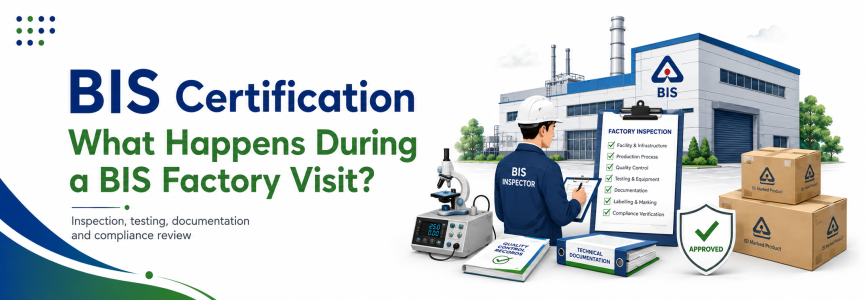



BIS Certification plays an important role in ensuring that products manufactured or sold in India meet prescribed requirements relating to quality, safety, performance, and reliability. For manufacturers applying for a BIS licence under applicable product certification schemes, one of the most important stages can be the BIS factory visit or factory inspection. A factory visit is not simply a physical inspection of the premises. It is a technical assessment through which the Bureau of Indian Standards (BIS) evaluates whether the manufacturer has the necessary manufacturing infrastructure, production controls, quality-control arrangements, testing facilities, competent personnel, and systems required to consistently manufacture products conforming to the applicable Indian Standard.
According to BIS, under its Scheme-I product certification process, a licence is granted after successful assessment of the manufacturer's manufacturing infrastructure, process controls, quality control, and testing capabilities through a visit to the manufacturing premises. Product conformity may also be established through third-party laboratory testing, testing at the manufacturing premises, or a combination of both. Understanding what happens during the visit can help manufacturers prepare properly and avoid deficiencies that may delay the grant of a BIS licence.
Note: BIS operates several conformity assessment schemes. The exact procedure varies according to the product, applicable Indian Standard, certification scheme, Product Manual, and other BIS guidelines. This article primarily explains factory visits associated with Scheme-I product certification, commonly associated with the ISI Mark, along with relevant principles applicable to foreign manufacturers.
What Is a BIS Factory Visit?
A BIS factory visit is an assessment of the manufacturing premises conducted as part of the BIS certification process. During the visit, the concerned certification officer assesses whether the factory is technically capable of manufacturing the product in accordance with the applicable Indian Standard.
The assessment is generally focused on four major areas:
-
Manufacturing infrastructure
-
Production and process controls
-
Quality-control arrangements
-
Product testing capabilities
The visit also allows BIS to verify information and documents submitted by the manufacturer during the application process. For foreign manufacturers applying under the Foreign Manufacturers Certification Scheme (FMCS), BIS similarly visits the manufacturing location to verify manufacturing and testing infrastructure and may draw samples for independent testing.
Why Does BIS Conduct a Factory Visit?
Obtaining a laboratory test report showing that one product sample complies with an Indian Standard does not necessarily prove that the factory can consistently manufacture conforming products. BIS therefore evaluates the manufacturing system itself. The objective is to determine whether the manufacturer can maintain required product quality continuously after the BIS licence is granted.
During the factory visit, BIS may verify whether:
-
Required manufacturing machinery is available and operational.
-
The manufacturing process matches the declared process.
-
Appropriate quality controls are implemented.
-
Required testing equipment is available.
-
Testing instruments are properly calibrated.
-
Qualified quality-control personnel are available.
-
Raw materials are controlled appropriately.
-
Production and testing records are maintained.
-
Products comply with the relevant Indian Standard.
-
The proposed marking and labelling comply with applicable BIS requirements.
This makes the factory visit an important technical stage rather than a simple administrative formality.
What Happens Before the BIS Factory Visit?
Before an inspection is scheduled, the manufacturer generally submits the prescribed BIS application along with required information and documents. The manufacturer should first identify the correct Indian Standard (IS) applicable to the product and study the corresponding BIS Product Manual and Scheme of Inspection and Testing, wherever applicable. BIS advises manufacturers to analyse and document their manufacturing infrastructure, process controls, quality-control arrangements, and testing capabilities before applying. Before the visit, the manufacturer should therefore ensure that the factory is actually ready for production and testing.
Important preparations may include:
-
Installation of manufacturing machinery
-
Installation of required testing equipment
-
Calibration of testing instruments
-
Availability of competent technical personnel
-
Availability of raw materials
-
Availability of adequate production quantities for inspection and sampling
-
Preparation of manufacturing and quality records
-
Implementation of required inspection and testing controls
-
Preparation of plant and factory layouts
-
Review of product marking requirements
A factory should preferably not treat the BIS visit as the starting point for establishing compliance. The required systems should already be implemented and capable of being demonstrated during inspection.
Step-by-Step: What Happens During a BIS Factory Visit?
1. Verification of the Factory and Manufacturing Premises
The certification officer first verifies the manufacturing premises mentioned in the application.
The officer may review the factory layout and physically examine different areas, including:
-
Raw-material storage
-
Manufacturing area
-
Production lines
-
Quality-control laboratory
-
Finished-goods storage area
-
Packaging area
-
Testing facilities
The objective is to confirm that the product for which certification is sought is genuinely manufactured at the declared premises and that adequate infrastructure exists. BIS guidelines specifically provide for verification of the plant layout showing manufacturing, raw-material storage, finished-product storage, and testing laboratory areas, along with the factory location plan.
2. Verification of Manufacturing Machinery
The officer examines the machinery and equipment used for manufacturing the product. The equipment available at the factory should generally correspond with the details declared in the BIS application and should be appropriate for producing the product covered by the relevant Indian Standard.
The officer may verify:
-
Type of machinery
-
Number of machines
-
Capacity
-
Operational condition
-
Manufacturing sequence
-
Important process parameters
If important production operations are performed outside the declared manufacturing premises, BIS may examine whether such arrangements are permissible under the applicable certification requirements. The manufacturer should therefore maintain a clear and accurate list of machinery and ensure that major production equipment is functioning on the date of inspection.
3. Review of the Manufacturing Process
The certification officer may observe actual manufacturing operations and understand how raw material is converted into the finished product. This allows BIS to identify important stages where product quality is controlled.
Depending upon the product, the officer may examine:
-
Raw-material inspection
-
Mixing or formulation
-
Cutting
-
Moulding
-
Assembly
-
Welding
-
Heat treatment
-
Coating
-
Finishing
-
Packaging
-
Final inspection
The exact manufacturing process will naturally differ from one product to another. The manufacturer should be able to demonstrate that appropriate controls are exercised at critical stages of production.
4. Verification of Quality-Control Personnel
BIS also verifies whether suitable quality-control personnel are available at the factory.
The personnel responsible for inspection and testing should understand:
-
Applicable Indian Standard
-
Testing procedures
-
Acceptance criteria
-
Testing frequency
-
Operation of laboratory equipment
-
Maintenance of test records
-
Action to be taken in case of product failure
Current BIS Scheme-I grant-of-licence guidelines specifically include details of quality-control personnel among the matters verified during the factory visit. Having laboratory equipment without competent personnel to operate it may therefore create problems during the assessment.
5. Inspection of the Factory Testing Laboratory
Testing capability is one of the most important aspects of the BIS factory visit. Depending upon the Indian Standard and applicable Product Manual, the manufacturer may be expected to maintain certain testing facilities within the factory.
The officer can physically verify:
-
Testing equipment
-
Laboratory environment
-
Test methods
-
Equipment range and accuracy
-
Calibration status
-
Testing records
-
Competency of laboratory personnel
The manufacturer should ensure that testing equipment is operational and capable of performing applicable tests.
6. Verification of Calibration Certificates
Testing instruments must provide reliable results. Therefore, calibration records and certificates for applicable testing equipment are important during BIS inspection.
The officer may verify whether:
-
Calibration certificates are valid.
-
Equipment identification matches the certificate.
-
Calibration is carried out appropriately.
-
Calibration frequency is being maintained.
-
Equipment is suitable for the required test range.
Calibration certificates of testing equipment are specifically included among the documents verified during a factory visit under BIS Scheme-I guidelines. Expired or missing calibration certificates can become a significant deficiency.
7. Verification of Raw Materials
The officer may also examine raw materials and components used in manufacturing. Where the applicable Indian Standard makes conformity of a particular raw material mandatory, evidence may be required to establish that the material complies with the prescribed requirement. Depending upon the circumstances, evidence may include appropriate certification or acceptable test reports. BIS guidelines also provide for verification of copies of raw-material test certificates, where applicable. Manufacturers should therefore maintain an organized system for supplier records, purchase documents, incoming inspection records, and raw-material test reports.
8. Review of Scheme of Inspection and Testing
An important document in BIS product certification is the Scheme of Inspection and Testing (SIT) contained in the applicable Product Manual. The SIT specifies the production controls expected from the manufacturer while operating the certification marks scheme. It may prescribe matters such as:
-
Product labelling and marking
-
Definition of control unit
-
Tests to be conducted
-
Frequency of tests
-
Number of samples
-
Acceptance criteria
-
Tests permitted to be subcontracted
-
Action to be taken in case of failure
BIS explains that the SIT essentially specifies the controls over production that a manufacturer is required to exercise while operating the certification marks scheme. During the factory visit, the manufacturer should be able to demonstrate that the proposed inspection and testing system can be followed effectively.
9. Factory Testing of the Product
The BIS certification officer may conduct or witness testing of products in the manufacturer's laboratory. Under the current Scheme-I grant-of-licence guidelines, factory testing is to be carried out for as many applicable requirements as possible. Certain characteristics such as workmanship, visual characteristics, surface defects, description, taste, or flavour, wherever relevant, may be checked at the factory itself. The tests performed will depend entirely upon the product and applicable Indian Standard.
For example, depending on the product category, testing may involve:
-
Dimensions
-
Mechanical properties
-
Electrical parameters
-
Chemical composition
-
Performance
-
Strength
-
Safety requirements
-
Visual examination
-
Functional testing
The manufacturer should therefore ensure that testing equipment, testing personnel, and samples are available during the visit.
10. Sample Selection and Drawal
Sample drawal is another major part of the factory inspection process. The certification officer may select product samples representing the varieties proposed to be covered under the BIS licence.
Applicable samples may be:
-
Tested at the factory;
-
Sent to an appropriate third-party laboratory; or
-
Evaluated through a combination of factory and independent testing.
Current BIS guidelines provide for drawal and sealing of samples and counter-samples in applicable cases. The samples are selected by the concerned BIS officer according to the applicable product guidelines and certification procedure. Manufacturers should therefore maintain sufficient production quantities and should not assume that they can decide which exact specimen will be selected.
11. Verification of Documents and Records
The factory visit includes a detailed review of documentation.
Depending upon applicability, documents that may be reviewed include:
-
Self-evaluation-cum-verification report
-
Details of quality-control personnel
-
Calibration certificates
-
Raw-material test certificates
-
Product/component drawings
-
Factory hygiene reports, where applicable
-
Plant layout
-
Factory location plan
-
Information regarding subcontracted tests
-
Inspection and test plan
-
Relevant undertakings
-
Previous corrective-action records, where applicable
These items are specifically identified in BIS's Scheme-I grant-of-licence guidelines. Manufacturers should keep documents arranged systematically so they can be produced immediately when requested.
12. Verification of Product Marking and Labelling
The certification officer may also review how the manufacturer proposes to mark certified products. After grant of the licence, the Standard Mark can only be used in accordance with applicable BIS requirements and the scope of the licence.
Depending upon the relevant standard and Product Manual, marking requirements may include information such as:
-
Product name or designation
-
Manufacturer information
-
Size, grade, type, or variety
-
Batch or lot identification
-
Licence-related information
-
Applicable Standard Mark
-
Other statutory declarations
Incorrect marking should be corrected before commercial use of the BIS Standard Mark.
How Long Does a BIS Factory Visit Take?
According to the BIS Scheme-I grant-of-licence guidelines dated 1 August 2025, a factory visit is normally one day for Indian manufacturers and two days for foreign manufacturers, although additional time may be required depending upon product testing and circumstances. For complex products or cases involving extensive factory testing, the assessment may require additional time.
What Happens If a Non-Conformity Is Found?
A factory visit does not automatically result in approval. If a significant non-conformity is identified during factory testing, the manufacturer may be asked to make improvements and demonstrate compliance through further assessment. The current Scheme-I guidelines provide that where a non-conformity is observed during factory testing, samples should not proceed for third-party testing at that stage; the applicant may instead be advised to undertake improvements, which can subsequently be verified through another inspection and factory testing.
Common deficiencies may include:
-
Missing testing equipment
-
Inadequate manufacturing facilities
-
Invalid calibration certificates
-
Incorrect testing methods
-
Lack of qualified personnel
-
Failure to produce required records
-
Product failure during testing
-
Inadequate raw-material controls
-
Difference between declared and actual manufacturing arrangements
Corrective action should be taken carefully and supported with appropriate evidence.
What Happens After the BIS Factory Visit?
After the visit, BIS reviews the inspection findings and applicable test results. Under the Scheme-I process, grant of licence depends on successful assessment of manufacturing capability and establishment of product conformity. Where independent testing is required, samples drawn during the visit may be sent to the appropriate laboratory. The results are then considered according to the applicable grant-of-licence procedure. If all applicable requirements are satisfactorily fulfilled and required fees and formalities are completed, BIS may grant the licence for use of the Standard Mark within the approved scope.
Does BIS Visit the Factory Again After Certification?
Yes. A successful initial inspection does not mean that the factory will never be inspected again. After grant of a BIS licence, BIS conducts surveillance to verify continued compliance. BIS states that surprise factory surveillance inspections may be conducted, during which manufacturing infrastructure, process controls, testing capabilities, product conformity, and factory testing may be reviewed. Samples can also be drawn for independent testing.
Therefore, BIS compliance should be maintained continuously and not only during the initial certification process.
How Can Manufacturers Prepare for a BIS Factory Visit?
Manufacturers can reduce the risk of delays by conducting a detailed internal readiness check before inspection.
Important steps include:
-
Study the applicable Indian Standard thoroughly.
-
Review the relevant BIS Product Manual and SIT.
-
Ensure all manufacturing machinery is installed and functional.
-
Keep required testing facilities operational.
-
Maintain valid calibration certificates.
-
Train quality-control personnel.
-
Maintain adequate production quantity for inspection and sampling.
-
Organize raw-material and supplier records.
-
Maintain test registers and production records.
-
Verify product marking requirements.
-
Keep plant layout and factory details updated.
-
Correct discrepancies between the application and actual factory facilities.
-
Conduct internal product testing before the BIS visit.
The objective should be to demonstrate that compliance is part of the regular manufacturing system rather than something arranged only for the inspection.
Conclusion
The BIS factory visit is one of the most important stages of BIS product certification for schemes where factory assessment is required. It enables BIS to determine whether a manufacturer has the manufacturing infrastructure, testing facilities, quality controls, competent personnel, and documentation necessary to consistently manufacture products meeting the applicable Indian Standard. During the visit, the BIS certification officer may inspect manufacturing facilities, observe production, verify testing equipment and calibration certificates, examine quality-control records, review raw materials, witness product testing, verify documentation, and select samples for further testing.
Manufacturers who understand these requirements and prepare their factory in advance can significantly reduce avoidable deficiencies and delays. More importantly, BIS certification should not be approached merely as a one-time approval. Once the licence is granted, the manufacturer is expected to continuously maintain conformity, as BIS may conduct surveillance inspections and product sampling during the operation of the licence. For manufacturers planning to apply for BIS Certification, careful preparation for the factory visit is therefore essential for achieving and maintaining successful product certification.
FAQs
Q1. Is a factory visit compulsory for every BIS Certification?
Ans. Not necessarily. BIS operates different conformity assessment schemes, and the procedure depends on the product and applicable certification scheme. Under Scheme-I product certification and FMCS cases, assessment of manufacturing premises is an important part of the certification process. Manufacturers should check the applicable scheme, Indian Standard, Product Manual, and current BIS guidelines for their product.
Q2. What does a BIS officer check during a factory visit?
Ans. The officer may verify manufacturing machinery, production processes, quality-control arrangements, testing equipment, calibration certificates, laboratory facilities, raw materials, technical personnel, production records, test records, marking requirements, and other documents relevant to the applicable Indian Standard.
Q3. How long does a BIS factory inspection normally take?
Ans. Under the current Scheme-I grant-of-licence guidelines, the factory visit normally requires one day for an Indian manufacturer and two days for a foreign manufacturer. Additional time may be required where extensive factory testing or other technical assessment is necessary.
Q4. Is product testing done during the BIS factory visit?
Ans. Yes, where applicable. The BIS certification officer may conduct or witness testing using the manufacturer's testing facilities. The tests depend on the applicable Indian Standard and Product Manual. Samples may also be selected for independent laboratory testing.
Q5. Does the manufacturer need an in-house testing laboratory?
Ans. The requirement depends on the applicable Indian Standard, Product Manual, SIT, and certification provisions. Manufacturers must maintain the testing capability required for their particular product, while certain permitted tests may be subcontracted where BIS provisions allow it.
Q6. What documents should be kept ready for a BIS factory visit?
Ans. Depending upon the product, important documents can include the self-evaluation report, list of manufacturing machinery, testing-equipment details, calibration certificates, quality-control personnel details, raw-material test reports, product drawings, plant layout, production records, test records, subcontracting details, and relevant inspection and testing plans.
Q7. What happens if the product fails during factory testing?
Ans. If a non-conformity is detected during factory testing, the certification process may be affected. Under applicable Scheme-I guidelines, the manufacturer may be required to take corrective action and demonstrate improvement through further inspection or testing before the application can proceed.
Q8. Who selects the sample during the BIS factory inspection?
Ans. Applicable product samples are selected or drawn by the BIS certification officer in accordance with the certification procedure, Product Manual, grouping guidelines, and scope proposed in the application. The manufacturer should keep adequate material available for sampling.
Q9. Can BIS conduct another factory visit after the licence is granted?
Ans. Yes. BIS conducts surveillance after certification and may carry out factory inspections, including surprise visits. During surveillance, BIS may verify continued operation of manufacturing and quality-control systems, witness tests, review records, and draw samples for independent testing.
Q10. How can a manufacturer avoid delays during the BIS factory visit?
Ans. The manufacturer should complete an internal compliance review before the visit. Machinery and testing equipment should be operational, calibration certificates should be valid, quality personnel should be available, products should be ready for testing and sampling, and all relevant technical and quality-control records should be organized. Any discrepancy between the BIS application and the actual factory setup should also be corrected before inspection.