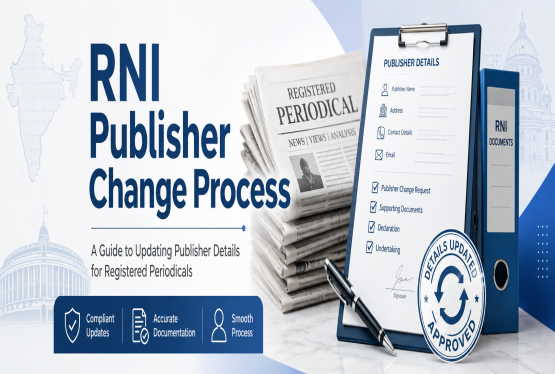



RNI Registration was the earlier name commonly used for registration of newspapers, magazines and periodicals in India. RNI means Registrar of Newspapers for India. However, after the new law, the office of RNI is now known as Press Registrar General of India (PRGI). Therefore, in today’s legal language, the correct term is PRGI Registration. PRGI Registration is required for publishers who want to print and publish newspapers, magazines, newsletters or other periodicals containing public news or comments on public news. The registration process is now handled online through the Press Sewa Portal.
The purpose of this registration is to give legal recognition to the publication, verify the title, maintain records of newspapers and periodicals, and ensure that publications are issued in compliance with the law. The earlier law, the Press and Registration of Books Act, 1867, has been replaced by the Press and Registration of Periodicals Act, 2023. The new Act came into effect from 1 March 2024, and the old RNI system has been replaced with a more digital and simplified PRGI system. The Government has also introduced the Press and Registration of Periodicals Rules, 2024 for practical implementation.
Meaning of PRGI Registration
PRGI Registration means obtaining a Certificate of Registration from the Press Registrar General of India for publishing a periodical. A periodical includes newspapers, magazines, journals or newsletters that are published at regular intervals and contain public news or comments on public news.The Act defines a “periodical” as any publication, including a newspaper, which is published and printed at regular intervals and contains public news or comments on public news. However, books and journals of scientific, technical and academic nature are not covered under this registration requirement. In simple words, if a person wants to start a newspaper, magazine, weekly publication, local news publication, political magazine, current affairs magazine or similar print publication for public circulation, PRGI Registration is required.
RNI to PRGI: What Has Changed?
Earlier, publishers used to apply under the RNI system. The process was largely manual and involved several steps, including title verification, declaration before the District Magistrate, submission of documents, publication of first issue and final registration. Now, under the new law, the process has been made online through the Press Sewa Portal. The Government has stated that all applications such as registration of periodicals, intimation by printing presses, revision of registration certificate, transfer of ownership, annual statement filing and circulation verification are to be handled through the Press Sewa Portal. This is an important recent update because many people still search for “RNI Registration,” but legally and officially, the process is now handled by PRGI.
Legal Framework Governing PRGI Registration
The registration of newspapers and periodicals in India is mainly governed by the following laws and rules:
1. Press and Registration of Periodicals Act, 2023
This is the main law governing registration of periodicals in India. It replaced the old Press and Registration of Books Act, 1867. The Act provides for registration of periodicals, intimation by printing presses, appointment of PRGI, suspension or cancellation of registration, annual statement filing, penalties and appeal provisions.
2. Press and Registration of Periodicals Rules, 2024
These Rules provide the procedural details for implementing the Act. They explain the online application process, forms, portal-based filing, fees, documents, annual statements and other compliances.
3. Press Sewa Portal
The Press Sewa Portal is the official online platform used for PRGI-related services. It supports paperless processing, e-sign facility, digital payment, QR code-based digital certificates, printing press intimation, application tracking and grievance support.
Important Sections and Provisions under PRP Act, 2023
Section 1: Short Title, Extent and Commencement
Section 1 provides the name of the Act as the Press and Registration of Periodicals Act, 2023. It extends to the whole of India. The Act came into force from 1 March 2024.
Section 2: Definitions
Section 2 defines important terms such as newspaper, periodical, publication, publisher, printer, owner, specified authority and Press Registrar General. These definitions are important because registration depends on whether the publication falls within the meaning of “periodical.”
A newspaper is generally a periodical printed on newsprint and brought out daily or at least once a week, containing current events, public news or comments on public news.
Section 3: Intimation by Printer
The printer or keeper of a printing press is required to provide intimation as prescribed under the Act and Rules. This helps PRGI maintain details of printing presses involved in publication of periodicals.
Section 5: Press Registrar General
Section 5 provides for the appointment and powers of the Press Registrar General of India. PRGI is responsible for registration of periodicals, maintaining the register, title allotment, annual statement records, circulation verification and related functions.
Section 7: Registration of Periodicals
This is one of the most important provisions. It deals with registration of periodicals. A publisher must obtain a Certificate of Registration before publishing the periodical. The application is made online through the Press Sewa Portal.
Section 8: Revision of Certificate or Title
If there is any change in registration particulars or title, the publisher can apply for revision of the certificate or title. This may be required in case of change in language, place of publication, periodicity, publisher details or other important particulars.
Section 9: Transfer of Ownership
If ownership of a registered periodical is transferred, the prescribed process must be followed. PRGI must be satisfied with the correctness and completeness of the transfer details. The publisher may also be required to obtain a revised certificate.
Section 10: Discontinuation of Periodical
If a registered periodical is discontinued, intimation must be given to PRGI and the specified authority within the prescribed time. The certificate may then be cancelled and the title may be removed from the register.
Section 11: Suspension or Cancellation
PRGI may suspend or cancel registration in certain cases, such as false representation, concealment of material facts, failure to publish continuously, use of same or similar title, or violation of title guidelines. However, the publisher or owner must be given an opportunity of being heard before suspension or cancellation.
Section 12: Annual Statement
Every registered periodical is required to furnish an annual statement as prescribed. This statement helps PRGI maintain official publication records, circulation information and other compliance details.
Section 14: Penalties
PRGI has power to impose a penalty if a periodical is published without registration or if the publisher fails to furnish annual statements within the required time. The Act has substantially reduced criminal punishment for procedural violations and focuses more on monetary penalties.
Section 15: Appeal
The Act provides for an appellate mechanism through the Press and Registration Appellate Board. A person aggrieved by certain orders may prefer an appeal as per the Act.
Who Needs PRGI Registration?
PRGI Registration is required for:
Newspaper publishers, magazine publishers, newsletter publishers, local news publications, political publications, current affairs publications, weekly or monthly periodicals, regional language newspapers, periodicals containing public news or comments on public news, and publishers bringing out printed periodicals for public circulation. PRGI Registration is not required for books or journals of scientific, technical and academic nature because these are specifically excluded from the definition of periodical under the new law.
Eligibility for PRGI Registration
Any Indian citizen or any person/entity registered in India can bring out a periodical, subject to the conditions under the Act. The applicant should not be convicted by any court for an offence involving terrorist activity, unlawful activity or an offence against the security of the State. The owner, publisher and printer must provide correct details on the Press Sewa Portal. The title should also comply with PRGI title guidelines and should not be identical or deceptively similar to an existing title.
Documents Required for PRGI Registration
- PAN and Aadhaar of owner/publisher
- Passport-size photo
- Mobile number and email ID
- Proposed title options
- Language and periodicity details
- Place and address of publication
- Printing press details
- Printer consent/confirmation
- Authorization letter, if applicable
- Entity registration proof, if applicable
- Address proof of office
- Any other document required on Press Sewa Portal
Step-by-Step PRGI Registration Process
Step 1: Create Owner Profile on Press Sewa Portal
The owner of the proposed periodical must create an account on the Press Sewa Portal. The owner has to provide basic details, contact details and required documents.
Step 2: Select Proposed Titles
The owner has to provide preferred titles for the proposed periodical. As per the online process, the owner may provide title options in order of preference. These titles should not be the same or similar to titles already held by another owner in the same language anywhere in India or in any other language in the same State.
Step 3: Mention Language and Place of Publication
The applicant must provide the language of the periodical and the place of publication. These details are important because title availability is checked with reference to language and location.
Step 4: Appoint Publisher
The owner appoints the publisher through the portal. The publisher is the person responsible for publishing the periodical. The publisher must create a separate profile and complete the required details.
Step 5: Printer Profile and Printing Press Selection
The printer or keeper of the printing press must also create a profile on the Press Sewa Portal. The publisher then selects or nominates the printing press from the portal database. If the printing press is not available, the printer must first create a profile.
Step 6: Fill Registration Application
The publisher fills the main registration application form online. The application includes details of owner, publisher, printer, title, periodicity, language, publication place and other required particulars.
Step 7: Payment of Government Fee
The prescribed registration fee is paid online. As per the Press Sewa process, the fee of ?1,000 is paid through the digital payment system integrated with the portal.
Step 8: Generation of ARN
After submission, the portal generates an Application Reference Number, commonly called ARN. This ARN is used for tracking and future communication.
Step 9: Five-Day Correction Window
After submission, the publisher gets a limited correction window. As per PRGI information, corrections may be allowed within five days after submission, but no correction can be made after this period.
Step 10: Verification by PRGI and Specified Authority
After the correction window closes, the application is sent simultaneously to PRGI and the specified authority. The specified authority generally means the District Magistrate, District Collector or other officer notified by the State Government or Union Territory Administration.
Step 11: Approval and Certificate of Registration
After verification and satisfaction of requirements, PRGI issues the Certificate of Registration. The certificate may be digitally available through the portal and may contain QR code-based verification.
Importance of Title Selection
Title selection is one of the most important parts of PRGI Registration. A title should be unique, clear and not misleading. It should not be identical or similar to an already registered title. It should also follow the PRGI Guidelines for Admissibility of Titles. PRGI has issued title guidelines under Section 5(3)(C) read with relevant definitions under the PRP Act, 2023. These guidelines are used to check whether a proposed title is admissible and available for registration. A weak or similar title may result in rejection or delay. Therefore, publishers should conduct a title search and keep multiple title options ready before applying.
Post-Registration Compliances
PRGI Registration is not the end of compliance. After registration, the publisher must follow regular compliance requirements. The periodical must be published as per the approved periodicity. Any change in title, ownership, printer, publisher, language, place of publication or other registration particulars should be updated through the portal. The annual statement must be filed as required under Section 12. If publication is discontinued, intimation must be given to PRGI and the specified authority.
Recent Updates in PRGI Registration
The major recent update is that the old RNI system has been replaced by PRGI under the Press and Registration of Periodicals Act, 2023. The Act came into effect from 1 March 2024, and the registration process has shifted online through the Press Sewa Portal.
The new system is paperless and provides online application filing, e-sign facility, digital payment, QR code-based certificates, online tracking, annual statement filing and grievance support. It also removes books and academic/scientific/technical journals from the scope of registration. Another important change is that the new Act has reduced criminal punishment for procedural defaults and focuses more on financial penalties. This is intended to make compliance easier for publishers while maintaining accountability.
Common Reasons for Delay in PRGI Registration
PRGI Registration may get delayed due to incorrect title selection, similarity with existing titles, mismatch in owner or publisher details, incomplete printer profile, wrong language or place of publication details, delay in printer acceptance, non-payment of fee, incomplete documents, portal errors or failure to respond to departmental queries. Many delays also happen because applicants still follow the old RNI process and do not understand the new PRGI portal flow. Since the process now involves owner, publisher and printer profiles, all three parties must complete their part correctly.
Conclusion
PRGI Registration is mandatory for newspapers and periodicals that contain public news or comments on public news. Earlier, this process was known as RNI Registration, but after the new law, it is now handled by the Press Registrar General of India through the Press Sewa Portal.
The Press and Registration of Periodicals Act, 2023 has made the process more digital, transparent and simplified. However, publishers must still ensure proper title selection, correct documentation, portal compliance, annual statement filing and timely updates in registration details. For any publisher planning to start a newspaper, magazine, newsletter or periodical in India, PRGI Registration is the first legal step before publication.
FAQs
Q1. What is PRGI Registration?
Ans. PRGI Registration is the legal registration required for publishing newspapers and periodicals in India. It is issued by the Press Registrar General of India.
Q2. Is RNI Registration still valid?
Ans. People still call it RNI Registration, but officially RNI has been renamed as PRGI. New applications are now handled through the PRGI system.
Q3. Which law governs PRGI Registration?
Ans. PRGI Registration is governed by the Press and Registration of Periodicals Act, 2023 and the Press and Registration of Periodicals Rules, 2024.
Q4. Is PRGI Registration required for magazines?
Ans. Yes, if the magazine is published periodically and contains public news or comments on public news, PRGI Registration is required.
Q5. Is PRGI Registration required for books?
Ans. No, books are not covered under PRGI Registration. Scientific, technical and academic journals are also excluded.
Q6. Where is the PRGI application filed?
Ans. The application is filed online through the Press Sewa Portal. The process is now digital and paperless.
Q7. Who can apply for PRGI Registration?
Ans. Any Indian citizen or entity registered in India can apply, subject to eligibility conditions under the Act.
Q8. What is the government fee for PRGI Registration?
Ans. As per the online process, a registration fee of ?1,000 is payable through the portal payment system.
Q9. Can PRGI Registration be cancelled?
Ans. Yes, PRGI may suspend or cancel registration in cases such as false information, non-publication, title violation or other legal non-compliances.
Q10. Is annual statement filing required after registration?
Ans. Yes, registered periodicals must file annual statements as required under the Act and Rules. Non-filing may attract penalty.