


Buying gold or silver jewellery is not merely a fashion purchase. Precious-metal jewellery often represents a major financial investment, and consumers naturally expect the purity claimed by a jeweller to be genuine. To strengthen transparency and traceability in the jewellery market, the Bureau of Indian Standards (BIS) introduced the Hallmark Unique Identification, commonly known as the HUID number. HUID has significantly changed the way hallmarked jewellery is identified in India. Instead of relying only on general hallmark symbols, a hallmarked jewellery article can carry its own unique identification code that can be checked through the BIS system.
The HUID helps connect a particular hallmarked article with information relating to the jeweller and the Assaying and Hallmarking Centre (AHC) involved in hallmarking it. Current BIS jeweller guidelines also provide for verification of six-digit alphanumeric HUID codes on hallmarked gold and silver jewellery or artefacts during market surveillance. For consumers, this creates an additional verification mechanism before purchasing jewellery. For jewellers, it improves accountability, record-keeping and traceability across the hallmarking process.
What Is an HUID Number?
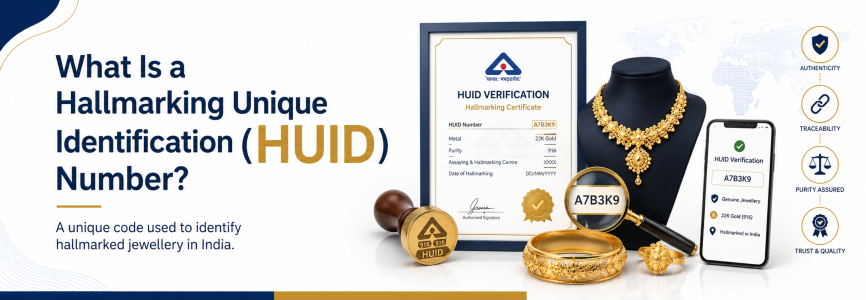
HUID stands for Hallmark Unique Identification.
It is a six-digit alphanumeric identification code associated with an individual hallmarked jewellery article. BIS describes HUID as a unique number used in the digital hallmarking system, and BIS-recognised Assaying and Hallmarking Centres laser-mark the HUID on jewellery as part of the prescribed hallmarking process. An HUID may contain both letters and numbers. It should not be understood as the jeweller's registration number or the Assaying and Hallmarking Centre's licence number. Instead, it functions as an article-specific identification code. This means that two separate pieces of hallmarked jewellery should not simply be treated as having one common HUID merely because they have the same purity, design or seller. The objective is to make the individual hallmarked article traceable within the BIS hallmarking ecosystem.
Why Was the HUID System Introduced?
Before the HUID-based system, gold jewellery hallmarking involved multiple physical identification marks.
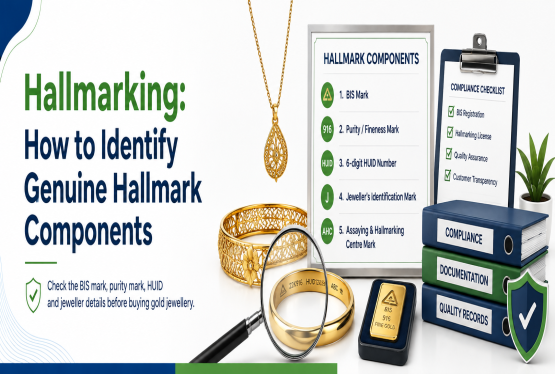
BIS states that before 1 July 2021, hallmarked gold jewellery generally contained four components:
- BIS mark
- Purity in carat and fineness
- Assaying Centre identification mark
- Jeweller's identification mark
With the introduction of the six-digit alphanumeric HUID system from 1 July 2021, the hallmarking structure for gold jewellery moved to three principal marks:
- BIS logo
- Purity/fineness mark
- Six-digit alphanumeric HUID
The HUID is generated through the BIS digital system and applied to the article by the Assaying and Hallmarking Centre. The transition was important because the earlier system depended more heavily on interpreting separate jeweller and assay-centre marks. HUID created a more digitally traceable mechanism under which information associated with a hallmarked article could be checked through BIS systems.
What Does a BIS Hallmark on Gold Jewellery Contain?
Under the HUID-based hallmarking system, consumers should understand the different markings appearing on gold jewellery.
1. BIS Logo
The BIS Standard Mark indicates that the article has been hallmarked under the BIS hallmarking framework.
2. Purity and Fineness Mark
The purity mark indicates the declared fineness of the gold.
For example:
- 22K916 indicates 22-carat gold with a fineness of 916 parts per thousand.
- 18K750 indicates 18-carat gold with a fineness of 750 parts per thousand.
- 14K585 indicates 14-carat gold with a fineness of 585 parts per thousand.
BIS standards and hallmarking requirements prescribe the permitted purity grades applicable to hallmarked articles.
3. Six-Digit HUID
The six-digit alphanumeric HUID provides the individual identification associated with the hallmarked article. These components should be read together rather than treating the HUID alone as a statement of gold purity.
How Is an HUID Number Generated?
HUID generation forms part of the digital assaying and hallmarking workflow. A registered jeweller submits jewellery for hallmarking to a BIS-recognised Assaying and Hallmarking Centre. The article undergoes the prescribed processes for testing and verification of declared fineness. BIS has developed a digital solution under which the hallmarking workflow is recorded online. A unique six-digit alphanumeric code is generated through the BIS system for the individual jewellery article, after which the Assaying and Hallmarking Centre applies the prescribed hallmark, including the HUID. This digital approach is important because it creates a connection between the physical marking on the jewellery and information maintained within the BIS hallmarking system.
Is HUID the Same as a Hallmark?
No. The terms are related but should not be used interchangeably. A hallmark is the complete official marking placed on a precious-metal article under the applicable hallmarking system. The HUID is the unique alphanumeric identification component forming part of that hallmarking framework.
In other words:
Hallmark = complete conformity/purity marking system
HUID = unique article-specific identification code forming part of the hallmark
This distinction is important because seeing an alphanumeric code by itself should not be treated as sufficient. Consumers should examine the complete hallmark and verify the HUID through official BIS facilities.
Why Is HUID Important for Consumers?
One of the biggest advantages of HUID is that consumers no longer need to rely entirely on verbal claims made at the jewellery counter. The HUID can be independently checked. BIS allows consumers to verify hallmarked jewellery through the “Verify HUID” feature available on the BIS Care App. BIS specifically states that consumers can use this facility to check the authenticity of hallmarked jewellery. This helps consumers identify inconsistencies before completing a high-value purchase.
For example, if the information returned against an HUID does not reasonably correspond with the jewellery being offered, the buyer should ask the jeweller for clarification rather than ignoring the mismatch.
How to Verify an HUID Number
Consumers can verify an HUID through the BIS Care App.
The general process is straightforward:
- Open the BIS Care App.
- Select the Verify HUID option.
- Enter the six-digit alphanumeric HUID appearing on the jewellery.
- Review the information returned by the BIS system.
- Compare the details with the jewellery being purchased.
BIS states that HUID verification can provide information relating to the registered jeweller, and its current jeweller-surveillance guidelines provide for matching HUID records against details including the type of jewellery, weight, photographs, jeweller and Assaying and Hallmarking Centre. Consumers should therefore make HUID verification part of their jewellery-buying routine, particularly for high-value purchases.
Why Is HUID Important for Jewellers?
HUID is equally significant for jewellery businesses. Registered jewellers are expected to maintain proper hallmarking practices and cooperate with BIS surveillance and verification requirements. BIS's July 2026 guidelines provide for market-surveillance officials to randomly verify HUIDs on hallmarked gold and silver jewellery and compare the details recorded in BIS software with the jewellery available for sale.
For jewellers, proper HUID management can help with:
- Inventory identification
- Article-wise tracking
- Hallmarking records
- Internal reconciliation
- Verification of AHC details
- Consumer queries
- Regulatory inspections
- Market surveillance
Businesses should therefore avoid treating HUID merely as another engraving required before sale. It forms part of a wider compliance and traceability system.
HUID for Jewellery Sold in Pairs
Jewellery is frequently sold in pairs, such as earrings, bangles or other matching articles. An important compliance point is that individual articles cannot always be treated as one unit simply because they are sold together. BIS states that each article in a pair and all detachable parts should have hallmarking with different HUIDs. Consumers should check the hallmark and fineness information on each relevant article.
For example, where a pair of earrings is required to carry individual hallmarks, a buyer should not assume that checking only one earring is sufficient. This article-level identification is one of the reasons the HUID framework improves traceability.
What Happens If Jewellery Is Melted and Remade?
A common question among jewellers is whether the old HUID can simply be retained when jewellery is melted and transformed into a new article. BIS clarifies that when old hallmarked jewellery is melted to manufacture new jewellery, the newly made article should be hallmarked and receive a new six-digit HUID before sale. This makes sense because HUID relates to the particular jewellery article that was originally hallmarked. Once that article ceases to exist and a different article is manufactured from the metal, a fresh hallmarking process is required for the new item.
What If the Hallmark or HUID Is Damaged?
Jewellery may undergo resizing, repair, polishing or alteration over its lifetime. In some cases, the portion carrying the hallmark may become damaged or erased. BIS provides that hallmarked jewellery can be re-hallmarked after undergoing the full assaying process, provided it conforms to the relevant Indian Standard. Jewellers should therefore not simply engrave a replacement HUID themselves. The HUID is part of the BIS hallmarking process and must arise through the authorised system.
Does the HUID Expire?
The HUID should not be confused with a temporary certificate number. BIS states that the hallmark remains valid for the entire lifetime of the hallmarked jewellery. BIS also clarifies that where hallmarked jewellery is returned to a jeweller after having been sold, the hallmark on that jewellery continues to remain valid. However, if the jewellery is subsequently melted and converted into a new article, that new article must go through hallmarking again and receive a new HUID.
HUID and Consumer Protection
HUID strengthens consumer protection because it improves the ability to identify and verify hallmarked articles. Consumers also have the right to get hallmarked or unhallmarked jewellery tested at a BIS-recognised Assaying and Hallmarking Centre on a chargeable basis. The centre is required to provide an assay report containing identification and test results. Where a hallmarked precious-metal article is found to have a shortage in purity compared with the declared standard, BIS rules provide for consumer compensation. BIS states that compensation can include two times the amount of the difference calculated on the basis of shortage of purity for the weight of the article, together with testing charges. This makes the hallmarking system more than a visual marking exercise—it creates mechanisms for verification and redressal.
Common Mistakes Consumers Make While Checking HUID
Consumers should avoid a few common errors.
Checking Only the Purity Mark
A “916” mark alone should not automatically be assumed to establish that an article has gone through the complete BIS hallmarking process.
Not Verifying HUID Digitally
Even where a code is physically visible, consumers should use the official BIS verification facility whenever possible.
Confusing HUID with Jeweller Registration Number
HUID is an article-specific identification code, whereas a jeweller's BIS registration relates to the jewellery business.
Checking Only One Item in a Pair
Where individual pieces or detachable components require separate hallmarking, each relevant HUID should be checked.
Ignoring Mismatched Information
If information displayed through HUID verification does not correspond with the jewellery being offered, consumers should seek clarification before purchasing.
HUID and Transparency in the Jewellery Industry
The jewellery sector has traditionally depended heavily on trust between buyers and sellers. HUID adds a technology-supported layer to that trust. A consumer can examine the physical hallmark, verify the HUID digitally and retain an invoice containing the relevant purchase details. For legitimate jewellers, this can also be beneficial. A transparent hallmarking system helps responsible businesses distinguish themselves from sellers who may make unsupported purity claims. HUID therefore serves three connected purposes:
Identification: It distinguishes an individual hallmarked article.
Traceability: It connects the article to information maintained through the BIS hallmarking system.
Consumer verification: It allows buyers to independently check hallmarked jewellery through BIS Care.
Together, these functions strengthen confidence in the precious-metal jewellery market.
Conclusion
A Hallmark Unique Identification (HUID) number is a six-digit alphanumeric code used as part of the BIS hallmarking system to uniquely identify a hallmarked jewellery article. Introduced as part of BIS's digital hallmarking framework from 1 July 2021, HUID created a more traceable system by linking individual hallmarked articles with digital records maintained through the hallmarking process.
For consumers, the biggest advantage is verification. Buyers can use the Verify HUID facility in the BIS Care App to check the authenticity and relevant details of hallmarked jewellery before making a purchase. For jewellers, HUID strengthens article-wise accountability, record management and regulatory compliance. BIS's current surveillance guidelines specifically provide for checking HUID details on hallmarked gold and silver articles against information recorded in BIS software.
FAQs
Q1. What is the full form of HUID?
Ans. HUID stands for Hallmark Unique Identification. It is a six-digit alphanumeric identification code used for individual jewellery articles under the BIS hallmarking system.
Q2. How many digits are there in an HUID?
Ans. An HUID consists of six alphanumeric characters, meaning it can contain a combination of letters and numbers. It is uniquely associated with the hallmarked jewellery article.
Q3. How can I verify the HUID of gold jewellery?
Ans. You can verify it using the Verify HUID feature available in the BIS Care App. Enter the HUID appearing on the jewellery and compare the information returned with the article being purchased.
Q4. Is HUID the same as the BIS hallmark?
Ans. No. HUID is one component of the hallmarking system. The hallmark includes the prescribed BIS identification and purity/fineness information along with the unique HUID under the applicable system.
Q5. Does every jewellery article have the same HUID?
Ans. No. HUID is intended to uniquely identify an individual hallmarked jewellery article. BIS also requires separate HUIDs on individual articles in pairs and relevant detachable parts.
Q6. Does an HUID expire?
Ans. BIS states that the hallmark remains valid for the entire lifetime of the hallmarked jewellery. A returned jewellery article also retains its hallmark, provided the article itself remains the hallmarked article.
Q7. What happens to the HUID if jewellery is melted?
Ans. If hallmarked jewellery is melted and used to manufacture a new jewellery article, the new article must undergo hallmarking and receive a new HUID before sale.
Q8. Can damaged hallmarking be applied again?
Ans. Yes. BIS states that jewellery with a damaged or erased hallmark can be re-hallmarked after undergoing the complete assaying process and being found compliant with the relevant Indian Standard.
Q9. Can consumers get HUID jewellery independently tested?
Ans. Yes. Consumers may approach a BIS-recognised Assaying and Hallmarking Centre to have jewellery tested on a chargeable basis and obtain an assay report showing the relevant test results.
Q10. Why should buyers verify HUID before purchasing jewellery?
Ans. HUID verification allows buyers to independently check information linked to a hallmarked article instead of relying solely on the seller's representation. BIS specifically provides the Verify HUID facility as a consumer-verification mechanism.