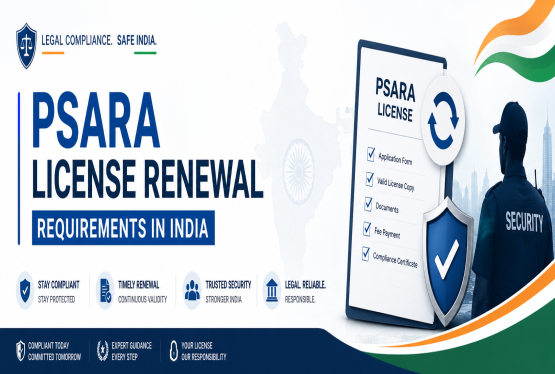



A PSARA Licence is a mandatory licence for any person, company, LLP, partnership firm or other eligible business entity that wants to start or run a private security agency in India. PSARA stands for the Private Security Agencies (Regulation) Act, 2005, which was introduced to regulate private security agencies and ensure that only verified, trained and legally compliant agencies provide security services. The Act is administered under the Ministry of Home Affairs and is implemented through the Controlling Authority appointed by the respective State Government. The Act was enacted on 23 June 2005 and came into force on 14 March 2006.
Private security agencies play an important role in malls, offices, factories, housing societies, banks, hospitals, schools, warehouses, events and commercial establishments. Since these agencies deploy security guards who interact with the public and handle sensitive premises, the law requires proper licensing, police verification, training, supervision and record maintenance. A business cannot legally provide private security guards without obtaining a PSARA Licence.
Meaning of Private Security Agency under PSARA
Under the PSARA law, a private security agency means any person or body of persons engaged in the business of providing private security guards or security services to another person, business, property or establishment. This includes agencies providing guards for residential buildings, corporate offices, industrial units, hotels, events, commercial spaces, cash transportation activities and other premises. The licence is not just a business permission. It is a regulatory approval that confirms that the applicant has met the eligibility conditions, has proper documents, has undergone required verification and is capable of running a security agency as per the standards prescribed under the law.
Legal Framework Governing PSARA Licence
The main law governing private security agencies is the Private Security Agencies (Regulation) Act, 2005. It contains provisions relating to appointment of Controlling Authority, eligibility for licence, application process, renewal, training, conditions of licence, records, inspection, cancellation, penalties and offences by companies. India Code lists the Act with sections from Section 1 to Section 25, including licence requirement, eligibility, renewal, cancellation, appeal, register maintenance and penalties.
Along with the Act, rules are also important. The Ministry of Home Affairs lists the Private Security Agencies Central Model Rules, 2020, which superseded the earlier Central Model Rules, 2006. It also lists the Private Security Agencies (Private Security to Cash Transportation Activities) Rules, 2018 for agencies involved in cash transportation services. The Central Model Rules, 2020 provide forms, procedure, training requirements, verification process, licence format and other operational details. However, PSARA is implemented at the State level, so applicants must also check the respective State rules, fee structure, required forms and local police verification process.
Section-Wise Legal Provisions under PSARA
Section 3: Appointment of Controlling Authority
Section 3 empowers the State Government to appoint a Controlling Authority for regulating private security agencies in the State. The Controlling Authority is responsible for receiving applications, verifying documents, granting licences, renewing licences, suspending licences, cancelling licences and ensuring compliance with the Act. This means that PSARA Licence is not issued by one central office for the whole country. It is issued State-wise. If an agency wants to operate in more than one State, it must comply with the licensing requirements of each State where it wants to provide security services.
Section 4: Licence is Mandatory
Section 4 is one of the most important provisions of PSARA. It states that no person shall carry on or commence the business of a private security agency unless a licence is obtained under the Act. Therefore, starting a private security agency without a valid PSARA Licence is illegal. This provision applies to all businesses that provide private security guards or security services to clients. Even if the agency has company registration, GST registration, Shops and Establishment registration or labour registrations, it still cannot operate as a security agency unless PSARA Licence is obtained.
Section 5: Eligibility for Licence
Section 5 deals with eligibility for obtaining a PSARA Licence. An applicant must be an eligible person or entity and must satisfy the conditions prescribed under the Act and State rules. Generally, a proprietorship, partnership firm, LLP, private limited company, one person company or other legally recognised business form may apply, subject to State-specific requirements. The applicant must have a clean background, proper office address, valid business documents and persons in control of the agency must not suffer from legal disqualifications.
Section 6: Persons Not Eligible for Licence
Section 6 provides disqualifications for obtaining a PSARA Licence. A person may not be eligible if he has been convicted of certain offences, has links with organisations banned by law, has been dismissed from government service on grounds of misconduct or moral turpitude, or is otherwise considered unsuitable by the authorities. This section is important because private security work involves public trust. The law ensures that persons controlling a security agency should have good antecedents and should not pose any risk to public order or safety.
Section 7: Application for Grant of Licence
Section 7 deals with the application process for obtaining PSARA Licence. The applicant has to file the application before the Controlling Authority in the prescribed manner along with the prescribed fee and documents. Under the Central Model Rules, 2020, the application is filed in Form I and the antecedent verification details are submitted in Form II. If the applicant is a company, firm or association, Form II is required for the proprietor, majority shareholder, partner or director, as applicable. The Rules also mention that the Controlling Authority may grant licence after making necessary enquiry and after compliance with the Act. The authority is also required to pass an order on the application within sixty days from the date of receipt of a complete application.
Section 8: Renewal of Licence
A PSARA Licence is not permanent. It must be renewed before expiry. The renewal application must be filed within the prescribed time and with the required documents and fee. If renewal is delayed, the agency may face operational issues and may not be able to legally continue its security business. Since licence validity and renewal procedure may vary depending on State rules and amendments, agencies should maintain a compliance calendar and apply for renewal well before the due date.
Section 9: Conditions for Commencement of Operation and Supervisors
Section 9 states that after receiving the licence, the agency must commence its activities within the prescribed period and must engage supervisors as required. Supervisors are important because they monitor private security guards, ensure discipline, maintain deployment records and act as a link between the agency, client and authorities. The Act also gives preference to persons having experience in the Army, Navy, Air Force or other armed forces while engaging supervisors. This reflects the intention of the law to promote professional standards in private security services.
Section 10: Eligibility to be a Private Security Guard
Section 10 deals with eligibility conditions for private security guards. A person must satisfy requirements relating to age, character, antecedents, physical standards and training. A security guard should not have a criminal background and should be fit to perform security duties. Private security guards are often posted at sensitive locations. Therefore, proper verification and training are necessary before deployment.
Section 11: Conditions of Licence
Section 11 provides that every licence is subject to conditions prescribed under the Act and rules. These conditions may relate to training, uniforms, identity cards, records, change in management, intimation to authorities, employment of guards and compliance with State rules. The Central Model Rules, 2020 require the licensee to undergo training relating to private security as prescribed by the Controlling Authority. The minimum training period for the licensee is six working days and includes topics such as security duties, access control, fire fighting, disaster management, legal provisions, labour laws, documentation, public interface and conduct rules.
Section 12: Licence to be Exhibited
Section 12 requires the licence to be displayed at the place of business. This helps clients, authorities and the public verify whether the agency is legally licensed. The Central Model Rules, 2020 also mention that the physical copy of licence should be delivered after issue and displayed at the agency’s place of business.
Section 13: Cancellation and Suspension of Licence
The Controlling Authority has the power to suspend or cancel the licence if the agency violates the Act, obtains the licence by misrepresentation, fails to comply with conditions, engages in misconduct, deploys unverified guards or acts against public interest. However, before cancellation, the agency is generally given a reasonable opportunity of being heard. This means the agency can submit its explanation before adverse action is taken.
Section 14: Appeal
If the licence is refused, suspended or cancelled, the applicant or agency may file an appeal before the appellate authority as prescribed. This provision protects the applicant from arbitrary rejection and gives a legal remedy against the decision of the Controlling Authority.
Section 15: Register to be Maintained
Section 15 requires every private security agency to maintain a register containing details of management, supervisors, guards, clients and other prescribed information. Proper records are essential for inspection and compliance. The register generally includes the name and address of guards, photographs, identity proof, police verification details, training details, salary records, deployment location, client details and date of joining or leaving.
Section 16: Inspection of Licence and Records
Section 16 allows inspection of the licence, records and other documents by the Controlling Authority or authorised officer. The agency must cooperate during inspection and produce all required documents. Non-maintenance of records or refusal to produce documents may create compliance risk and may lead to action under the Act.
Section 17: Photo Identity Card
Section 17 requires issue of photo identity cards to private security guards. A guard deployed by a licensed agency must carry an identity card issued by the agency. This helps clients, police and the public identify the guard and verify his association with the agency.
Section 18: Disclosure of Information
Section 18 prohibits unauthorised disclosure of information acquired by a private security guard during duty. Security guards may come across sensitive client information, business data, movement details, CCTV areas, access systems and confidential premises information. The law expects guards and agencies to maintain confidentiality.
Section 20: Punishment for Contravention
Section 20 provides punishment for contravention of certain provisions of the Act. Running a private security agency without licence or violating key provisions may attract imprisonment, fine or both, depending on the nature of contravention.
Section 21: Unauthorised Use of Uniform
Section 21 deals with penalty for unauthorised use of certain uniforms. Private security agencies must ensure that their uniforms do not resemble the uniforms of armed forces, police or government security agencies. This prevents confusion and misuse.
Section 22: Offences by Companies
Section 22 states that where an offence is committed by a company, persons in charge of and responsible for the conduct of business may also be held liable. Therefore, directors, partners and key managerial persons must ensure proper PSARA compliance.
Sections 24 and 25: Rule-Making Powers
Section 24 empowers the Central Government to frame model rules for adoption by States. Section 25 empowers State Governments to make rules for carrying out the provisions of the Act. This is why State-wise rules, forms and fees may differ. The Central Government has issued model rules, including the Central Model Rules, 2020.
Documents Required for PSARA Licence
- Business registration proof
- PAN and GST certificate
- Office address proof
- Rent agreement / ownership proof
- NOC from property owner
- Aadhaar and PAN of directors / partners / proprietor
- Passport-size photographs
- Police verification documents
- Affidavit and declaration
- Training institute MOU
- Details of guards and supervisors
- Uniform and logo details
- ESI, EPF and labour registration, if applicable
- Board resolution / authorisation letter
- Government fee payment proof
Training Requirement under PSARA
Training is an important part of PSARA compliance. A private security agency must ensure that its guards and supervisors are properly trained before deployment. The Central Model Rules, 2020 provide that the licensee must undergo training, and the training syllabus may include security duties, fire fighting, disaster management, legal provisions, labour laws, documentation, access control, patrolling, communication equipment and public dealing. The training requirement ensures that guards are not merely deployed as manpower but are prepared to handle practical security responsibilities. Clients also prefer agencies that can provide trained, disciplined and verified guards.
PSARA Licence Application Process
The process starts with selecting the business structure and preparing business documents. After this, the applicant needs to arrange office proof, director or partner KYC documents, police verification documents and training institute agreement. The application is then filed with the respective State Controlling Authority through the prescribed mode. After submission, the authority examines the documents and may forward details for police verification. The premises of the agency may also be verified. If the authority is satisfied, the licence is granted. Under the Central Model Rules, the authority is expected to pass an order within sixty days from the date of receipt of a complete application. After licence approval, the agency must display the licence at its office, issue identity cards to guards, maintain registers, provide training and comply with the conditions of licence.
Recent Updates and Current Compliance Position
The most important recent legal development is the availability of the Private Security Agencies Central Model Rules, 2020, which superseded the earlier 2006 model rules. The Ministry of Home Affairs lists the 2020 Rules along with the PSARA Act, 2005 and the Cash Transportation Rules, 2018. The PSARA portal also provides access to the Act, Central Model Rules, cash transportation rules and gazette notifications. The portal shows that online licensing application facilities are available for most States and Union Territories, except certain jurisdictions where the online process may still be under process. For agencies engaged in cash transportation activities, additional compliance under the Private Security Agencies (Private Security to Cash Transportation Activities) Rules, 2018 is relevant. These rules are important for agencies providing cash van, ATM cash movement, bank cash transportation and similar high-risk services.
Why PSARA Licence is Important
PSARA Licence gives legal recognition to a private security agency. It improves credibility before clients, housing societies, corporates, banks and government departments. Many clients ask for PSARA Licence before entering into a security service agreement. It also protects the agency from penalties and business interruption. Without PSARA Licence, a security agency may face action from authorities and may not be allowed to deploy guards legally. A valid licence also helps in tender participation, institutional contracts and long-term commercial assignments.
Penalties for Non-Compliance
Operating without a PSARA Licence or violating licence conditions can result in serious consequences. The agency may face suspension or cancellation of licence, prosecution, fine or imprisonment depending on the violation. Directors, partners or persons responsible for business operations may also be liable in case of offences by companies. Common violations include deploying guards without verification, not providing training, not maintaining registers, not issuing identity cards, using prohibited uniforms, changing address or management without intimation, and continuing business after licence expiry.
Conclusion
PSARA Licence is mandatory for any business that wants to operate as a private security agency in India. It helps ensure that the agency follows proper legal standards, completes police verification, trains security guards, maintains records, and provides reliable security services to clients.
Compliance Calendar LLP can assist you with the complete PSARA Licence process, including document preparation, application filing, coordination with the department, and compliance support. With the right guidance, private security agencies can avoid delays, objections, and legal issues while starting their business smoothly.
FAQs
Q1. What is PSARA Licence?
Ans. PSARA Licence is a legal licence required to start or operate a private security agency in India. It is issued under the Private Security Agencies (Regulation) Act, 2005 by the Controlling Authority of the respective State.
Q2. Is PSARA Licence mandatory?
Ans. Yes, PSARA Licence is mandatory for any person or business that wants to provide private security guards or security services. Operating a private security agency without this licence is not legally allowed.
Q3. Who issues PSARA Licence?
Ans. PSARA Licence is issued by the Controlling Authority appointed by the State Government. Since the licence is State-specific, the applicant must apply in the State where the agency wants to operate.
Q4. Can a private limited company apply for PSARA Licence?
Ans. Yes, a private limited company can apply for PSARA Licence. It must submit incorporation documents, director details, registered office proof, police verification documents and other documents required by the State authority.
Q5. Is police verification required for PSARA Licence?
Ans. Yes, police verification is an important part of the PSARA application process. The antecedents of the applicant, directors, partners or key persons are verified before the licence is granted.
Q6. Is training compulsory under PSARA?
Ans. Yes, training is a key requirement under PSARA. The agency must ensure proper training of guards and supervisors as prescribed under the applicable rules and directions of the Controlling Authority.
Q7. Can one PSARA Licence be used across India?
Ans. Generally, PSARA Licence is State-specific. If an agency wants to operate in multiple States, it may need to obtain licence or permission as per the requirements of each State.
Q8. What happens if a security agency works without PSARA Licence?
Ans. If a security agency operates without PSARA Licence, it may face legal action, penalty, prosecution and business closure. The agency may also lose client contracts because most professional clients ask for a valid PSARA Licence.
Q9. Can PSARA Licence be cancelled?
Ans. Yes, the Controlling Authority can suspend or cancel the licence if the agency violates the Act, breaches licence conditions, submits false information, deploys unverified guards or acts against public interest.
Q10. What are the important post-licence compliances?
Ans. After receiving the licence, the agency must display the licence, maintain registers, issue identity cards, train guards, inform changes in management or address, cooperate during inspection and comply with all licence conditions.