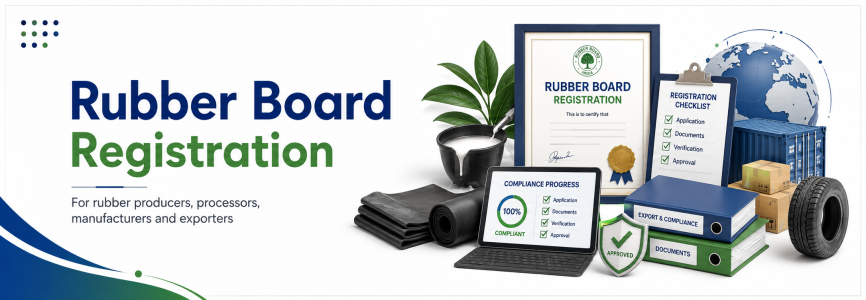



India is one of the world’s important producers and consumers of natural rubber, and the sector supports industries ranging from tyres, footwear and automotive components to medical goods, industrial products, latex goods and consumer products. Because natural rubber is an important plantation and industrial commodity, its production, purchase, sale, processing and use are regulated through a statutory framework administered primarily by the Rubber Board under the Ministry of Commerce and Industry, Government of India. The principal legislation is the Rubber Act, 1947, read with the Rubber Rules, 1955, as amended from time to time.
The expression “Rubber Board Registration” is often used commercially as a broad term, but legally it may refer to different regulatory requirements. An owner of land planted with rubber is dealt with under the registration provisions of the Rubber Act, while dealers, processors and manufacturers dealing with rubber generally operate under the licensing framework provided by Section 14 of the Act and the Rubber Rules. Exporters may additionally require export-related registrations such as an RCMC depending on their activity. Understanding this distinction is important before applying.
What Is the Rubber Board?
The Rubber Board is a statutory body constituted by the Central Government under Section 4 of the Rubber Act, 1947. The Act declares the Rubber Board to be a body corporate having perpetual succession and powers relating to the development of the rubber industry. The Board functions under the administrative control of the Department of Commerce, Ministry of Commerce and Industry.
Under Section 8 of the Rubber Act, the Board performs developmental and regulatory functions connected with the rubber industry. These include promoting rubber production, encouraging research, improving methods of cultivation and processing, providing technical advice, training growers, collecting statistics from estates, dealers and manufacturers, and advising the Central Government regarding matters concerning the development, import and export of rubber. The Rubber Board therefore operates not merely as a registration authority but as the principal governmental institution responsible for supporting and regulating India’s natural rubber sector.
Legal Meaning of Rubber
The Rubber Act gives “rubber” a specific statutory meaning. Under Section 3, rubber includes crude rubber prepared from the leaves, bark or latex of a rubber plant, fluid or coagulated latex at different stages of treatment, concentrated latex calculated by dry rubber content, scrap rubber, sheet rubber, powdered rubber and different forms and varieties of crepe rubber. However, rubber already contained in a manufactured article is generally excluded from this definition. This distinction is important because the licensing provisions primarily regulate transactions involving rubber as a raw or processed material rather than automatically regulating every finished product containing rubber.
Legal Provisions Governing Rubber Board Registration
The main statutory framework consists of the Rubber Act, 1947 and the Rubber Rules, 1955. Section 25 of the Act empowers the Central Government to make rules dealing with registration applications, licences, fees, records, returns, grading, marketing and related matters. The Rubber Rules prescribe operational procedures and forms through which these statutory requirements are implemented.
Several amendments have modernised this framework. In particular, the Rubber Rules were amended in 2017 to require specified licence applications and statutory returns to be filed online. The Rubber Board today operates Project RUBIS, through which licence, return and RCMC-related services are made available electronically.
Section 10 – Registration of Rubber Estates
Section 10 of the Rubber Act, 1947 specifically deals with registration. It provides that a person owning land planted with rubber plants must apply to the Rubber Board for registration as an owner in respect of each estate owned by that person. Once registration has been granted, it continues until cancelled by the Board.
This provision must be distinguished from licences required for commercial transactions. An estate owner’s registration under Section 10 is different from the special licences applicable to dealers, manufacturers and processors who buy, sell, acquire or process rubber.
Section 14 – Licensing of Transactions in Rubber
One of the most important provisions is Section 14 of the Rubber Act. It states that a person cannot sell or otherwise dispose of rubber, and a person cannot buy or otherwise acquire rubber, except under and in accordance with a general or special licence issued by the Rubber Board.
Therefore, businesses commercially buying or selling rubber should carefully determine whether they fall within a category for which a Rubber Board licence is necessary. Conducting regulated transactions without the applicable licence can expose the business to proceedings under the Act.
Who Needs a Rubber Board Licence?
The licensing system broadly covers rubber dealers, rubber processors and rubber goods manufacturers whose activities involve acquiring, purchasing, processing, selling or otherwise dealing in rubber. The Rubber Board’s current RUBIS portal provides separate application facilities for dealer licences, processor licences, manufacturer licences and certain other licence categories.
A dealer generally acquires rubber for resale or otherwise deals commercially in rubber. A processor acquires rubber and processes it into another marketable form. A manufacturer uses rubber for manufacturing products and therefore requires regulatory permission to purchase or otherwise acquire rubber where the Rules apply.
Dealer Licence
Dealer licensing is governed principally by Rule 39 of the Rubber Rules, 1955. The Rules provide for an application relating to a special licence to deal in rubber, and amendments have expressly extended the regulatory wording to imported natural rubber as well. Since the 2017 amendment, the relevant application process is required to be carried out online.
The Rubber Board’s current online guidance states that fresh dealer licence applications are made through the RUBIS system under the fresh licence facility. The current official guidance also provides for payment of the prescribed licence fee electronically.
Processor Licence
A business acquiring natural rubber for processing and subsequently selling the processed material may fall within the processor licensing category. Rule 39A regulates the relevant process, and the 2017 amendments specifically introduced online application and online licence-related procedures under that rule.
The Rubber Board currently provides a separate processor licence application facility through RUBIS. Current official guidance indicates that the fresh licence fee for the standard processor category is calculated for a three-year period and is payable through the prescribed electronic modes.
Manufacturer Licence
A manufacturer is defined under the Act as a person engaged in manufacturing an article in which rubber is used. Manufacturers that need to purchase or otherwise acquire rubber are regulated through Rule 40 of the Rubber Rules, 1955. Official Rubber Board guidance states that a manufacturer seeking a special licence to purchase or otherwise acquire rubber applies under Rule 40.
The applicable forms distinguish between the application and the licence issued after approval. Current Rubber Board guidance also differentiates manufacturer fees according to the annual quantity of rubber proposed to be acquired.
Forms Used for Rubber Board Licensing
The Rubber Rules contain prescribed forms for various categories. Form B is associated with an application for a dealer licence, while the manufacturer licensing framework involves Form D for application and Form E for the licence issued after approval. The Rules also contain separate provisions and forms for processors and other specific transactions. Because the application system has moved online, applicants should follow the latest form and document requirements shown on the Rubber Board’s official RUBIS portal instead of relying solely on old printed versions of the Rules.
Documents Generally Required
The documents required for Rubber Board Registration or licensing depend on the nature of the applicant, such as a proprietorship, partnership firm, LLP, company, dealer, processor or manufacturer. Applicants are generally required to submit identity, business and operational documents to establish the legal existence of the entity and the nature of its rubber-related activities.
The commonly required documents include:
- PAN Card: PAN of the proprietor, firm, LLP or company, as applicable.
- GST Registration Certificate: GST Registration details of the business, wherever registration is applicable.
- Business Registration Proof: Certificate of Incorporation, LLP Incorporation Certificate, Partnership Deed or other constitution document.
- Address Proof of Business Premises: Documents establishing the registered office, factory, warehouse or business location.
- Local Authority Licence: Trade licence, factory licence or other local approval, wherever applicable.
- Contact Details: Valid mobile number, email address and communication details of the applicant.
- Electricity Connection Details: Electricity connection or consumption details may be required for certain processors or manufacturers.
- Rubber Requirement Details: Information regarding the estimated quantity of natural rubber required for business or manufacturing activities.
- Stock Details: Details of existing rubber stock, wherever applicable.
- Previous Consumption Details: Information regarding earlier consumption or use of rubber may be required for existing manufacturers or processors.
- Authorisation Documents: Board resolution, authorisation letter or other authority document where the application is filed on behalf of a company, LLP or other entity.
- Additional Supporting Documents: Any other document requested by the Rubber Board depending on the category and nature of the application.
Applicants should ensure that the business name, PAN, GST details, address and other particulars are consistent across all documents submitted with the application. Any mismatch or incomplete information may lead to queries, delay in processing or rejection of the Rubber Board licence application.
Rubber Board Registration and Licence Application Procedure
The present system is substantially online. An applicant should first identify the correct regulatory category based on whether the business is an estate owner, dealer, processor, manufacturer or exporter. Dealer, processor and manufacturer applications are available through the Rubber Board’s RUBIS system. The applicant completes the relevant online application, provides the required business and operational information, uploads or submits supporting documents and pays the applicable fee.
The Board may scrutinise the information and supporting records before granting the licence. Applicants should not treat mere submission of an online application as permission to commence regulated transactions. Where a special licence is required under Section 14, the activity should be undertaken only in accordance with a valid licence and its conditions.
Validity and Renewal
Under Section 15, a special licence issued under Section 14 remains valid for the period specified in the licence, and the Board may extend its validity. The Board may also revoke a special licence for reasons recorded in writing. Current Rubber Board online guidance states that fresh licences are generally issued for a three-year period, while renewals may be issued for five years, subject to the applicable category and current Board procedure. Businesses should therefore verify the validity printed on their actual licence rather than assuming a standard period.
Current Licence Fees
Rule 45 was amended in 2018 to prescribe annual licence fees. It provides, among other things, ?500 per licence for a manufacturer purchasing more than 100 kilograms but not exceeding four tonnes, ?1,000 for a manufacturer purchasing more than four tonnes, ?1,000 for a dealer and ?1,000 for a processor for a year or part thereof.
Because fresh licences are now issued for multi-year periods, the current RUBIS guidance reflects the fee for the applicable duration together with GST. For example, official Rubber Board guidance currently indicates ?3,540 including GST at 18% for a three-year dealer or processor licence and for a manufacturer acquiring more than four tonnes, subject to the latest portal instructions.
Restriction on Possession of Rubber
Section 16 establishes another important compliance principle. It restricts possession of rubber by persons who are neither owners or occupants of estates nor persons who acquired the rubber under a general or special licence. Rubber involved in a contravention may also become subject to forfeiture proceedings in accordance with law.
This makes licensing important not only at the stage of purchase or sale but also in relation to lawful commercial possession.
Statutory Returns and Record-Keeping
Section 20 of the Rubber Act deals with submission of returns and maintenance of accounts, and the Rubber Rules prescribe detailed return requirements. Rule 43 provides for monthly and annual returns by different categories of stakeholders. The 2017 amendment moved specified returns to an online submission system.
The amended prescribed forms provide that various monthly returns are generally to be filed by the 15th of the succeeding month. Dealers, manufacturers and other regulated stakeholders must therefore treat return filing as an ongoing statutory obligation rather than considering licence issuance to be the end of compliance.
Failure to file returns, maintaining inaccurate records or furnishing knowingly false information can trigger regulatory proceedings.
Inspection Powers of the Rubber Board
The Act grants inspection powers to authorised officials. Regulatory officers may inspect land, estates, factories, business premises and relevant records within the scope of the Act to verify compliance. The statutory framework also permits collection of information and statistics from estates, dealers and manufacturers.
Accordingly, licensed entities should maintain purchase invoices, sales records, stock registers, production or consumption data, statutory returns and relevant business documents in an organised and verifiable manner.
Rubber Cess and Section 12
Section 12 of the Rubber Act provides for a duty of excise or rubber cess on rubber produced in India at a rate that may be fixed by the Central Government subject to the statutory ceiling. The Act also contains provisions concerning assessment, payment, returns, recovery and refunds.
Because liability may depend upon the nature of the transaction, current notifications and applicable exemptions, businesses should not calculate any cess solely from the maximum statutory figure appearing in the Act. The applicable rate and present legal position should be checked against current government notifications.
Import and Export of Rubber
Under Section 11, the Central Government has power to prohibit, restrict or otherwise control imports or exports of rubber through orders published in the Official Gazette. Contravention of an applicable order can result in monetary penalty, cancellation of a Section 14 licence, or both, in addition to consequences under customs law.
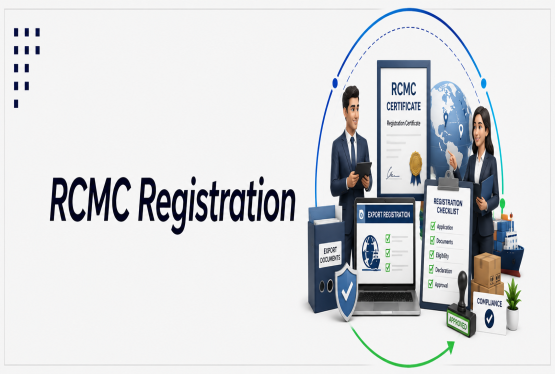
Exporters should also distinguish a domestic Rubber Board licence from RCMC registration. The Rubber Board website identifies the Board as an Export Promotion Council for natural rubber and provides RCMC-related facilities, while DGFT guidance recognises commodity boards and export promotion councils as RCMC-issuing authorities.
An RCMC for export-promotion purposes is therefore different from the statutory licence required for buying, selling or acquiring rubber under the Rubber Act.
Grading, Quality and Marketing Requirements
Rubber quality is also part of the regulatory framework. Rule 48, as amended, requires processors and persons covered by the relevant rule to grade and market their products in conformity with standards specified by the Bureau of Indian Standards from time to time. Businesses engaged in processing should consequently consider both Rubber Board licensing obligations and any separate BIS, product-standard, environmental, factory, labour, GST or other regulatory requirements applicable to their operations.
Cancellation and Revocation of Licence
Under Section 15, the Rubber Board may revoke a special licence for reasons recorded in writing. A licence holder should therefore ensure that transactions remain within the activity, quantity, premises, period and conditions authorised by the licence. Material misrepresentation, non-compliance with licence conditions, failure to submit required returns or violation of statutory obligations may expose a licensee to regulatory action. Changes in constitution, business address, contact details or operational particulars should also be updated according to the current Rubber Board procedure.
Penalties Under the Rubber Act
The penalty framework was significantly modernised by the Jan Vishwas (Amendment of Provisions) Act, 2023. Section 26 now provides monetary penalties for contraventions of the Act or Rules, knowingly furnishing false statements in statutory reports or returns, obstructing an officer of the Board, or failing to produce required books or records. The present statutory penalty may extend to ?50,000 for such contraventions.
The Jan Vishwas legislation was introduced to rationalise and decriminalise various regulatory offences. The amendments relating to the Rubber Act came into force on 9 August 2024.
Adjudication and Appeal After the Jan Vishwas Amendment
A major recent development is the introduction of Section 26B, which establishes an administrative adjudication mechanism for penalties. The Executive Director may appoint the Secretary to the Board or another authorised officer as the adjudicating officer. The affected person must be given a reasonable opportunity of being heard before a penalty is imposed.
A person aggrieved by the adjudicating officer’s order may appeal to the Executive Director within 60 days of receiving the order. Delay may be condoned where sufficient cause is shown, and the legislation provides that the appeal should ordinarily be disposed of within sixty days from filing. Unpaid penalties may be recovered as arrears of land revenue.
This change is particularly significant for businesses because many contraventions that previously involved criminal-style consequences have moved toward an administrative monetary-penalty framework.
Rubber (Amendment) Rules, 2023
Another relevant recent legal development is the Rubber (Amendment) Rules, 2023. The amendment modified Rule 27A so that the Executive Director is to be an officer in the rank of Deputy Secretary to the Government of India or above, replacing the earlier reference to Joint Secretary. This amendment concerns the administrative structure of the Board rather than changing the basic dealer or manufacturer licensing system, but it forms part of the current legal framework.
Digitalisation of Rubber Board Compliance
A continuing regulatory development has been the movement from paper-based procedures to online compliance. The 2017 amendments expressly required online applications under Rules 39, 39A, 40 and 40A and online submission of returns under Rule 43. The Rubber Board currently continues this approach through Project RUBIS, which provides digital facilities for licences, statutory returns and RCMC services.
As of 19 August 2026, the official Rubber Board website continues to list Project RUBIS among its regulatory online services. Businesses should therefore rely on the current online portal for operative forms, payment amounts and filing procedures in addition to consulting the underlying Act and Rules.
Other Registrations May Still Be Required
A Rubber Board licence does not replace other registrations that may apply to a business. Depending on its activities, a rubber business may separately require incorporation or LLP registration, PAN, GST registration, local trade licence, factory registration, pollution control approvals, labour registrations, Importer Exporter Code, BIS certification or other product-specific approvals. Rubber Board registration should therefore be viewed as one part of the overall compliance framework applicable to the enterprise rather than a universal business licence.
Importance of Rubber Board Registration
Proper registration and licensing provide a lawful framework for acquiring, possessing, processing and dealing in rubber. They also enable the Rubber Board to maintain industry statistics, monitor the supply chain, regulate trade and support orderly development of the natural rubber sector. The statutory return system additionally creates traceability concerning rubber stocks, purchases, sales and consumption. For manufacturers and traders, obtaining the correct licence also reduces the risk of interruption during inspection, disputes concerning lawful possession or statutory penalty proceedings.
Conclusion
Rubber Board Registration in India is not a single registration applicable uniformly to every rubber-related business. The legal requirement depends on the activity undertaken. Section 10 of the Rubber Act, 1947 deals primarily with registration of owners of rubber estates, while Section 14, read with the Rubber Rules, 1955, creates the licensing framework governing the purchase, sale and acquisition of rubber by dealers, processors, manufacturers and other regulated persons.
Businesses must also comply with ongoing obligations relating to statutory returns, record maintenance, lawful possession, inspections, grading and marketing standards and, where relevant, import-export regulations and RCMC requirements. The shift to online filing, multi-year licensing practices and the Jan Vishwas reforms effective from 9 August 2024 have made the framework more digital and increasingly based on administrative penalties rather than traditional criminal prosecution for many regulatory defaults.
For any enterprise planning to trade, process, manufacture with or export rubber, the safest approach is to identify its exact business activity first and then obtain the appropriate Rubber Board registration, licence or export registration before undertaking transactions. Since licence fees, portal requirements, trade policy conditions and government notifications can change, applicants should verify the latest requirements on the official Rubber Board and DGFT platforms at the time of filing.
Frequently Asked Questions (FAQs)
Q1. What is Rubber Board Registration in India?
Ans: Rubber Board Registration refers to statutory registration or licensing required under the Rubber Act, 1947.
It may apply to rubber estate owners, dealers, processors, manufacturers and certain exporters.
The applicable registration depends on the nature of the business activity.
2. Is Rubber Board Registration mandatory?
Ans: Yes, registration or licensing is mandatory for persons carrying out activities covered by the Rubber Act and Rubber Rules.
Dealers, processors and manufacturers dealing with natural rubber may require a valid licence.
Operating without the required licence can result in regulatory action and penalties.
Q3. Who needs a Rubber Board licence?
Ans: Rubber dealers, processors and manufacturers purchasing, selling or acquiring natural rubber may require a licence.
Rubber estate owners are separately covered under the registration provisions of the Rubber Act.
Exporters may also need an RCMC depending on their export activities.
Q4. How can I apply for Rubber Board Registration?
Ans: Applications for various Rubber Board licences can be submitted through the Rubber Board's online RUBIS portal.
Applicants need to provide business, identity and operational details along with prescribed documents.
The applicable government fee must also be paid online.
Q5. What documents are required for Rubber Board Registration?
Ans: Generally, PAN, GST registration, business constitution documents and address proof may be required.
Additional documents can include local licences and details of rubber consumption or business operations.
The exact requirements depend on whether the applicant is a dealer, processor or manufacturer.
Q6. What is the validity of a Rubber Board licence?
Ans: The validity depends on the type of licence and the period specified by the Rubber Board.
Fresh licences may generally be granted for a specified multi-year period under the current procedure.
Businesses should always check the validity mentioned on their issued licence.
Q7. Can Rubber Board Registration be renewed?
Ans: Yes, Rubber Board licences can generally be renewed according to the applicable Rules and Board procedure.
Renewal should be completed before the existing licence expires to avoid compliance issues.
Updated documents and prescribed renewal fees may be required.
Q8. Are statutory returns required after obtaining the licence?
Ans: Yes, licensed dealers, processors and manufacturers may have periodic return-filing obligations.
Applicable returns generally contain details of rubber purchases, sales, stock and consumption.
Failure to file prescribed returns can lead to regulatory proceedings.
Q9. What is the penalty for violating Rubber Board rules?
Ans: Contraventions of the Rubber Act or Rules can attract monetary penalties under the amended legal framework.
Certain violations may attract penalties extending up to ?50,000 depending on the circumstances.
Licence-related action may also arise where statutory conditions are violated.
Q10. Is Rubber Board Registration the same as RCMC?
Ans: No, a Rubber Board licence and an RCMC serve different regulatory purposes.
A Rubber Board licence primarily regulates specified transactions involving rubber under the Rubber Act.
RCMC is generally relevant for export promotion and foreign trade-related requirements.