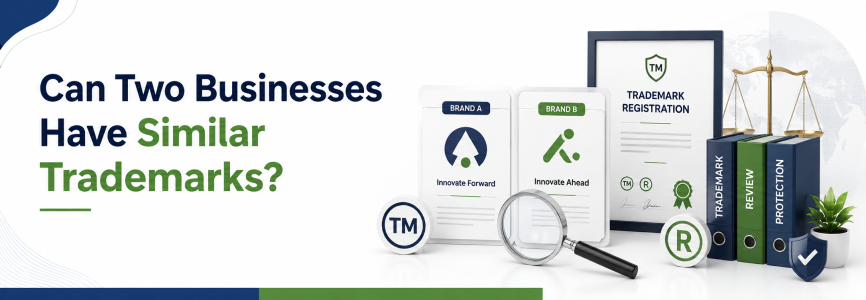



A trademark is one of the most valuable identifiers of a business. A brand name, logo, label, symbol, or other distinctive sign helps consumers identify the commercial source of particular goods or services. Because businesses often operate in crowded markets, however, a practical question frequently arises: Can two businesses legally have similar trademarks?
The answer is yes, in certain circumstances—but not always.
Under Indian trademark law, the existence of some similarity between two marks does not automatically make the later trademark illegal or unregistrable. The important questions are how similar the trademarks are, whether the goods or services are identical or related, whether consumers are likely to become confused, whether one mark has an earlier right, and whether the earlier trademark enjoys a particularly strong reputation. The Trade Marks Act, 1999 specifically addresses conflicts involving identical and similar marks. Section 11 provides that registration can be refused where similarity or identity between an earlier trademark and a later trademark, together with similarity or identity of the relevant goods or services, creates a likelihood of confusion or association among the public.
What Is Considered a Similar Trademark?
The Trade Marks Act defines a mark as "deceptively similar" when it so nearly resembles another mark that it is likely to deceive or cause confusion.
Similarity can arise in several ways.
1. Visual Similarity
Two trademarks may look similar because of:
-
similar spelling;
-
identical or closely resembling logos;
-
similar device elements;
-
comparable stylisation;
-
similar arrangement of words; or
-
an overall similar visual impression.
For example, changing one or two letters of an established brand name may not necessarily make the later trademark sufficiently different. The Trade Marks Registry's examination guidance states that trademarks should generally be considered as a whole, rather than by taking one isolated part of one trademark and comparing it with one part of another. It also explains that an overly meticulous letter-by-letter comparison is not the proper approach.
2. Phonetic Similarity
Two marks can be spelled differently and still sound substantially alike. Suppose, for illustration, one business uses "Klearza" while another adopts "Clearza." Their written forms are different, but when spoken they may sound almost identical. This becomes particularly relevant where consumers commonly request products verbally, hear about brands through advertisements, or rely on pronunciation instead of seeing the written trademark. The official Trade Marks Registry guidance indicates that overall visual, structural, and phonetic similarity may be considered while evaluating the likelihood of confusion.
3. Conceptual Similarity
Sometimes two trademarks may communicate substantially the same idea even though their words are not identical. For example, two marks could use different words but combine similar dominant concepts, symbols, or presentation in a way that makes consumers associate one with the other. Consequently, businesses should not assume that changing spelling or adding a minor design element automatically eliminates trademark risk.
The Main Test: Likelihood of Consumer Confusion
The central question in many trademark conflicts is whether consumers are likely to believe that the goods or services offered under the two trademarks originate from the same business or from commercially connected businesses. Section 11(1) of the Trade Marks Act addresses this principle. A later trademark may face refusal where its identity or similarity with an earlier trademark, combined with identity or similarity of the goods or services, creates a likelihood of confusion, including a likelihood of association with the earlier trademark. Importantly, actual evidence that customers have already become confused is not always necessary. The Trade Marks Registry's examination guidance explains that the likelihood of confusion must be probable, but actual confusion need not already have occurred.
The assessment may therefore consider matters such as:
-
similarity between the trademarks;
-
distinctiveness of the earlier trademark;
-
similarity between the respective goods or services;
-
type of consumers;
-
purchasing circumstances;
-
overall impression of the marks; and
-
likelihood that consumers will associate one business with another.
The Registry's guidance identifies the similarity of the marks, distinctiveness of the earlier mark, and degree of similarity between the respective goods or services as particularly relevant considerations during examination.
Can Similar Trademarks Exist in Different Classes?
Yes, similar or even identical trademarks may sometimes coexist when they relate to sufficiently different goods or services. Trademark applications are classified according to goods and services. However, being in different trademark classes does not automatically mean there is no conflict.
Consider a hypothetical example.
A business might use the trademark "NEXORA" for industrial machinery, while another business wishes to use NEXORA for an unrelated category of professional services. Depending on the actual circumstances, the two may potentially coexist if consumers are unlikely to believe that both businesses are commercially connected. On the other hand, goods or services falling into different classes can still be related from a commercial perspective. The Trade Marks Act itself recognizes that goods and services can be associated where they are likely to be traded or provided by the same business. Accordingly, an applicant should not rely exclusively on the class number while assessing trademark availability.
Same Trademark Class Does Not Automatically Mean Rejection Either
The opposite is also important.
Two marks appearing within the same class are not necessarily automatically conflicting. A trademark class can cover a broad variety of goods or services. The specific specification, market, consumer base, distinctiveness of the marks, and overall likelihood of confusion must still be examined.
For example, two businesses might file trademarks in the same broad class but seek protection for substantially different goods. Whether coexistence is possible would depend on the complete circumstances.
Therefore, the question should not simply be:
"Are these trademarks in the same class?"
A more appropriate question is:
"Considering both the marks and the relevant goods or services, is there a realistic likelihood of consumer confusion?"
What If the Earlier Trademark Is Well Known?
Greater caution is necessary when the earlier trademark is a well-known trademark.
Ordinarily, similarity between trademarks is closely evaluated together with similarity between the relevant goods and services. Well-known trademarks can receive broader protection. Section 11(2) provides that an identical or similar mark can face refusal even for dissimilar goods or services where the earlier trademark is well known in India and use of the later mark without due cause would unfairly benefit from, or harm, the distinctive character or reputation of the earlier mark. Section 29 similarly provides protection in infringement situations involving registered trademarks having a reputation in India where an identical or similar mark is used for dissimilar goods or services and the statutory conditions are met. This means that adopting a famous brand name for an entirely different category of business cannot automatically be justified by saying, "We operate in a different class."
What Is Honest Concurrent Use?
Indian trademark law recognizes certain circumstances in which identical or similar marks can be registered for more than one proprietor. Section 12 of the Trade Marks Act deals with honest concurrent use or other special circumstances. It permits the Registrar, where appropriate, to allow registration by more than one proprietor of identical or similar trademarks even for the same or similar goods or services, subject to conditions and limitations that the Registrar may impose. This provision does not mean that every business that has used a similar trademark for some time automatically qualifies.
The applicant may need to demonstrate circumstances supporting honest and concurrent adoption and use. The Trade Marks Registry's official guidance explains that evidence supporting honest concurrent use may include circumstances demonstrating honest adoption, continuous and concurrent use, and goodwill or common-law rights acquired in the trademark. Therefore, honest concurrent use is better understood as a specific legal basis that may permit coexistence—not a general exemption from trademark rules.
Consent From the Earlier Trademark Owner
Consent may also become relevant in appropriate cases. Section 11(4) provides that Section 11 does not prevent registration where the proprietor of the earlier trademark or other earlier right consents to registration; the Registrar may then register the later mark under special circumstances under Section 12. The Trade Marks Registry's examination guidance also discusses consent as one possible way of addressing a conflict with an earlier cited mark.
Businesses considering a coexistence or consent arrangement should carefully define matters such as:
-
goods and services;
-
territorial use;
-
logo presentation;
-
distribution channels;
-
online advertising;
-
future expansion;
-
enforcement rights; and
-
restrictions designed to reduce confusion.
Consent should not be treated merely as an informal understanding between businesses where significant trademark rights are involved.
Prior Use Can Be Extremely Important
Trademark registration is important, but the date on which a trademark began to be used can also materially affect a dispute. Section 34 of the Trade Marks Act protects certain vested rights of a prior user. Broadly, the Act prevents a registered proprietor from restraining another person's continuous use of an identical or nearly resembling trademark for relevant goods or services where that person's use began before the relevant earlier date specified under the section. This means that a business should not assume that registration alone necessarily defeats every earlier user.
Evidence of use may therefore become crucial. Businesses should maintain records such as:
-
invoices;
-
purchase orders;
-
advertisements;
-
brochures;
-
website archives;
-
packaging;
-
sales records;
-
social media records;
-
GST or business documents;
-
promotional material; and
-
dated commercial correspondence.
Such evidence can help establish when and how a trademark entered commercial use.
What About an Unregistered Trademark?
An unregistered trademark generally cannot support an infringement action merely on the basis of trademark registration rights because Section 27(1) states that no action for infringement can be instituted for an unregistered trademark. However, Section 27(2) expressly preserves remedies relating to passing off. Section 11 also recognizes that registration may be prevented where use of the proposed mark would be liable to be stopped under passing-off law protecting an unregistered trademark used in trade. Therefore, searching only registered trademarks is not always sufficient before launching a new brand. A business should also consider earlier unregistered brands with substantial market use and goodwill.
When Can Similarity Become Trademark Infringement?
Registration of a later similar mark and actual marketplace use are related but distinct issues. Section 29 deals with infringement of registered trademarks. Among other circumstances, infringement can arise where an unauthorized person uses an identical or deceptively similar mark for relevant goods or services in circumstances covered by the section. Section 29(2) specifically addresses identity or similarity of trademarks together with identity or similarity of goods or services where public confusion or association is likely. The provision also states that where both the mark and the relevant goods or services are identical under Section 29(2)(c), the court shall presume likelihood of confusion. Trademark disputes may therefore arise even where a later business believes that small differences in spelling, font, colour, packaging, or presentation are enough to distinguish its brand.
Adding a Word May Not Solve the Problem
Businesses sometimes discover an existing trademark and attempt to avoid conflict simply by adding words such as:
-
India;
-
Global;
-
Enterprises;
-
Solutions;
-
Official;
-
Group;
-
International;
-
Plus; or
-
Pro.
Whether such an addition is sufficient depends on the trademark as a whole and the overall likelihood of confusion. If the dominant and distinctive portion of the earlier trademark remains substantially reproduced, adding a descriptive or weak expression may not necessarily remove the conflict. Similarly, merely changing the font or colour of a word mark does not guarantee that a new mark becomes legally distinct.
How Should Businesses Check Similar Trademarks Before Filing?
A comprehensive trademark search should normally be undertaken before substantial money is invested in a new brand. The Trade Marks Registry provides a public trademark search facility through which applicants can review existing trademark records.
A practical search should go beyond checking the exact spelling of the proposed brand. Businesses should consider:
-
exact matches;
-
similar spellings;
-
phonetic equivalents;
-
prefixes and suffixes;
-
visually similar marks;
-
related goods and services;
-
earlier pending applications;
-
well-known marks;
-
relevant unregistered market use; and
-
overall commercial impression.
This can significantly reduce the possibility of receiving a Section 11 objection after filing or facing opposition or enforcement issues after launching the brand.
What Happens If the Trademark Registry Finds a Similar Mark?
During examination, the Trade Marks Registry may cite an earlier trademark and raise an objection under Section 11 where the statutory conditions concerning similarity and likelihood of confusion are considered applicable. The Registry's examination guidance states that where same or similar earlier trademarks belonging to different proprietors are found for the same or similar description of goods or services, an objection may be raised where the identity or similarity creates a likelihood of confusion.
An applicant may then need to respond based on the particular circumstances.
Possible arguments or strategies may involve:
-
demonstrating that the marks are sufficiently different;
-
showing differences between goods or services;
-
explaining distinct trade channels or consumer groups where legally relevant;
-
relying on prior rights;
-
producing evidence of honest concurrent use;
-
obtaining appropriate consent;
-
restricting the specification where suitable; or
-
otherwise addressing the Registry's objection.
The correct approach depends entirely on the facts and the earlier cited trademarks.
Practical Example of Trademark Coexistence
Suppose Business A owns "ORBITA" for specialised industrial valves.
Business B later proposes "ORBITA" for educational coaching services.
Because the businesses, services, consumers, and commercial channels may be very different, coexistence might potentially be possible, subject to the complete trademark search and legal analysis.
Now consider Business C proposing "ORBITAA" for industrial valves competing with Business A.
Even though an extra letter has been added, the appearance and pronunciation could remain very close. Since the goods are also identical or highly similar, the potential for confusion would be substantially greater. The analysis therefore depends on the combination of the mark, goods or services, marketplace context, earlier rights, reputation, and consumer perception.
Why Businesses Should Avoid "Almost the Same" Branding
Even where a similar trademark might technically be registrable, deliberately selecting a brand that closely resembles an established competitor can create unnecessary commercial risk.
Possible consequences include:
-
examination objections;
-
cease-and-desist notices;
-
infringement proceedings;
-
passing-off claims;
-
rebranding expenses;
-
packaging replacement costs;
-
domain-name disputes;
-
marketplace listing problems; and
-
loss of customer confidence.
A distinctive trademark is generally easier to protect, enforce, market, and develop into an independent business asset.
Conclusion
Can two businesses have similar trademarks? Yes—but only in circumstances where the law permits coexistence and the relevant rights do not create an unacceptable conflict.
Two identical or similar trademarks may potentially coexist where their goods or services are sufficiently different and consumers are unlikely to assume a commercial connection. In appropriate cases, honest concurrent use, consent, or prior-user rights may also affect the outcome. However, different trademark classes do not automatically guarantee coexistence, and well-known trademarks may receive protection even against use involving dissimilar goods or services.
For businesses, the safest approach is to conduct a comprehensive trademark search before finalising, advertising, or investing significantly in a brand. Compliance Calendar LLP assists startups, companies, entrepreneurs, and brand owners with trademark searches, trademark registration, examination report replies, objections, oppositions, hearings, renewals, and other trademark-related requirements in India.
FAQs
Q1. Can two companies register the same trademark in India?
Ans. It may be possible in certain circumstances. Whether the same or similar trademark can be registered by different proprietors depends on factors including the goods or services, likelihood of confusion, prior rights, consent, and honest concurrent use. Section 12 specifically allows the Registrar to permit registration by more than one proprietor in cases of honest concurrent use or other special circumstances.
Q2. Can the same trademark be registered in different classes?
Ans. Potentially, yes. However, registration in a different class does not automatically eliminate trademark conflict. Section 11 considers similarity between the marks and the relevant goods or services, and well-known marks can receive protection even in relation to dissimilar goods or services.
Q3. What is a deceptively similar trademark?
Ans. Under Section 2(1)(h) of the Trade Marks Act, a trademark is deceptively similar when it so nearly resembles another trademark that it is likely to deceive or cause confusion.
Q4. Can changing one letter make a trademark different?
Ans. Not necessarily. Trademark comparison is not limited to exact spelling. Visual, structural, phonetic, and overall similarity may be considered, and the Registry's guidance states that a meticulous letter-by-letter comparison is not the correct test.
Q5. Can two trademarks sound the same but have different spellings?
Ans. They can exist, but phonetic similarity can create a trademark conflict if consumers are likely to become confused. The overall visual, structural, phonetic, and conceptual impression of the marks may be relevant to the assessment.
Q6. What is honest concurrent use in trademark law?
Ans. Honest concurrent use refers to circumstances in which different proprietors have honestly used identical or similar trademarks concurrently. Section 12 gives the Registrar discretion to permit such registrations, subject to appropriate conditions or limitations.
Q7. Does the first person to register a trademark always win?
Ans. Not necessarily. Prior use can be highly significant. Section 34 preserves specified rights of a person who continuously used an identical or nearly resembling trademark before the relevant earlier date described in that provision.
Q8. Can an unregistered trademark stop another trademark?
Ans. Potentially, yes. Although an unregistered mark does not support an infringement action under Section 27(1), Section 27(2) preserves passing-off remedies. Section 11 also recognizes passing-off rights as a potential basis affecting registration.
Q9. Can I use a famous trademark for completely different products?
Ans. This can be legally risky. Section 11(2) provides broader protection for well-known trademarks in specified circumstances even where the later goods or services are dissimilar, particularly where the later use would unfairly benefit from or harm the distinctive character or reputation of the well-known mark.
Q10. What should I do if a similar trademark already exists?
Ans. Before filing or launching the brand, conduct a detailed trademark search and examine the earlier mark's status, owner, filing and use details, goods or services, and similarity to your proposed mark. Depending on the circumstances, options may include choosing a more distinctive mark, modifying the application, responding to an objection, obtaining consent, relying on prior rights, or presenting evidence supporting honest concurrent use. The appropriate strategy depends on the facts of each case.