


Gold and silver jewellery are not only decorative products in India but are also widely purchased as valuable assets. When consumers buy precious-metal jewellery, one of the most important questions is whether the purity claimed by the jeweller is genuine. Since purity cannot normally be determined merely by looking at an ornament, the Bureau of Indian Standards (BIS) Hallmarking Scheme provides an important system of third-party assurance. Hallmarking is the accurate determination and official recording of the proportionate content of precious metal in an article. BIS explains that a hallmark acts as an official indication of the purity or fineness of precious-metal articles. At present, gold and silver are the two precious metals covered under India's hallmarking framework.
However, consumers should know what an authentic hallmark actually looks like. Simply seeing a stamp such as “916” on gold jewellery is not enough to establish that it has been properly hallmarked. Genuine hallmarked jewellery contains prescribed components that allow the article's purity and identity to be verified. This article explains the components of a genuine hallmark, how to verify a Hallmark Unique Identification or HUID, the meaning of common purity marks, precautions consumers should take while purchasing jewellery, and how BIS protects buyers against short-purity articles.
What Is BIS Hallmarking?
BIS hallmarking is a system under which precious-metal jewellery or artefacts are assessed for purity and marked after being tested through a BIS-recognised Assaying and Hallmarking Centre. The purpose of hallmarking is primarily to protect consumers against adulteration and incorrect declarations of purity. BIS also considers hallmarking important for improving confidence in India's precious-metals market and supporting export competitiveness. Under the system, eligible registered jewellers send jewellery articles to recognised Assaying and Hallmarking Centres. The articles are tested according to the prescribed standards and, when found conforming, are hallmarked with the applicable markings. For a customer, this means that the hallmark provides third-party assurance that the declared purity has been assessed under the BIS hallmarking framework.
Why Is Hallmarking Important for Jewellery Buyers?
The price of precious-metal jewellery depends significantly on purity. A small difference in gold content can create a substantial difference in value, especially for expensive jewellery.
For example, an article represented as 22-carat gold is expected to correspond to the prescribed fineness of 916 parts per thousand. If the actual gold content is materially lower, the consumer may be paying 22-carat prices for an inferior product.
Hallmarking helps reduce this risk by introducing independent assessment and traceability.
It benefits consumers by:
-
Providing third-party assurance of purity.
-
Making jewellery more transparent and traceable.
-
Helping buyers distinguish between different purity grades.
-
Creating accountability for registered jewellers.
-
Providing mechanisms for verification and complaints.
-
Offering consumer remedies where hallmarked jewellery is found below the marked purity.
What Does a Genuine Gold Hallmark Contain?
This is one of the most important points for consumers to understand.
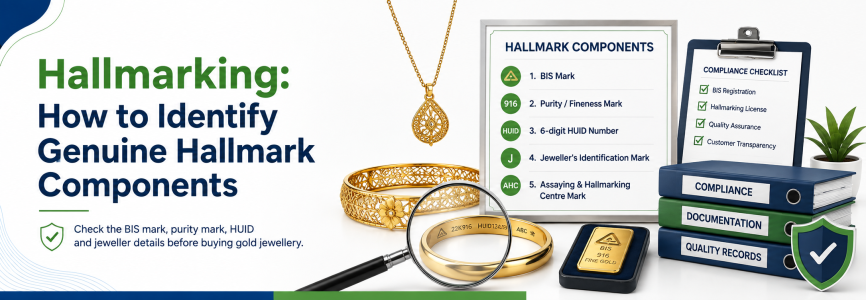
For gold jewellery hallmarked under the HUID system introduced from 1 July 2021, the hallmark consists of three mandatory components:
-
BIS Standard Mark / BIS Logo
-
Purity in carat and fineness
-
Six-digit alphanumeric HUID number
BIS specifically confirms that, since the introduction of HUID on 1 July 2021, these three marks constitute the hallmark on gold jewellery. Older articles are hallmarked before the HUID system can carry the earlier marking format. Therefore, the date and circumstances of hallmarking are relevant when examining older jewellery.
Component 1: BIS Standard Mark
The first component to look for is the BIS Standard Mark or BIS logo.
The presence of the BIS mark indicates that the article has been hallmarked under the BIS system. Consumers should not confuse a jeweller's own logo, brand symbol, shop name or decorative stamp with the BIS Standard Mark. When inspecting jewellery, the BIS mark may be very small because jewellery pieces often provide limited space for marking. Therefore, a magnifying glass may be required to see it clearly. BIS requires registered jewellery outlets to make a magnifying glass of at least 10X magnification available so that customers can inspect the hallmark details on jewellery. Consumers should therefore ask the jeweller to show the BIS mark clearly instead of relying only on verbal assurances that an article is “BIS certified” or “hallmarked.”
Component 2: Purity in Carat and Fineness
The second important component indicates the actual declared purity of the precious metal.
For gold, purity is generally represented by both caratage and fineness.
Common examples include:
-
14K585 – 14-carat gold with a fineness of 585 parts per thousand.
-
18K750 – 18-carat gold with a fineness of 750 parts per thousand.
-
20K833 – 20-carat gold with a fineness of 833 parts per thousand.
-
22K916 – 22-carat gold with a fineness of 916 parts per thousand.
-
23K958 – 23-carat gold with a fineness of 958 parts per thousand.
-
24KS995 – 24-carat special-grade gold with a fineness of 995 parts per thousand.
BIS currently identifies these six permitted caratage/fineness grades under IS 1417:2016 for hallmarking of gold jewellery and artefacts.
What Does 916 Gold Mean?
The marking 916 is commonly seen on Indian gold jewellery. It indicates a fineness of 916 parts per thousand, broadly corresponding to 91.6% gold content and 22-carat gold. However, buyers should understand an important distinction: “916” alone should not automatically be treated as proof of a complete modern BIS hallmark. For HUID-based hallmarked gold jewellery, consumers should look for the BIS Standard Mark, purity/caratalage marking and the six-digit HUID together.
Component 3: Six-Digit HUID Number
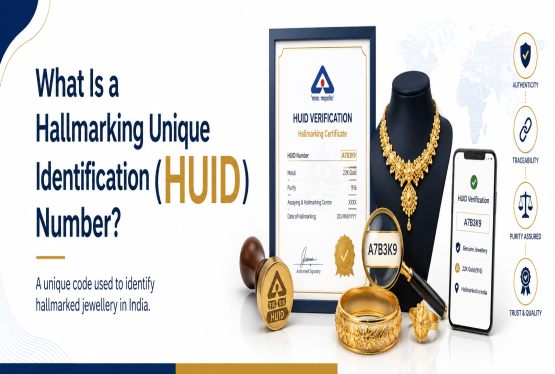
The Hallmark Unique Identification (HUID) number is one of the most significant reforms in India's hallmarking system. HUID is a unique six-digit alphanumeric code assigned to a hallmarked jewellery article. Each hallmarked item receives its own identification number, improving traceability within the hallmarking system. A HUID might visually resemble a six-character combination of letters and numbers. Consumers should not assume that any random six-character engraving is genuine. The code should be verified using BIS's official verification facility.
Why Is HUID Important?
The HUID system helps create traceability between the jewellery article, hallmarking process and registered jeweller. Previously, gold jewellery carried four marks, including identification marks relating to the jeweller and Assaying and Hallmarking Centre. With the introduction of HUID from 1 July 2021, BIS replaced that format for gold jewellery with the three-mark system consisting of the BIS mark, purity/fineness and HUID. This makes the HUID particularly useful for consumers because it provides a digital verification mechanism.
How to Verify HUID Through the BIS Care App
Consumers can verify a HUID using the official BIS Care App. BIS provides a “Verify HUID” feature through which consumers can check information associated with hallmarked gold jewellery before purchase.
A practical verification process is:
-
Locate the six-digit HUID number engraved on the jewellery.
-
Open the official BIS Care App.
-
Select the Verify HUID option.
-
Enter the HUID exactly as marked.
-
Review the information displayed.
-
Compare the displayed information with the jewellery being offered and the jeweller selling it.
BIS states that consumers can use HUID verification to obtain information connected with the jeweller's registration. If the information displayed through verification does not correspond appropriately with the article or transaction, consumers should seek clarification before completing the purchase.
Are Jeweller and Hallmarking Centre Marks Still Mandatory?
Consumers often encounter older articles, internet graphics or previous hallmarking guidance showing additional marks such as:
-
Jeweller's identification mark
-
Assaying and Hallmarking Centre identification mark
These were part of the earlier system.
For gold jewellery hallmarked under the present HUID-based system, the mandatory hallmark consists of the BIS mark, purity in carat/fineness and the six-digit HUID. BIS further clarifies that a manufacturer or jeweller may place its own mark on the article in addition to the mandatory marks, but such an additional mark is not one of the three mandatory modern hallmark components. This distinction is important when educating consumers about genuine current hallmarks.
Hallmarking of Silver Jewellery
India's hallmarking framework also covers silver. A significant recent development is the introduction of HUID-based hallmarking for silver jewellery and articles under the revised IS 2112:2025, effective on a voluntary basis from 1 September 2025.
Under this revised system, the silver hallmark consists of:
-
BIS Standard Mark with the word “SILVER”
-
Purity grade
-
HUID code
The revised standard provides purity grades including 800, 835, 925, 958, 970, 990 and 999. Consumers purchasing silver articles should therefore consider the applicable standard and marking system rather than assuming that gold and silver markings will always appear identically.
Check Every Article Separately
When jewellery is purchased as a pair, such as earrings, consumers should examine each article. BIS states that each article in a pair should have its own hallmark. Similarly, detachable parts that can be easily removed or replaced should also carry the appropriate hallmark. This is important because one genuine hallmarked part should not be used to create the impression that an entire set is hallmarked when other separate components are not. A buyer purchasing earrings, for example, should inspect both earrings rather than checking only one.
Examine the Hallmark with a Magnifying Glass
Hallmarks can be extremely small. Buyers should therefore avoid rejecting or accepting an article merely because the markings cannot be seen easily with the naked eye. At registered jewellery outlets, customers should have access to a minimum 10X magnifying glass for checking hallmark details.
When inspecting the jewellery, check whether:
-
The BIS mark is visible.
-
Caratage and fineness are readable.
-
The HUID contains six alphanumeric characters.
-
Markings appear properly applied.
-
The HUID can be verified digitally.
Always Obtain a Proper Invoice
A genuine hallmark is only one part of a safe jewellery transaction. Consumers should always obtain a proper bill or invoice from the jeweller.
According to BIS consumer guidance, the invoice for hallmarked precious-metal articles should contain relevant information including:
-
Description of each article
-
Net weight of precious metal
-
Purity in carat and fineness
-
Hallmarking charges
BIS also emphasizes that obtaining an authentic invoice is important for complaint or dispute resolution. Consumers should preserve the invoice even after the purchase because it provides important evidence regarding the transaction.
Check Whether the Jeweller Is BIS Registered
Consumers should preferably purchase hallmarked jewellery through a properly registered jeweller. The BIS certificate of registration should be displayed prominently at the sales outlet. BIS consumer guidance also requires appropriate hallmarking information to be made available at the shop.
Before purchasing high-value jewellery, customers can therefore verify:
-
Whether the outlet displays its BIS registration certificate.
-
Whether hallmarked jewellery is represented correctly.
-
Whether a 10X magnifying glass is available.
-
Whether the jeweller provides a proper invoice.
-
Whether the HUID can be verified through the BIS Care App.
Can a Consumer Get Jewellery Independently Tested?
Yes. A consumer who wants independent confirmation of the purity of jewellery can approach a BIS-recognised Assaying and Hallmarking Centre for testing. BIS states that consumers can have hallmarked or unhallmarked jewellery samples tested at recognised Assaying and Hallmarking Centres on a chargeable basis, and the centre is required to issue an assay report identifying the article tested.
This mechanism can be useful where a consumer has concerns about purity or wishes to verify an important jewellery purchase.
What If Hallmarked Jewellery Has Lower Purity Than Declared?
BIS provides an important consumer protection mechanism. Where hallmarked jewellery purchased by a consumer is subsequently found to have lower purity than what was marked, the consumer may be entitled to compensation. Under the applicable BIS rule described by BIS, compensation is two times the amount of difference calculated on the basis of the shortage of purity for the weight of the article, along with testing charges. This makes preservation of invoices and other transaction records especially important.
Common Mistakes Consumers Should Avoid
Despite increased awareness of hallmarking, buyers can still make mistakes.
Assuming “916” Alone Means BIS Hallmarked
A 916 stamp indicates claimed fineness, but modern HUID-based hallmarked gold jewellery should carry all three prescribed components.
Not Verifying the HUID
A code engraved on jewellery should not simply be accepted at face value. Use the BIS Care App to verify it.
Checking Only One Earring or Detachable Part
Each article in a pair and applicable detachable parts should be checked separately.
Buying Without an Invoice
Without a proper invoice, resolving future disputes can become more difficult.
Confusing Brand Marks with BIS Hallmarks
Jewellers may use their own logos or identification marks. These do not replace the mandatory BIS hallmark components.
Ignoring the Purity Mark
Consumers sometimes focus exclusively on whether an article is hallmarked while failing to check whether it is 14K, 18K, 22K or another permitted grade. Hallmarking confirms the declared purity; it does not mean every hallmarked product has the same gold content.
Simple Checklist Before Buying Hallmarked Gold Jewellery
Before completing a purchase, a consumer should:
-
Look for the BIS Standard Mark.
-
Check the caratage and fineness mark, such as 22K916.
-
Locate the six-digit alphanumeric HUID.
-
Verify the HUID through the BIS Care App.
-
Examine each jewellery article separately.
-
Check hallmarks on detachable parts where applicable.
-
Confirm that the jeweller displays BIS registration.
-
Request a 10X magnifying glass if the hallmark is difficult to read.
-
Obtain a detailed invoice mentioning purity and weight.
-
Preserve the invoice for future verification or complaints.
Conclusion
Hallmarking provides an important layer of protection for consumers purchasing gold and silver jewellery in India. However, the value of the system depends upon consumers understanding what they should actually inspect. For gold jewellery hallmarked under the HUID system introduced from 1 July 2021, the three essential components are the BIS Standard Mark, purity expressed in caratage and fineness, and a six-digit alphanumeric HUID number.
Consumers should not rely only on a “916” stamp, a jeweller's verbal assurance or the appearance of an article. The HUID should be verified through the BIS Care App, each article should be checked individually, and a proper invoice should always be obtained. With HUID-based traceability, recognised Assaying and Hallmarking Centres and consumer compensation mechanisms, India's hallmarking system gives buyers useful tools for protecting themselves against purity-related malpractice. An informed consumer who knows how to identify and verify genuine hallmark components is therefore in a much stronger position when purchasing precious-metal jewellery.
FAQs
Q1. What are the three components of a genuine BIS hallmark on current gold jewellery?
Ans. For gold jewellery hallmarked under the HUID system introduced from 1 July 2021, the hallmark contains three mandatory components: the BIS Standard Mark, purity in carat and fineness, and a six-digit alphanumeric HUID number.
Q2. Is 916 gold automatically BIS hallmarked?
Ans. No. “916” represents fineness corresponding to 22-carat gold, but the number alone is not the complete modern BIS hallmark. HUID-based hallmarked gold jewellery should also carry the BIS Standard Mark and six-digit HUID.
Q3. What is HUID in gold jewellery?
Ans. HUID stands for Hallmark Unique Identification. It is a unique six-digit alphanumeric code assigned to each hallmarked gold jewellery article and is designed to improve traceability.
Q4. How can I check whether a HUID is genuine?
Ans. Consumers can use the Verify HUID feature in the official BIS Care App. Enter the six-digit HUID marked on the jewellery and compare the information returned with the article and jeweller details.
Q5. Does a genuine hallmark still require the jeweller's identification mark?
Ans. For current HUID-based gold hallmarking, the three mandatory components are the BIS mark, purity/fineness and HUID. A jeweller or manufacturer may put its own mark additionally, but it is not one of the three mandatory HUID hallmark components.
Q6. Should both earrings in a pair have hallmarks?
Ans. Yes. BIS guidance states that each article in a pair should carry its hallmark. Applicable detachable parts should also be hallmarked separately.
Q7. Can I ask the jewellery shop for a magnifying glass to inspect the hallmark?
Ans. Yes. BIS guidance provides that registered jewellers should have a magnifying glass with at least 10X magnification available for customers to inspect hallmark details.
Q8. Can a consumer independently test gold jewellery for purity?
Ans. Yes. Consumers can approach a BIS-recognised Assaying and Hallmarking Centre for testing of jewellery on a chargeable basis. The centre can provide an assay report for the tested article.
Q9. What happens if hallmarked jewellery is found to have lower purity?
Ans. Where a hallmarked article is found below the declared purity, BIS rules provide for compensation calculated at twice the amount of the purity shortage for the weight of the article, together with applicable testing charges.
Q10. Is HUID also available for silver jewellery?
Ans. Yes. Under the revised IS 2112:2025, HUID-based hallmarking for silver jewellery and articles was introduced on a voluntary basis from 1 September 2025. The revised hallmark includes the BIS Standard Mark with “SILVER,” the purity grade and the HUID code.