
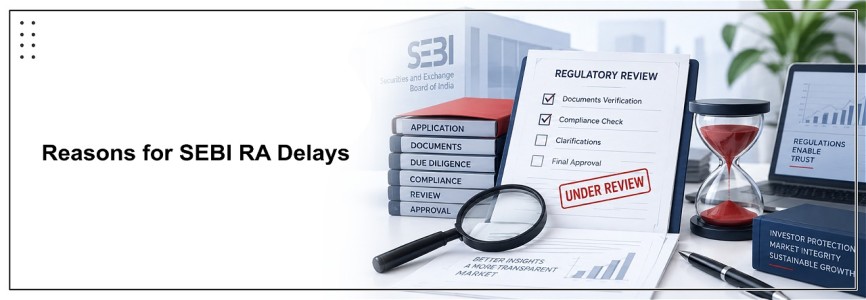



SEBI Research Analyst registration is an important regulatory requirement for individuals and entities intending to provide securities research and related recommendations in India. The application process involves a detailed review of the applicant’s eligibility, qualifications, NISM certification, infrastructure, business model, ownership structure and compliance arrangements under the SEBI (Research Analysts) Regulations, 2014 and applicable circulars. BSE Limited currently functions as the Research Analyst Administration and Supervisory Body (RAASB), while SEBI continues to grant the final certificate of registration.
Applications may be delayed or may attract clarification queries when documents are incomplete, information is inconsistent, qualifications or certifications do not meet prescribed requirements, or the proposed business model overlaps with investment advisory, distribution or other regulated activities. Applicants should therefore prepare complete and accurate documentation, clearly explain their proposed research services and ensure that their operational setup aligns with the current SEBI Master Circular for Research Analysts dated February 6, 2026.
Incomplete Research Analyst Registration Application
One of the fundamental reasons an application may not progress smoothly is incomplete information. The application for Research Analyst registration requires information concerning the applicant, entity structure, qualification, personnel, proposed research services, regulatory history and other prescribed particulars. The applicable Form A instructions expressly state that the application should be complete in all respects and accompanied by supporting documents.
An application may therefore require further clarification where important information is missing or supporting documents do not adequately establish the statements made by the applicant. For example, problems may arise where the applicant provides educational details without certificates, mentions employment experience without appropriate supporting information, fails to properly disclose directors or partners, or provides incomplete information about its proposed research activity. Applicants should therefore treat the registration application as a complete regulatory submission rather than merely an online form-filling exercise.
Mismatch Between Information and Supporting Documents
Consistency is extremely important in a regulatory application. Even where all required documents are uploaded, queries may arise if the information appearing in different documents does not match. For example, the applicant's name may appear differently on the PAN, incorporation documents and application. Similarly, the registered office address may differ across incorporation records, GST records, bank documents or the registration application.
Differences in dates of employment, qualification details, shareholding percentages, designation of directors or partners, or business descriptions can also require clarification. A seemingly minor difference can create uncertainty about the applicant's identity, eligibility or business structure. Before submission, applicants should therefore conduct a line-by-line reconciliation of the information appearing across all forms and supporting documents.
Incorrect Selection of Applicant Category
Research Analyst registration is available to different categories of applicants, including individuals, partnership firms, LLPs and body corporates, subject to the applicable regulatory requirements. However, the compliance requirements vary according to the structure of the applicant.
An individual applying as an RA cannot simply rely on documents applicable to a private limited company, while a non-individual applicant must properly identify its principal officer, relevant research personnel and organisational responsibilities. Incorrectly selecting an applicant category or failing to align the documents with the actual legal structure can lead to clarification requirements. The applicant should decide the proposed regulatory structure before starting the registration process.
Qualification Requirements Are Not Properly Satisfied
Qualification has historically been one of the most important aspects of Research Analyst registration. The position was revised through the SEBI (Research Analysts) (Second Amendment) Regulations, 2025, notified on November 25, 2025. Under the amended Regulation 7, relevant persons may satisfy the qualification requirement through, broadly:
-
a graduate degree or equivalent recognised qualification, or CFA Charter from the CFA Institute, together with the relevant NISM certification; or
-
the prescribed Post Graduate Program in the Securities Market (Research Analysis) from NISM or another NISM programme specified by SEBI.
Accordingly, applicants relying on old eligibility criteria may unnecessarily complicate their applications. Queries may arise where the degree is not clearly identifiable, the university or institution is not adequately established, certificates are incomplete, or the applicant relies on an educational programme without demonstrating how it satisfies Regulation 7. The educational pathway selected should therefore be clearly mapped to the current regulation.
NISM Certification Issues
Possessing an educational qualification alone may not satisfy the Research Analyst requirements where the applicable NISM certification is also required. The current regulatory requires relevant certification to be maintained by persons covered under Regulation 7.
Problems may arise where:
the applicant has not passed the applicable examination; the certificate has expired; the name appearing on the certificate differs from the application; the certification relates to another securities-market function; or the applicant assumes an old certification continues indefinitely without checking the applicable renewal requirement.
SEBI enforcement history also demonstrates that maintaining valid certification is treated as an ongoing compliance requirement. Applicants should therefore check both the type and validity of the certification before submitting the registration application.
Qualification or Certification of Employees, Partners or Associated Persons
For a non-individual Research Analyst, eligibility does not depend only on the qualification of one person. The current extends qualification and certification requirements to persons who perform relevant research functions, including the principal officer and other persons covered by Regulation 7. The November 2025 amendments also expressly address persons associated with research services.
This means an applicant should properly identify who will perform research, who will supervise research, who will interact with clients and who will carry out supporting functions. Where the organisational chart says one thing while the employee documentation suggests another, additional clarification may become necessary. The applicant should therefore prepare a clear function-wise employee and management structure before filing.
Unclear Role of the Principal Officer
For a non-individual Research Analyst, the role of the principal officer is important. Queries can arise when the proposed principal officer's designation, responsibilities, employment relationship or qualification is unclear. For example, merely designating a person as a principal officer on paper may not be enough if the overall application does not demonstrate the person's actual regulatory and supervisory role.
The principal officer's employment documents, qualification, certification and proposed responsibilities should be consistent throughout the application.
Persons Associated with Research Services Not Correctly Identified
The regulatory now recognises different persons who may be associated with the research-service process. Applicants sometimes focus only on the person preparing the research report while overlooking sales personnel, relationship teams and others involved in the research-service business.
In March 2026, SEBI also announced a separate certification module for persons associated with research services who undertake sales and other non-core activities, reflecting the increased regulatory attention given to these personnel. Accordingly, an applicant should carefully determine which employees fall within the relevant certification.
Issues in Part-Time Research Analyst Applications
SEBI's permits certain applicants to operate as part-time Research Analysts, but this category has specific conditions. A part-time RA may generally be an individual or partnership firm engaged in another activity or employment that is unrelated to securities and does not involve handling or managing client funds or providing investment-related advice or recommendations.
SEBI has clarified that professionals such as members of ICAI, ICSI and ICMAI, as well as certain other professionals, may qualify subject to the conditions of the. Where an applicant is employed, an employer NOC may also become relevant under the applicable. Queries may therefore arise where the applicant's second business is vaguely described or appears to overlap with financial advice, securities activity or management of client money. Applicants should clearly explain the nature of their other employment or business and demonstrate the required separation.
Failure to Demonstrate an Arms-Length Relationship
Where a Research Analyst carries out another permitted business activity, the separation between the two businesses becomes important. For example, an applicant registered both as an Investment Adviser and Research Analyst must separately comply with each regulatory and maintain an arms-length relationship between the two activities.
A vague statement that the businesses will remain separate may not adequately explain the operational arrangement. Applicants should consider matters such as separate client engagement, documentation, communications, invoicing, research processes and regulatory disclosures. The purpose is to ensure that clients can clearly identify which regulated service they are receiving.
Confusion Between Research Analyst and Investment Adviser Activities
Another significant source of regulatory concern can arise where the proposed business model is not clearly defined. A Research Analyst typically provides research services and recommendations concerning securities, whereas personalised investment advice may fall within the Investment Adviser regulatory.
If an applicant's website, business plan, draft agreement or promotional material uses expressions such as:
“personalised portfolio planning,”
“custom investment advice,”
“wealth management,”
or
“investment planning based on your financial goals,”
the regulator may need greater clarity about the actual activity proposed.
Applicants should accurately describe their service model instead of using broad financial-services terminology.
Unclear Definition of Research Services
Applicants should clearly explain what kind of research they propose to provide. For example, the proposed service may include equity research reports, sectoral research, trading recommendations, securities analysis, thematic research or model portfolios.
The February 2026 Master Circular confirms that research services can also include recommendation of model portfolios, which are subject to their own regulatory guidelines. If the applicant merely states that it will provide “financial research services” without describing what those services actually involve, further queries may arise.
The business model should therefore explain:
the type of securities covered;
the nature of recommendations;
how research will be generated;
how reports will be delivered;
the type of clients targeted; and
whether model portfolios will be provided.
Model Portfolio Business Not Properly Disclosed
A Research Analyst proposing to provide model portfolios has additional regulatory considerations. Under the current, model portfolio recommendations are specifically recognised as a form of research service, and SEBI has prescribed guidelines for them.
An applicant intending to operate such a service should not describe it merely as ordinary stock research if the underlying product is effectively a model portfolio. The application and business documentation should accurately reflect the proposed product.
Deposit Requirement Is Not Properly Addressed
The earlier capital-adequacy for Research Analysts has been replaced by a deposit requirement linked to the number of clients. Under the current, the applicable deposit is:
|
Maximum Number of Clients |
Deposit Requirement |
|
Up to 150 clients |
Rs.1 lakh |
|
151–300 clients |
Rs.2 lakh |
|
301–1,000 clients |
Rs.5 lakh |
|
1,001 or more clients |
Rs.10 lakh |
The deposit can currently be maintained in permitted forms including units of a liquid mutual fund, overnight mutual fund or a deposit with a scheduled bank, and must be marked as lien in favour of RAASB in the prescribed manner.
For a new applicant, failure to complete the deposit or lien-related requirement in accordance with the applicable procedure can affect completion of the registration process.
RAASB Enlistment Requirements Are Incomplete
Since July 25, 2024, the Research Analyst supervision has involved RAASB. BSE Limited has been recognised as the current RAASB and is responsible for various administration and supervision functions. Regulation 6 requires an applicant seeking RA registration to be enlisted with RAASB, and the Master Circular provides the applicable supervisory.
BSE also provides the online interface through which applicants seeking RA registration submit their applications. Incomplete enlistment details, unpaid administrative charges or deficiencies in documents submitted through the RAASB process may therefore slow the application.
Inadequate Infrastructure Declaration
A Research Analyst must have the necessary infrastructure to effectively undertake research activities. Following the November 2025 amendments, Form A contains a declaration regarding the applicant having the necessary infrastructure to effectively discharge Research Analyst activities.
Infrastructure does not simply mean having an office. Depending on the nature of the proposed business, the applicant should be able to demonstrate operational capability for research creation, data handling, communication, record keeping, client servicing and regulatory compliance. If the proposed business appears substantial but the information submitted about its operational setup is unclear, additional clarification may be sought.
Regulatory History Is Not Properly Disclosed
An applicant's regulatory background is another important aspect of intermediary registration. Information concerning past regulatory actions, proceedings or adverse matters should be disclosed accurately wherever the application requires such disclosure.
Trying to omit a matter because the applicant considers it “minor” can create a larger problem if the information subsequently emerges through regulatory checks. Full and accurate disclosure is generally preferable to incomplete or inconsistent disclosure.
Fit-and-Proper Concerns
Applicants and relevant connected persons must satisfy applicable fit-and-proper requirements. The fit-and-proper forms part of SEBI's intermediary regulations and is relevant to Research Analysts as registered securities-market intermediaries. Queries can therefore arise where there are regulatory proceedings, serious financial defaults, securities-market restrictions or other matters relevant to the applicable fit-and-proper criteria.
Such matters do not necessarily produce the same regulatory result in every case; the facts and governing regulations need to be examined individually. Applicants should nevertheless disclose relevant matters carefully and provide explanations and supporting orders or documents wherever necessary.
Shareholding or Beneficial Ownership Information Is Unclear
For companies, LLPs and other non-individual applicants, the regulator must be able to understand who owns and controls the applicant. Problems may arise where the shareholding structure does not reconcile with MCA records or where indirect ownership is not properly explained.
If corporate shareholders are involved, the ownership chain may need to be presented clearly enough to establish the natural persons or entities exercising ownership or control. The application should therefore contain consistent information regarding promoters, directors, partners, shareholders and beneficial owners, wherever applicable.
Objects Clause Does Not Support the Proposed Activity
For a company or LLP, constitutional documents should be reviewed before applying. If the applicant's Memorandum of Association, LLP agreement or other constitutional records describe an entirely unrelated business and provide no reasonable basis for research-related activity, this can create an avoidable inconsistency. Before filing, the entity should verify that its constitutional documents are aligned with the proposed regulated business.
Business Name or Trade Name Creates Confusion
The brand or trade name used by the applicant should also be carefully examined. SEBI's Research Analyst contains requirements concerning advertisements and use of trade or brand names.
Problems can arise if promotional materials create an impression that the business itself is SEBI, is guaranteed by SEBI, or enjoys some special regulatory approval beyond the actual registration. Registration with SEBI indicates regulatory registration; it should not be marketed as an endorsement of the analyst's recommendations or investment performance.
Website and Digital Presence Do Not Match the Proposed Business
An applicant's website, social media presence and online advertisements can provide important context about the actual nature of its activity. For example, the registration application may state that the business proposes only securities research, while its website simultaneously advertises personalised advisory, guaranteed returns or fund-management services.
Such inconsistencies can raise significant compliance concerns. The applicant should therefore review its entire online presence before registration. All descriptions of services should match the actual proposed regulatory activity.
Promises of Assured or Guaranteed Returns
A research business should not be built around promises that a recommendation will necessarily generate profits.
Expressions such as:
“guaranteed stock calls,”
“100% profitable trades,”
“assured monthly return,”
“zero-loss recommendations,”
or
“fixed profit from the stock market”
are inconsistent with the risk-based nature of securities markets and may create serious regulatory concerns. Research is fundamentally analytical. Outcomes in securities markets cannot be guaranteed merely because a recommendation has been issued by an analyst. Marketing language should therefore be reviewed carefully before applying.
Fee Structure Is Not Aligned with the RA Structure
Applicants proposing paid research services should structure fees in accordance with the current SEBI. Under the February 2026 Master Circular, Research Analysts may charge individual and HUF clients up to Rs.1,51,000 per annum per family, subject to the detailed and periodic revision based on the Cost Inflation Index. Different arrangements apply to certain non-individual and accredited investors.
The Master Circular also contains rules concerning advance fees, refunds and disclosure of fee-related terms. A proposed subscription model that clearly conflicts with the regulatory fee may therefore need to be revised.
Conflict-of-Interest Policies Are Weak or Generic
Research Analysts are expected to manage conflicts of interest. An applicant should understand how conflicts can arise through financial interests, relationships with subject companies, investment banking relationships, personal trading and other business activities.
Simply copying a generic conflict-of-interest policy without adapting it to the applicant's actual operations may be insufficient from a compliance perspective. The policy should address the applicant's real business model.
Personal Trading Controls Are Not Properly Understood
The RA Regulations contain specific restrictions relating to personal trading by Research Analysts and covered persons. SEBI's 2025 FAQ clarifies, among other things, restrictions relating to trading in securities recommended or followed by the analyst during specified periods around publication of a research report.
Applicants should therefore have an internal process for monitoring applicable personal trading restrictions. A non-individual Research Analyst should also understand how these requirements affect employees involved in research.
Compliance Officer Arrangements Are Incomplete
A non-individual RA must establish an appropriate compliance structure. Under the current, an independent professional meeting specified conditions may also be appointed for monitoring compliance in certain circumstances. The principal officer nevertheless retains the responsibility contemplated under the regulatory.
Queries may arise if the application does not clearly identify who will monitor compliance or how regulatory obligations will be implemented. The compliance arrangement should therefore be finalised before the registration process reaches an advanced stage.
Research and Distribution Activities Are Not Properly Segregated
The current includes client-level segregation requirements concerning research and distribution activities. The February 2026 Master Circular provides that a client generally should not simultaneously receive conflicting research and distribution services within the relevant RA group/family, subject to specified exceptions and conditions.
Where an applicant belongs to a group engaged in product distribution, the proposed structure should therefore be carefully examined. Failure to properly identify group activities can result in subsequent restructuring or regulatory clarification.
Client Onboarding Structure Is Not Ready
Registration is not merely about the applicant's personal eligibility. The applicant should also be capable of operating in accordance with the post-registration regulatory. Research Analysts are required to disclose prescribed terms and conditions to clients and obtain client consent before providing research services or charging fees.
Fee-paying clients are also subject to applicable KYC requirements. Applicants should therefore prepare onboarding documentation before commencing commercial operations.
Mandatory Disclosures Are Missing From Draft Research Reports
Research reports issued by registered Research Analysts are subject to regulatory disclosure requirements. The regulations require disclosure of specified financial interests, compensation relationships and other conflicts.
Accordingly, if sample reports are prepared for the registration or business setup process, they should be designed using the proper Research Analyst disclosure. Research recommendations should also have an adequate documentary basis.
Record-Keeping Systems Are Inadequate
SEBI requires Research Analysts to maintain prescribed records relating to research and client activities. The current includes requirements relating to research reports, recommendations, rationale, KYC records, client details, terms and conditions and communications with clients.
The February 2026 Master Circular also consolidates the record-maintenance applicable to Research Analysts. An applicant intending to serve hundreds or thousands of clients should therefore have systems capable of retaining and retrieving the required information.
Inconsistent Declarations and Undertakings
Research Analyst applications contain multiple declarations and undertakings. These should not be treated as routine paperwork. For example, an applicant may provide an undertaking regarding segregation of activities but describe an operational model elsewhere that contradicts the undertaking.
Similarly, an applicant may declare sufficient infrastructure but provide information suggesting that essential operational arrangements have not yet been established. Every declaration should therefore be checked against the underlying facts.
Delayed Responses to Regulatory Queries
Even a well-prepared application may receive clarification queries. A query itself should not necessarily be treated as a negative development. Regulatory authorities may require additional information to establish whether applicable requirements are satisfied.
However, the application can remain pending longer when responses are delayed or incomplete. The response should answer every query separately, attach the relevant supporting documents and avoid providing generic explanations. Where multiple issues are raised, a point-wise response generally makes the submission easier to evaluate.
How to Reduce Queries and Delays in SEBI RA Registration
Applicants can significantly improve the quality of their registration submission through proper pre-filing preparation. Before submitting the application, the applicant should confirm its exact business model, decide whether registration is sought as a full-time or part-time RA, identify the correct applicant entity, check qualifications and NISM certifications, review other financial activities, complete the required deposit arrangements, prepare ownership details, evaluate conflicts of interest and reconcile all documents.
The applicant should also review its website, social media pages, marketing material and proposed client documentation to ensure that the public description of the business is consistent with the activity described in the registration application. Most importantly, applicants should use the current regulations and February 6, 2026 Master Circular, rather than relying on older online articles that may still refer to previous educational, net-worth or registration requirements.
Conclusion
Delays in SEBI Research Analyst registration often result from multiple small deficiencies rather than a single major issue. Incomplete qualification documents, expired or incorrect NISM certification, unclear ownership details, inconsistencies in declarations, inadequate infrastructure information, or overlap with investment advisory and distribution activities can all lead to regulatory queries. Applicants should therefore review every document carefully and ensure that the information provided across the application, supporting records, website, business model and internal compliance documents remains accurate and consistent.
A well-prepared application should clearly explain the proposed research services, the persons responsible for research activities, the client servicing model, fee structure, deposit arrangements, compliance responsibilities and conflict-management. Proper preparation before filing can reduce avoidable clarifications and help the registration process move more efficiently. Applicants should also respond to any regulatory query promptly, point-wise and with complete supporting documents while ensuring continued compliance with the latest SEBI and RAASB requirements.
Frequently Asked Questions
Q1. Why does a SEBI Research Analyst application receive queries?
Ans. Queries may arise where documents are incomplete, information is inconsistent, qualification or certification requirements are unclear, the proposed business model overlaps with another regulated activity, ownership information requires clarification, or other eligibility requirements have not been adequately established.
Q2. Does receiving a query mean the RA application has been rejected?
Ans. No. A query generally means that further information, clarification or documentation is required before the application can be processed further. The applicant should respond completely and accurately within the applicable process.
Q3. What qualification is required to become a Research Analyst in 2026?
Ans. Under the November 25, 2025 amendments, the qualification route broadly includes a recognised graduate degree or equivalent/CFA Charter together with the applicable NISM certification, or the specified NISM Post Graduate Program in Securities Market (Research Analysis), subject to Regulation 7.
Q4. Is postgraduate qualification compulsory for SEBI RA registration?
Ans. Not under the current Regulation 7. The November 2025 amendments expanded the qualification route to include a recognised graduate degree or equivalent qualification, subject to the applicable certification requirements.
Q5. Is a NISM certificate mandatory?
Ans. Relevant NISM certification requirements apply under Regulation 7 depending upon the qualification route and person's role. Applicants should check the current certification requirement applicable to the individual RA, principal officer and other covered persons.
Q6. Can a person have another job and also become a Research Analyst?
Ans. SEBI permits part-time RA registration in specified situations. The other business or employment must satisfy the conditions applicable to part-time RAs, and employed applicants may need an employer NOC depending on their circumstances.
Q7. Is net worth still required for Research Analyst registration?
Ans. The current RA uses a client-linked deposit requirement rather than the older net-worth structure. The deposit presently ranges from Rs.1 lakh to Rs.10 lakh depending on the applicable client slab.
Q8. Who processes Research Analyst registration applications?
Ans. BSE Limited is presently recognised as the Research Analyst Administration and Supervisory Body. Applicants use the prescribed RAASB registration, while SEBI grants the certificate of registration.
Q9. Can a Research Analyst also be an Investment Adviser?
Ans. An individual or partnership firm registered as an Investment Adviser may also be considered for Research Analyst registration subject to the applicable requirements. Separate compliance with both regulatory and an arms-length relationship between activities are required.
Q10. How can an applicant avoid unnecessary delays?
Ans. The applicant should prepare all documentation before filing, verify qualification and certification requirements, keep information consistent across records, clearly describe the business model, properly disclose other activities and regulatory history, establish deposit and compliance arrangements and respond promptly to any regulatory query.


_crop10_thumb.jpg)


_crop10_thumb.jpg)


-Form_crop10_thumb.jpg)

_crop10_thumb.jpg)


_learn_crop10_thumb.jpeg)


_crop10_thumb.jpg)

_crop10_thumb.jpg)


_crop10_thumb.jpg)





_for_Foreign_Directors_learn_crop10_thumb.jpeg)


_Act,_2015_learn_crop10_thumb.jpg)










_learn_crop10_thumb.jpg)






























_crop10_thumb.jpg)
_crop10_thumb.jpg)
_(1)_crop10_thumb.jpg)







_crop10_thumb.png)







_crop10_thumb.jpg)

_crop10_thumb.jpg)






_crop10_thumb.png)

_crop10_thumb.jpg)




_crop10_thumb.png)
