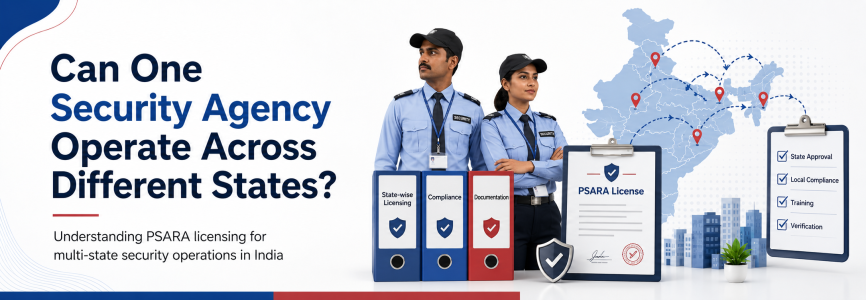



India’s private security industry increasingly serves clients whose operations extend beyond a single city or State. Banks, warehouses, manufacturing companies, hospitals, retail chains, residential projects, logistics businesses and corporate groups may require security personnel at dozens of locations across India. This creates an important compliance question:
Can one private security agency operate across different States under a single PSARA licence?
The short answer is no—a single PSARA licence is not an all-India licence.
A private security company may certainly expand its business into multiple States, but it generally needs to obtain the appropriate PSARA licence separately for each State or Union Territory in which it proposes to provide private security services. The Ministry of Home Affairs (MHA) specifically clarifies that PSARA licences are issued State-wise and may cover one district, multiple districts or the whole State. The licences are granted by the respective Controlling Authorities appointed by State/UT Governments. Therefore, a company having a PSARA licence for Delhi cannot automatically deploy security guards in Haryana, Uttar Pradesh, Maharashtra or Karnataka merely on the strength of its Delhi licence.
What Is a PSARA Licence?
The Private Security Agencies (Regulation) Act, 2005 regulates businesses providing private security services in India. The Act prohibits a person from carrying on or commencing the business of a private security agency without holding the prescribed licence. The licensing framework is administered primarily through the States and Union Territories. Each State or UT has a designated Controlling Authority responsible for processing licence applications and regulating private security agencies operating within its jurisdiction. MHA's official FAQ confirms that Controlling Authorities appointed under State/UT Governments grant PSARA licences. For this reason, PSARA compliance has an important territorial component.
Is There an All-India PSARA Licence?
No. There is currently no single PSARA licence that automatically authorises a private security agency to operate throughout India. MHA specifically answers the question of whether PSARA licences are issued State-wise by stating that they are and that a licence may be obtained for:
- One district;
- A number of districts; or
- The whole State.
Therefore, the licence issued by one State's Controlling Authority does not automatically extend into another State.
Example
Suppose ABC Security Services Pvt. Ltd. obtains a whole-State PSARA licence for Haryana.
The company can operate within Haryana according to the geographical scope of that licence.
If the company later obtains a client contract requiring guards in:
- Delhi;
- Uttar Pradesh;
- Rajasthan; and
- Punjab,
its Haryana licence does not by itself authorise security operations in those four jurisdictions. The company would need to examine and complete the licensing requirements applicable to each additional State/UT.
Can the Same Company Obtain PSARA Licences in Multiple States?
Yes. The restriction is not that a security agency must operate in only one State. The important requirement is that its operations must be properly licensed in each relevant jurisdiction. Therefore, the same company, LLP, partnership or other eligible applicant may seek licences in multiple States, subject to the PSARA eligibility requirements and the rules applicable in each jurisdiction.
In practical terms, a security company may ultimately maintain a licence portfolio such as:
- Delhi PSARA Licence
- Haryana PSARA Licence
- Uttar Pradesh PSARA Licence
- Rajasthan PSARA Licence
- Maharashtra PSARA Licence
- Karnataka PSARA Licence
The corporate entity may remain the same, but the regulatory approvals are State-specific. This distinction is particularly important for security businesses attempting to build a national presence.
Why Is PSARA Licensing State-Wise?
The PSARA framework gives an important role to State Governments and their Controlling Authorities. Although the Private Security Agencies (Regulation) Act, 2005 is Central legislation, licensing and several aspects of implementation are handled at the State/UT level. MHA's official materials identify the State/UT Controlling Authorities as the authorities responsible for granting licences. The Ministry has issued the Private Security Agencies Central Model Rules, 2020, which superseded the earlier 2006 Model Rules. However, applicants must still review the rules, procedures and requirements applicable in the particular State or UT in which they want to operate. This is why a security company should never assume:
“We obtained PSARA once, so we are PSARA compliant everywhere.”
A better approach is:
“In which States do we provide private security services, and do we hold valid licences covering each of those locations?”
District Licence vs Whole-State Licence
Even within one State, geographical coverage must be considered carefully. Under the PSARA Act, the statutory licence fee depends on the operational area.
MHA currently states the following fees:
- 5,000 – licence for one district;
- 10,000 – licence for more than one but up to five districts;
- 25,000 – licence for the whole State.
This has an important commercial impact.
A business intending to serve only one district may initially seek the limited geographical licence available under the applicable framework. However, a company planning to provide guards throughout the State may find a whole-State licence more appropriate.
Practical Example
A security agency obtains a licence for operations only in one eligible district. Six months later, it signs contracts in several additional districts. Before starting those deployments, the agency should verify whether its existing licence covers the new areas and complete the necessary regulatory action if it does not. The commercial team should therefore coordinate with the compliance team before signing multi-location contracts.
How Multi-State PSARA Licensing Works
A company expanding across States should generally approach licensing as a separate compliance project for each State.
Step 1: Identify the States Where Services Will Be Provided
Start with an operational map.
List every State and UT where the company:
- Already deploys guards;
- Has signed contracts;
- Is bidding for contracts; or
- Plans to commence operations.
This exercise helps management understand its real licensing exposure.
Step 2: Check the Existing Licence Scope
Review each PSARA licence already held.
Check:
- State/UT;
- District coverage;
- Licence number;
- Date of issue;
- Expiry date; and
- Licence conditions.
Do not rely only on an internal statement such as “PSARA available.” The actual geographical scope matters.
Step 3: Review the Applicable State Rules
State-specific requirements can differ. The Central Model Rules provide a broad framework, but the application should be prepared according to the current requirements of the relevant Controlling Authority.
Possible differences can relate to:
- Application documentation;
- Affidavits;
- Office requirements;
- Police verification;
- Training arrangements;
- Online filing procedures;
- Supporting certificates; and
- Local procedural requirements.
A checklist prepared for one State should therefore not automatically be copied for another.
Step 4: Establish Appropriate Operational Arrangements
The applicant should ensure that it can genuinely operate and supervise services within the State. Depending on the applicable State requirements, documents relating to the business premises or operational establishment may form part of the application and verification process. The 2020 Central Model Rules permit the Controlling Authority to verify the premises declared by the private security agency. Security agencies expanding nationally should therefore build real operational infrastructure instead of maintaining licences merely on paper.
Step 5: Arrange Training Compliance
Training is a major component of PSARA. The Act and Rules require prescribed training of private security guards and supervisors, and MHA has also introduced an SOP concerning recognition/licensing of training institutes by State/UT Controlling Authorities. A multi-State agency should determine how training obligations will be fulfilled in every jurisdiction where guards are recruited or deployed. The organisation should maintain consistent central standards while also satisfying State-specific regulatory requirements.
Step 6: Complete Antecedent Verification
PSARA licensing involves verification of applicants' antecedents. MHA states that licences are issued after the Controlling Authority verifies the antecedents of applicants and/or makes such inquiries as considered necessary.
Companies applying across several States should therefore maintain updated documentation relating to:
- Directors;
- Partners;
- Proprietors;
- Relevant shareholders;
- Authorised representatives; and
- Other persons required under the applicable rules.
Inconsistent information across State applications can create unnecessary complications.
Step 7: File Separate State Applications
MHA confirms that PSARA applications can be made through the Private Security Agency Licensing Portal, although implementation and processing remain linked with the relevant State/UT authorities. Each required State application should be treated independently. Receiving approval in one State does not guarantee automatic approval in another.
Can Guards Be Deployed to Another State Under an Existing Licence?
This should be approached carefully. A security agency cannot avoid State-wise licensing simply by arguing that its security guards are employees of a company licensed elsewhere. The relevant issue is where the agency is carrying on the business of providing private security services. If it undertakes a security contract and deploys personnel in another State, the business should ensure that it holds the licence required for operations in that jurisdiction.
Example
A Gurgaon-based security company holds a Haryana PSARA licence.
A corporate client asks it to deploy:
- 30 guards in Gurugram; and
- 20 guards at the client's Noida office.
The Haryana licence may cover the Gurugram deployment if it has the appropriate territorial scope. However, Noida is in Uttar Pradesh. The company should therefore ensure that its Uttar Pradesh operations are covered by an appropriate UP PSARA licence before providing the service there.
What About a Client with a Pan-India Contract?
National contracts are common in organised security services. A bank, retail chain, logistics company or manufacturing group may prefer to appoint one agency to manage hundreds of locations throughout India. Commercially, one master service agreement may be possible. Regulatorily, however, the security agency must examine the licence requirements in every State where the contract will be performed.
Therefore:
One client contract does not equal one PSARA licence.
The agency may need multiple State licences supporting the same national commercial agreement. This should be considered during tendering itself.
A security company should avoid winning a nationwide contract at a price that does not account for:
- Multi-State licence applications;
- Training compliance;
- Local supervision;
- State offices or infrastructure where required;
- Renewals;
- Police verification;
- Documentation; and
- Compliance manpower.
Does a Branch Office Automatically Create PSARA Permission?
No. Registering a branch office, GST location or other business establishment in a State does not by itself replace a PSARA licence. Corporate registration and security-sector licensing serve different purposes. A company may have a valid office, GST registration and employees in a State but still need the applicable PSARA approval before carrying on private-security-agency business there. Likewise, holding a PSARA licence does not eliminate other applicable employment, tax, labour or local-business compliances.
Can a Franchise Use the Parent Company's PSARA Licence?
Businesses should be very cautious with this model. A PSARA licence is granted to the licensed applicant under the statutory. An independent franchisee or unrelated legal entity should not assume that it can lawfully operate merely by displaying the licence issued to the brand owner or another company. Where multiple entities are independently providing security services, the licensing position of each legal entity and jurisdiction should be examined separately.
The underlying question is:
Which legal entity is actually contracting with the client and providing the security service?
That entity should have the regulatory authority required for the operation.
PSARA Licence Validity and Renewal for Multi-State Agencies
MHA's official FAQ states that a PSARA licence is valid for five years. It further states that renewal should be applied for to the Controlling Authority not less than 45 days before the expiry date of the existing licence. For an agency holding licences across several States, renewal management can become complicated.
For example:
|
State |
Licence Expiry |
|
Delhi |
March 2027 |
|
Haryana |
June 2027 |
|
Rajasthan |
October 2027 |
|
Uttar Pradesh |
January 2028 |
Missing even one renewal can create a regulatory problem for operations in that State. Multi-State agencies should therefore maintain a central PSARA compliance calendar with advance reminders.
Importance of Centralised Compliance Management
As a private security agency expands, compliance should become more centralised—not less. A national security company should maintain a master register containing:
- State name;
- Controlling Authority;
- Licence number;
- Licence scope;
- Issue date;
- Expiry date;
- Renewal deadline;
- Branch details;
- Training arrangements;
- Responsible compliance officer;
- Relevant client locations.
This gives management visibility across the organisation. It also prevents a sales team from accidentally commencing operations in an unlicensed State.
Consequences of Operating Without the Required PSARA Licence
Operating a private security agency without the required licence can expose the business to regulatory consequences under the PSARA Act. Section 4 establishes the fundamental prohibition against carrying on private security agency business without a licence. Apart from statutory consequences, unlicensed operations can also create major commercial risks.
Clients may:
- Terminate contracts;
- Withhold payments;
- Disqualify the agency from tenders;
- Demand compliance evidence;
- Report the matter to authorities; or
- Refuse future empanelment.
For large agencies, the reputational consequences may exceed the direct licensing cost.
Multi-State Expansion Strategy for Security Agencies
A growing security business should not apply randomly for licences across India. Instead, licence expansion should follow commercial demand.
A practical approach may be:
Phase 1 – Home State
Obtain a whole-State licence and establish strong operations.
Phase 2 – Neighbouring States
Expand into States where clients already have requirements.
Phase 3 – Major Commercial Markets
Consider high-demand markets based on the company's target industries.
Phase 4 – National Coverage
Develop a coordinated compliance network covering strategic States and UTs. This approach can prevent unnecessary licensing expenditure while ensuring licences are available where business opportunities exist.
Role of Compliance Calendar LLP in Multi-State PSARA Licensing
Managing one PSARA application can involve significant documentation. Managing applications across several States requires considerably greater coordination.
Compliance Calendar LLP can assist security agencies with:
- Multi-State PSARA licensing strategy;
- State-wise applicability review;
- Licence-scope assessment;
- Application documentation;
- Director and entity documents;
- Training arrangement guidance;
- Police-verification documentation;
- State-specific application support;
- Compliance deficiency responses;
- Licence renewals;
- Expansion into additional States; and
- Centralised PSARA compliance planning.
For agencies pursuing nationwide security contracts, planning the licence roadmap before submitting commercial bids can reduce regulatory and operational risk.
Conclusion
A private security agency can operate across multiple States in India, but it cannot generally do so under one PSARA licence. The PSARA is State-oriented. MHA expressly confirms that licences are issued State-wise and can cover one district, several districts or the whole State. The relevant State/UT Controlling Authority grants the licence. Therefore, a security agency licensed in one State should not assume that the same licence permits operations elsewhere. The same legal entity can expand into several States, but it should obtain the required PSARA approvals for each jurisdiction and comply with the relevant State-specific rules. For growing agencies, the best strategy is to integrate licensing with business expansion. Before signing a new contract, ask:
Where will the guards actually be deployed?
If the answer includes a State in which the agency is not appropriately licensed, PSARA compliance should be addressed before services begin. For professional assistance with multi-State PSARA licensing, new applications, renewals and State-wise compliance, businesses can connect with Compliance Calendar LLP.
FAQs
Q1. Can one PSARA licence be used throughout India?
Ans. No. PSARA licences are issued State-wise. MHA confirms that a licence may cover one district, multiple districts or the whole State, but it does not automatically authorise operations in other States.
Q2. Can the same company obtain PSARA licences in several States?
Ans. Yes. An eligible company or other applicant can seek licences in multiple States. Separate applications must generally be made before the respective State/UT Controlling Authorities and the applicable State requirements must be satisfied.
Q3. If I have a Delhi PSARA licence, can I provide guards in Haryana?
Ans. Not merely on the basis of the Delhi licence. Since licences are State-wise, the agency should obtain appropriate licensing for its Haryana operations before providing covered private security services there.
Q4. Is there any national or all-India PSARA licence?
Ans. No single all-India licence is provided under the present PSARA licensing structure. Agencies seeking nationwide operations generally need a portfolio of State/UT licences.
Q5. What is the fee for a whole-State PSARA licence?
Ans. MHA currently states that the statutory licence fee is ?25,000 for the whole State, ?10,000 for more than one but up to five districts, and ?5,000 for one district. Additional professional or compliance costs are separate.
Q6. Are PSARA requirements exactly the same in every State?
Ans. No. The Central Act provides the overall framework, and MHA has issued Central Model Rules, but applicants should check the rules and procedural requirements applicable in each State or UT.
Q7. Can guards employed in one State be transferred to another State?
Ans. Employment transfer alone does not remove the agency's licensing obligation. If the agency provides private security services in another State, it should ensure that its business operations there are covered by the required State/UT PSARA licence.
Q8. How long is a PSARA licence valid?
Ans. According to MHA's official FAQ, a PSARA licence is valid for five years. Renewal should ordinarily be applied for not less than 45 days before expiry.
Q9. Can one security agency take a pan-India client contract?
Ans. Yes, commercially one agency may contract with a client having locations across India. However, the agency should hold the appropriate PSARA licence for each State or UT where it actually provides private security services.
Q10. Can Compliance Calendar LLP assist with PSARA licences in multiple States?
Ans. Yes. Compliance Calendar LLP can assist with State-wise licensing strategy, documentation, applications, training-related requirements, renewals and compliance planning for private security agencies expanding across multiple jurisdictions.


_crop10_thumb.jpg)


_crop10_thumb.jpg)


-Form_crop10_thumb.jpg)

_crop10_thumb.jpg)


_learn_crop10_thumb.jpeg)


_crop10_thumb.jpg)

_crop10_thumb.jpg)


_crop10_thumb.jpg)





_for_Foreign_Directors_learn_crop10_thumb.jpeg)


_Act,_2015_learn_crop10_thumb.jpg)










_learn_crop10_thumb.jpg)




































_crop10_thumb.jpg)


_crop10_thumb.jpg)
_(1)_crop10_thumb.jpg)









_crop10_thumb.png)











_crop10_thumb.jpg)


_crop10_thumb.jpg)







_crop10_thumb.png)

_crop10_thumb.jpg)








_crop10_thumb.png)