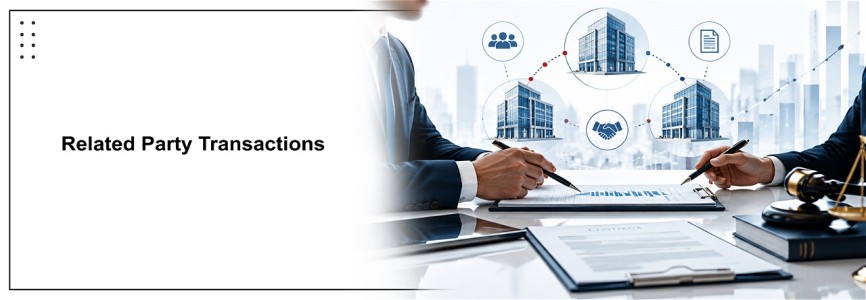



Related Party Transactions are a part of business and are also an important area of compliance under the Companies Act, 2013. In the course, companies often enter into transactions with directors, promoters, key managerial personnel (KMPs), their relatives, group companies, subsidiaries, associate companies and other connected entities.
Related Party transactions are not prohibited, provided the company has carried in accordance with the applicable provision. However, the company should enter into such transactions with due care because the RPT may create conflict of interest. Companies Act, 2013 has prescribed rules relating to the approval, disclosure and reporting of related party transactions, to ensure transparency interests of the company and its stakeholders.
To ensure transparency to these transactions and protect the interests of the company and its stakeholders, the Companies Act, 2013 provides a framework covering their identification, approval and disclosure. From a practical compliance perspective, companies shall consider the requirements of Sections 177, 184 and 188, along with Section 134 and the relevant Rules there to, while entering into RPT and preparing annual financial statements and Board’s Report.
What is a Related Party Transaction?
A Related Party Transaction (RPT) is a transaction entered between a company as defined under Section 2(76) of the Companies Act, 2013. This can include transactions with the company’s directors, KMPs, their relatives, holding or subsidiary companies, associate companies, fellow subsidiaries, or other entities where the company’s directors or their relatives have a interest. Therefore, before entering into such transaction, the company should first identify whether the other party is a related party and then accordingly check the applicable provision and disclosure requirements.
Identifying the company’s related parties should be the starting point of the RPT compliance process. Once the related parties have been identified, the company should review its transactions during the financial year to determine whether any of them fall under the provision of RPT or not.
Therefore, the first step for any company is to identify all its related parties. Once the related parties is identified, the company should review its books and records to identify all transactions with those parties during the financial year. This review should not be limited only to major transactions; even routine dealings such as purchases, sales, rent, consultancy fees, service arrangements, reimbursements or other payments may need to be considered. This initial exercise helps the company determine which transactions require approval, which need to be disclosed, and which may have to be reported in Form AOC-2.
Transactions Covered under Section 188
Section 188 of the Companies Act, 2013 mainly deals with transactions entered into by a company with its related parties. It covers common business dealings such as buying or selling goods or materials, or purchasing or selling property from or to a related party. It also includes leasing of property, so arrangements such as rent paid to or received from a related party should also be checked from an RPT compliance perspective. In short, whenever a company enters into these types of transactions with a related party, it should carefully review the applicable requirements under Section 188.
Further, Section 188 covers transactions relating to the availing or rendering of services. Therefore, management consultancy, professional services, technical services, administrative services or other similar arrangements entered into with related parties should be reviewed for compliance. The section also covers the appointment of a related party to any office or place of profit in the company, its subsidiary company or associate company. In addition, the underwriting of securities or derivatives of the company by a related party is also covered within the scope of Section 188.
Accordingly, companies should not limit their RPT review only to purchases and sales. Transactions such as rent, consultancy fees, management fees, service arrangements, appointment-related payments and underwriting arrangements may also require consideration under the related party provisions.
Role of Section 177 – Audit Committee in RPT
Section 177 of the Companies Act, 2013 is relevant to companies that are required to constitute an Audit Committee. One of the important functions of the Audit Committee is to approve or modify transactions of the company with related parties.
Therefore, before entering into an RPT, the company should determine whether the transaction requires approval or review by the Audit Committee. For recurring transactions, an omnibus approval may also be considered where permitted under the applicable provisions and subject to the prescribed conditions. The Audit Committee should also periodically review related party transactions and ensure that transactions are being undertaken in accordance with the approved terms and applicable legal requirements.
Role of Section 184 – Disclosure of Interest by Directors
Section 184 deals with the disclosure of interest by directors. Every director is required to inform the company about their interest in other companies, firms, bodies corporate or associations, as required under the law. If a director has a direct or indirect interested in a transaction, the director must disclose that interest and follow the applicable rules regarding participation in the meeting.
For instance, if a company plans to purchase goods from another company in which one of its directors has an interest, that connection should be disclosed before the Board considers the transaction. This helps ensure that the Board is aware of the director's interest and that the decision is taken transparently. Section 184 is mainly about disclosing the director's interest, while Section 188 deals with the company's transactions or arrangements with related parties.
Section 134 – Disclosure in the Board’s Report
Section 134 becomes important when the company prepares its annual Board’s Report. The company is required to provide details of the relevant contracts or arrangements entered into with related parties as covered under Section 188(1). These particulars are required to be disclosed in the prescribed format, i.e., Form AOC-2, wherever applicable. Therefore, while finalising the annual accounts and Board’s Report, the company should carefully review its related party transactions to ensure that all the required disclosure have been properly made.
The prescribed form for this purpose is Form AOC-2.
At the time of preparing the annual financial statements and Board's Report, the company should conduct a detailed review of its related party transactions and determine which transactions are required to be disclosed in AOC-2.
Transactions Should Be Reported in Form AOC-2?
Form AOC-2 broadly requires disclosure of specified related party contracts and arrangements under two categories. The first category relates to contracts or arrangements with related parties that are not at arm's length. Where a related party transaction is not undertaken on an arm's-length basis, the relevant particulars should be considered for disclosure in Part A of Form AOC-2.
The second category relates to material contracts or arrangements with related parties that are at arm's length. Accordingly, the fact that a transaction is at arm's length does not automatically mean that it can be ignored for AOC-2 purposes. The company should separately evaluate whether the transaction falls within the materiality requirements applicable to Part B of Form AOC-2. This distinction is extremely important because approval requirements and disclosure requirements are not always the same.
Ordinary Course of Business and Arm's-Length Transactions
One of the most common misconceptions regarding RPT compliance is that if a transaction is undertaken in the ordinary course of business and at arm's length, there is no requirement to consider it for any RPT disclosure. The company should instead conduct a separate analysis. The fact that a transaction qualifies for the exception under Section 188 in respect of approval requirements does not necessarily mean that the company can disregard all other disclosure obligations.
For example, suppose a company takes an office premises on rent from a promoter-group entity. If the rent is commercially reasonable and the arrangement is in the ordinary course of business, the company should still examine:
For example, if a company takes a property on rent from another entity, it should not simply treat it as a normal rental expense. The company should first check whether the landlord qualifies as a related party and then determine whether the requirements of Section 177, Section 184 and Section 188 are applicable. It should also examine whether the transaction has been entered into at arm’s length and in the ordinary course of business, and whether it falls within the applicable materiality criteria. In addition, the company should check whether the transaction needs to be disclosed in the financial statements and whether it is required to be reported separately in Form AOC-2. This kind of step-by-step review helps ensure that all related party compliance requirements are properly addressed.
Another important point is that AOC-2 should not be confused with related party disclosures in the notes to the financial statements.
The applicable accounting standards, such as Ind AS 24 or AS 18, may require disclosure of related party transactions and balances in the financial statements. These disclosures may include purchases, sales, remuneration, rent, services, loans, advances, outstanding balances and other transactions.
However, disclosure of a transaction in the financial statements does not automatically mean that the requirements relating to AOC-2 have been fulfilled.
The company should therefore separately review:
Books of Account → Related Party Transactions → Financial Statement Disclosure → AOC-2 → Board's Report
All these records should be properly reconciled.
Practical Examples of Transactions That Should Be Reviewed
A company should pay particular attention to transactions such as purchases from promoter-group companies, sales to subsidiaries or associate companies, rent paid to directors or their relatives, consultancy or professional fees paid to related parties, management fees, reimbursement of expenses, loans and advances, purchase or sale of property, service arrangements and other recurring transactions.
For instance, if a company pays Rs.50 lakh as rent during the year to an entity controlled by a director's relative, the company should not simply classify it as “rent expense” and close the matter. The transaction should first be examined from the related party perspective and then assessed under Sections 177, 184 and 188, as applicable, along with the relevant financial statement and AOC-2 requirements.
Case Study – ROC Penalty for Non-Disclosure in AOC-2
The importance of proper AOC-2 disclosure can be seen from ROC adjudication proceedings involving companies that failed to disclose related party transactions in the prescribed form. In the case of SDU Projects Private Limited, the ROC Karnataka examined the company's related party transactions and noted that certain transactions had not been disclosed in Form AOC-2 attached to the Board's Report. The company argued, among other things, that the transactions were undertaken in the ordinary course of business and at arm's length.
The ROC, however, considered the disclosure requirements separately from the question of whether the transaction required approval under Section 188. An aggregate penalty of Rs.8 lakh was imposed on the company and its officers for the relevant non-compliance. The case provides an important practical lesson for companies: a conclusion that an RPT is at arm's length or in the ordinary course of business should not, by itself, be treated as a conclusion that no AOC-2 disclosure is required.
Another reported matter involving Bluemax Capital Solution Private Limited concerned related party transactions that were reflected in the company's financial information but were not appropriately disclosed through AOC-2 in the Board's Report. The reported penalty was approximately Rs.4.5 lakh. These cases highlight the importance of ensuring consistency between the company's books, financial statements, Board's Report and Form AOC-2.
Practical RPT Compliance Checklist
Before finalising the financial statements and Board’s Report, a company should carry out a proper review of all related party transactions rather than treating AOC-2 as a routine year-end formality. The process should ideally begin with preparing a complete list of all related parties of the company, including directors, key managerial personnel (KMPs), their relatives, holding companies, subsidiaries, associate companies, fellow subsidiaries and other entities covered under the Companies Act, 2013.
Once the related parties have been identified, the company should review its books of accounts and identify all transactions carried out with these parties during the financial year. This exercise should cover not only purchases and sales but also rent, consultancy and professional fees, service arrangements, remuneration, loans, advances, guarantees, reimbursements and other payments or receipts. It is important to look beyond the obvious transactions because some RPTs can easily get missed when they are recorded under normal business expense or income heads.
After identifying the transactions, the company should examine each transaction to determine whether it falls within the categories specified under Section 188 of the Companies Act, 2013. At the same time, the company should check whether the transaction required review or approval by the Audit Committee under Section 177 and whether any director had a direct or indirect interest requiring disclosure under Section 184. At this stage, the company should also look at whether the transaction is being carried out in the normal course of its business and at a fair market price, i.e., on an arm’s-length basis. This is important because these factors can determine what kind of approvals and compliances may apply to the transaction. After this, the company should check whether the transaction requires any additional approval, such as approval from the shareholders, under the applicable provisions of the Companies Act, 2013. Once the approval requirements have been checked, the company should separately consider the disclosure requirements under the applicable accounting standards and ensure that the related party transactions and outstanding balances are appropriately reflected in the notes to the financial statements.
Finally, the company should carry out a specific review for Form AOC-2. The fact that a transaction is already disclosed in the financial statements should not be taken as automatically satisfying the AOC-2 requirement. The company should independently determine whether the transaction is required to be reported in AOC-2 and, where applicable, provide the necessary particulars. Before filing the financial statements and Board’s Report, it is good practice to reconcile the books of accounts, related party disclosures, Board’s Report and Form AOC-2 so that there is no inconsistency between the different documents.
Conclusion
Related Party Transactions are not limited to large or unusual transactions. It is important to understand that related party transactions are not limited to large or unusual dealings. Even routine business transactions, such as purchases and sales, payment of rent, consultancy or professional fees, service arrangements, reimbursements and other payments made to related parties can fall within the scope of the RPT provisions under the Companies Act, 2013.
The Companies Act, 2013 addresses different aspects of these transactions through various provisions. Section 177 mainly deals with the role of the Audit Committee, while Section 184 focuses on disclosure of interest by directors and Section 188 deals with specified contracts and arrangements with related parties. In addition, Section 134, read with the applicable Rules, requires the relevant related party transactions to be disclosed in the Board’s Report through Form AOC-2. Therefore, companies should look at RPT compliance as a complete process—from identifying the transaction and obtaining the required approvals to making the necessary disclosures in the financial statements and Board’s Report.


_crop10_thumb.jpg)


_crop10_thumb.jpg)


-Form_crop10_thumb.jpg)

_crop10_thumb.jpg)


_learn_crop10_thumb.jpeg)


_crop10_thumb.jpg)

_crop10_thumb.jpg)


_crop10_thumb.jpg)




_for_Foreign_Directors_learn_crop10_thumb.jpeg)


_Act,_2015_learn_crop10_thumb.jpg)










_learn_crop10_thumb.jpg)





















_crop10_thumb.jpg)
_crop10_thumb.jpg)
_(1)_crop10_thumb.jpg)





_crop10_thumb.png)




_crop10_thumb.jpg)


_crop10_thumb.jpg)





_crop10_thumb.png)
_crop10_thumb.jpg)



_crop10_thumb.png)