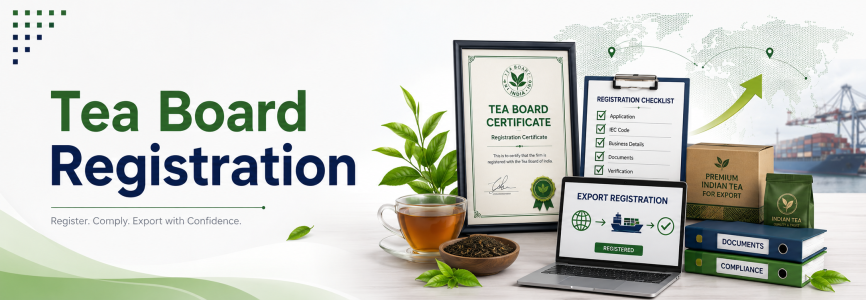



India’s tea industry is regulated more closely than many ordinary trading businesses. A person planning to export tea cannot simply obtain an Importer-Exporter Code, find an overseas buyer and dispatch the shipment. The business must also identify the correct Tea Board licence, complete the online application and comply with quality, packaging, return-filing and shipment-level requirements.
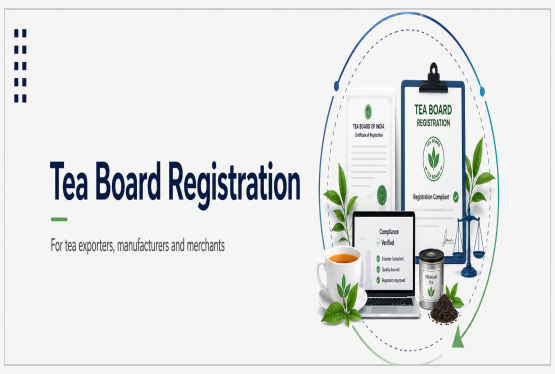
The expression Tea Board Registration is often used broadly, but Tea Board India issues several different licences and certificates. These include the Tea Exporter Licence, Permanent Exporter Licence, Registration-cum-Membership Certificate, buyer registration, warehouse licence, flavoured-tea registration and manufacturing-unit registration.
For a business intending to export tea from India, the most important approval is the Tea Exporter Licence issued under the Tea Act, 1953 and the Tea (Distribution and Export) Control Order, 2005. An exporter may separately require an RCMC for Foreign Trade Policy benefits and other registrations depending on whether it manufactures, blends, stores, packages, imports or sells flavoured tea.
What Is Tea Board Registration?
Tea Board Registration refers to the registration or licensing of businesses engaged in regulated activities connected with tea. Tea Board India was established under Section 4 of the Tea Act, 1953 as a statutory body responsible for regulating and developing the Indian tea industry. Its legal functions extend to tea production, marketing, quality, distribution and export.
A new applicant must therefore begin by identifying the exact activity it proposes to undertake. The licence required by a tea exporter is different from the registration required by a tea buyer, warehouse operator, manufacturer or importer.
Tea Exporter Licence
A Tea Exporter Licence allows an eligible person, firm, company, corporate body, cooperative society or association to carry on the business of exporting tea from India. Tea Board’s official material confirms that anyone intending to export tea outside India must obtain the appropriate licence.
The licence is issued electronically through Tea Board’s eGICCS portal. It is a statutory business licence and should not be confused with a simple membership certificate.
Permanent Exporter Licence
A regular exporter may eventually qualify for conversion of the exporter licence into a Permanent Exporter Licence. The Tea (Distribution and Export) Control Order provides that the exporter should have complied with the Tea Act, Tea Rules, Tea Board Bye-Laws and applicable control orders.
The principal order also requires an export volume of at least 1,00,000 kilograms annually during each of the preceding three years. Once granted, the permanent licence remains valid unless it is suspended or cancelled.
Registration-cum-Membership Certificate
An RCMC records the exporter’s membership with the Tea Board for Foreign Trade Policy purposes. It may be relevant when the exporter seeks specified benefits, concessions or authorisations under the FTP.
Tea Board’s published checklist for a new RCMC requires the prescribed application in Appendix 19A and 19B, the applicant’s IEC and payment of the applicable online fee. The exporter should not assume that the RCMC alone replaces the statutory Tea Exporter Licence.
Is Tea Board Registration Mandatory for Exporters?
Yes, a valid Tea Exporter Licence is a legal requirement for exporting tea from India. Section 17 of the Tea Act provides that no tea may be exported unless it is covered by a licence issued by or on behalf of the Tea Board.
Section 18 further restricts the shipment or export of tea unless the owner delivers the required valid licence or permit to the Customs authority. These provisions place the Tea Board licence at the centre of the legal export process rather than treating it as an optional trade membership.
The Licence Must Exist Before Export
A business should complete the Tea Board application before arranging its commercial shipment. An IEC by itself does not authorise the business to export tea where the Tea Act and the applicable Control Order require a Tea Board licence. Export documentation, Customs procedures and shipment-level clearances should be planned only after confirming that the exporter licence is active and accurately records the applicant’s current details.
Tea Seed Requires Separate Permission
The Tea Act distinguishes between tea and tea seed. Tea exports require a licence issued by or on behalf of the Board, while tea seed exports require a permit issued by or on behalf of the Central Government. Businesses exporting planting material, roots, cuttings, buds or other propagating portions of the tea plant should therefore not rely on an ordinary tea exporter licence without checking the specific permit requirement.
Key Laws Governing Tea Board Registration
Tea Board Registration is governed by a combination of the Tea Act, subordinate rules and control orders. Applicants must consider the Tea Act, 1953, the Tea Rules, 1954 and the Tea (Distribution and Export) Control Order, 2005. The Foreign Trade Policy, Customs law, food-safety regulations and destination-country standards may also apply. Registration with Tea Board does not remove the exporter’s obligations under these separate laws.
Tea Act, 1953
The Tea Act provides the principal statutory structure for controlling the Indian tea industry. Section 4 establishes Tea Board India, while Sections 17 and 18 deal specifically with export licensing and shipment restrictions. Sections 34 and 35 empower authorised officers to inspect premises, books and records and permit the Board to call for returns relating to production, stock, sale and export.
Tea Rules, 1954
The Tea Rules contain procedural and administrative provisions made under the Tea Act 1954. They should be read with the Act and subsequent control orders, circulars and directions issued by Tea Board. Applicants must also comply with the forms, fees and conditions prescribed by the licensing authority through the current online system.
Tea (Distribution and Export) Control Order, 2005
The 2005 Control Order defines an exporter as a person, firm, company, corporate body or cooperative society engaged in exporting tea, including imported tea exported outside India. It establishes the licensing authority, application system, quality standards, packaging duties and grounds for suspension or cancellation.
The Order covers green tea, instant tea and value-added products such as packet tea, tea bags, flavoured tea, quick-brewing black tea and ready-to-drink tea falling within its definition.
Who Can Apply for a Tea Exporter Licence?
A proprietorship, partnership firm, LLP, company, corporate body, cooperative society or another eligible association may apply. The applicant must operate through a legally identifiable business and hold an IEC issued by DGFT. The name and address recorded in the IEC should match the particulars entered in the Tea Board application. Address inconsistencies are particularly important because Tea Board’s document checklist specifically requires the IEC address to correspond with Form A.
Merchant Exporter
A merchant exporter purchases tea from gardens, factories, auction buyers or other lawful suppliers and exports it in its own name. Such an exporter does not necessarily have to own a tea garden or manufacturing unit merely to obtain the exporter licence.
However, it must procure tea through lawful channels and maintain complete purchase, stock, quality and export records.
Manufacturer Exporter
A manufacturer exporter manufactures, processes, blends, packs or produces tea through its own or authorised facility. Depending on the activity, separate manufacturing-unit registration, warehouse licensing, FSSAI licensing or flavoured-tea registration may also apply.
An exporter licence does not automatically approve the manufacturing or warehousing premises from which the tea is processed or packed.
Documents Required for Tea Exporter Registration
Tea Board’s official supporting-document checklist for a new exporter licence is concise. Each document must be self-attested and carry the seal of the applicant business where applicable. Applicants should nevertheless review the live eGICCS upload fields because additional information or clarification may be sought according to the applicant’s constitution and business activity.
Form A
The applicant must submit the prescribed Form A, duly completed and signed with the date and business seal. It should be signed by the proprietor, partner or director, depending on the constitution of the applicant. All information should be verified before signing because the application includes declarations regarding compliance with the Tea Act and applicable Control Orders.
Importer-Exporter Code
A copy of the IEC issued by DGFT must be uploaded. The address appearing in the IEC should match the address entered in Form A. Where the eGICCS system displays a null IEC authentication result, Tea Board’s FAQ directs the applicant to raise a helpdesk ticket and attach the IEC certificate along with the eGICCS user ID.
Application Fee
The applicable fee must be paid online through the Tea Board portal. The current published fee for a new Tea Exporter Licence is ?2,800 plus 18% GST, making the total ?3,304. The current fee schedule provides a five-year validity for both new and renewed exporter licences. A Permanent Exporter Licence also carries a fee of ?2,800 plus GST and has lifetime validity, subject to suspension or cancellation.
How to Apply for Tea Board Registration Online
The application is filed through Tea Board India’s eGICCS portal. The system is used for licence applications, registrations, supporting-document uploads, online payments, clarification responses, application tracking and downloading approved certificates. The process is electronic, but applicants must print, sign, scan and re-upload the completed application form before final acknowledgement is generated.
Step 1: Create an eGICCS Account
Open the Tea Board online licensing portal and select the sign-up option. Enter the applicant’s name, organisation details, address, email, mobile number, proposed user ID and password. An OTP is sent to the registered email address and mobile number. The account becomes available for further processing after both authentication requirements are completed.
Step 2: Select Licence or Registration
Log in with the newly created credentials and open the licence or registration section. Accept the prescribed undertaking and select the state connected with the applicant’s business. Choose Tea Exporter Licence as the application category. Selecting RCMC, buyer registration or another category will not result in the statutory exporter licence.
Step 3: Enter the Applicant’s Details
Enter the legal name, business constitution, address, contact details, IEC particulars and other information requested by the selected application category. The information should correspond with the applicant’s legal and DGFT records. Applicants should avoid using shortened trade names or outdated addresses that do not appear in the IEC.
Step 4: Upload the Supporting Documents
Prepare a separate PDF file for each supporting document. Upload the completed Form A, IEC and other documents requested by the portal. Files should be readable and should show every relevant page, signature, date and business seal. Tea Board’s FAQ specifically instructs users to create separate scanned PDF files for individual supporting documents.
Step 5: Pay the Online Fee
Pay the application fee through credit card, debit card or net banking. Preserve the transaction receipt, application reference number and proof of debit. Where payment is debited but remains unverified on the portal, the applicant should raise a helpdesk ticket and attach the bank statement and application reference number.
Step 6: Print, Sign and Re-upload the Form
After completing the online information and payment, print the generated application form. The authorised proprietor, partner or director should sign and seal the form. Scan the signed document and upload it to the portal. Once this step is completed, the system generates an acknowledgement and application reference number.
Step 7: Track the Application
Application status can be checked after logging in and opening the License Management module. The applicant should use the search function to review whether the application is under scrutiny, awaiting clarification or approved. Tea Board sends email and SMS updates at stages including submission, scrutiny, clarification, inspection, acceptance and licence generation.
Step 8: Respond to Clarification
Where the authority identifies incomplete or inconsistent information, the application is placed under the clarification section. The applicant must answer the observation and upload corrected records through the eGICCS portal. Tea Board’s FAQ states that a clarification may remain available for response for the applicable 90- or 120-day period. Failure to respond can result in automatic rejection, after which a fresh application may be required.
Step 9: Download the Approved Licence
After approval, log in to the License Management module and open the completed-application section. Search for the approved application and use the view or download option to obtain the digitally issued licence. The business should verify its name, address, licence number, issue date and expiry date immediately after downloading it.
Validity and Renewal
The current Tea Board fee schedule gives an exporter licence a validity of five years. This reflects the Tea Board’s 2021 regulatory-compliance circular, which enhanced the earlier three-year validity period to five years for both fresh and renewed licences. Renewal should be completed before the licence expires. The eGICCS portal displays an alert approximately 30 days before expiry, and payment of the renewal fee enables auto-renewal on the expiry date. If the fee is not paid before expiry, the licence expires automatically and cannot be revived through ordinary renewal. The exporter must then submit a fresh application and may receive a new licence number.
Changes After Registration
The exporter licence is personal to the licensee and cannot be sold or transferred. If the licensed business is sold or transferred, the purchaser or transferee must obtain a fresh licence. Where a licensee enters into a partnership, the change must be reported to the Licensing Authority within 30 days and the licence must be suitably amended. Dissolution of a partnership must also be reported within 30 days.
If any other application particulars are proposed to be changed, the licensee must intimate the authority at least 15 days in advance and obtain an amendment. The Control Order provides that such an amendment is made without a fee and remains valid for the unexpired portion of the original licence.
Compliance After Receiving the Licence
Obtaining the exporter licence does not complete the legal process. The exporter must comply with quality standards, packaging requirements, record maintenance, returns and directions issued by the Licensing Authority. The business should maintain purchase records, stock registers, invoices, export contracts, shipping bills, packing details, test reports and buyer communications.
Packing and Marking
Tea containers must display the particulars specified by the Licensing Authority and should be packed and sealed in a manner that reveals tampering. Bulk-export packaging must also comply with applicable standards or buyer-agreed specifications where the Control Order permits such arrangements.
False or misleading statements concerning origin, quality or composition should not be placed on the label or container.
Quality of Tea
The Control Order prohibits the export of adulterated tea, tea that does not meet the prescribed specifications or tea carrying false or misleading claims. Where the importing country or foreign buyer prescribes a stricter specification, the more stringent requirement may become relevant.
Tea Board may inspect consignments, take samples and call for export contracts or other supporting records.
Imported Tea Re-exported from India
Imported tea intended for export must be exported within six months from its import into India. The Control Order also requires a minimum value addition of 50% for the export of imported tea. The exporter must maintain evidence of the imported tea’s CIF value, exported tea’s FOB value, processing, blending, packaging and final destination.
Export Returns
Tea Board has statutory power to require exporters and other industry participants to furnish returns relating to production, purchase, stock, sale and export. Tea Board’s online system includes a Returns Management module for filing the applicable e-returns. Registered exporters should assign responsibility for timely and accurate return filing instead of waiting for a specific notice from the Board.
Export Clearance Certificate
Tea Board’s current fee structure states that the clearance certificate for tea export is issued without a fee. The certificate is obtained through the Tea Council portal rather than through the ordinary exporter-licence application screen. The exporter may need separate access credentials for that portal and should check the shipment-level requirement before dispatch.
Other Registrations That May Be Required
A Tea Exporter Licence does not replace IEC, GST registration, FSSAI licensing, Customs registration, LUT or tax-payment requirements. These approvals arise under different laws and depend on the applicant’s business and transactions.
A manufacturer may require manufacturing-unit registration, while a business storing, blending or packing tea may need a Tea Warehouse Licence. Flavoured tea requires a separate registration process and test reports from an eligible Tea Board-enlisted NABL-accredited laboratory.
Buyer registration may be required for purchasing tea as a primary buyer from manufacturing units or public auctions. Tea importers require the applicable distributor or import-related permission rather than relying only on an exporter licence.
Suspension and Cancellation
The Licensing Authority may suspend or cancel an exporter licence after giving the holder an opportunity of being heard. Grounds include material misrepresentation, breach of contractual obligations to a foreign buyer, contravention of the Tea Act or Control Orders and failure to comply with official directions.
A Permanent Exporter Licence may also be cancelled where the holder has not exported tea during the preceding three consecutive years. A suspension or cancellation order must state its reasons and must be communicated to the licensee.
Penalties for Non-Compliance
Exporting tea without the legally required licence can attract action under Sections 17, 18 and 36 of the Tea Act. Customs-related consequences may also arise where a consignment is shipped without the prescribed licence or permit.
Section 42 currently permits a penalty of up to ?50,000 for covered contraventions and up to ?1 lakh for a subsequent contravention. Section 41 provides a penalty of up to ?50,000 for contravention of specified orders concerning price or distribution and also permits forfeiture of the relevant property.
The adjudication process requires a reasonable opportunity of being heard. An appeal against the adjudicating officer’s order may generally be filed before the Deputy Chairman of Tea Board within 60 days from receipt of the order.
Companies, firms and their responsible officers may also face liability. Directors, managers, secretaries or partners can be proceeded against where the contravention occurred with their consent, connivance or neglect, subject to the statutory defences.
Recent Tea Board Updates
A significant recent legal update took effect on 24 June 2026 through the Jan Vishwas amendments. Section 37 now provides for a warning in the first instance where a required return is not filed or a knowingly false return is furnished, followed by a penalty that may extend to ?1 lakh for subsequent contraventions.
The amendment also expanded the adjudication framework to allow the authorised officer to issue a warning letter in appropriate cases. This does not make return filing optional; it changes the manner in which specified first and subsequent defaults are addressed.
Tea Board also rolled out an online Tea Mark licensing portal in July 2026 as part of a quality-assurance and traceability initiative. Tea Mark certification is separate from the exporter licence and should not be presented as a substitute for statutory Tea Board Registration.
Conclusion
Applying for Tea Board Registration online is manageable when the applicant first identifies the correct licence. A person planning to export tea should ordinarily obtain a Tea Exporter Licence through the Tea Board eGICCS portal and should separately assess whether RCMC, warehouse, manufacturing, flavoured-tea or other registrations are required.
The basic application requires Form A, an IEC carrying a matching address and payment of the online fee. The current exporter licence fee is ?3,304 including GST, and the published validity period is five years.
After approval, the exporter must continue complying with packing, quality, return-filing, inspection and shipment-level requirements. Changes in the business constitution or licence particulars must be reported promptly, and renewal must be completed before expiry.
Tea Board Registration should therefore be viewed as the beginning of a regulated export relationship—not merely a certificate downloaded once and forgotten. A carefully maintained licence and compliance system can help the exporter avoid shipment delays, licence cancellation, financial penalties and disputes with overseas buyers.
Frequently Asked Questions (FAQs)
Q1. Is Tea Board Registration mandatory for exporting tea?
Ans: Yes, a valid Tea Exporter Licence is generally required to export tea from India.
The requirement arises under Sections 17 and 18 of the Tea Act, 1953.
An Importer-Exporter Code alone does not authorise the export of tea.
The licence should be obtained before arranging a commercial shipment.
Q2. What is the difference between a Tea Exporter Licence and RCMC?
Ans: A Tea Exporter Licence legally permits a business to export tea from India.
RCMC records the exporter’s membership with Tea Board for FTP purposes.
RCMC may be needed for specified export benefits, concessions or authorisations.
One certificate should not automatically be treated as a substitute for the other.
Q3. Who can apply for a Tea Exporter Licence?
Ans: A proprietorship, partnership, LLP, company or cooperative society may apply.
The applicant must have a valid IEC issued by DGFT.
Merchant exporters and manufacturer exporters may both obtain the licence.
The legal name and address should match the IEC and application records.
Q4. What documents are required for Tea Board Registration?
Ans: The primary documents include a completed and signed Form A and IEC copy.
The application should carry the authorised signatory’s signature and business seal.
The address in Form A should match the address mentioned in the IEC.
Additional documents may be requested through the eGICCS portal during scrutiny.
Q5. How can I apply for Tea Board Registration online?
Ans: The application is filed through Tea Board India’s eGICCS portal.
The applicant must create an account, select the licence and enter business details.
Documents are uploaded, and the prescribed application fee is paid electronically.
The generated form must then be signed, scanned and uploaded for final submission.
Q6. What is the fee for a new Tea Exporter Licence?
Ans: The published application fee is ?2,800 plus GST at the applicable rate.
At 18% GST, the total payable amount is presently ?3,304.
The final amount should be verified on the eGICCS portal before payment.
The payment receipt and application reference number should be preserved.
Q7. What is the validity of a Tea Exporter Licence?
Ans: A new or renewed Tea Exporter Licence is currently valid for five years.
The issue and expiry dates are mentioned on the digitally issued licence.
The renewal fee should be paid before the certificate expires.
An expired licence may require a fresh application instead of ordinary renewal.
Q8. Can a Tea Exporter Licence be transferred?
Ans: No, a Tea Exporter Licence is personal to the licence holder.
It cannot ordinarily be sold or transferred with the business.
A purchaser or transferee must apply for a fresh licence in its own name.
Changes in partnership or business details must also be reported promptly.
Q9. Can Tea Board suspend or cancel an exporter licence?
Ans: Yes, the licence may be suspended or cancelled for statutory non-compliance.
Possible grounds include misrepresentation, breach of directions or export violations.
The licence holder must ordinarily be given an opportunity to present its case.
The authority must communicate the reasons for suspension or cancellation.
Q10. Does Tea Board Registration replace IEC, FSSAI or GST?
Ans: No, each registration serves a separate legal and regulatory purpose.
IEC is required for foreign trade, while FSSAI governs food-safety activities.
GST, Customs, LUT and product-specific approvals may also apply independently.
Exporters should prepare a complete compliance checklist before starting shipments.


_crop10_thumb.jpg)


_crop10_thumb.jpg)


-Form_crop10_thumb.jpg)

_crop10_thumb.jpg)


_learn_crop10_thumb.jpeg)


_crop10_thumb.jpg)

_crop10_thumb.jpg)


_crop10_thumb.jpg)




_for_Foreign_Directors_learn_crop10_thumb.jpeg)


_Act,_2015_learn_crop10_thumb.jpg)










_learn_crop10_thumb.jpg)



























_crop10_thumb.jpg)

_crop10_thumb.jpg)
_(1)_crop10_thumb.jpg)






_crop10_thumb.png)


_crop10_thumb.jpg)

_crop10_thumb.jpg)





_crop10_thumb.png)
_crop10_thumb.jpg)