
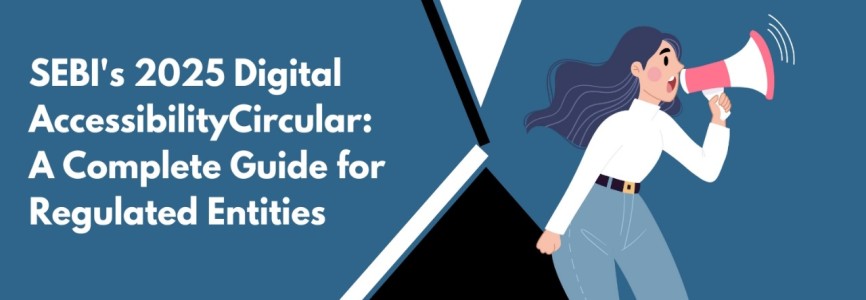



SEBI has released a clarification that all financial intermediaries and institutions regulated by it such as brokers, mutual fund, depositories, investment advisers, Association of Portfolio Managers in India (APMI) etc. must ensure their digital platforms are easily accessible to every investor. This includes websites, mobile apps, trading systems, dashboards, and used by investors.
The purpose of this clarification is to promote digital inclusivity, meaning no investor should face difficulty using digital financial services due to disability, age-related issues, or technical limitations. Whether someone is visually impaired, has difficulty hearing, or struggles to navigate complex websites, SEBI wants all platforms to be user-friendly and compliant with accessibility standards.
This move supports SEBI’s broader goal of protecting investors, increasing transparency, and ensuring fair access across the securities market. It reinforces SEBI's commitment to creating a financial system where technology becomes a bridge not used by the investors
Investor Right to Digital Accessibility
SEBI has declared that digital accessibility is not just a technical requirement. This means all investors, including senior citizens, persons with disabilities, and those with limited digital skills, must be able to access and use the digital platforms of any Regulated Entity (RE) without difficulty.
To enforce this, SEBI has added digital accessibility as a mandatory component of the Investor Charter, which every intermediary must follow. This includes stockbrokers, depositories, mutual funds, investment advisers, KRAs, portfolio managers, and Regulated Entity (RE).
By placing digital accessibility in the Investor Charter, SEBI ensures that it becomes a shared responsibility across the entire financial ecosystem. It shifts accessibility from being a “good-to-have feature” to a non-negotiable requirement, ensuring that no investor is left behind due to technological or physical barriers.
Extended Compliance Timeline for REs
SEBI has recognised that implementing full digital accessibility across all digital platforms such as websites, trading apps, and investor portals requires time, technical upgrades, and expert evaluation. Therefore, instead of demanding immediate compliance or audit reports, SEBI has extended the compliance timeline for all Regulated Entities (REs).
Under this revised framework, every RE must:
-
Submit its digital accessibility readiness status by March 31, 2026, covering all platforms they operate.
-
Specify whether each platform meets the AA-level accessibility standards as defined under global guidelines such as the Web Content Accessibility Guidelines (WCAG).
This extended timeline gives REs sufficient opportunity to thoroughly examine their digital systems, conduct internal assessments, identify accessibility gaps, upgrade interfaces, and implement corrections.
The purpose of this relaxation is to ensure realistic, high-quality compliance rather than rushed or incomplete efforts. By 2026, SEBI expects all REs to be fully aligned with global accessibility standards, ensuring that investors with disabilities or digital challenges receive a seamless, inclusive, and barrier-free online experience.
Mandatory Reporting in a Prescribed Format
To ensure that all Regulated Entities (REs) report their digital accessibility status in a consistent and comparable manner, SEBI has introduced a standardised reporting format. This format must be followed by every RE when submitting their compliance details.
Under this requirement, each RE must clearly disclose:
-
The exact URL or digital location of every platform that investors use whether it is a website, mobile app, trading terminal, or service portal.
-
The current accessibility status of each platform (for example, whether it is fully accessible, partially compliant, or yet to be tested).
-
The compliance level achieved under international standards such as WCAG Level A, AA, or AAA.
-
Any gaps that remain along with the expected timelines for achieving full compliance.
-
Technical or operational challenges that may delay or limit the implementation of accessibility measures.
By using this structured format, SEBI ensures full transparency, uniformity, and comparability in reporting across all financial institutions. Investors and regulators can easily understand the accessibility readiness of each platform, promoting accountability and improving digital inclusion across the securities market.
Accessibility Complaints Allowed on SCORES
SEBI has strengthened investor protection by allowing individuals to file digital accessibility–related complaints directly through its online grievance redressal platform SCORES (SEBI Complaints Redress System). This means that if an investor is unable to use a website, mobile app, trading portal, or any digital service of a Regulated Entity (RE) due to accessibility issues, they now have an official channel to report it.
Once such a complaint is submitted on SCORES:
-
The Regulated Entity is required to take corrective measures this may include fixing inaccessible features, updating the interface, correcting navigation barriers, or improving compatibility with assistive technologies like screen readers.
-
The RE must provide a compliance confirmation to SEBI after resolving the issue. Only then can the complaint be marked as closed.
This mechanism ensures accountability, faster redressal, and higher transparency. It empowers investors to demand accessible digital services and ensures that REs take accessibility requirements seriously. By integrating accessibility complaints into SCORES, SEBI has created a more inclusive and responsive financial ecosystem for all users.
Requirement for Periodic Accessibility Audits
SEBI has made periodic digital accessibility audits compulsory for all Regulated Entities (REs). This requirement ensures that every digital platform used by investors whether a website, mobile app, customer portal, or trading/transaction interface remains accessible, compliant, and user-friendly at all times.
Under this mandate:
-
All digital platforms must undergo regular accessibility audits to evaluate whether they meet globally recognised accessibility standards, particularly WCAG (Web Content Accessibility Guidelines) at the AA level.
-
These audits must be conducted only by qualified and certified accessibility professionals, ensuring technical accuracy and unbiased evaluation.
-
The audit must check elements such as screen-reader compatibility, keyboard navigation, colour contrast, font readability, alternative text for images, error identification, and overall usability for persons with disabilities or senior citizens.
SEBI also requires that:
-
Audit reports must be documented, preserved, and available for inspection by SEBI or any regulatory authority.
-
REs must use these audit findings to fix gaps, upgrade interfaces, and continuously improve accessibility.
This requirement ensures that accessibility is not treated as a one-time compliance exercise but as an ongoing commitment to inclusivity, investor protection, and regulatory transparency.
Reporting Responsibility Based on Entity Type
SEBI has clearly defined who each Regulated Entity (RE) must report to regarding digital accessibility compliance. This prevents duplication, confusion, and delays in the reporting process. Since different intermediaries fall under different supervisory bodies, SEBI has aligned the reporting responsibility with their regulatory structure.
Under this clarification:
-
Stockbrokers and Depository Participants must report their accessibility compliance status to the Stock Exchanges or Depositories with which they are registered.
This ensures immediate supervision by the entities that already monitor their trading, operational, and compliance functions.
-
Investment Advisers and Research Analysts must report to the authority responsible for supervising them, such as designated divisions or administrative bodies authorised by SEBI.
These intermediaries operate under specialised regulatory oversight, making this route more efficient.
-
All other Regulated Entities, including:
-
Mutual Funds and Asset Management Companies
-
Alternative Investment Funds (AIFs)
-
Know Your Client Registration Agencies (KRAs)
-
Portfolio Managers
-
Credit Rating Agencies
-
Debenture Trustees
must submit their digital accessibility reports directly to SEBI.
This categorisation ensures:
-
Proper channelisation of reports
-
Faster review and response
-
Better monitoring through existing supervisory structures
-
Reduced administrative burden on the REs
Overall, this clarification enhances compliance efficiency and ensures smooth coordination between REs, market infrastructure institutions, and SEBI.
Legal Basis for the Clarification
SEBI has used its regulatory authority granted under the SEBI Act, 1992 and various market regulations to issue this clarification on digital accessibility. These powers allow SEBI to direct all Regulated Entities (REs) to follow measures that strengthen:
-
Investor protection: Ensuring every investor, including persons with disabilities and senior citizens, can access essential financial services without barriers.
-
Market transparency: Making digital platforms clearer, easier to navigate, and more user-friendly so investors can make informed decisions.
-
Fair operational practices: Ensuring all intermediaries follow uniform digital standards and do not unintentionally exclude any category of investors.
-
Enhanced governance standards: Raising the overall quality of digital infrastructure across financial markets in line with global standards like WCAG.
With this clarification, SEBI has made digital accessibility a legal expectation not merely an optional initiative. Regulated Entities must now treat accessibility as a mandatory compliance requirement, similar to security standards, KYC norms, or grievance-redressal obligations. This shift ensures an inclusive, transparent, and investor-friendly digital ecosystem across India’s financial markets.
Significance of SEBI’s Digital Accessibility Initiative
SEBI’s digital accessibility initiative marks a major step forward for India’s financial ecosystem. Its significance extends across investor empowerment, market integrity, and global alignment.
-
Investor Inclusion: By mandating accessibility standards, SEBI enables individuals with visual, hearing, motor, or cognitive disabilities to access digital financial platforms without barriers. This ensures equal participation for all investors, especially senior citizens and differently-abled users, eliminating long-standing accessibility gaps.
-
Increased Transparency: When digital access becomes a right instead of a privilege, intermediaries are compelled to maintain clear, user-friendly platforms. This reduces information asymmetry and ensures that every investor experienced or new can access essential information easily.
-
Strengthened Digital Governance: Regulated Entities (REs) must follow structured guidelines, maintain documentation, and adhere to global standards like WCAG. This improves the overall governance framework and ensures accountability in digital operations.
-
Reduced Complaints and Digital Barriers: Accessible platforms allow smoother navigation, fewer technical hurdles, and minimal service disruptions. This leads to fewer investor complaints, quicker resolutions, and improved user satisfaction.
-
Alignment with International Standards: By adopting globally recognized accessibility norms, India’s financial sector aligns itself with international best practices. This enhances the credibility of Indian markets and supports foreign investor confidence, making the country’s digital financial infrastructure future-ready.
Conclusion
SEBI’s clarification (SEBI Circular No. HO/13/19/13(2)2025-ITD-1_VIAP/I/187/2025) marks a transformative step toward creating a more inclusive, transparent, and investor-friendly digital ecosystem. By extending compliance timelines, introducing structured reporting formats, enabling accessibility-related grievances on SCORES, and mandating periodic audits, SEBI ensures that every Regulated Entity enhances its digital infrastructure in line with global accessibility standards. These measures not only promote fairness but also ensure that investors regardless of age, disability, or digital proficiency can easily access financial services across trading platforms, mutual fund systems, depository interfaces, and advisory applications.
For Regulated Entities, this clarification is more than just a regulatory requirement. It is a strategic opportunity to modernize digital frameworks, improve user experience, and strengthen investor trust through better accessibility and usability. Early adoption of these standards helps reduce grievances, enhance operational efficiency, and position entities as leaders in India's digital-first financial landscape. Ultimately, this SEBI initiative lays the foundation for a future-ready securities ecosystem where every investor can participate confidently and without barriers.


_crop10_thumb.jpg)


_crop10_thumb.jpg)


-Form_crop10_thumb.jpg)

_crop10_thumb.jpg)


_learn_crop10_thumb.jpeg)


_crop10_thumb.jpg)

_crop10_thumb.jpg)


_crop10_thumb.jpg)





_for_Foreign_Directors_learn_crop10_thumb.jpeg)


_Act,_2015_learn_crop10_thumb.jpg)











_learn_crop10_thumb.jpg)












































_crop10_thumb.jpg)


_crop10_thumb.jpg)

_(1)_crop10_thumb.jpg)













_crop10_thumb.png)












_crop10_thumb.jpg)


_crop10_thumb.jpg)








_crop10_thumb.png)


_crop10_thumb.jpg)










_crop10_thumb.png)











_crop10_thumb.jpg)
