
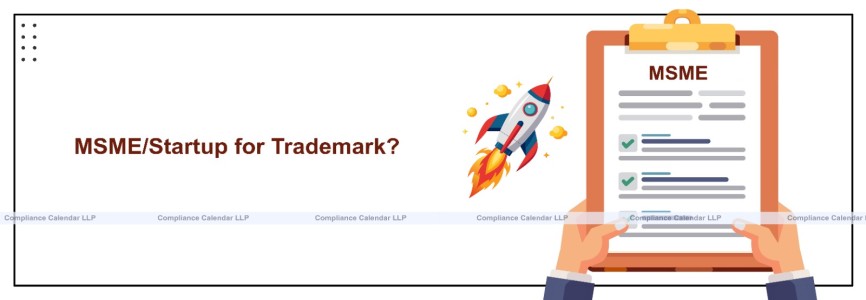



Many founders and small business owners believe that they must first obtain an MSME (Udyam) certificate or a Startup (DPIIT) certificate before applying for a trademark. This confusion usually arises because these registrations are often done at the time of starting a business. However, trademark registration is a separate legal process meant to protect a brand name, logo, or slogan. It is governed by trademark law and depends only on who owns the brand and whether it is being used or planned to be used.
Having an MSME or Startup certificate is not compulsory to file a trademark application. These certificates matter only if you want to claim a lower government fee available for startups and small enterprises. In simple terms, you can apply for a trademark without these certificates, but you need them only to get the fee benefit.
Legal Position Under the Trade Marks Act, 1999
Trademark registration in India is governed by the Trade Marks Act, 1999, which clearly explains who can apply for a trademark. As per Section 18 of the Act, any person who owns a trademark or plans to use a trademark can apply for registration. The law looks at who owns the brand, whether the mark is distinctive, and the goods or services for which protection is sought. It does not require the applicant to have MSME registration, DPIIT startup recognition, or any other business-related certificate.
This means that individuals, sole proprietors, partnership firms, LLPs, private limited companies, or any other legal entities can apply for a trademark regardless of their MSME or Startup status. Trademark rights are linked to brand ownership and business identity, not to tax registrations or government recognition schemes.
Trade Marks Rules, 2017 and Where MSME/Startup Comes In
The Trade Marks Rules, 2017 explain the procedure, forms, and government fees for trademark registration. While these Rules do not make MSME or Startup registration compulsory for filing a trademark, they do create different fee categories for applicants. Generally, applicants are divided into two groups individuals, startups, and small enterprises, and other entities. The difference between these categories affects only the amount of government fee payable.
This is where MSME or Startup certificates become relevant. They are not needed to apply for a trademark, but they are usually required if the applicant wants to claim the reduced government fee meant for startups or small enterprises. In simple terms, anyone can file a trademark without these certificates, but to get the fee concession, proper MSME or Startup proof is necessary.
What “Startup” and “MSME/Small Enterprise” Means for Trademark Fee Purposes
For trademark fee purposes, the term “Startup” generally refers to a business that has been officially recognised as a startup under the Government’s startup recognition system, most commonly through DPIIT recognition. Similarly, a “small enterprise” means a business that qualifies under the MSME and can prove this status with a valid MSME or Udyam Registration Certificate. These definitions matter only for deciding the government fee category, not for determining whether a trademark can be filed.
The Trademark Registry does not examine your business model or scale of operations. It only checks whether you can justify the category under which you have paid the lower trademark fee. If an applicant claims the startup or small enterprise category without valid proof, the Registry may reclassify the application under the regular fee category, ask for payment of the fee difference, or raise a procedural objection.
Is the MSME or Startup Certificate Mandatory for Filing TM-A?
The trademark application is filed in Form TM-A. The form requires details such as applicant name, address, entity type, the mark, class, specification of goods/services, and whether the mark is “used” or “proposed to be used.” There is no legal requirement in TM-A that you must have MSME or Startup recognition to file.
However, if you choose the applicant category that attracts a lower fee, the Registry may expect supporting proof. In many cases, the portal/filing process itself prompts you to support your category selection. This is a practical requirement tied to fees, not a legal eligibility condition for trademark registration itself.
Who Can File a Trademark Without MSME/Startup Certificate?
A trademark can be filed by any person or business even if they do not have an MSME or Startup certificate. An individual can apply for a trademark in their own name without any special registration. The same applies to freelancers, consultants, trainers, content creators, and early-stage founders who want to protect their brand identity before formalising their business.
Likewise, sole proprietorships, partnership firms, LLPs, and private limited companies can file trademark applications without MSME registration or DPIIT Startup recognition. The key requirement is that the applicant details are correctly mentioned and the basic trademark documents are properly submitted. The only difference is related to government fees if the applicant does not claim or cannot prove MSME/Startup status, the trademark application will be processed under the regular fee category, but the registration itself remains completely valid.
When Is the Certificate Actually Needed?
The MSME/Startup certificate becomes important mainly in these situations. First, when you want to pay the reduced government fee meant for startups and small enterprises. Second, when the Registry questions your fee category selection and asks you to justify it. Third, when you are filing as a business entity and want the trademark records to reflect your startup/small enterprise status accurately for fee and procedural purposes.
If you are filing as an “individual” (and genuinely qualify), you may not need MSME/Startup proof. But if you are filing as “startup/small enterprise,” you should keep your certificate ready.
What Happens If You Claim Startup/MSME Category Without Proof?
If an applicant claims the Startup or MSME category while filing a trademark application but does not have valid proof, the Trademark Registry may take corrective action. In most cases, the Registry may ask the applicant to pay the difference in government fees and treat the application as filed under the regular category. Sometimes, a procedural objection may also be raised, which can delay the processing of the application.
Making an incorrect declaration can reduce the credibility of the trademark filing and may create complications during examination or later stages. In serious situations, wrong claims can even be viewed as misrepresentation. Therefore, it is always advisable to select the correct applicant category and submit proper supporting documents when claiming Startup or MSME benefits.
Conclusion
An MSME (Udyam) certificate or a Startup (DPIIT) certificate is not compulsory to apply for or obtain trademark registration in India. Trademark registration is governed by the Trade Marks Act, 1999, which focuses on who owns the brand and whether the mark is being used or is intended to be used. The law does not link trademark rights with business size, government recognition, or special certificates. Any individual or business entity can legally protect its brand without holding MSME or Startup status.
However, MSME or Startup certificates become relevant only for fee-related benefits. Under the Trade Marks Rules, startups and small enterprises are allowed to pay a lower government fee. If an applicant does not have these certificates, the trademark application is still valid, but it will be processed under the regular fee category instead of the concessional one.
Frequently Asked Questions
Q1. Is MSME or Startup certificate mandatory for trademark registration in India?
Ans. No. An MSME (Udyam) certificate or Startup (DPIIT) certificate is not mandatory to file or obtain a trademark in India. Trademark registration is governed by the Trade Marks Act, 1999, and the key requirement is that the applicant must be the proprietor of the mark and must be using it or intending to use it. The Act does not make MSME or DPIIT recognition a condition for filing or registration. These certificates relate to business recognition schemes, not trademark ownership.
Q2. Can I file a trademark without MSME or Startup registration?
Ans. Yes. You can file a trademark even if you have not taken MSME registration or Startup recognition. Many businesses apply for trademark protection at the idea stage, before starting operations or before applying under MSME/DPIIT. The Trademark Registry accepts applications from individuals and all types of entities based on ownership and proper application details, irrespective of MSME or Startup status.
Q3. Why is MSME or Startup certificate mentioned in trademark filing?
Ans. MSME/Startup status is mentioned mainly because of government fee categories under the Trade Marks Rules and fee schedule. Certain applicants such as individuals, startups, and small enterprises are eligible for concessional filing fees. To claim that lower fee, the applicant must generally be able to prove their category through valid supporting documents like Udyam certificate or DPIIT recognition.
Q4. What happens if I don’t have MSME or Startup certificate?
Ans. Nothing adverse happens to your trademark eligibility. You can still file and proceed normally with your trademark application. The only practical impact is that you may have to pay the regular government fee applicable to “others” (non-concessional category). The trademark application remains valid and can be registered if it meets the legal requirements of distinctiveness, non-conflict with earlier marks, and proper specification of goods/services.
Q5. Can individuals file a trademark without MSME registration?
Ans. Yes. Individuals can file a trademark in their personal name without MSME registration. This is common for freelancers, creators, consultants, trainers, and founders who want early brand protection. The law permits any person to apply as proprietor. Later, if the business is converted into a firm/LLP/company, the trademark can be assigned/transferred through proper legal procedure.
Q6. Can a private limited company file a trademark without MSME or DPIIT recognition?
Ans. Yes. A private limited company can file a trademark even if it does not have MSME registration or DPIIT recognition. Trademark registration is not dependent on business recognition. The company only needs to provide correct entity details (name, address, incorporation proof if required, authorised signatory) and file for the correct classes and goods/services. MSME/DPIIT matters only if the company wants a fee concession as a small enterprise/startup.
Q7. Is MSME or Startup certificate required in Form TM-A?
Ans. Form TM-A does not make MSME or Startup certificate compulsory for filing. TM-A primarily captures applicant details, mark details, class, goods/services description, and usage status (used/proposed to be used). However, if you select the “startup/small enterprise” category for lower fee, you should keep the supporting certificate ready because the Registry can ask for proof or the portal may require it during filing.
Q8. What if I wrongly claim Startup/MSME category without proof?
Ans. If you claim startup/MSME/small enterprise category without valid proof, the Registry may require you to pay the differential fee and treat your application under the regular category. It may also lead to procedural objections or delays. In serious cases, repeated incorrect declarations can be viewed as misrepresentation. Practically, it’s always safer to choose the correct category and attach documentary proof when claiming a concession.
Q9. Does MSME or Startup registration improve trademark approval chances?
Ans. No. MSME or DPIIT recognition does not increase the chances of trademark approval. Trademark examination is based on trademark law factors such as distinctiveness, similarity with earlier marks, descriptiveness, likelihood of confusion, and compliance with the Trade Marks Act and Rules. The Registry does not grant approval because a business is an MSME or a startup. Those statuses affect fees and may assist in business benefits elsewhere, but not trademark registrability.
Q10. Should I get MSME or Startup certificate before trademark filing?
Ans. It is not compulsory. If you want to claim the concessional government fee, then getting the MSME/Startup certificate before filing can be useful. If your priority is early brand protection, you can file the trademark immediately under the regular category and later obtain MSME/DPIIT benefits for other purposes. The best approach depends on your timeline, entity structure, and whether you qualify for the concession at the time of filing.


_crop10_thumb.jpg)


_crop10_thumb.jpg)


-Form_crop10_thumb.jpg)

_crop10_thumb.jpg)


_learn_crop10_thumb.jpeg)


_crop10_thumb.jpg)

_crop10_thumb.jpg)


_crop10_thumb.jpg)




_for_Foreign_Directors_learn_crop10_thumb.jpeg)


_Act,_2015_learn_crop10_thumb.jpg)







_learn_crop10_thumb.jpg)





















_crop10_thumb.jpg)

_crop10_thumb.jpg)
_(1)_crop10_thumb.jpg)


_crop10_thumb.png)
_crop10_thumb.jpg)

_crop10_thumb.jpg)




_crop10_thumb.png)
_crop10_thumb.jpg)



_crop10_thumb.png)







_crop10_thumb.jpg)
