
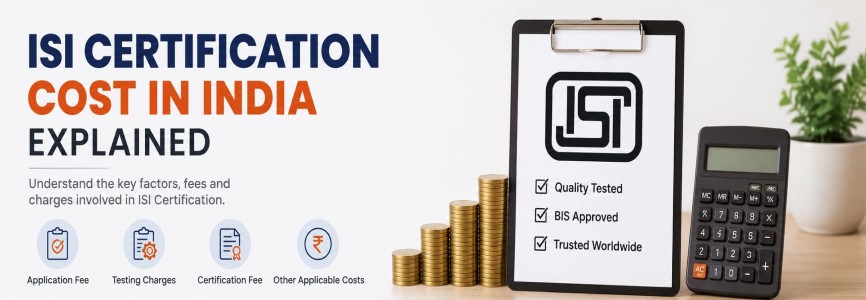



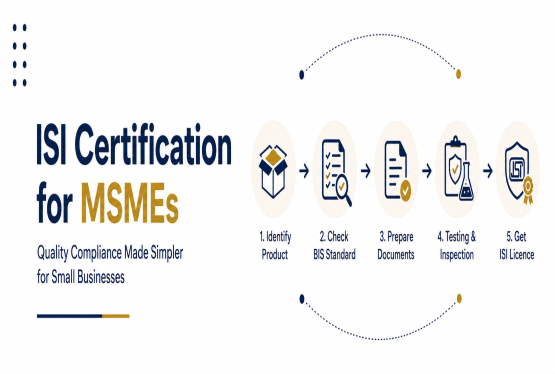
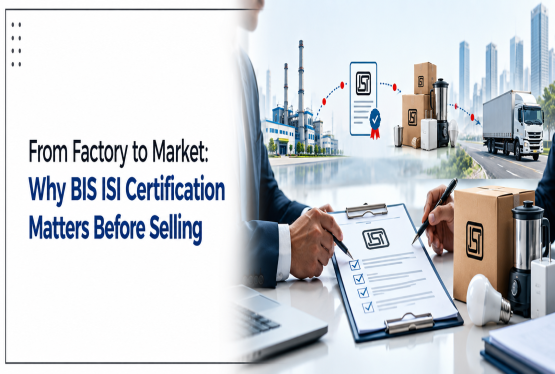
ISI Certification is one of the most important product quality approvals in India. It is issued by the Bureau of Indian Standards (BIS) and allows a manufacturer to use the ISI Mark on certified products. For many products, ISI Certification is mandatory before manufacturing, selling, importing or distributing the product in the Indian market.
One of the first questions asked by manufacturers is: “How much does ISI Certification cost in India?” The answer is not the same for every product. The cost depends on the product category, applicable Indian Standard, testing requirements, factory location, number of varieties, BIS inspection, marking fee and professional assistance required. This article explains the main cost components involved in ISI Certification in simple language, so manufacturers and business owners can understand the expected expenses before applying.
What is ISI Certification?
ISI Certification is granted under the BIS Product Certification Scheme. It confirms that a product conforms to the relevant Indian Standard. After obtaining the BIS licence, the manufacturer can mark the product with the ISI Mark. ISI Certification is generally applicable to products such as cement, steel products, electrical appliances, pressure cookers, helmets, footwear, pipes, chemicals, valves, cylinders, wires, cables and many other regulated goods. For products covered under Quality Control Orders, ISI Certification becomes compulsory. Without a valid BIS licence, such products cannot be legally manufactured or sold in India.
Is ISI Certification Cost Fixed?
No, ISI Certification cost is not fixed for all products. BIS has official fee components such as application fee, licence fee, inspection charges and marking fee, while product testing charges depend on the applicable Indian Standard and laboratory requirements. BIS also provides product-wise marking fee details through its official marking fee search system. The total cost may increase if the product requires multiple tests, factory infrastructure improvement, additional samples, consultant support or foreign manufacturer inspection.
Main Cost Components of ISI Certification
1. BIS Application Fee
The application fee is paid at the time of filing the application with BIS. This is a basic government fee for processing the application. It is generally a small part of the total cost, but it is compulsory for every application.
2. BIS Licence Fee
Once the licence is granted, the manufacturer has to pay the prescribed licence fee. This fee is connected with the use of the ISI Mark and maintenance of the BIS licence.
3. Inspection Charges
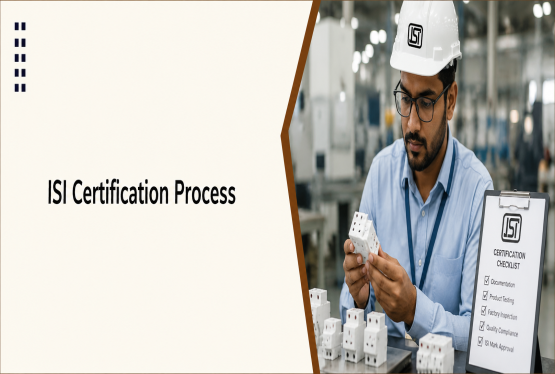
Before granting the licence, BIS officers usually inspect the manufacturing premises. During inspection, they check production facilities, testing equipment, quality control records, raw material records, calibration certificates, technical staff details and sample availability. Inspection charges may vary depending on the type of application, location of the factory and duration of inspection. For foreign manufacturers, the inspection cost is usually higher because travel, stay and related expenses may also be involved.
4. Product Testing Charges
Testing cost is one of the most important parts of ISI Certification expenses. The product sample has to be tested as per the applicable Indian Standard. Testing may be conducted in a BIS-recognised laboratory or, in some cases, in the factory laboratory if permitted. The cost depends on the product type and number of tests required. For example, simple products may have lower testing charges, while electrical, chemical, steel, construction or safety-related products may require detailed testing.
5. Sample Cost
The manufacturer has to provide product samples for testing. In some cases, the sample cost may be low. However, for heavy, expensive or industrial products, sample cost can become significant. The cost may also increase if more than one variety, size, grade or model is required to be tested.
6. Factory Testing Facility Cost
For ISI Certification, the factory must usually have proper in-house testing facilities as per the applicable Indian Standard and BIS requirements. If the manufacturer does not already have required testing equipment, additional investment may be needed. This may include testing machines, measuring instruments, calibration support, lab setup, records and trained quality personnel.
7. Marking Fee
Marking fee is the fee payable for using the ISI Mark on the certified product. It is generally product-specific and may depend on quantity, unit, slab and minimum annual marking fee. BIS provides product-wise marking fee details through its official marking fee search platform. This is an important recurring cost and should be checked carefully before applying.
8. Professional Fee
Many manufacturers take professional help for BIS application filing, document preparation, factory readiness, test coordination, reply to BIS queries and licence follow-up. Professional fee depends on the product category, complexity of the Indian Standard, number of models or grades, factory condition and urgency of work.
Estimated ISI Certification Cost in India
The cost of ISI Certification may broadly include government fee, testing fee, inspection fee, marking fee, sample cost and professional charges. For a simple product, the cost may be comparatively lower. For technical, industrial, electrical, chemical, steel or safety products, the total cost may be higher due to detailed testing and factory compliance requirements. Manufacturers should not calculate only the government application fee. They should also consider testing charges, laboratory setup, sample preparation, marking fee and post-licence compliance cost.
Cost for Indian Manufacturers
For Indian manufacturers, the cost generally includes: Application fee, BIS inspection charges, product testing charges, sample cost, marking fee, factory testing facility cost and consultant fee, if professional support is taken. The final amount depends on the Indian Standard and the product category. A small manufacturer may also be eligible for certain rebates or benefits depending on applicable BIS policies and category of enterprise.
Cost for Foreign Manufacturers
Foreign manufacturers who want to sell regulated products in India generally need BIS Certification under the Foreign Manufacturers Certification Scheme, where applicable. The cost for foreign manufacturers is usually higher than Indian manufacturers because it may include overseas factory inspection, travel expenses, authorised Indian representative support, documentation, testing and bank guarantee requirements. Foreign manufacturers should plan the budget properly before starting the BIS application process.
Factors That Affect ISI Certification Cost
The total cost may change due to several factors:
-
The first factor is the product category. Some products have simple testing requirements, while others need detailed mechanical, chemical, electrical or performance testing.
-
The second factor is the number of models, varieties, sizes or grades. If the manufacturer wants to cover multiple varieties under one licence, additional testing or grouping approval may be required.
-
The third factor is factory readiness. If the factory already has proper equipment, records and trained staff, the cost may remain controlled. If not, additional investment may be needed.
-
The fourth factor is the testing laboratory. Different laboratories may have different timelines and testing charges.
-
The fifth factor is marking fee. Since marking fee is product-specific, it must be checked separately for the relevant Indian Standard.
Why Cost Planning is Important
Many manufacturers start the ISI Certification process without understanding the full cost. Later, they face delays due to missing testing equipment, incomplete documents, sample failure, wrong product selection or inadequate quality control records. Proper cost planning helps businesses avoid unnecessary delays and rejection. It also helps in preparing the factory before BIS inspection.
Documents Required for ISI Certification
Common documents required for ISI Certification include business registration proof, factory licence, manufacturing process flow chart, list of machinery, list of testing equipment, calibration certificates, raw material details, quality control records, product details, brand details, lab test reports and identity details of authorised signatory.
How to Reduce ISI Certification Cost
A manufacturer can reduce unnecessary expenses by preparing the factory before filing the application. Proper product classification, correct Indian Standard identification, availability of testing equipment, proper documentation and sample readiness can reduce delays and repeat testing. It is also important to avoid applying under the wrong standard or submitting incomplete documents. Such mistakes may increase the overall cost and timeline.
Conclusion
ISI Certification cost in India depends on many factors, including product type, Indian Standard, testing requirement, factory inspection, marking fee, sample cost and professional assistance. There is no single fixed cost for all products. Before applying, every manufacturer should check the applicable Indian Standard, product testing requirements, marking fee and factory readiness. A proper cost estimate helps in avoiding delays and ensures a smoother BIS certification process.
Compliance Calendar LLP assists manufacturers, importers and foreign manufacturers with BIS ISI Certification, documentation, testing coordination, factory compliance, application filing and BIS follow-up.
FAQs
Q1. What is the cost of ISI Certification in India?
Ans. The cost depends on the product, Indian Standard, testing charges, inspection fee, marking fee and professional support required.
Q2. Is ISI Certification cost same for all products?
Ans. No, the cost is different for every product because testing and marking fee requirements vary product-wise.
Q3. Is product testing cost included in BIS government fee?
Ans. No, testing charges are usually separate and depend on the applicable Indian Standard and laboratory.
Q4. What is marking fee in ISI Certification?
Ans. Marking fee is the fee payable for using the ISI Mark on certified products. It is generally product-specific.
Q5. Do small manufacturers get any benefit in BIS fee?
Ans. Certain MSME-related rebates or benefits may be available depending on BIS policy and eligibility.
Q6. Is factory inspection compulsory for ISI Certification?
Ans. Yes, factory inspection is generally required before grant of BIS ISI licence.
Q7. Why does ISI Certification become expensive for some products?
Ans. It becomes expensive when the product requires detailed testing, costly samples, multiple varieties or additional factory equipment.
Q8. Is professional fee compulsory?
Ans. No, professional fee is not a government fee. It is paid only if the manufacturer takes expert assistance.
Q9. Can one ISI licence cover multiple product varieties?
Ans. In some cases, multiple varieties may be covered if permitted under BIS grouping guidelines and testing requirements.
Q10. How can Compliance Calendar LLP help?
Ans. Compliance Calendar LLP helps with product standard identification, documents, application filing, testing coordination, factory readiness and BIS follow-up.


_crop10_thumb.jpg)


_crop10_thumb.jpg)


-Form_crop10_thumb.jpg)

_crop10_thumb.jpg)


_learn_crop10_thumb.jpeg)


_crop10_thumb.jpg)

_crop10_thumb.jpg)


_crop10_thumb.jpg)




_for_Foreign_Directors_learn_crop10_thumb.jpeg)


_Act,_2015_learn_crop10_thumb.jpg)










_learn_crop10_thumb.jpg)





















_crop10_thumb.jpg)

_crop10_thumb.jpg)
_(1)_crop10_thumb.jpg)





_crop10_thumb.png)

_crop10_thumb.jpg)

_crop10_thumb.jpg)




_crop10_thumb.png)
_crop10_thumb.jpg)



_crop10_thumb.png)





_crop10_thumb.jpg)
