
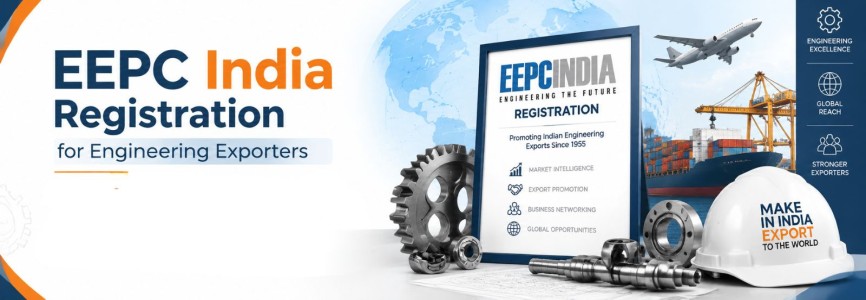



India has emerged as one of the fastest-growing manufacturing and engineering export hubs in the world. From automobile components and industrial machinery to electrical equipment, metal products, and technical services, Indian engineering exporters are increasingly expanding into international markets. To support and promote this sector, the Government of India established the Engineering Export Promotion Council (EEPC India), formerly known as the Engineering Export Promotion Council, as an export promotion body under the Ministry of Commerce & Industry.
For businesses engaged in exporting engineering goods and services, obtaining EEPC India Registration and securing a Registration-Cum-Membership Certificate (RCMC) is an important compliance requirement. The RCMC acts as recognition that an exporter is registered with the appropriate Export Promotion Council and helps exporters access various benefits available under India’s Foreign Trade Policy.
EEPC India registration is particularly beneficial for manufacturers, merchant exporters, MSMEs, and engineering businesses planning to participate in global trade exhibitions, buyer-seller meets, export promotion schemes, and international business opportunities.
What is EEPC India Registration?
EEPC India Registration refers to obtaining membership with the Engineering Export Promotion Council of India by exporters dealing in engineering products and services. After successful registration, the exporter receives an RCMC (Registration-Cum-Membership Certificate) issued through the applicable process.
The RCMC certifies that the exporter is registered with EEPC India for engineering products covered under its jurisdiction. Under the Foreign Trade Policy framework, exporters seeking benefits, incentives, or support under various export promotion schemes may require an RCMC from the relevant Export Promotion Council.
EEPC India works as an interface between engineering exporters and the Government by promoting exports, supporting policy development, organising trade events, and providing market-related assistance to exporters.
The council covers a wide range of engineering products including:
- Automobile components
- Industrial machinery
- Electrical machinery
- Heavy engineering equipment
- Metal products
- Industrial tools
- Medical and scientific equipment
- Defence-related engineering products
- Technical services related to engineering sectors
Role of EEPC India in Promoting Engineering Exports
EEPC India plays a significant role in strengthening India's engineering export ecosystem. It provides exporters with opportunities to connect with international buyers and understand global market requirements.
The major functions of EEPC India include:
1. Export Promotion Activities
EEPC India conducts international exhibitions, trade fairs, buyer-seller meets, and business delegations to help Indian exporters enter global markets.
2. Policy Representation
The council represents issues faced by engineering exporters before government authorities and provides recommendations regarding export policies.
3. Market Intelligence Support
Registered members receive access to export-related information, market updates, trade opportunities, and industry insights.
4. Global Business Opportunities
Membership allows exporters to participate in international promotional events and connect with overseas buyers.
5. Support for MSME Exporters
EEPC India particularly supports small and medium engineering enterprises by providing platforms to compete internationally. EEPC India currently operates as one of India's major engineering export promotion organisations with thousands of members across India.
Legal Provisions Related to EEPC India Registration
EEPC India registration is governed primarily through the following legal and regulatory frameworks:
1. Foreign Trade Policy (FTP)
The Foreign Trade Policy issued by the Directorate General of Foreign Trade (DGFT) provides the regulatory framework for exports and imports in India. Under the FTP framework, exporters may require an RCMC issued by the concerned Export Promotion Council or authorised body to avail certain benefits and participate in export promotion activities.
2. Foreign Trade (Development and Regulation) Act, 1992
The Foreign Trade (Development and Regulation) Act, 1992 provides legal authority to regulate and promote foreign trade activities in India. DGFT operates under this Act and manages export-import related policies, registrations, and authorisations.
3. DGFT e-RCMC System
DGFT has introduced digital processes for obtaining Registration-Cum-Membership Certificates through online platforms. Exporters can apply electronically and manage their export-related registrations through digital systems.
Who Needs EEPC India Registration?
EEPC India registration is generally required by businesses involved in engineering exports, including:
Manufacturer Exporters
Manufacturers producing engineering products and exporting them directly to foreign buyers can obtain EEPC membership.
Examples:
- Machinery manufacturers
- Auto component manufacturers
- Electrical equipment manufacturers
Merchant Exporters
Businesses purchasing engineering goods from manufacturers and exporting them internationally can also apply for membership.
MSME Engineering Exporters
Small and medium businesses involved in engineering manufacturing can benefit significantly from EEPC membership.
Engineering Service Providers
Certain engineering-related service providers dealing with international markets may also become eligible depending on their activities.
Eligibility Criteria for EEPC India Registration
To obtain EEPC India Registration, the applicant must fulfil certain eligibility conditions prescribed for engineering exporters. The applicant should have a valid export-related identity, operate in an eligible engineering category, and provide complete business documentation for verification.
1. Valid Import Export Code (IEC)
The applicant must possess a valid and active Import Export Code (IEC) issued by the Directorate General of Foreign Trade (DGFT). IEC is mandatory for any business involved in import or export activities in India and acts as the primary identification number for international trade transactions.
2. Engineering Product/Service Category
The applicant’s business activities must relate to engineering products or services covered under the scope of EEPC India. Exporters dealing in machinery, electrical equipment, automobile components, industrial products, metal goods, and other engineering sectors are generally eligible to apply for membership.
3. Valid Business Entity
EEPC India registration can be obtained by various types of business organisations, including:
- Proprietorship firms
- Partnership firms
- Limited Liability Partnerships (LLPs)
- Private Limited Companies
- Public Limited Companies
- Other eligible legal entities engaged in engineering exports
The applicant must have proper registration and legal recognition of the business entity.
4. Compliance with Documentation Requirements
The applicant must submit accurate and complete documents related to the business, export activities, and ownership details. Documents such as IEC certificate, PAN, GST registration , incorporation documents, bank details, and other supporting records may be required for verification and approval of EEPC India membership.
Documents Required for EEPC India Registration
The following documents are generally required:
Basic Documents
- Import Export Code (IEC) Certificate
- PAN Card of business/entity
- GST Registration Certificate
- Address proof of business
- Bank certificate/cancelled cheque
- Business registration documents
Entity-Specific Documents
For Private Limited Company:
- Certificate of Incorporation
- Memorandum of Association
- Articles of Association
- Board details
For LLP:
- LLP Incorporation Certificate
- LLP Agreement
For Partnership:
- Partnership Deed
- Firm registration documents
For Proprietorship:
- Proprietor PAN
- Business proof documents
Additional Documents
- Export performance details
- CA-certified export turnover certificate wherever applicable
- MSME/Udyam Registration Certificate (if applicable)
EEPC India requires supporting documents depending on membership category and export performance.
Types of EEPC India Membership
EEPC India generally provides different membership categories based on the nature of the applicant.
1. Ordinary Membership
Ordinary membership is generally available for exporters directly involved in exporting engineering goods and services. These members may participate in export promotion activities and obtain relevant certificates.
2. Associate Membership
Associate membership is generally available for businesses connected with the engineering export sector but not directly exporting at the same level as ordinary members. Membership category may depend upon eligibility and applicable EEPC guidelines.
Process for EEPC India Registration
Obtaining EEPC India Registration involves a series of online and documentation-based steps. Exporters must ensure that all required details and documents are accurately submitted to avoid delays in approval.
Step 1: Obtain IEC Registration
Before applying for EEPC India membership, the exporter must obtain a valid Import Export Code (IEC) issued by the Directorate General of Foreign Trade (DGFT). IEC is a mandatory requirement for carrying out export activities in India, and it is required to apply for EEPC membership.
Step 2: Determine Product Classification
The exporter must identify whether the products or services fall under the engineering categories covered by EEPC India. Proper classification of products according to applicable HS Codes helps in selecting the correct membership category and prevents unnecessary delays or objections during verification.
Step 3: Submit Online Application
The applicant needs to complete the EEPC India membership application through the online registration portal. The exporter is required to provide essential details such as business information, IEC details, GST details, product/service category, and contact information while submitting the application.
Step 4: Upload Required Documents
After completing the application, the applicant must upload supporting documents required for verification. These may include IEC certificate, PAN card, GST certificate, business incorporation documents, bank details, and other relevant records. Incomplete or incorrect documents may lead to queries or delay in processing.
Step 5: Payment of Membership Fees
The applicant must pay the applicable EEPC India membership fees based on the selected membership category and applicable criteria. The payment confirmation is generally required to complete the registration process.
Step 6: Verification and Approval
EEPC India reviews the submitted application, documents, and eligibility details. After successful verification and satisfaction of all requirements, the membership is approved, and the exporter receives confirmation along with the Registration-Cum-Membership Certificate (RCMC). This certificate enables the exporter to access EEPC India services and export promotion benefits.
Benefits of EEPC India Registration
EEPC India Registration provides several advantages to engineering exporters by helping them access export promotion opportunities, expand their global presence, and establish credibility in international markets. The membership acts as a valuable support system for manufacturers, MSMEs, and exporters involved in engineering goods and services.
1. Access to Export Promotion Schemes
An exporter holding an RCMC issued by EEPC India becomes eligible to participate in various export promotion activities and government-supported programmes under the Foreign Trade Policy. It helps exporters utilise opportunities designed to increase India's engineering exports.
2. International Market Opportunities
EEPC India members get opportunities to participate in international trade fairs, exhibitions, buyer-seller meetings, and business delegations. These platforms help exporters showcase their products, identify overseas customers, and explore new international markets.
3. Government Recognition
EEPC India membership provides official recognition to engineering exporters and enhances their credibility among foreign buyers, importers, and international business partners. It reflects that the exporter is registered with a recognised export promotion council.
4. Business Networking Opportunities
Registered members can connect with various stakeholders, including foreign buyers, importers, industry associations, government bodies, and other exporters. Such networking opportunities help businesses build partnerships and increase export possibilities.
5. Export Information and Market Updates
Members receive access to important information related to export policies, global market trends, trade opportunities, international events, and regulatory updates. This helps exporters make informed decisions while expanding their overseas operations.
6. Support for MSME Engineering Exporters
EEPC India provides valuable support to small and medium engineering enterprises by offering market access opportunities, promotional platforms, and guidance for entering international markets. MSMEs can leverage EEPC membership to improve their global visibility and grow their export business.
Validity and Renewal of EEPC India Membership
EEPC India membership generally operates on a financial year basis. Members are required to renew their membership and pay applicable subscription fees within the prescribed timeline. For renewal, exporters may need to provide updated details including export performance information and supporting documents. EEPC India has issued membership renewal requirements for financial years where members are required to submit relevant export performance certificates and supporting documents.
Recent Updates Related to EEPC India and Engineering Exports
The engineering export sector is continuously evolving with increasing focus on digital compliance, MSME participation, and global market expansion. Government initiatives and EEPC India programmes are helping exporters access international opportunities through simplified processes and export promotion activities.
Digitalisation of Export Compliance
Export registrations and certification processes are increasingly being shifted to online platforms, improving transparency, reducing paperwork, and making compliance procedures faster for exporters.
Increasing Focus on MSME Export Growth
Government initiatives are encouraging MSMEs to participate in international trade by providing better access to export support, market opportunities, and business facilitation services.
Expansion of Global Trade Opportunities
Indian engineering exporters are exploring new international markets through trade agreements, exhibitions, buyer-seller meets, and export promotion programmes.
Common Reasons for Delay or Rejection of EEPC Registration
EEPC registration applications may face delays due to incorrect information, incomplete documents, or non-compliance with eligibility requirements.
Incorrect Product Classification
Wrong selection of product categories or HS Codes may result in verification issues or rejection.
Mismatch in Business Information
Differences in details provided in IEC, GST, PAN, or company records may lead to queries from EEPC India.
Incomplete Documentation
Missing, unclear, or incorrect documents can delay the approval process.
Expired IEC
An inactive or expired IEC can prevent successful EEPC membership registration.
Compliance Requirements After EEPC Registration
After obtaining EEPC India membership, exporters must maintain valid IEC status, complete GST and export-related compliances, renew membership on time, and maintain proper export records. Compliance with DGFT, customs, FEMA, and other applicable regulations is also necessary.
Difference Between IEC and EEPC India Registration
IEC is a mandatory code issued by DGFT that allows a business to undertake import and export activities. EEPC India Registration provides membership recognition and RCMC certification for engineering exporters, helping them access export promotion benefits and industry support.
Conclusion
EEPC India Registration is an important compliance step for engineering exporters who want to establish credibility, access export promotion opportunities, and participate in global markets. The RCMC issued through EEPC India helps exporters connect with international opportunities while ensuring alignment with India's export promotion framework.
For manufacturers, MSMEs, merchant exporters, and engineering businesses, obtaining EEPC India membership can become a strategic advantage for expanding overseas operations. With increasing focus on manufacturing growth, "Make in India", and global trade expansion, engineering exporters who maintain proper registrations and compliance frameworks can better compete in international markets.
Businesses planning engineering exports should ensure timely IEC compliance, proper documentation, and EEPC India registration to build a strong foundation for sustainable global trade growth.
Q1. What is EEPC India Registration? Ans: EEPC India Registration is the process of obtaining membership with the Engineering Export Promotion Council of India. It provides exporters with a Registration-Cum-Membership Certificate (RCMC), enabling them to access export promotion benefits and opportunities. Q2. Who can apply for EEPC India Registration? Ans: Manufacturers, merchant exporters, MSMEs, and businesses dealing in engineering products or services can apply for EEPC India membership. The applicant must have a valid IEC issued by DGFT and operate in an eligible engineering category. Q3. Is IEC mandatory for EEPC India Registration? Ans: Yes, a valid Import Export Code (IEC) issued by DGFT is required for EEPC India Registration. IEC acts as the primary identification number for businesses involved in international trade activities. Q4. What is the purpose of an EEPC India RCMC Certificate? Ans: The RCMC certificate confirms that an exporter is registered with EEPC India and is recognised under the export promotion framework. It helps exporters participate in trade events, export promotion programmes, and other benefits. Q5. What documents are required for EEPC India Registration? Ans: Common documents include IEC certificate, PAN card, GST registration certificate, business registration documents, bank details, and product-related information. Additional documents may be required depending on the business structure. Q6. How long does it take to obtain EEPC India Registration? Ans: The processing time depends on the accuracy of submitted information and documents. Applications with complete and correct details are generally processed faster after verification by EEPC India. Q7. Is EEPC India membership mandatory for all exporters? Ans: EEPC India membership is not mandatory for every exporter; however, engineering exporters seeking RCMC certification, export promotion support, and industry benefits may require EEPC India registration. Q8. How long is EEPC India membership valid? Ans: EEPC India membership is generally valid for the applicable membership period as prescribed by the council. Exporters must renew their membership within the specified timeline to continue receiving benefits. Q9. Can MSME exporters apply for EEPC India Registration? Ans: Yes, MSME exporters involved in engineering products and services can apply for EEPC India membership. It helps small businesses access global markets, trade opportunities, and export support services. Q10. What happens if the IEC details are incorrect during registration? Ans: Incorrect or mismatched IEC details may result in queries, delays, or rejection of the application. Exporters should ensure that IEC, GST, PAN, and business information are accurate before applying.Frequently Asked Questions (FAQs)


_crop10_thumb.jpg)


_crop10_thumb.jpg)


-Form_crop10_thumb.jpg)

_crop10_thumb.jpg)


_learn_crop10_thumb.jpeg)


_crop10_thumb.jpg)

_crop10_thumb.jpg)


_crop10_thumb.jpg)





_for_Foreign_Directors_learn_crop10_thumb.jpeg)


_Act,_2015_learn_crop10_thumb.jpg)










_learn_crop10_thumb.jpg)



































_crop10_thumb.jpg)

_crop10_thumb.jpg)

_(1)_crop10_thumb.jpg)








_crop10_thumb.png)







_crop10_thumb.jpg)


_crop10_thumb.jpg)






_crop10_thumb.png)
_crop10_thumb.jpg)






_crop10_thumb.png)









_crop10_thumb.jpg)
