
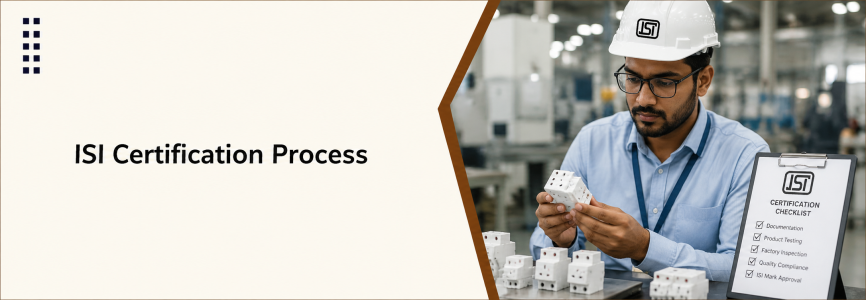



ISI Certification Registration is one of the most important product quality approvals in India. The ISI mark is issued by the Bureau of Indian Standards, commonly known as BIS, and it shows that a product conforms to the relevant Indian Standard. For manufacturers, ISI certification is not just a quality mark; for many products, it is a legal requirement before manufacturing, selling, distributing, importing or supplying the product in India. The ISI mark is mostly used under the BIS Product Certification Scheme, especially Scheme-I of the BIS Conformity Assessment framework. Under this scheme, BIS grants a licence to a manufacturer to use the Standard Mark on specified products after verifying the manufacturing process, testing facilities, quality control system, factory infrastructure and conformity of the product with the applicable Indian Standard.
In India, many products are covered under mandatory BIS certification through Quality Control Orders. These orders are issued by the concerned Ministry or Department of the Central Government in the interest of public safety, consumer protection, fair trade, health, environment and national security. Once a product is notified under a Quality Control Order, the manufacturer cannot legally sell or supply that product without a valid BIS licence and ISI mark.
Meaning of ISI Certification
ISI stands for Indian Standards Institution, the earlier name associated with standardisation in India. Today, the ISI mark is administered by the Bureau of Indian Standards under the BIS Act, Rules and Conformity Assessment Regulations. The mark indicates that the product has been manufactured according to the relevant Indian Standard and has passed the required conformity assessment process.
ISI Certification is mainly product-based and factory-specific. This means the licence is issued for a particular product, against a particular Indian Standard, for a particular manufacturing location. If the manufacturer has multiple factories, separate applications may be required depending on the product and manufacturing location. Similarly, if the same manufacturer wants to add more varieties, grades, sizes or types, the scope of the licence may need to be expanded.
Why ISI Certification is Important
ISI Certification is important because it gives legal permission to manufacture and sell notified products in India. For products under compulsory certification, ISI registration is not optional. It becomes a pre-condition for market entry. From a business perspective, the ISI mark improves customer confidence, supports government tender participation, reduces quality disputes and creates a strong compliance image. Retailers, institutional buyers, government departments, distributors and e-commerce platforms often prefer or require BIS-certified products.
From a legal perspective, manufacturing or selling a notified product without BIS certification may lead to seizure of goods, cancellation proceedings, penalties, prosecution and reputational loss. Therefore, manufacturers should check whether their product falls under compulsory certification before starting commercial production or market supply.
Legal Framework Governing ISI Certification
ISI Certification is governed through multiple legal instruments. The main law is the Bureau of Indian Standards Act, 2016. This Act gives legal authority to BIS for standardisation, certification, use of Standard Mark, inspection, enforcement and penalties. The BIS Rules, 2018 provide the procedural and administrative framework for implementation of the Act. The BIS Conformity Assessment Regulations provide detailed schemes for grant of licence, conditions of licence, surveillance, renewal, suspension and cancellation.
The most relevant conformity assessment route for ISI Mark is Scheme-I under the BIS Conformity Assessment Regulations. Scheme-I deals with product certification for use of the Standard Mark on goods and articles. The licence is granted after BIS is satisfied that the manufacturer has proper manufacturing capability, testing facility, process control, quality assurance system and product conformity. In addition to the BIS Act and Regulations, Quality Control Orders play a major role. A Quality Control Order makes compliance with Indian Standards mandatory for specified products. Once a product is covered by a QCO, the manufacturer, importer or seller must ensure that the product bears the BIS Standard Mark under a valid licence.
Important Legal Sections and Provisions
Section 14 of the BIS Act, 2016
Section 14 empowers the Central Government to notify goods, articles, processes, systems or services for mandatory use of the Standard Mark. This is the legal basis for compulsory BIS certification through Quality Control Orders. When a product is notified under this section, the manufacturer must obtain BIS certification before using the Standard Mark and before placing the product in the Indian market.
Section 15 of the BIS Act, 2016
Section 15 is related to prohibition on certain activities where notified goods do not conform to the prescribed Indian Standard or do not bear the Standard Mark under a valid licence. In simple words, if a product is under compulsory certification, it cannot be manufactured, imported, distributed, sold, hired, leased, stored or exhibited for sale unless it complies with the applicable standard and carries the valid BIS mark.
Section 17 of the BIS Act, 2016
Section 17 prohibits improper use of the Standard Mark. A person cannot use the ISI mark or any imitation of it without a valid BIS licence. False marking, misleading use, use on non-covered products or use after expiry/cancellation of licence may attract legal action. This section is important because many businesses wrongly assume that once they have applied for BIS certification, they can start using the ISI mark. This is incorrect. The ISI mark can be used only after grant of licence and only on products covered under the scope of that licence.
Section 29 of the BIS Act, 2016
Section 29 provides penalties for contravention of the provisions of the Act. Misuse of Standard Mark, sale of non-certified notified products and violation of licence conditions may lead to fine, imprisonment or both, depending on the nature of contravention. The penalty framework is strict because BIS certification deals with product safety, public health and consumer protection. Therefore, manufacturers should not use fake marks, expired licence numbers or misleading product labels.
BIS Conformity Assessment Regulations
The BIS Conformity Assessment Regulations provide the detailed mechanism for grant, operation, renewal, suspension and cancellation of BIS licences. Regulation 4 and Regulation 5 are relevant for grant of licence under Scheme-I. Regulation 6 deals with conditions of licence. Regulation 8 deals with renewal and deferment-related matters. Regulation 11 deals with cancellation in case of violation or non-compliance.
Products Covered under ISI Certification
ISI Certification applies to a wide range of products. Some products are voluntarily certified, while many are under compulsory certification. Products under compulsory certification are notified through Quality Control Orders. Examples of product categories commonly associated with BIS/ISI certification include cement, electrical appliances, household goods, steel products, chemicals, pressure cookers, helmets, cylinders, footwear, toys, cables, switches, packaged drinking water, automotive components and various industrial products. However, the exact applicability depends on the Indian Standard number and the relevant Quality Control Order. A manufacturer should not rely only on the product name. It is necessary to check the technical specification, product composition, intended use, Indian Standard number and notification status.
Recent Updates Related to ISI Certification
The BIS compliance framework is continuously expanding. In recent years, the Central Government has issued several Quality Control Orders covering products such as chemicals, textiles, footwear, steel, furniture, electrical goods, safety products and industrial items. This means more products are moving from voluntary certification to mandatory certification. BIS has also strengthened online filing, product-specific guidelines, surveillance, market sampling and enforcement action against misuse of the ISI mark. The Manak Online portal is now the main platform for filing, communication, renewal and licence-related activities.
As per the current BIS framework, certain upcoming Quality Control Orders are notified with future enforcement dates. Manufacturers must monitor these dates carefully because once the enforcement date arrives, non-certified products may not be legally sold or supplied in India. BIS has also updated its rules and conformity assessment framework from time to time, including amendments to the BIS Conformity Assessment Regulations. Therefore, businesses should check the latest BIS notification, product-specific guidelines and QCO status before applying.
Eligibility for ISI Certification
The eligibility criteria should be checked product-wise, but generally the following persons or entities can apply:
- Manufacturer of the product.
- Factory owner producing the product.
- Indian manufacturer having manufacturing and testing facility.
- Foreign manufacturer through the Foreign Manufacturers Certification Scheme, wherever applicable.
- MSME manufacturer, subject to product-specific requirements.
- Existing manufacturer seeking scope expansion for additional varieties.
- Manufacturer having proper plant, machinery and process control.
- Manufacturer having in-house or permitted testing arrangement.
- Manufacturer ready to follow Scheme of Inspection and Testing.
- Manufacturer willing to allow BIS factory inspection and sample testing.
A trader, distributor, retailer or brand owner generally cannot obtain ISI certification unless they are also the actual manufacturer or have a manufacturing arrangement that satisfies BIS requirements. BIS licence is primarily granted to the manufacturing unit, not merely to the brand owner.
Documents Required for ISI Certification
The document list may vary depending on the product and scheme, but commonly required documents include:
- Business registration proof.
- Factory address proof.
- Manufacturing unit details.
- GST registration certificate.
- PAN card of entity or proprietor.
- Aadhaar/PAN of authorised signatory.
- Authorisation letter.
- Factory layout plan.
- Manufacturing process flow chart.
- List of manufacturing machinery.
- List of testing equipment.
- Calibration certificates of testing equipment.
- Details of quality control staff.
- Product details with grade, type, size and variety.
- Applicable Indian Standard number.
- Test report, wherever required.
- Raw material details.
- Scheme of Inspection and Testing compliance details.
- Trademark or brand details, if applicable.
- Undertaking and declarations.
- Nomination of authorised Indian representative for foreign manufacturer, if applicable.
Step-by-Step Process for ISI Certification Registration
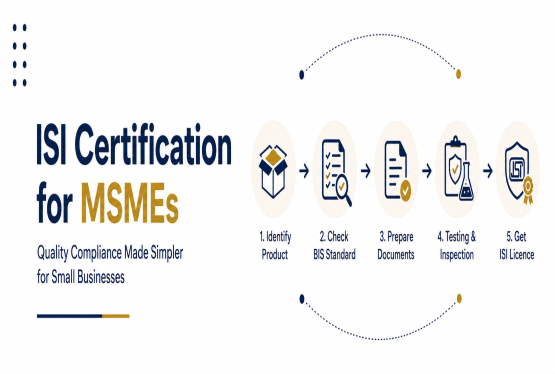
Step 1: Product Identification
The first step is to identify the exact product and applicable Indian Standard. This is very important because BIS certification is granted standard-wise. A wrong standard selection may delay or reject the application. The manufacturer should check the product name, technical specification, material composition, usage and applicable BIS standard. If the product is covered under a Quality Control Order, certification becomes mandatory.
Step 2: Gap Analysis
Before filing the application, the manufacturer should conduct a gap analysis. This includes checking whether the factory has required machinery, testing equipment, trained quality staff, calibration records, manufacturing controls and internal inspection system. If the factory does not have the required testing facilities, the manufacturer may need to upgrade the laboratory or use permitted external testing facilities, depending on BIS guidelines and product requirements.
Step 3: Preparation of Documents
After confirming eligibility, all legal, technical and factory documents should be prepared. Documents should be accurate and consistent with the application form. Any mismatch in business name, factory address, product variety, machinery details or test facilities may lead to BIS queries. The manufacturer should also prepare product labels, marking details and quality control records as per BIS requirements.
Step 4: Online Application Filing
The application is filed online through the BIS portal, generally Manak Online. The applicant must submit the required form, product details, manufacturing unit details, documents, fee and other required information. Under Scheme-I, application is generally filed in Form-V as specified under the BIS conformity assessment framework. After submission, BIS examines the application and may raise queries if documents are incomplete or unclear.
Step 5: Application Scrutiny by BIS
BIS scrutinises the application to verify whether the product is covered under the relevant Indian Standard, whether documents are complete and whether the applicant appears eligible for certification. If BIS finds deficiencies, it may raise clarification or ask for additional documents. The applicant must respond within the prescribed time. Delay in replying may result in rejection or delay in grant of licence.
Step 6: Factory Inspection
BIS conducts factory inspection to verify manufacturing capability, testing arrangements, quality control system, production process and records. The inspection is a very important stage because BIS checks whether the factory can consistently manufacture products as per the relevant Indian Standard. During inspection, BIS officers may verify raw material control, production process, testing records, calibration certificates, laboratory facilities, quality staff competence, packing, marking and storage conditions.
Step 7: Sample Drawal and Testing
BIS may draw product samples during factory inspection. These samples are tested either in BIS-recognised laboratories or as per applicable testing requirements. The purpose is to confirm that the product conforms to the relevant Indian Standard. The applicant is usually responsible for testing charges and timely submission of samples. If the sample fails, BIS may give an opportunity for corrective action or retesting depending on the guidelines and facts of the case.
Step 8: Review of Test Reports
After testing, BIS reviews the test reports and inspection findings. If the product conforms to the standard and the factory satisfies the requirements, BIS may process the application for grant of licence. If there are non-conformities, BIS may issue a query, ask for corrective action, require fresh testing or reject the application if deficiencies are serious or unresolved.
Step 9: Grant of Licence
Once BIS is satisfied, a licence is granted to the manufacturer. The licence mentions the product, Indian Standard number, scope, varieties, grades, brand details, licence number and validity period. After grant of licence, the manufacturer can use the ISI mark only on products covered under the licence and only in the manner permitted by BIS. Use of the mark on products outside the scope is a violation.
Step 10: Marking and Post-Licence Compliance
After certification, the manufacturer must follow the Scheme of Inspection and Testing, maintain quality records, test products regularly, pay marking fee, renew licence on time and allow BIS surveillance inspections. The licence holder must ensure continuous conformity. ISI certification is not a one-time approval. It is an ongoing compliance obligation.
Timeline for ISI Certification
The timeline depends on the product, documentation, inspection, sample testing and response to BIS queries. BIS FAQ indicates that the average time may vary depending on the selected option, completeness of application, inspection, sample deposition, testing and fee compliance. In practical terms, manufacturers should keep buffer time before launching products, especially if the product is under a Quality Control Order with a fixed enforcement date.
Validity and Renewal of ISI Licence
Under Scheme-I, BIS licence may initially be granted up to two years. The licence is valid only for the product varieties mentioned in the scope. It can be renewed by submitting the renewal application, required fee, production details and other documents through the online portal. Renewal may be granted for a further period, subject to compliance history and BIS requirements. If renewal is not applied on time or the licence is under suspension, complications may arise.
Surveillance and Market Monitoring
BIS conducts surveillance after grant of licence. This may include surprise factory visits, verification of production and testing records, witnessing of testing, drawing of factory samples and market sample testing.Market surveillance is important because BIS checks whether ISI-marked products available in the market continue to comply with Indian Standards. If non-conformity is found, BIS may take action against the licence holder.
Suspension and Cancellation of ISI Licence
BIS may suspend or cancel a licence if the manufacturer violates licence conditions, fails product testing, misuses the ISI mark, does not maintain required testing facilities, refuses inspection, fails to pay fees or does not comply with BIS directions. Cancellation can seriously affect business operations, especially where the product is under compulsory certification. After cancellation, the manufacturer cannot use the ISI mark or sell notified products under that licence.
Common Mistakes to Avoid
Many manufacturers face delays because they apply without identifying the correct Indian Standard. Some submit incomplete documents or do not maintain proper testing facilities. Others fail to respond to BIS queries on time. Another common mistake is using the ISI mark before licence grant. Some businesses also use one licence for multiple products or varieties not covered under the scope. This is legally risky and may lead to enforcement action. Manufacturers should also avoid treating BIS certification as only a paperwork process. BIS focuses on actual manufacturing capability, product testing, process control and consistent conformity.
Benefits of ISI Certification
ISI Certification improves product credibility and customer trust. It shows that the product has been tested and certified as per Indian Standard. It also helps businesses enter regulated markets and participate in government or institutional supply. For compulsory products, the biggest benefit is legal market access. Without BIS certification, such products cannot be legally sold after the enforcement date of the applicable Quality Control Order. ISI Certification also helps reduce product liability risk, improves brand image and supports long-term quality control.
Conclusion
ISI Certification Registration is a legal and quality compliance requirement for many products in India. It is governed by the BIS Act, BIS Rules, BIS Conformity Assessment Regulations and Quality Control Orders. For manufacturers, the process involves product identification, document preparation, online application, factory inspection, sample testing, grant of licence and post-certification compliance.
Businesses should check whether their product is covered under compulsory BIS certification before manufacturing or selling it. If the product is notified under a Quality Control Order, obtaining ISI certification becomes mandatory. A proper application, accurate documents, adequate testing facilities and timely compliance can make the certification process smooth and reduce the risk of delay, rejection or enforcement action.
FAQs
Q1. What is ISI Certification?
Ans. ISI Certification is a product certification granted by BIS that allows a manufacturer to use the ISI mark on a product. It confirms that the product complies with the relevant Indian Standard.
Q2. Is ISI Certification mandatory for all products?
Ans. No, ISI Certification is not mandatory for all products. However, for products notified by the Central Government through Quality Control Orders, BIS certification and use of Standard Mark become mandatory.
Q3. Who grants ISI Certification in India?
Ans. ISI Certification is granted by the Bureau of Indian Standards. BIS is the National Standards Body of India and is responsible for standardization, certification and quality assurance.
Q4. How does ISI Certification improve product credibility?
Ans. It improves credibility by showing that the product has been tested and certified as per Indian Standards. Customers and buyers trust ISI-marked products because they indicate safety, quality and compliance.
Q5. Can an importer apply for ISI Certification?
Ans. For many products, BIS certification is granted to the manufacturer, including foreign manufacturers under the applicable BIS scheme. Importers usually need to ensure that the foreign manufacturer has the required BIS licence before importing notified products.
Q6. What happens if a mandatory product is sold without ISI Certification?
Ans. Selling a notified product without valid BIS certification may lead to seizure of goods, penalty, prosecution and imprisonment under the BIS Act, 2016.
Q7. Can a manufacturer use the ISI mark without BIS approval?
Ans. No. The ISI mark can be used only after obtaining a valid BIS licence. Unauthorized use of the ISI mark is a legal offence.
Q8. Is ISI Certification useful for tenders?
Ans. Yes. Many government and institutional tenders require BIS or ISI certification for eligible products. Certification improves the chance of participating in such procurement opportunities.
Q9. How long does it take to get ISI Certification?
Ans. The timeline depends on the product category, documentation, testing requirements, factory readiness and BIS inspection process. Delays may occur if documents are incomplete or the product fails testing.
Q10. Does ISI Certification need renewal?
Ans. Yes. BIS licences are granted for a specific period and must be renewed as per BIS requirements. The manufacturer must maintain compliance and apply for renewal before expiry.


_crop10_thumb.jpg)


_crop10_thumb.jpg)


-Form_crop10_thumb.jpg)

_crop10_thumb.jpg)


_learn_crop10_thumb.jpeg)


_crop10_thumb.jpg)

_crop10_thumb.jpg)


_crop10_thumb.jpg)




_for_Foreign_Directors_learn_crop10_thumb.jpeg)


_Act,_2015_learn_crop10_thumb.jpg)










_learn_crop10_thumb.jpg)









































_crop10_thumb.jpg)

_crop10_thumb.jpg)

_(1)_crop10_thumb.jpg)









_crop10_thumb.png)








_crop10_thumb.jpg)

_crop10_thumb.jpg)








_crop10_thumb.png)


_crop10_thumb.jpg)







_crop10_thumb.png)










_crop10_thumb.jpg)
