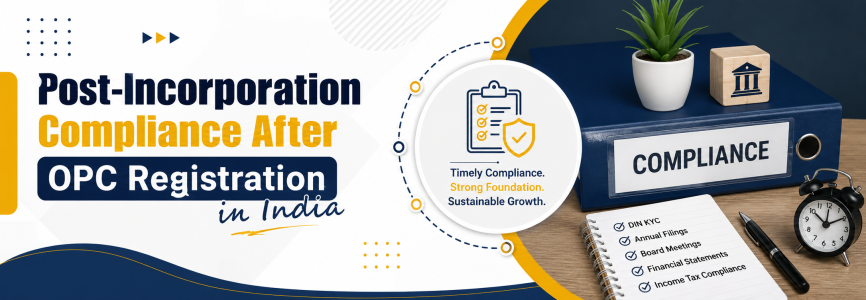



OPC Registration is a major step for any solo founder who wants to start a business with a separate legal identity. However, the work does not end after receiving the Certificate of Incorporation. Once a One Person Company is registered, the founder must complete several post-incorporation compliances to keep the company legally active and compliant.
Many first-time founders focus on starting business operations, getting clients, creating invoices and building their brand. While these things are important, legal compliance should also be handled from the beginning. An OPC is registered under the Companies Act, 2013, and therefore it must follow ROC filings, accounting rules, tax filings and other applicable legal requirements.
Post-incorporation compliance helps the company avoid penalties, maintain clean records and build trust before banks, customers, vendors and government authorities. It also helps the founder keep personal and business records separate, which is one of the biggest advantages of registering an OPC. This article explains the important post-incorporation compliances after OPC Registration in India in a simple and practical manner.
Opening a Current Bank Account
After OPC incorporation, the company should open a current bank account in its own name. Since an OPC is a separate legal entity, business transactions should not be carried out through the personal bank account of the founder. A current account helps the company receive business payments, pay vendors, deposit capital and maintain proper financial records.
Banks usually ask for the Certificate of Incorporation, PAN of the company, Memorandum of Association, Articles of Association, registered office proof, board resolution and KYC documents of the director. The requirements may differ slightly from bank to bank, but the company documents are generally required in all cases.
Using a personal bank account for business transactions is a common mistake. It may create confusion during accounting, tax filing and audit. Therefore, founders should open a current account as soon as possible after incorporation.
Deposit of Subscription Money
After the bank account is opened, the subscriber must deposit the subscription money into the company’s bank account. The subscription money is the amount agreed to be paid by the member for the shares taken at the time of incorporation. For example, if the OPC is incorporated with a subscribed capital of ?1,00,000, the shareholder should deposit this amount into the company’s current account. The bank statement then acts as proof that the company has received the share capital.
This step is important because it is connected with the filing of Form INC-20A. If the subscription money is not deposited properly, the company may face difficulty while filing the declaration for commencement of business.
Filing of Form INC-20A
Form INC-20A is one of the most important post-incorporation compliances for an OPC. It is a declaration for commencement of business. A company having share capital must file this form within 180 days from the date of incorporation.
This form confirms that the subscriber has paid the value of shares agreed to be taken by them. Until Form INC-20A is filed, the company should not commence business operations or borrow money. Missing this filing may lead to penalties and may also affect the company’s active status.
The main document required for Form INC-20A is the bank statement showing receipt of subscription money. The form is filed with the digital signature of the director and certification by a professional, wherever applicable. For every newly incorporated OPC, INC-20A should be treated as a priority compliance. It should not be delayed until the last date.
Appointment of First Auditor
After incorporation, the OPC is required to appoint its first auditor. The first auditor is generally appointed by the Board of Directors within 30 days from the date of incorporation. The auditor is responsible for checking the financial records of the company and issuing the audit report.
Even if the OPC has limited transactions or no major business activity in the first year, audit-related compliance should not be ignored. A company is different from a proprietorship, and its financial statements must be properly prepared and audited.
The appointment of the auditor should be recorded in the company’s documents. In many cases, Form ADT-1 is also filed to record the appointment of the auditor with the Registrar of Companies. A founder should select a qualified Chartered Accountant who can guide the company on audit, accounting and annual filing requirements.
Maintaining Books of Accounts
Every OPC must maintain proper books of accounts from the date of incorporation. Accounting should not be postponed until the end of the financial year. If records are not maintained regularly, the founder may face issues while preparing financial statements, GST returns, income tax returns and ROC filings.
Books of accounts should properly record sales, purchases, expenses, bank entries, capital received, loans, assets, liabilities and other business transactions. All invoices, receipts, bank statements, payment proofs and agreements should be safely maintained.
Proper accounting also helps the founder understand the financial position of the company. It shows whether the business is making profit, how much money is being spent and what liabilities are pending. For a small OPC, this financial clarity is very useful for business planning.
Issue of Share Certificate
After receiving the subscription money, the OPC should issue a share certificate to its member. A share certificate is proof that the person owns shares in the company. Since an OPC has only one member, this step may look simple, but it is still an important company record.
The share certificate should mention the name of the company, name of the shareholder, number of shares, face value, certificate number and date of issue. The company should also update its register of members. Maintaining proper share records helps in future situations such as conversion, change in capital, due diligence or legal verification.
Maintaining Statutory Registers and Records
An OPC must maintain statutory records as required under company law. These records show important details about the company, its member, director, shares, meetings, decisions and other corporate matters.
Even though an OPC has only one member, it is still a company. Therefore, basic registers, minutes and records should be maintained carefully. These documents may be required at the time of annual filing, audit, inspection, conversion or any future legal work. Good recordkeeping from the beginning saves time and reduces errors. It also creates a professional system for the company.
Display of Company Name and Details
After incorporation, the OPC should use its correct company name on official documents and business communication. The company name should be mentioned on invoices, letterheads, contracts, business proposals, email signatures and website, wherever applicable.
The company should also mention its Corporate Identification Number, registered office address, email ID and other required details in official communication as per applicable legal requirements. This helps the company present itself as a legally registered and professional business. It also gives confidence to clients and vendors while dealing with the company.
GST Registration and GST Compliance
GST Registration is not mandatory for every OPC immediately after incorporation. It depends on the nature of business, turnover, type of supply and place of supply. However, the founder must check whether GST applies to the company.
An OPC may need GST Registration if it crosses the prescribed turnover limit, makes interstate taxable supplies, sells through an e-commerce operator or falls under any mandatory registration category. Many B2B clients also prefer to work with vendors who can issue GST invoices. Once GST Registration is obtained, the company must file GST returns on time. It must maintain proper GST invoices, purchase records, input tax credit details and tax payment records. Delay in GST filing may lead to late fees, interest and other compliance issues.
Income Tax Compliance
An OPC is required to file its income tax return every year. This requirement applies even if the company has low revenue or no major business activity. Since an OPC is a company, it generally files its income tax return in Form ITR-6.
The company should maintain proper books of accounts, expense records, tax computation and audit details. If the company makes payments such as professional fees, rent, salary, commission or contractor charges, TDS applicability should also be checked. Income tax compliance should not be handled only at the end of the year. The founder should keep records updated throughout the year so that tax filing becomes smooth and accurate.
TDS Compliance
TDS compliance becomes relevant when the OPC makes certain payments on which tax is required to be deducted. These payments may include professional fees, contractor payments, rent, salary, commission or interest.
If TDS applies, the company must deduct tax at the correct rate, deposit it with the government and file TDS returns within the due date. The company may also need to obtain TAN for TDS compliance. Many small companies miss TDS compliance because they assume it applies only to large businesses. This is not correct. TDS depends on the type and amount of payment. Therefore, each important payment should be checked from a tax compliance point of view.
Shops and Establishment and Other State-Level Compliance
Apart from ROC and tax compliance, an OPC may also need state-level registrations depending on its business location and activity. Shops and Establishment Registration is one such common compliance for businesses operating from an office, shop or commercial place.
Professional Tax Registration may also apply in some states. If the company hires employees, labour law compliances such as PF, ESI and labour welfare fund may also become applicable depending on employee count and state rules. These compliances are not the same for every OPC. A founder should check the requirements based on the state, business activity, number of employees and place of operation.
Board Meetings and Company Decisions
An OPC gets certain relaxations under the Companies Act, but company decisions should still be properly recorded. If the OPC has only one director, some board meeting provisions may not apply in the same manner as they apply to companies with more directors. However, important decisions should still be documented.
Decisions such as opening a bank account, appointing an auditor, approving financial statements, changing the registered office, entering into important contracts or borrowing money should be recorded properly. Maintaining minutes and written records helps prove that the company has taken decisions in a proper and legal manner.
Annual Financial Statements
At the end of every financial year, the OPC must prepare its financial statements. These statements show the financial position and performance of the company. They generally include the balance sheet, profit and loss account, notes to accounts and auditor’s report.
The financial statements should be prepared on the basis of proper books of accounts. They should match the bank records, invoices, expenses, tax records and other financial documents. For an OPC, financial statements must be audited by a Chartered Accountant before being filed with the Registrar of Companies. Even if the company has not earned revenue, annual financial statement preparation and filing may still be required.
Filing of Form AOC-4
Form AOC-4 is filed with the Registrar of Companies for submitting the financial statements of the OPC. This is one of the main annual ROC compliances. The form contains financial information such as share capital, assets, liabilities, revenue, expenses, profit or loss and audit details. The audited financial statements and auditor’s report are generally attached with the form. For an OPC, AOC-4 is usually filed within 180 days from the end of the financial year. Since the financial data becomes part of the company’s official record, it should be prepared and filed carefully.
Filing of Form MGT-7A
Form MGT-7A is the annual return form applicable to One Person Companies and small companies. It contains basic annual details of the company, including registered office, principal business activities, shareholding, director details and other company information.
An OPC is not required to hold an Annual General Meeting like other companies. However, it is still required to file its annual return. MGT-7A helps the ROC keep updated records of the company every year. This filing should not be missed, even if the company has no major business activity during the year.
Director KYC Compliance
Every person who has a Director Identification Number must complete DIR-3 KYC compliance every year, as applicable. This applies to OPC directors also. If the director does not complete KYC within the due date, the DIN may be marked as deactivated due to non-filing of KYC. Once the DIN is deactivated, the director may face difficulty in signing company forms and completing MCA filings. For this reason, the OPC founder should complete DIN KYC on time every year.
Registered Office Compliance
The registered office of the OPC should always remain valid and accessible. This is the official address of the company where government notices, MCA communication and legal documents may be sent. If the company changes its registered office, the required form must be filed with the ROC. The company should also maintain proof of the registered office, such as rent agreement, electricity bill, property tax receipt or NOC from the owner, depending on the case. Using an old or inactive address can create problems if the company misses important notices or official communication.
Event-Based Compliance
Apart from regular annual compliance, an OPC must also complete event-based compliance whenever certain changes take place in the company. These changes may include change in registered office, change in director, change in nominee, increase in authorised capital, change in auditor, alteration of MOA or AOA, change in company name or conversion of OPC into a private limited company.
Most event-based filings have specific timelines. If the company delays these filings, additional fees and penalties may apply. Therefore, whenever any major change takes place in the company, the founder should immediately check whether ROC filing is required.
Nominee-Related Compliance
A nominee is an important part of an OPC structure. The nominee is the person who may become the member of the company in case the sole member dies or becomes incapable of managing the company. If the nominee withdraws consent, becomes ineligible or needs to be changed, the company must complete the required documentation and ROC filing. The nominee’s consent and identity details should be properly maintained in the company records. This compliance should not be ignored because nominee details are directly connected with the continuity of the OPC.
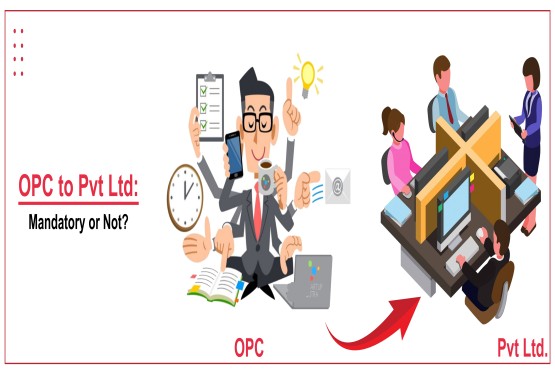
Conversion-Related Compliance
As the business grows, the founder may decide to convert the OPC into a private limited company. This may happen when the founder wants to add more shareholders, raise investment, expand ownership or create a larger business structure.
Compliance Before Conversion
Before conversion, the company should make sure that all annual filings, tax filings, statutory records and accounting records are updated.
Benefit of Clean Records
Pending compliance can delay the conversion process and create additional work. A clean compliance record makes future growth and restructuring easier.
Common Mistakes After OPC Registration
Many first-time founders make compliance mistakes because they treat an OPC like a normal proprietorship. This can create legal and financial issues later. Common mistakes include delay in filing INC-20A, not depositing subscription money, using personal bank accounts for business, not appointing an auditor, delaying accounting work, missing annual ROC filing, ignoring GST or TDS compliance and not completing DIR-3 KYC.
These mistakes may look small in the beginning, but they can result in penalties, additional fees and compliance burden. The best way to avoid them is to maintain proper records and track due dates from the first year itself.
Importance of Post-Incorporation Compliance
Post-incorporation compliance is important because it keeps the OPC legally active and professionally managed. A company with clean records is easier to manage, easier to audit and easier to expand. Compliance also improves business credibility. Banks, clients, vendors, government departments and investors may check whether the company is active and compliant before dealing with it. If the company’s filings are pending, it may affect trust and delay business opportunities.
For a solo founder, compliance also helps maintain a clear difference between personal identity and business identity. This is important because limited liability protection works better when company records are properly maintained.
Conclusion
Post-incorporation compliance after OPC Registration in India is an important responsibility for every solo founder. After incorporation, the company must open a current bank account, deposit subscription money, file INC-20A, appoint an auditor, maintain books of accounts, complete tax filings and file annual ROC forms.
An OPC gives the founder the benefit of separate legal identity and limited liability, but these benefits come with legal responsibilities. If compliance is handled from the beginning, the company can avoid penalties and maintain a clean business record. For first-time founders, the best approach is to maintain proper records from day one and track all due dates. With timely compliance, an OPC can run smoothly and grow with confidence.
FAQ’S
Q1. Is compliance required after OPC Registration?
Ans. Yes, an OPC must complete ROC, tax, accounting and annual filing compliances after incorporation.
Q2. Is Form INC-20A mandatory for OPC?
Ans. Yes, an OPC with share capital must file Form INC-20A before starting business operations.
Q3. When should INC-20A be filed for OPC?
Ans. Form INC-20A should be filed within 180 days from the date of incorporation.
Q4. Does an OPC need a current bank account?
Ans. Yes, an OPC should open a current bank account in the company’s name.
Q5. Is auditor appointment required for OPC?
Ans. Yes, an OPC must appoint its first auditor after incorporation.
Q6. Does OPC need to file annual returns?
Ans. Yes, an OPC must file annual ROC forms such as AOC-4 and MGT-7A.
Q7. Is GST mandatory for every OPC?
Ans. No, GST applies only if the OPC meets GST registration requirements.
Q8. Does OPC need to file income tax return?
Ans. Yes, an OPC must file its income tax return every year.
Q9. Is DIR-3 KYC required for OPC director?
Ans. Yes, the OPC director must complete DIR-3 KYC every year, if applicable.
Q10. What happens if OPC compliance is missed?
Ans. Missing compliance may lead to penalties, additional fees and filing issues.


_crop10_thumb.jpg)


_crop10_thumb.jpg)


-Form_crop10_thumb.jpg)

_crop10_thumb.jpg)


_learn_crop10_thumb.jpeg)


_crop10_thumb.jpg)

_crop10_thumb.jpg)


_crop10_thumb.jpg)




_for_Foreign_Directors_learn_crop10_thumb.jpeg)


_Act,_2015_learn_crop10_thumb.jpg)










_learn_crop10_thumb.jpg)










































_crop10_thumb.jpg)


_crop10_thumb.jpg)


_(1)_crop10_thumb.jpg)








_crop10_thumb.png)








_crop10_thumb.jpg)


_crop10_thumb.jpg)






_crop10_thumb.png)
_crop10_thumb.jpg)







_crop10_thumb.png)