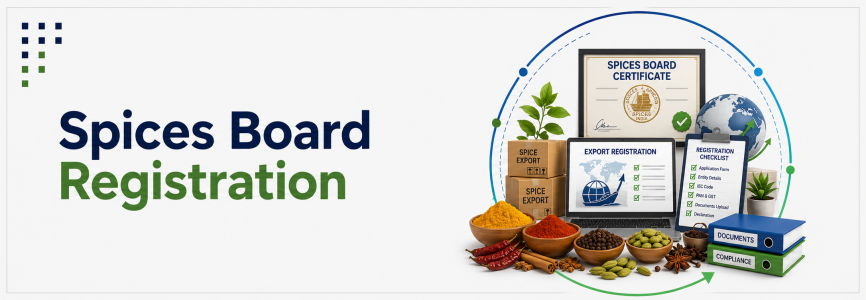



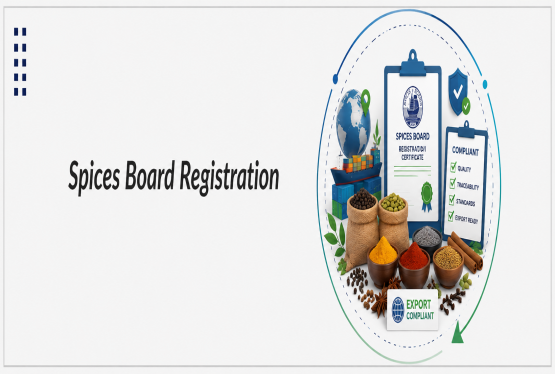
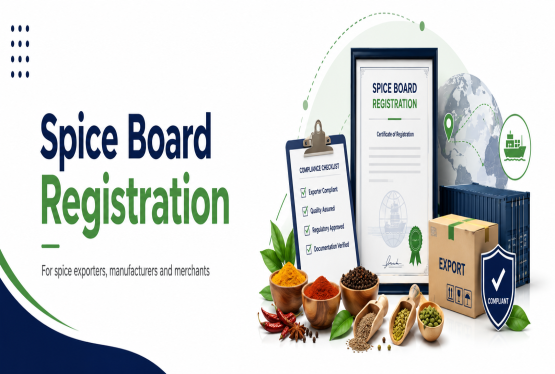
India offers significant opportunities for businesses exporting whole spices, ground spices, masala blends, spice oils and other value-added products. However, an Importer Exporter Code alone is not sufficient to begin this business. An exporter dealing in products covered by the Spices Board Act must obtain a Certificate of Registration as Exporter of Spices, commonly known as CRES.
CRES gives the business statutory authority to export spices from India and connects it with the regulatory, quality-control and export-promotion system administered by the Spices Board. It is therefore not merely a membership certificate but an essential legal approval for carrying on the spices export business.
Meaning of Spices Board Registration
Spices Board Registration means registration of an eligible business as a merchant exporter or manufacturer exporter of spices. It is separate from company or LLP incorporation, GST registration, an FSSAI licence and IEC. A spice exporter may require all these approvals because each registration operates under a different law.
The certificate is issued to a particular business entity and is not transferable. It records the exporter’s identity, constitution, category and approved particulars. Changes in ownership, constitution, name, address or processing unit must therefore be reported and processed through the prescribed amendment or fresh-registration procedure.
Legal Provisions Governing CRES
The principal legislation is the Spices Board Act, 1986. Section 3 establishes the Spices Board, while Section 7 authorises it to develop and regulate exports, grant export certificates, control export quality, promote better processing, grading and packaging, collect industry statistics and undertake export-development programmes.
Section 11 provides that no person may commence or carry on the business of exporting any spice except under and in accordance with a certificate. Section 12 governs the application and grant of that certificate. Section 13 permits its suspension or cancellation for violation of certificate conditions or in the public interest, while Section 14 provides the right to appeal.
The procedural requirements are further governed by the Spices Board Rules, 1987 and the Spices Board (Registration of Exporters) Regulations, 1989. These regulations deal with applications, documents, certificate conditions, reporting obligations, renewal, maintenance of records and changes in the exporter’s business.
Products Covered Under the Act
The Schedule to the Spices Board Act includes cardamom, pepper, chilli, ginger, turmeric, coriander, cumin, fennel, fenugreek, celery, aniseed, caraway, dill, cinnamon, cassia, garlic, curry leaf, kokam, mint, mustard, parsley, saffron, vanilla, clove, asafoetida, nutmeg, mace, basil, poppy seed, rosemary, sage, thyme, oregano, tarragon, tamarind and several other specified spices.
The law is not limited to raw or whole spices. It also covers spices in any form, including curry powders, spice oils, oleoresins and mixtures in which spice content is predominant. Exporters of masala blends, powders, seasonings and value-added spice preparations should therefore examine the composition and applicable ITC (HS) classification of their products.
Who Must Obtain Spices Board Registration?
Any person proposing to carry on the business of exporting covered spices or spice products from India ordinarily requires CRES. The applicant may operate as a proprietorship, partnership firm, limited liability partnership, company, co-operative society, farmer producer organisation or another legally recognised business entity.
CRES is linked to the exporter’s legal identity and IEC. It cannot be used by another business. Where a registered business is sold or transferred, the purchaser does not automatically acquire the seller’s certificate and must obtain registration in its own name.
Merchant Exporter and Manufacturer Exporter
A merchant exporter purchases spices or spice products from farmers, processors, manufacturers or other domestic suppliers and exports them to overseas buyers. Activities such as cleaning, grinding, sterilisation or packing may be outsourced to third-party processing units.
A manufacturer exporter operates or legally controls a processing or manufacturing unit. The Spices Board may inspect the unit and examine its machinery, licences, storage arrangements, hygiene systems and operational facilities before granting manufacturer status. Every establishment used for warehousing, processing or value addition of export spices should be disclosed in the application.
The applicant should select the correct category because a merchant exporter cannot claim to be a manufacturer merely because the goods are packed under its brand. The category should reflect who actually controls and operates the processing facility.
Difference Between CRES, RCMC and IEC
The Importer Exporter Code is the DGFT business identification number required for import-export activity, but IEC does not replace CRES. Before applying for Spices Board Registration, the exporter should have an active IEC and ensure that its PAN, bank account and business details are correctly updated on the DGFT portal.
Paragraph 2.57(b) of the Foreign Trade Policy 2023 provides that CRES issued by the Spices Board is treated as a Registration-cum-Membership Certificate for policy purposes. A registered spice exporter therefore does not ordinarily require a separate RCMC from another export promotion council for the same mainstream spice business.
CRES may consequently be used while applying for eligible authorisations, concessions or export-promotion benefits under the Foreign Trade Policy, subject to the conditions of the relevant scheme.
Basic Eligibility Requirements
Before filing the application, the applicant should have a legally constituted business, PAN, active IEC, bank account, valid contact information and premises connected with the declared business activity.
The legal name and address should remain consistent across IEC, PAN, GST registration, FSSAI licence, bank documents, incorporation documents and lease or ownership records. Material differences between these documents may result in a deficiency notice or request for clarification.
The correct FSSAI licence must also be obtained for the actual food-business activity. The FoSCoS eligibility criteria updated on 1 April 2026 classify Trader/Merchant-Exporter and Exporter-Manufacturer activities under Central Licence categories. The selected kind of business must correctly reflect whether the applicant manufactures, trades, repacks, stores or handles products for domestic as well as export markets.
Documents Required for CRES
The document set normally includes IEC details, PAN, GST registration or an acceptable declaration where GST is not applicable, a valid FSSAI licence, a bank report in the prescribed format and proof of the constitution of the business.
A company generally submits its Certificate of Incorporation, Memorandum of Association, Articles of Association and current directors’ details. An LLP submits its incorporation certificate and LLP agreement, while a partnership firm submits its partnership deed and partner details.
Where an employee or authorised representative files the application, an authority letter from the proprietor, partner or director should be submitted. The details of the authorised person should correspond with the information entered in the application.
A manufacturer exporter may additionally be required to provide Udyam registration mentioning the spice activity, pollution-control approval where applicable, ownership papers or a valid lease or rent agreement, photographs of the premises, details of machinery and processing activities, and other documents required for inspection.
Application Process Through the DGFT Portal
Fresh and renewal CRES applications are now submitted through the DGFT e-RCMC system. The applicant must log in through its IEC-linked account, access the electronic RCMC service, select the Spices Board as the registering authority, enter the exporter category and product details, upload the supporting documents and pay the prescribed fee through the online payment gateway.
The particulars entered in the application must match the IEC profile. The applicant should carefully select merchant or manufacturer status and disclose all locations involved in storing, processing or adding value to spices.
After submission, the competent Spices Board office examines the application. Deficiencies may be communicated to the applicant for correction. Where manufacturer status is sought, the application may proceed for documentary or physical inspection before the certificate is approved.
Inspection of the Processing Unit
Manufacturer CRES is granted only after the Spices Board is satisfied with the facilities available at the applicant’s processing plant or unit. The inspection may confirm legal possession of the premises, actual processing capability, machinery, storage facilities, hygiene arrangements and whether the addresses mentioned on FSSAI and other licences match the application.
A processing unit with missing approvals, incorrect address records or inadequate operational facilities may not qualify for manufacturer registration. A merchant exporter using outside processors should retain proper agreements, purchase invoices, processing records and traceability documents relating to the outsourced work.
Government Fees for CRES
The published fee for fresh manufacturer registration is ?17,700, including 18% GST. The fee for fresh merchant registration is ?11,800, including GST.
The published renewal fee is ?11,800 for a manufacturer exporter and ?8,850 for a merchant exporter. The amendment fee is ?5,900. These amounts are paid through the payment gateway integrated with the DGFT portal.
Government fees may be revised through subsequent circulars. The amount generated on the DGFT portal at the time of filing should therefore be checked before payment.
Validity and Renewal of CRES
CRES is presently valid for three years from the date of issue. This replaced the older block-period system under which certificates expired at the end of a common three-year period.
The exporter must submit the renewal application before the certificate expires. An application received after expiry is not entertained as an ordinary renewal, and the exporter may be required to apply as a fresh applicant.
Exporters that have not undertaken any export of spices during the certificate’s validity may also be required to submit a fresh application instead of obtaining renewal. Pending quarterly returns should be completed before the renewal application is filed.
Conditions Attached to Registration
CRES is personal to the certificate holder and cannot be sold, assigned or transferred. The exporter must follow the instructions issued by the Board, maintain the prescribed registers and produce books, accounts and business records when lawfully required. Changes in ownership, constitution, name or address should be intimated within the prescribed period. The 1989 Regulations provide a 30-day period for reporting such changes, with limited power to condone delay where sufficient reasons are established.
Registered exporters may also be required to register export contracts for specified spices and register brand names where the Board has notified such a requirement for branded consumer packs. Spices Board brand registration is different from trademark registration under the Trade Marks Act, 1999. Exporters selling spices under their own label should separately protect the brand through trademark registration.
Quarterly Export Returns
Every registered exporter must submit quarterly export, purchase and import returns through the Spices Board’s Export Support System. The return must be submitted on or before the tenth day of the succeeding quarter. A Nil return is mandatory even where the exporter has not undertaken any export, purchase or import during the quarter.
A Spices Board circular dated 26 March 2025 directed exporters to clear pending quarterly returns for 2022-23, 2023-24 and 2024-25. The circular demonstrates that quarterly filing is an actively monitored compliance obligation and not merely a statistical formality.
The Board has also clarified that failure to submit returns on time, or failure to export any spice during the validity period, can make the exporter ineligible for renewal. Applications filed after expiry without completed returns may be summarily rejected, and the fee paid may not be refunded.
Quality Testing and Shipment Compliance
CRES authorises the business to operate as a spice exporter, but it does not automatically clear every export consignment. Section 7 of the Spices Board Act empowers the Board to control the quality of spices intended for export.
Mandatory sampling, laboratory testing or official certification may apply to selected spices and destinations. The Spices Board operates Quality Evaluation Laboratories and an Export Support System for processing sampling requests, test reports and shipment-related quality clearances.
Exporters must comply with importing-country requirements relating to pesticide residues, aflatoxins, contaminants, microorganisms, additives, prohibited dyes, cleanliness and foreign matter. Product and destination requirements can change, so the latest circulars should be reviewed before every shipment.
Depending on the product and destination, the exporter may also need compliant packaging and labelling, phytosanitary certification, a certificate of origin, fumigation or treatment documents, health certificates and buyer-specific laboratory reports.
Other Legal Registrations
Spices Board Registration operates alongside other laws. IEC remains mandatory, while GST registration, LUT filing, export invoices, shipping bills and refund procedures are governed separately by GST and customs laws.
Exports are treated as zero-rated supplies under Section 16 of the Integrated Goods and Services Tax Act, subject to the conditions prescribed under the Act and Rules. Exporters may follow the applicable route for export under LUT or on payment of integrated tax, depending on the prevailing legal provisions.
FSSAI licensing applies according to the food-business activity. Manufacturer exporters may also require factory registration, fire approval, municipal permission, pollution-control consent, labour registrations or local trade licences depending on their operations and the state in which the unit is situated.
Organic products, GI-tagged spices and exports to certain overseas markets may require additional certification, authorised-user registration, overseas food-facility registration or destination-specific approvals.
Suspension, Cancellation and Appeal
Under Section 13 of the Spices Board Act, the Board may cancel a certificate where the exporter has violated its terms or where the Central Government considers cancellation necessary in the public interest.
Pending a decision on cancellation, the Board may suspend the certificate for a period not exceeding 45 days and require the certificate holder to show cause within 15 days. A final cancellation order cannot be made without giving the exporter a reasonable opportunity of being heard.
Section 14 permits an aggrieved exporter to appeal to the Central Government in the prescribed manner. After hearing the appellant, the Central Government may confirm, modify or reverse the order.
Penalties and Recent Legal Amendment
The Jan Vishwas (Amendment of Provisions) Act, 2023 revised the penalty provisions under the Spices Board Act with effect from 9 August 2024.
Failure to furnish required returns, knowingly furnishing false returns, obstructing authorised officers, failing to produce records, exporting spices in contravention of Section 11 and other violations may attract a monetary penalty extending to ?50,000. A subsequent contravention may attract a penalty extending to ?1 lakh.
Section 30A provides for adjudication by an authorised officer after giving the affected person a reasonable opportunity of being heard. An appeal against the adjudicating officer’s order may be filed before the Secretary to the Board within 60 days, subject to condonation where sufficient cause is shown.
Section 32 also connects unauthorised spice exports with the Customs Act, 1962, by treating the relevant goods as goods whose export is prohibited or restricted. This means a non-compliant consignment may face customs consequences in addition to action under the Spices Board Act.
Recent Updates for Spice Exporters
A major procedural update is the integration of fresh and renewal CRES applications with the DGFT e-RCMC portal. The Spices Board’s 2024 circular confirms three-year validity, compulsory filing of renewal before expiry and completion of pending quarterly returns before renewal.
The 2025 circular on quarterly returns reinforces online filing and confirms that Nil returns are required even where no transactions have taken place. Exporters should maintain a quarterly compliance calendar instead of waiting until renewal to clear several years of pending filings.
As of July 2026, the Spices Board states that the SPICED export-development scheme has been extended until 30 September 2026, or until approval of the successor scheme, whichever is earlier. Exporters holding valid CRES may access eligible support for market expansion, trade promotion and technological interventions, subject to the conditions of the relevant component.
Common Reasons for Delay or Rejection
Common practical causes of delay include differences in legal names or addresses across IEC, GST, FSSAI and bank records, an incorrect bank report, selection of the wrong exporter category and failure to provide complete constitutional documents.
Manufacturer applications may face delays where the applicant cannot establish lawful possession of the processing unit, the FSSAI licence does not contain the correct unit address or the premises are not operationally ready for inspection. These risks follow from the Board’s prescribed document and inspection requirements.
Renewals may be rejected where the application is filed after expiry, quarterly returns remain pending or no spice export was undertaken during the certificate’s validity. CRES should therefore be treated as a continuing compliance obligation rather than a one-time registration.
Conclusion
Spices Board Registration is the statutory foundation for exporting spices and spice products from India. Section 11 of the Spices Board Act makes the certificate mandatory, while the Spices Board Regulations impose continuing duties relating to records, returns, inspection, reporting of changes and renewal.
CRES also operates as the exporter’s RCMC under Foreign Trade Policy 2023. However, it does not replace IEC, FSSAI, GST, customs or destination-specific quality approvals.
A compliant exporter must coordinate all these registrations and maintain accurate business records. Timely quarterly returns, proper quality testing and renewal before expiry are essential to prevent disruption of exports, rejection of applications, customs action and statutory penalties.
Frequently Asked Questions (FAQs)
Q1. Is Spices Board Registration mandatory for spice exporters?
Ans: Yes, exporters dealing in spices or spice products covered under the Spices Board Act must obtain CRES.
CRES stands for Certificate of Registration as Exporter of Spices.
Exporting covered spices without a valid certificate may result in penalties and customs action.
The registration must be obtained before commencing regular spice export activities.
Q2. What is CRES Registration?
Ans: CRES is the statutory registration issued by the Spices Board to eligible spice exporters.
It authorises a business to export spices and specified value-added spice products from India.
The certificate may be granted under the merchant exporter or manufacturer exporter category.
It also operates as an RCMC for spice exports under the Foreign Trade Policy.
Q3. Who can apply for Spices Board Registration?
Ans: A proprietorship, partnership firm, LLP, company, cooperative society or other eligible entity may apply.
The applicant must have a valid PAN, IEC, bank account and required business registrations.
The legal name and address should match across all supporting documents.
Manufacturer exporters must also establish their processing or manufacturing facilities.
Q4. What is the difference between a merchant and manufacturer exporter?
Ans: A merchant exporter purchases spices from manufacturers, processors, traders or farmers for export.
A manufacturer exporter processes or manufactures spice products at its own or legally controlled unit.
Manufacturer applications may require additional licences, machinery details and unit inspection.
The correct category must be selected according to the exporter’s actual business activities.
Q5. Is IEC required before applying for CRES?
Ans: Yes, a valid Importer Exporter Code is generally required before filing the CRES application.
The IEC is issued by the Directorate General of Foreign Trade to eligible importers and exporters.
CRES does not replace the IEC because both registrations serve different legal purposes.
The IEC profile should be active and updated before the CRES application is submitted.
Q6. What documents are required for Spices Board Registration?
Ans: Common documents include PAN, IEC, FSSAI licence, GST details and a prescribed bank report.
Constitutional documents such as an incorporation certificate or partnership deed are also required.
Manufacturer exporters may need unit photographs, machinery details, Udyam registration and premises proof.
The Spices Board may request additional documents depending on the applicant’s category and activity.
Q7. What is the validity period of CRES?
Ans: A CRES certificate is generally valid for three years from its date of issue.
The exporter must file the renewal application before the existing certificate expires.
Applications filed after expiry may be treated as fresh registration applications.
Pending quarterly returns should be completed before applying for renewal.
Q8. Are quarterly returns mandatory for registered exporters?
Ans: Yes, registered exporters must submit quarterly export, purchase and import returns online.
A Nil return must also be filed when no transaction has taken place during the quarter.
Returns are generally required by the tenth day of the succeeding quarter.
Failure to file returns may affect renewal and may also attract regulatory action.
Q9. Does CRES replace an FSSAI licence?
Ans: No, CRES and an FSSAI licence are issued under different laws and serve separate purposes.
CRES authorises the export of spices, while FSSAI regulates food manufacturing, storage and trading activities.
The appropriate Central FSSAI licence may be required depending on the exporter’s business model.
Both registrations should contain consistent business and premises details.
Q10. Is quality testing mandatory for spice exports?
Ans: Quality testing may be mandatory depending on the spice, destination country and applicable Board directions.
Exporters must comply with limits relating to pesticide residues, contaminants, microorganisms and prohibited substances.
Certain consignments may require sampling or testing through authorised laboratories before export.
Buyer-specific and importing-country quality standards must also be checked before shipment.


_crop10_thumb.jpg)


_crop10_thumb.jpg)


-Form_crop10_thumb.jpg)

_crop10_thumb.jpg)


_learn_crop10_thumb.jpeg)


_crop10_thumb.jpg)

_crop10_thumb.jpg)


_crop10_thumb.jpg)





_for_Foreign_Directors_learn_crop10_thumb.jpeg)


_Act,_2015_learn_crop10_thumb.jpg)










_learn_crop10_thumb.jpg)



































_crop10_thumb.jpg)

_crop10_thumb.jpg)
_(1)_crop10_thumb.jpg)









_crop10_thumb.png)










_crop10_thumb.jpg)


_crop10_thumb.jpg)






_crop10_thumb.png)


_crop10_thumb.jpg)