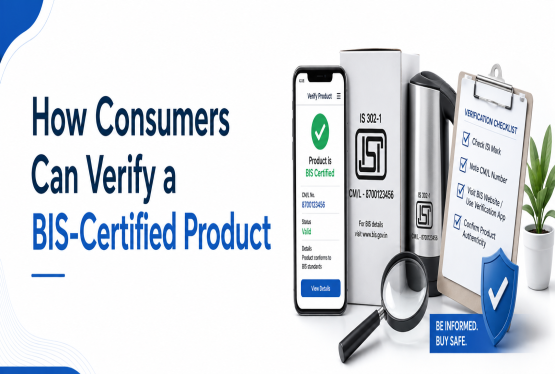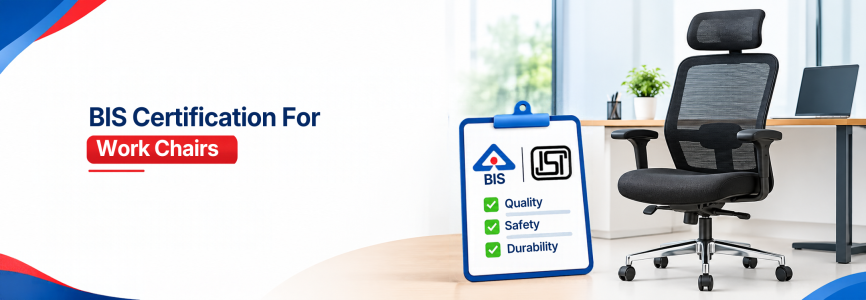



A good office chair should do more than look comfortable. It should support daily use, remain stable when someone leans back and withstand years of regular movement. But how can a buyer know whether a chair is actually safe and durable? This is where BIS Certification for Work Chairs under IS 17631:2022 becomes important.
The Bureau of Indian Standards (BIS) has prescribed quality and safety requirements for work chairs. Under the Furniture (Quality Control) Order, 2025, BIS Certification became mandatory for covered work chairs in 2026, subject to applicable exemptions. The government has also introduced several amendments affecting small manufacturers, importers, existing stock and certification requirements. Here is what manufacturers and furniture businesses need to know.
What is BIS Certification for Work Chairs?
BIS Certification for Work Chairs confirms that a chair meets the requirements of IS 17631:2022 – Work Chairs — Specification. This Indian Standard covers important aspects of work-chair design, dimensions, strength, stability and durability.
For example, an adjustable office chair must meet relevant safety and performance requirements. Its seat, backrest, wheels, base and adjustment mechanisms are evaluated through applicable tests. After successful assessment, BIS may grant the manufacturer a licence to use the ISI Mark on approved products.
Is BIS Certification Mandatory for Work Chairs in 2026?
Yes. BIS certification is mandatory for work chairs covered under IS 17631:2022, unless an applicable exemption is available. The government notified the Furniture (Quality Control) Order, 2025, under the BIS Act, 2016.
The important implementation dates are:
|
Category |
Implementation date |
|
General manufacturers |
13 February 2026 |
|
Micro and small enterprises |
13 August 2026 |
|
Qualifying smaller manufacturers |
Conditional exemption |
The order requires covered furniture to carry the ISI Mark under a valid BIS licence. Importers and sellers must also ensure that covered products comply with the applicable requirements.
Which Work Chairs Require BIS Certification?
IS 17631:2022 applies to work chairs meeting the definition and scope of the standard.
Common examples include:
- Adjustable office chairs
- Ergonomic swivel chairs
- Executive office work chairs
- Height-adjustable computer chairs
- Work chairs with or without armrests
- Office chairs with reclining mechanisms
The actual design and intended use determine whether a chair falls under this standard.
For example, an adjustable office chair may fall under IS 17631:2022, while a fixed visitor chair may fall under IS 17632:2022, which covers general-purpose chairs and stools.
Important Requirements and Tests under IS 17631:2022
IS 17631:2022 sets requirements to help ensure that work chairs are suitable for their intended use.
-
Design and workmanship : Chairs should not have unsafe sharp edges, exposed projections or poorly finished components. Moving parts and adjustment mechanisms must meet applicable requirements.
-
Dimensions : Seat height, width, depth and other relevant dimensions are checked against the standard.
-
Stability testing : This checks whether a chair can resist overturning under prescribed conditions, including forward, sideways and backward loading.
-
Static-load testing : The seat, backrest, armrests and other applicable components are tested to evaluate their ability to withstand specified loads.
-
Durability testing : Repeated-load tests evaluate the chair's performance during extended use. These may include the seat, backrest, swivel mechanism, castors and chair base.
-
Surface and material requirements : Relevant upholstery and surface-performance requirements must be checked against the current standard, including its amendments.
Amendment No. 1 to IS 17631:2022
One important update concerns Amendment No. 1 to IS 17631:2022, referenced in later technical records as Amd. 1:2025. The amendment affects technical requirements relating to work-chair testing. Certain later laboratory records identify changes to surface-performance test parameters. Manufacturers should obtain the current amendment from the official BIS Standards Portal rather than relying entirely on older test lists. The June 2025 BIS Product Manual still recorded no amendments at the time of its publication. Consequently, its testing provisions should be checked against the later amendment before preparing samples.
Latest Furniture QCO Amendments and Updates 2026
The Furniture QCO has undergone several important changes. These updates are relevant to manufacturers and importers of work chairs.
|
Notification |
Important update |
|
Furniture QCO, February 2025 |
Mandatory certification introduced for six furniture categories |
|
First Amendment, February 2026 |
R&D imports, existing-stock relief and export-related exemptions |
|
S.O. 777(E), February 2026 |
Revised exemption limits for qualifying smaller manufacturers |
|
Second Amendment, March 2026 |
Conditional relief for earlier furniture imports |
|
Transition Facilitation Order, June 2026 |
Conditional alternative compliance arrangement |
|
Third Amendment, November 2026 |
Revised dates for eligible imported furniture consignments |
February 2026: R&D and existing-stock exemptions
The Furniture QCO Amendment dated 12 February 2026 introduced three important provisions.
-
Research and development: Eligible manufacturers holding or applying for BIS Certification may import up to 200 covered goods or articles per financial year for R&D, subject to conditions. These goods cannot be sold commercially and must be disposed of as scrap.
-
Existing stock: Eligible manufacturers may sell, display or offer qualifying stock manufactured domestically or imported before implementation for up to 12 months from the applicable commencement date, subject to the required BIS self-declaration.
-
Export-related imports: Certain non-BIS-marked goods and components imported by Indian furniture manufacturers for export production may qualify for exemption under prescribed conditions.
February 2026: Exemption for smaller manufacturers
The government revised the exemption limits for certain Udyam-registered enterprises manufacturing furniture domestically.
To qualify, the enterprise must meet both financial conditions:
-
Investment in plant and machinery or equipment at original cost must not exceed Rs 1 crore.
-
Previous financial year's turnover must not exceed Rs 5 crore, as certified by a Chartered Accountant.
This is a conditional exemption, not a general exemption for all MSMEs.
March 2026: Import relaxation
The Furniture QCO Second Amendment introduced temporary relief for certain imported furniture consignments shipped or ordered before implementation. The exemption depended on purchase-order dates, shipping documents and customs clearance conditions.
These import provisions were subsequently revised in November 2026.
June 2026: Transition Facilitation Order
The government introduced the Transition Facilitation (Quality Control) Order, 2026. It provides a conditional alternative compliance mechanism for specified QCO-covered products. Businesses cannot rely on it automatically; the relevant eligibility, application and approval requirements must be satisfied.
November 2026: Latest Furniture QCO Third Amendment
The Furniture (Quality Control) Third Amendment Order, 2026, dated 2 November 2026, introduced revised import-related conditions.
Certain imported furniture products may qualify for exemption when:
|
Document |
Deadline |
|
Purchase order |
On or before 12 August 2026 |
|
Bill of Lading |
On or before 30 November 2026 |
|
Bill of Entry |
On or before 31 December 2026 |
The importer must also submit the required purchase order, Bill of Lading, Bill of Entry and supporting documents to BIS within seven days of consignment clearance, on its letterhead signed by an authorised signatory.
Important: This is a conditional exemption for qualifying imports. It does not extend the general mandatory BIS certification deadline for all work chairs.
BIS Product Manual for Work Chairs: June 2025 Update
BIS issued Product Manual PM/IS 17631/2/June 2025, providing guidance on work-chair certification.
Manufacturers producing several similar chair models may be able to group eligible designs into a single family and select a lead model for testing. The grouping conditions consider features such as materials, construction, maximum user mass, weekly usage rating and specified dimensional differences. This can simplify certification for manufacturers producing multiple work-chair variants. However, all models must satisfy the applicable grouping conditions and be included in the approved BIS licence scope.
Documents Required for BIS Certification of Work Chairs
Manufacturers should generally prepare:
- Business registration and factory address proof
- Factory layout and manufacturing process details
- List of machinery and testing equipment
- Product drawings and dimensions
- Work-chair model and family details
- Raw material and component information
- Quality control records
- Applicable laboratory test reports
- Authorised signatory documents
BIS may request additional documents depending on the application and manufacturing arrangements.
How to Apply for BIS Certification for Work Chairs
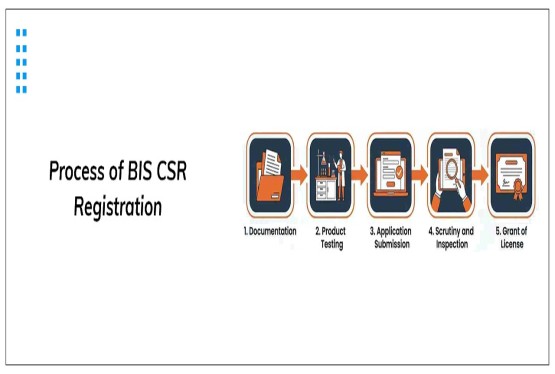
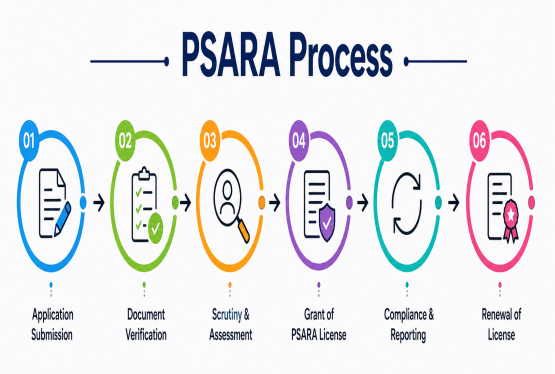
The application process generally involves six steps.
Step 1: Identify the standard
Confirm that the product is covered by IS 17631:2022 and review its current amendments.
Step 2: Prepare the factory
Arrange the necessary manufacturing, inspection and testing facilities.
Step 3: Select chair models
Identify the proposed models, product families and relevant lead models.
Step 4: Arrange testing
Complete the applicable product tests through the appropriate laboratory arrangements.
Step 5: Submit the BIS application
Apply through www.manakonline.in with the required documents and fees.
Step 6: Obtain the licence
BIS reviews the application, conducts the necessary assessment and grants the licence after satisfactory compliance.
BIS Certification Fees for Work Chairs
BIS certification costs depend on several factors, including application fees, inspection, laboratory testing and marking fees. The BIS marking-fee schedule published in January 2026 lists a standard minimum marking fee of Rs 2,93,000 for IS 17631:2022, along with lower minimum-fee tiers for eligible categories. The listed unit marking rate is Rs 4.90 per chair. These are tariff figures, not a complete certification quotation. The applicable minimum-fee category, testing expenses, inspection charges and other fees must be confirmed. Manufacturers should check the current BIS fee schedule before applying.
Penalty for Non-Compliance
Manufacturing, importing or selling covered work chairs without complying with mandatory BIS requirements may attract action under the BIS Act, 2016. Depending on the violation, penalties can include fines, imprisonment and enforcement measures against non-compliant products. Manufacturers should not use the ISI Mark without a valid licence or assume that submitting a certification application automatically permits unrestricted sales.
Conclusion
A work chair is used every day, often for several hours. Its safety and durability should never depend only on appearance or price. BIS Certification under IS 17631:2022 helps ensure that covered office work chairs meet the applicable Indian requirements. With the Furniture QCO becoming mandatory in 2026 and several amendments affecting manufacturers and importers, businesses should review the latest rules before manufacturing, importing or selling covered work chairs. Understanding the applicable standard, certification process and exemptions can help prevent compliance problems while improving product reliability.
Frequently Asked Questions
Q1. Is BIS certification mandatory for work chairs in 2026?
Ans. Yes. BIS certification is mandatory for work chairs covered under IS 17631:2022, subject to applicable exemptions under the Furniture QCO.
Q2. What is IS 17631:2022?
Ans. It is the Indian Standard for work chairs, covering relevant requirements relating to design, dimensions, safety, stability, strength and durability.
Q3. When did BIS certification become mandatory for work chairs?
Ans. The general implementation date was 13 February 2026. Micro and small enterprises received additional implementation time until 13 August 2026.
Q4. Does BIS certification apply to ergonomic office chairs?
Ans. Yes, where the ergonomic chair meets the definition and scope of a work chair under IS 17631:2022.
Q5. What is Amendment No. 1 to IS 17631:2022?
Ans. It is a technical amendment to the work-chair standard, referenced as Amd. 1:2025. Manufacturers should consult the official current text for the exact changes.
Q6. Are small furniture manufacturers exempt from BIS certification?
Ans. Certain Udyam-registered manufacturers may qualify if investment in plant and machinery or equipment at original cost does not exceed ?1 crore and previous-year turnover does not exceed ?5 crore, subject to the prescribed conditions.
Q7. Can imported work chairs be sold without BIS certification?
Ans. Generally, covered imports require BIS compliance. Specific exemptions may apply, including qualifying transitional imports covered by the November 2026 amendment.
Q8. Can one BIS licence cover different chair models?
Ans. Eligible models may be grouped into families under BIS guidelines. The approved licence must cover the relevant product models and scope.
Q9. What are the main BIS tests for work chairs?
Ans. Important tests cover dimensions, stability, static-load performance and durability, along with other requirements applicable to the chair's design and materials.
Q10. How can manufacturers apply for BIS certification?
Ans. Manufacturers can prepare the required documents, arrange testing and apply through BIS Manakonline. BIS evaluates compliance before granting a licence.
Article last updated on : 04 Nov 2026.