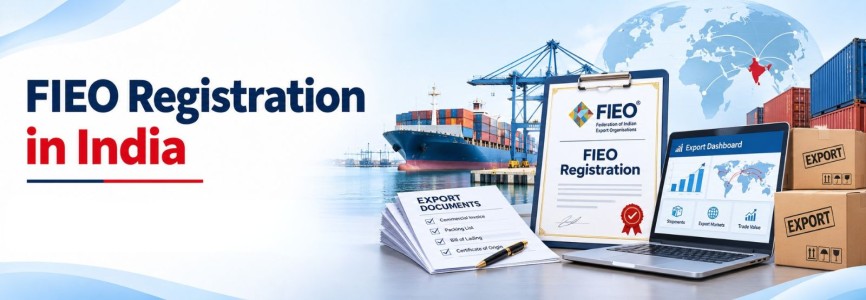



FIEO Registration in India is an important step for exporters looking to expand their businesses into international markets and access export promotion services. Whether a business exports multiple products, provides services to overseas clients or is preparing to enter global trade, registration with the Federation of Indian Export Organisations (FIEO) can provide membership recognition, market information and access to export-related opportunities.
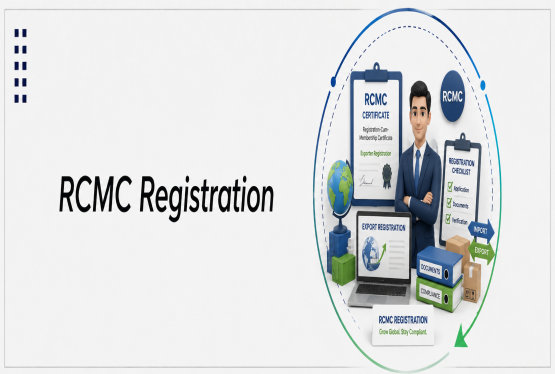
India's export sector includes thousands of manufacturers, merchant exporters, service providers, startups and MSMEs. While obtaining an Import Export Code (IEC) is generally the first legal step towards international trade, businesses also need to understand the role of a Registration-cum-Membership Certificate (RCMC Registration).
FIEO is an export promotion organisation established in 1965 under the initiative of the Ministry of Commerce, Government of India. It represents exporters across industries and provides an important connection between Indian businesses, trade authorities and international markets.
However, not every exporter needs FIEO membership. Under India's Foreign Trade Policy, the appropriate RCMC issuing authority generally depends on the exporter's main product or service category. This article explains the FIEO Registration process in 2026, eligibility criteria, required documents, RCMC application procedure, government-recognised membership requirements, fees, validity, renewal, benefits and applicable Indian foreign trade regulations.
What is FIEO Registration in India?
FIEO Registration is the process through which an eligible exporter obtains membership of the Federation of Indian Export Organisations, usually by applying for an electronic Registration-cum-Membership Certificate (e-RCMC). FIEO is recognised as an Export Promotion Council for specified purposes under India's Foreign Trade Policy. It supports exporters through trade promotion activities, international business information, government representation and export-related services. An RCMC certifies that the exporter is registered with the relevant recognised export promotion organisation.
FIEO is particularly relevant where:
-
The export product is not covered by another Export Promotion Council or Commodity Board.
-
The business exports multiple products and has not yet established its main line of business, subject to the applicable DGFT rules.
-
The business provides services falling within FIEO's recognised registration jurisdiction.
-
An exporter already registered with another council wishes to obtain additional FIEO membership for its services and facilities.
FIEO's official membership guidance confirms that e-RCMC applications must be submitted through the DGFT portal. For a broader explanation of the registration system, businesses can read How to Apply for RCMC Registration Online in India
Is FIEO Registration Mandatory for Exporters in India?
FIEO Registration is not mandatory for every exporter in India. Its applicability depends on the exporter's product category, main line of business and the Foreign Trade Policy requirements relevant to the business. Paragraph 2.57 of Foreign Trade Policy 2023 generally requires RCMC when an exporter applies for specified import or export authorisations or benefits and concessions under the policy, unless exempted. However, RCMC is not a universal licence required for every ordinary export shipment.
Furthermore, where a specific council or statutory commodity board regulates the relevant product, the exporter should ordinarily obtain registration from that authority rather than automatically selecting FIEO.
|
Business category |
FIEO Registration applicability |
|---|---|
|
Multi-product exporter without an established main business line |
May obtain FIEO RCMC, subject to applicable conditions |
|
Exporter of products not covered by another council |
FIEO is the relevant registering authority |
|
Eligible service exporter |
FIEO RCMC may be applicable |
|
Exporter already registered with another council |
Additional FIEO membership may be optional |
|
Coffee exporter |
Coffee Board requirements generally apply |
|
Marine products exporter |
MPEDA requirements generally apply |
|
Spices exporter |
Spices Board requirements generally apply |
|
Domestic business not engaged in exports |
FIEO e-RCMC generally not required solely for domestic operations |
Businesses must select the correct authority based on DGFT's Appendix 2T and Paragraph 2.80 of the Handbook of Procedures.
Legal Provisions Governing FIEO Registration in India
FIEO Registration and RCMC requirements are governed primarily by India's foreign trade legislation and related procedural rules. Foreign Trade (Development and Regulation) Act, 1992 The Foreign Trade (Development and Regulation) Act, 1992 provides the statutory basis for regulating and developing India's international trade.
Relevant provisions include:
-
Section 3: Empowers the Central Government to make provisions concerning foreign trade development and regulation.
-
Section 5: Authorises the Government to formulate and amend the Foreign Trade Policy.
-
Section 6: Deals with DGFT and its functions.
-
Section 7: Governs the Import Export Code.
FIEO RCMC operates within the foreign trade policy system established under this legislation.
Foreign Trade Policy, 2023
Foreign Trade Policy 2023, as amended, governs several export authorisations, benefits, concessions and procedural requirements. Paragraphs 2.56 and 2.57 are especially relevant to Export Promotion Councils and RCMC. Importantly, obtaining RCMC does not automatically entitle an exporter to financial incentives or exemptions. The business must independently satisfy the conditions of the relevant scheme.
Handbook of Procedures, 2023
The Handbook of Procedures contains the practical rules for obtaining and maintaining RCMC. Important provisions include:
|
Provision |
Subject |
|---|---|
|
Paragraph 2.77 |
Registering authorities |
|
Paragraph 2.80 |
Selection of the appropriate council and RCMC application |
|
Paragraph 2.81 |
RCMC validity |
|
Paragraph 2.82 |
Reporting changes in business details |
|
Paragraph 2.83 |
De-registration |
|
Paragraph 2.84 |
Appeal against RCMC-related decisions |
Appendix 2T identifies the recognised registering authorities for different export sectors. The current rules require exporters to declare their main line of business and generally select the council concerned with that product or service.
FIEO Memorandum and Articles of Association
FIEO's membership arrangements are also governed by its Memorandum and Articles of Association. These documents specify membership categories and eligibility conditions, including registered, associate, ordinary and status-holder membership classifications.
Who is Eligible for FIEO Registration in 2026?
Businesses with an active IEC may apply for FIEO membership, subject to the relevant product jurisdiction and membership requirements. Eligible applicants may include proprietorship firms, partnerships, Limited Liability Partnerships, private limited companies, public limited companies and other recognised business entities. FIEO also provides membership arrangements for businesses at different stages of export development.
Multi-Product Exporters
Businesses exporting several different goods may qualify for FIEO RCMC where their main line of business is not yet established and the applicable DGFT conditions are fulfilled.
Service Exporters
FIEO acts as the registering authority for service exporters other than the specified service categories assigned elsewhere under the Handbook of Procedures. The applicant must correctly identify its service activity rather than assuming all professional or IT services automatically fall under FIEO.
Merchant and Manufacturer Exporters
Both merchant exporters and manufacturers may apply where FIEO is the appropriate registering authority for their activities.
New Export Businesses and Startups
New businesses can seek applicable membership after obtaining their IEC, even if they have limited previous export activity. The category and supporting documents depend on FIEO's eligibility rules. For businesses preparing their first international transactions, the article Planning to Export? Start with RCMC Registration explains why selecting the appropriate registration authority is important.
Documents Required for FIEO Registration in India
Applicants must provide accurate business details and supporting documents while applying for FIEO RCMC through the DGFT portal.
The exact requirements depend on the applicant's legal constitution, membership category and information already available in its IEC profile.
|
Document |
Purpose |
|---|---|
|
Primary identification of the exporter |
|
|
PAN card |
Tax and business identification |
|
Certificate of Incorporation or business constitution documents |
Proof of legal establishment |
|
GST registration certificate, where applicable |
Verification of tax-related details |
|
Registered office address |
Business address verification |
|
Bank account details |
Banking information linked to exporter records |
|
Authorisation letter or board resolution, where required |
Authority of the person submitting the application |
|
Product or service details |
Identification of the main line of business |
|
ITC (HS) codes, where applicable |
Classification of exported goods |
|
DGFT Status Holder Certificate, if applicable |
Verification of One Star to Five Star status |
|
SEZ or EOU approval documents, if applicable |
Verification of specialised membership category |
|
Membership fee payment details |
Confirmation of applicable subscription and processing charges |
The DGFT system draws several particulars from the applicant's IEC profile. Applicants should therefore update their IEC information before filing. Not every document in this list is required from every exporter. For example, a new proprietorship business ordinarily will not possess an Export House recognition certificate, while an SEZ unit may need additional supporting records. Businesses can refer to the RCMC Registration Checklist for New Export Businesses for additional guidance on preparing export registration documents.
FIEO Registration Process Online in India (2026)
The FIEO RCMC application process is conducted online through the DGFT e-RCMC module. FIEO confirms that new applications, renewals and amendments must be submitted through this facility.
|
Step |
Registration process |
Description |
|---|---|---|
|
Step 1 |
Obtain an IEC |
Obtain and activate the Import Export Code issued by DGFT. |
|
Step 2 |
Visit the DGFT portal |
Log in to the DGFT website using credentials linked to the IEC. |
|
Step 3 |
Select e-RCMC |
Open Services, choose e-RCMC and select the application option. |
|
Step 4 |
Choose FIEO |
Select the Federation of Indian Export Organisations as the registering authority. |
|
Step 5 |
Complete application |
Enter membership category, products, services and relevant business details. |
|
Step 6 |
Upload supporting documents |
Submit the documents and declarations requested for the selected category. |
|
Step 7 |
Pay membership fees |
Pay the applicable subscription and one-time processing fee. |
|
Step 8 |
Application verification |
FIEO scrutinises the application and may request clarification. |
|
Step 9 |
Receive e-RCMC |
After approval, download the electronically issued RCMC from the DGFT portal. |
Step 1: Obtain an Active IEC
An exporter must first obtain an Import Export Code from DGFT. Check that the IEC profile contains the correct business name, PAN, registered address, contact details and other applicable particulars.
Step 2: Access the DGFT e-RCMC Facility
Visit the official DGFT portal and log in to the account linked with the IEC. Navigate to the e-RCMC service to begin a new application.
Step 3: Select FIEO as the Registering Authority
Choose FIEO only after confirming that it is the appropriate registering authority for the business. The applicant must declare its main line of business and provide the requested membership information.
Step 4: Provide Product and Membership Details
Select the applicable membership category, such as multi-product exporter, service provider, SEZ, EOU or recognised Status Holder. The portal may also request ITC (HS) codes, business branches, GST details and supporting declarations.
Step 5: Submit Documents and Pay Fees
Upload the required supporting records and complete the membership fee payment. The payable amount depends on the selected category, subscription period and applicable processing charges.
Step 6: Verification and Approval
FIEO examines the submitted information and may seek clarification if details are incomplete or inconsistent. After approval, the e-RCMC is issued digitally through the DGFT portal.
FIEO Registration Fees in India (2026)
FIEO membership fees depend on the applicant's category, turnover, export status and subscription period. According to FIEO's current published membership schedule, the following annual subscription fees apply for the April–March financial year.
Standard Membership Fees
|
Membership category |
Annual fee (excluding GST) |
|---|---|
|
Multi-Product Group |
Rs 7,000 |
|
Special Economic Zone (SEZ) |
Rs 10,750 |
|
Export Oriented Unit (100% EOU) |
Rs 10,250 |
|
Service Provider |
Rs 7,250 |
Premium Membership Fees
FIEO specifies premium membership categories for companies with annual turnover of ?5 crore or more.
|
Premium category |
Annual fee (excluding GST) |
|---|---|
|
Premium Multi-Product Group |
Rs 7,850 |
|
Premium SEZ |
Rs 11,500 |
|
Premium EOU |
Rs 11,350 |
|
Premium Service Provider |
Rs 8,000 |
Status Holder Membership Fees
|
Status Holder category |
Annual fee (excluding GST) |
|---|---|
|
One Star Export House |
Rs 10,500 |
|
Two Star Export House |
Rs 14,000 |
|
Three Star Export House |
Rs 28,000 |
|
Four Star Export House |
Rs 56,000 |
|
Five Star Export House |
Rs 1,05,000 |
The above fees exclude 18% GST. FIEO additionally specifies a one-time processing fee of ?1,000 plus 18% GST for issuing e-RCMC to a new member. Members making advance membership payments may receive a 5% discount for three years or a 10% discount for five years, subject to FIEO's conditions. FIEO also provides a special payment option for certain new memberships during January–March. The latest payable amount should be checked through FIEO's official membership fee calculator before payment.
FIEO RCMC Validity and Renewal
Under Paragraph 2.81 of the Handbook of Procedures, an RCMC is ordinarily valid for five licensing years, beginning on 1 April of the licensing year in which it is issued and ending on 31 March of the fifth licensing year, unless otherwise specified. For example, an RCMC issued during FY 2026–27 would ordinarily have a validity period from 1 April 2026 to 31 March 2031. However, exporters must distinguish the certificate's validity from the membership subscription period. An RCMC valid for five years does not automatically mean that five years of FIEO membership fees have been paid. FIEO charges annual subscriptions, with advance payment options available.
How to Renew FIEO Membership and RCMC
Exporters should review their certificate expiry and subscription dues before beginning the renewal process. For RCMC renewal, applicants should log in to DGFT, open the e-RCMC module, select the relevant renewal option and complete the required filing. Business details must be verified, and applicable membership charges must be paid. Applications for renewal, amendment or changes in business particulars must use the DGFT e-RCMC module.
Benefits of FIEO Registration in India
FIEO Registration offers benefits to eligible exporters seeking to develop their presence in international markets. Apart from RCMC-related recognition, members can access trade information, promotional programmes and support services.
1. Recognition Under India's Foreign Trade Policy
FIEO is a Government-recognised Export Promotion Council. Its RCMC confirms registration with the organisation for applicable Foreign Trade Policy purposes. This can be important when an exporter applies for authorisations, benefits or concessions that require a valid RCMC. However, membership does not automatically entitle the business to every export incentive. Each government programme has separate eligibility conditions.
2. Access to International Trade Opportunities
FIEO organises and facilitates international trade exhibitions, buyer-seller meetings and export promotion events. These initiatives can help businesses:
-
Explore international markets.
-
Meet potential overseas buyers and distributors.
-
Understand demand for Indian products and services.
-
Learn about emerging export opportunities.
Participation and any available financial assistance depend on the relevant event or programme conditions.
3. Export Market Information and Policy Updates
FIEO provides information on foreign trade developments, market trends, tariffs and export-related policies. Members may access trade publications, industry updates, seminars and other resources that help them understand developments affecting international business.
4. Certificate of Origin Services
FIEO provides Certificate of Origin services, including applicable non-preferential and preferential certificates. A Certificate of Origin identifies the country of origin of exported goods. It may be required for customs purposes, buyer verification or trade agreement benefits. However, the exporter must meet the applicable origin rules. FIEO membership does not automatically establish that every product qualifies for preferential tariff treatment.
5. Support for Export-Related Issues
FIEO represents exporter concerns before relevant government departments and trade authorities. It engages with organisations such as DGFT, CBIC, RBI and other stakeholders on matters affecting export businesses. This can help members remain informed about policy developments and participate in relevant industry discussions.
6. Training and Export Business Development
FIEO conducts training programmes, seminars and workshops on international trade. These can help new exporters understand:
-
Export documentation and customs procedures.
-
Foreign trade regulations.
-
International marketing and buyer development.
-
Trade agreements and market access requirements.
FIEO also offers business visibility opportunities through its member directory and related trade promotion platforms. For businesses preparing their export operations, the Learn article Why RCMC Registration Matters for Indian Exporters explains how membership and regulatory preparation support international trade.
Difference Between IEC, FIEO Registration and RCMC
IEC, FIEO Registration and RCMC serve different purposes.
|
Particulars |
IEC |
FIEO Membership |
RCMC |
|---|---|---|---|
|
Issuing authority |
DGFT |
FIEO |
Recognised council or authority |
|
Purpose |
Import-export identification |
Membership and export promotion services |
Registration for applicable FTP purposes |
|
Mandatory for every exporter? |
Generally required, subject to exceptions |
No |
Required in specified circumstances |
|
Validity |
Subject to applicable IEC maintenance rules |
Membership subscriptions apply |
Generally five licensing years |
|
Export incentives |
Does not itself confer eligibility |
Does not guarantee incentives |
May be required for specified FTP benefits |
An exporter generally obtains IEC first and then applies for RCMC from the appropriate registering authority when required. For example, a business exporting different non-specialised products may be eligible for FIEO RCMC, while a seafood exporter may be required to register with MPEDA under separate commodity legislation.
Compliance Requirements After FIEO Registration
Exporters must continue maintaining accurate registration particulars and complying with applicable Foreign Trade Policy requirements.
Maintain an Active IEC
IEC particulars should remain accurate and be confirmed or updated within the applicable DGFT timelines. Changes to legal name, address or constitution should be reflected in relevant registrations.
Report Changes in Business Details
Paragraph 2.82 of the Handbook of Procedures requires an RCMC holder to inform the registering authority of changes in ownership, constitution, name or address within one month.
Maintain Membership Subscriptions
FIEO members should pay the relevant subscription charges and monitor outstanding dues.
Follow Product-Specific Export Requirements
FIEO RCMC does not replace product-specific approvals, customs authorisations or importing-country requirements. Exporters must independently comply with laws applicable to their products.
Complete Customs and Banking Requirements
Goods exporters must comply with applicable customs filing requirements and relevant banking arrangements. Businesses can review AD Code Registration for information about exporter banking details and ICEGATE procedures.
Avoid Misuse of RCMC
Providing false declarations or violating membership conditions may result in regulatory action. Under the Handbook of Procedures, de-registration is subject to prescribed notice and representation requirements. The rules also provide an appeal mechanism for applicable RCMC-related decisions.
Latest FIEO Registration Updates in 2026
Continued Use of DGFT's e-RCMC Portal
As of November 2026, FIEO continues to direct applicants to DGFT's electronic RCMC module for issuance, renewal and amendment. DGFT Trade Notice No. 35/2021-22 established the mandatory common digital filing arrangement. The process remains relevant in 2026.
Current FIEO Membership Fee Structure
FIEO publishes category-based subscription fees, premium membership requirements and advance payment discounts. Applicants should use the official fee calculator because payable charges depend on turnover, category, subscription duration and processing fees.
RCMC Rules Continue Under FTP 2023
Foreign Trade Policy 2023 and the Handbook of Procedures continue to govern RCMC registration, subject to amendments. The principal requirements concerning council selection, certificate validity and reporting of business changes remain important for exporters.
Clarification on Post-Export Remission Schemes
Exporters should distinguish RCMC requirements for FTP authorisations and concessions from post-export remission schemes. DGFT has clarified that RCMC is not required solely for specified post-export remission schemes such as RoDTEP, RoSCTL and Duty Drawback. This does not remove other circumstances where RCMC is required.
Digital Trade Facilitation and Market Support
FIEO continues to provide membership services, policy updates, trade events and international market development support. Businesses should monitor official FIEO announcements and DGFT notifications rather than assuming that older procedures or scheme conditions remain unchanged.
Common Mistakes to Avoid During FIEO Registration
Applicants sometimes experience delays because they misunderstand the relationship between FIEO and other Export Promotion Councils. Common mistakes include selecting FIEO without verifying product jurisdiction, using outdated IEC details, choosing the wrong membership category and submitting incomplete authorisation documents. Businesses should also avoid assuming that RCMC validity and annual subscription periods are identical.
Another mistake is treating FIEO membership as a replacement for statutory product registrations. For example, exporters dealing in regulated marine products, coffee or spices must examine the rules applicable to their respective commodity boards. Correct selection of the registering authority and complete documentation can help reduce avoidable deficiencies.
Conclusion
FIEO Registration in India is an important option for eligible exporters seeking RCMC recognition, trade promotion support and access to international business opportunities. The registration process is conducted through DGFT's e-RCMC portal and requires an active IEC, correct membership category, accurate business information and payment of applicable fees.
For exporters operating in 2026, the most important consideration is identifying whether FIEO is the correct registering authority. Businesses dealing in products covered by specialised Export Promotion Councils or Commodity Boards must follow the relevant jurisdictional requirements. Maintaining valid registration, timely membership payments and updated business records can help exporters avoid compliance difficulties and support their long-term international business plans.
Frequently Asked Questions (FAQs)
Q1. Is FIEO Registration mandatory for all exporters in India in 2026?
Ans: No. FIEO Registration is not compulsory for every exporter in India. It is relevant to eligible multi-product exporters, service exporters and businesses whose products are not covered by another Export Promotion Council or Commodity Board. RCMC requirements depend on the applicable Foreign Trade Policy provisions.
Q2. How can I apply for FIEO Registration online in 2026?
Ans: Visit the official DGFT portal, log in using your IEC-linked account and select Services → e-RCMC. Choose FIEO as the registering authority, complete the application, upload the required documents and pay the membership fees. FIEO issues the certificate digitally after approval.
Q3. What is the latest FIEO Registration fee in India in 2026?
Ans: FIEO's published annual Multi-Product Group membership fee is ?7,000 plus 18% GST. New applicants must also pay a one-time e-RCMC processing fee of ?1,000 plus GST, making the standard first-year total ?9,440. Other membership categories have different charges.
Q4. Can a startup, MSME or proprietorship apply for FIEO RCMC Registration?
Ans: Yes. Eligible startups, MSMEs, proprietorships, LLPs, partnerships and companies can apply for FIEO membership after obtaining an active IEC. The applicant must select the appropriate membership category based on its products, services, business status and applicable registration rules.
Q5. What documents are required for FIEO RCMC Registration online?
Ans: Applicants generally need an active IEC, PAN-linked business details, registered office information, product or service particulars and authorised signatory details. Additional documents may be required for SEZ units, EOUs and DGFT-recognised Status Holders. Applicants should follow the DGFT portal's current checklist.
Q6. Can I obtain FIEO Registration without an Import Export Code (IEC)?
Ans: An IEC is generally required to obtain FIEO e-RCMC because the application is linked to the exporter’s DGFT profile. FIEO also provides certain membership options for entities without an IEC, but these do not replace exporter RCMC registration.
Q7. Can a new exporter apply for FIEO RCMC without previous export turnover?
Ans: Yes. Eligible new exporters can apply for FIEO RCMC even if they have not completed their first export shipment. However, the business must have an active IEC and fall within FIEO's applicable registration jurisdiction. Previous export turnover is not a universal requirement for standard membership.
Q8. How long is FIEO RCMC valid, and when should it be renewed?
Ans: FIEO RCMC is ordinarily valid for five licensing years, ending on 31 March of the fifth licensing year, unless otherwise specified. Exporters should renew the certificate before expiry and maintain their applicable annual FIEO membership subscriptions separately.
Q9. Can a multi-product exporter obtain one RCMC from FIEO?
Ans: Yes. Eligible multi-product exporters whose main line of business is not yet established may obtain an RCMC from FIEO under the applicable DGFT rules. However, exporters dealing in products regulated by specific Commodity Boards or Export Promotion Councils must follow the relevant registration requirements.
Q10. What are the benefits of FIEO Registration for Indian exporters?
Ans: FIEO membership provides access to export promotion events, international trade fairs, buyer-seller meetings, market information and policy updates. Members can also access eligible Certificate of Origin services, training programmes and business networking opportunities. Government incentives are subject to separate eligibility conditions
Article last updated on : 04 Nov 2026.