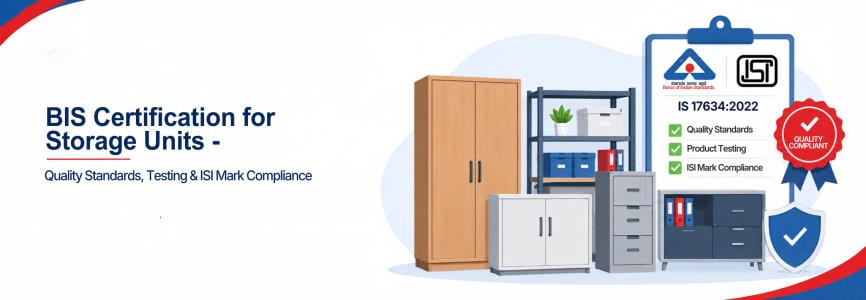



Storage units are an important part of almost every home, office, school and commercial building. We use wardrobes to keep clothes, cabinets to store important documents, and shelves to organise books, files and household items. These products make everyday life easier, but their safety is something most people rarely consider. What happens if a tall wardrobe falls forward when someone opens its doors? Can a filing cabinet remain stable when several drawers are pulled out? Will a storage shelf continue to support heavy items after years of use? To improve furniture safety and quality in India, the Bureau of Indian Standards (BIS) introduced IS 17634:2022 – Storage Units Specification.
This Indian Standard establishes requirements relating to the design, construction, dimensions, strength, stability, durability and performance of storage furniture. Under the Furniture (Quality Control) Order, 2025, BIS ISI Certification has become mandatory for covered storage units, subject to the implementation dates, exemptions and amendments notified by the Government of India. The rules have also undergone important changes during 2026.
What is BIS Certification for Storage Units?
BIS Certification for Storage Units is a product certification process through which a manufacturer demonstrates that its storage furniture meets the requirements of IS 17634:2022, including the applicable amendments. The certification is administered by the Bureau of Indian Standards under Scheme-I of Schedule-II to the BIS (Conformity Assessment) Regulations, 2018. Once the manufacturer fulfils the required conditions and obtains a valid BIS licence, it is authorised to use the ISI Mark on the storage-unit models covered by that licence.
For example, a company manufacturing steel office cabinets must ensure that its products satisfy the relevant strength, stability, safety and construction requirements. The company must also maintain appropriate manufacturing and quality control arrangements. BIS Certification is therefore more than obtaining a laboratory test report. It includes product conformity, assessment of manufacturing capabilities and continued compliance after the licence is granted. The certification requirement generally applies at the manufacturing level, including foreign manufacturers supplying covered products to India. Importers and sellers must ensure that their covered products comply with the Quality Control Order.
What is IS 17634:2022?
IS 17634:2022 is the Indian Standard titled Storage Units — Specification, published by BIS. It establishes performance and safety requirements for storage furniture intended for domestic and institutional use. The standard addresses both movable and non-movable components, including shelves, doors, drawers and other storage elements. It applies to completely manufactured storage units as well as ready-to-assemble units.
The standard was developed to bring various storage furniture requirements under a common Indian Standard. It superseded several earlier standards, including IS 1883, IS 3312, IS 3313, IS 3314 and IS 3497, among others. Its technical requirements also draw upon recognised international furniture testing methods, including relevant ISO standards for storage furniture strength and stability.
Which Storage Units Are Covered Under IS 17634:2022?
The standard applies to a broad range of storage furniture intended for homes, offices and institutions.
Common examples include:
|
Storage unit |
Common use |
|
Wardrobes |
Storing clothes and personal belongings |
|
Steel almirahs |
Household and office storage |
|
Filing cabinets |
Keeping office documents |
|
Bookshelves |
Storing books and files |
|
Storage cupboards |
General household or workplace use |
|
Drawer cabinets |
Organising documents and accessories |
|
Office storage units |
Storing records and office materials |
|
Wall-mounted cabinets |
Storage attached to walls or structures |
|
Metal shelving units |
Holding files, books and other items |
|
Ready-to-assemble cabinets |
Modular home and office storage |
The product's name alone does not decide whether certification is required. Its actual design, construction, intended use and the scope of IS 17634:2022 must be examined.
For example, a storage cabinet designed for office documents may be covered. However, specialised industrial equipment or products designed for a different purpose should not automatically be classified under this standard without reviewing the applicable specifications. Manufacturers should establish the correct product classification before submitting their BIS application.
Is BIS Certification Mandatory for Storage Units in India?
Yes. BIS Certification is mandatory for covered storage units under the Furniture (Quality Control) Order, 2025, issued by the Department for Promotion of Industry and Internal Trade (DPIIT). The order was issued under Section 16 of the BIS Act, 2016, through notification S.O. 801(E), dated 13 February 2025, and published in the Official Gazette on 14 February 2025. It requires covered furniture products to conform to their respective Indian Standards and bear the Standard Mark under a valid BIS Scheme-I licence.
Mandatory BIS Implementation Dates
|
Enterprise category |
Implementation date |
|
General enterprises |
14 February 2026 |
|
Micro and small enterprises |
14 August 2026 |
|
Qualifying exempt enterprises |
Exemption applies subject to prescribed conditions |
These dates follow the Gazette publication date and the original 12-month and 18-month commencement periods. Businesses should also consider the subsequent exemptions and transitional orders.
The Quality Control Order applies to six furniture categories:
The table below provides an overview of the BIS ISI Certification requirements for different furniture products in India. In this article, we will specifically cover IS 17634:2022, which applies for Storage Units.
|
Product |
Applicable Indian Standard |
|
IS 17631:2022 |
|
|
IS 17632:2022 |
|
|
IS 17633:2022 |
|
|
IS 17634:2022 |
|
|
IS 17635:2022 |
|
|
IS 17636:2022 |
Covered furniture cannot lawfully be manufactured for the regulated Indian market, imported or sold without meeting the applicable requirements, unless a notified exemption or transitional provision applies.
Non-compliance may result in enforcement action and penalties under the BIS Act, 2016.
Latest Amendment No. 1 to IS 17634:2022
BIS issued guidelines on 5 January 2026 for implementing Amendment No. 1 to IS 17634:2022.The last date for implementation was 9 January 2026. This amendment introduced six significant technical and administrative changes. Manufacturers applying for a new BIS licence, as well as existing licence holders, must follow the amended requirements.
|
Requirement |
Amendment |
|
Product marking |
Additional requirements introduced |
|
Mechanical damage resistance |
Test removed |
|
Clothes rail deflection |
Specified limit relaxed |
|
Stability test |
Potential energy calculation clarified |
|
Clause 6 |
Renamed Raw Material Requirements |
|
Testing samples |
Series of units permitted |
Following the amendment, BIS revised its Product Manual to PM/IS 17634/3/Dec 2025, including changes to grouping guidelines and the Scheme of Inspection and Testing. BIS also clarified that existing manufacturers were required to provide confirmation of implementation of the additional product marking requirements.
Latest Furniture Quality Control Order Amendments in 2026
The technical amendment to IS 17634:2022 is not the only important development. During 2026, the Government of India also amended the Furniture (Quality Control) Order to address existing stock, imports, research activities and certain smaller manufacturers. These changes are especially important for companies importing wardrobes, steel almirahs, filing cabinets and other storage furniture.
February 2026 – Furniture (Quality Control) Amendment Order
Through S.O. 774(E), dated 12 February 2026 and published on 13 February 2026, the government introduced three important relaxations.
-
Research and Development Imports Eligible manufacturers holding a BIS licence or having applied for certification can import up to 200 covered articles per financial year for research and development purposes, subject to the notified conditions. These products cannot be sold commercially. The manufacturer must maintain the required records and dispose of the products as scrap in accordance with the order.
-
Sale of Existing Stock Eligible manufacturers may sell, display or offer for sale qualifying stock manufactured or imported before the applicable implementation date for up to 12 months from that date. A self-declaration must be submitted to BIS. This is a conditional exemption and does not apply automatically to every trader or stockist.
-
Imports for Export Manufacturing Specified non-BIS-marked furniture products, components or sub-assemblies imported for manufacturing furniture intended for export may qualify for exemption. The manufacturer must submit the prescribed declaration, maintain records and ensure that the imported goods are not diverted to the domestic market.
February 2026 – Revised Exemption for Micro Enterprises
The government also amended the exemption applicable to certain Udyam-registered enterprises through S.O. 777(E), published on 13 February 2026.
The revised exemption covers qualifying domestically manufactured goods where:
-
Investment in plant and machinery or equipment at original cost does not exceed ?1 crore.
-
Turnover in the previous financial year does not exceed ?5 crore, as certified by a Chartered Accountant.
-
The enterprise is registered on the Udyam Portal and fulfils the applicable conditions.
March 2026 – Second Amendment for Imported Furniture
The Furniture (Quality Control) Second Amendment Order, 2026, S.O. 1125(E), dated 2 March 2026, introduced transitional provisions for certain imported furniture consignments. It addressed shipments dispatched before the implementation date and goods ordered before that date, subject to specified Bill of Lading, Bill of Entry and documentation conditions. However, the relevant provisions were subsequently replaced by the Third Amendment Order in November 2026. Businesses should therefore rely on the updated conditions when assessing current import eligibility.
June 2026 – Transition Facilitation (Quality Control) Order
The government issued the Transition Facilitation (Quality Control) Order, 2026, through S.O. 3417(E), dated 25 June 2026. The Furniture (Quality Control) Order is included among the notified product categories. The order creates a conditional compliance arrangement for eligible manufacturers and specified supply situations, involving the prescribed approval process and BIS certification provisions. This does not mean BIS Certification for Storage Units has been cancelled. Manufacturers seeking to rely on the arrangement must satisfy the applicable conditions instead of assuming they are automatically exempt.
November 2026 – Furniture (Quality Control) Third Amendment Order
The latest verified change is the Furniture (Quality Control) Third Amendment Order, 2026, issued through S.O. 5950(E), dated 2 November 2026. This amendment replaced the seventh and eighth provisos of the earlier order and introduced revised conditions for specified imported goods.
An imported storage-unit consignment may qualify for exemption when all the following conditions are fulfilled:
|
Document |
Required date |
|
Purchase Order |
On or before 12 August 2026 |
|
Bill of Lading |
On or before 30 November 2026 |
|
Bill of Entry |
On or before 31 December 2026 |
The importer must also submit copies of the purchase order, Bill of Lading, Bill of Entry and other supporting documents to BIS within seven days of consignment clearance. These documents must be submitted on the importer's letterhead, duly signed by the authorised signatory.
For example, a furniture importer who ordered storage cabinets before the notified cut-off date may qualify for this exemption if the shipping, customs and documentation conditions are also satisfied. A purchase order alone is not sufficient. This exemption is particularly relevant to businesses whose furniture shipments were planned before the mandatory implementation requirements but were delayed during transportation or customs clearance.
Mandatory Requirements Under IS 17634:2022
Storage units must comply with the applicable requirements relating to construction, dimensions, material performance and safety.
The exact requirements depend on the product design, construction and intended use.
1. Design and Workmanship Requirements
Storage furniture must be designed and manufactured in accordance with the applicable requirements of Clause 4. A cabinet may appear strong from the outside, but weak joints, poorly fitted doors or unsuitable construction can affect its performance. Manufacturers must pay attention to component assembly, connections, workmanship and other design features that could affect the safety or performance of the finished product.
2. Dimensional Requirements
Clause 5 deals with applicable dimensions. Manufacturers must ensure that relevant measurements and tolerances conform to the standard. This includes dimensions associated with the storage unit and its functional components, as applicable to the particular design.
3. Raw Material Requirements
Under amended Clause 6, raw materials and relevant surface materials must meet the applicable performance requirements. These may include tests relating to resistance to wet heat, dry heat, cold liquids, oils and fats, pencil hardness and adhesive performance. Where fabric or leather is used, additional relevant material tests may apply. For example, an upholstered storage bench may have different applicable material requirements from an ordinary steel filing cabinet.
4. Strength and Durability Requirements
Storage units must withstand specified loads and repeated use without unacceptable failure. Testing may cover shelves, doors, drawers, clothes rails and other movable or non-movable parts. A bookshelf should be able to support the loads prescribed for its performance category, while a filing cabinet must meet the relevant requirements for its drawers and construction.
5. Stability Requirements
The standard includes stability requirements intended to reduce the risk of storage furniture overturning. For example, opening a drawer can shift the weight distribution of a cabinet. Stability testing evaluates its behaviour under prescribed conditions. Tall wardrobes and storage units with drawers, doors or other movable elements require particular attention to their applicable stability tests. Wall-mounted units must also satisfy the relevant requirements for storage furniture mounted to a building or structure.
6. Product Marking Requirements
Manufacturers must mark their products according to Clause 9, including Amendment No. 1. The required marking should be consistent with the applicable standard and the manufacturer's approved product details. After obtaining the BIS licence, the manufacturer must also follow the rules governing use of the Standard Mark, including the applicable licence identification requirements.
Using the ISI Mark without a valid authorisation is prohibited.
Performance Categories of Storage Units
IS 17634:2022 classifies storage units into three performance categories.
|
Category |
Test level |
Intended use |
|
Domestic |
Level 1 |
Household storage furniture |
|
Institutional (Light) |
Level 2 |
Storage furniture for lighter institutional use |
|
Institutional (Heavy) |
Level 3 |
Furniture intended for more demanding institutional use |
The performance category affects the relevant testing requirements and approved scope of certification.
For example, a wardrobe designed for domestic use may not have the same testing conditions as a heavy-duty institutional storage cabinet. Manufacturers must declare the appropriate performance category during BIS certification.
BIS Testing Requirements for Storage Units
Testing plays an important role in determining whether a storage unit can be certified under IS 17634:2022. The tests are intended to evaluate the furniture's performance under specified conditions. They are not a guarantee that the furniture can withstand unlimited weight or every possible form of misuse.
-
Shelves and Storage Surfaces : Shelves must be evaluated for the applicable strength and deflection requirements. A shelf holding books or files may bend slightly under load. Testing determines whether its performance remains within the prescribed limits.
-
Doors and Hinges : Cabinet doors are opened and closed repeatedly. Applicable strength and durability tests assess whether doors and their supporting components can perform satisfactorily. The tests depend on the type of door, such as hinged, sliding or other construction.
-
Drawers and Extension Elements : Drawers and sliding storage components are subject to relevant performance requirements. Testing helps assess their strength, durability and behaviour during operation.
-
Clothes Rails : Wardrobes containing clothes rails must satisfy the applicable tests for deflection and strength. The relaxation introduced by Amendment No. 1 for specified non-visible clothes rails must be considered when testing these products.
-
Wall-Mounted Storage Units : Storage units fixed to a wall or another structure must satisfy the relevant requirements for mounted furniture. The mounting arrangement and associated load conditions are important because inadequate fixing can create a serious safety risk.
-
Stability Testing : Storage units must be tested for stability under the prescribed conditions. The 2026 technical amendment clarified the potential energy calculation used in the relevant stability test.
-
Material Performance Testing : Applicable raw material tests assess how finishes, surfaces and other materials perform under specified conditions. Not every test applies to every product. A manufacturer should prepare a product-specific testing plan using the latest standard and BIS Product Manual.
Documents Required for BIS Certification of Storage Units
Manufacturers must submit documents that establish their business identity, manufacturing capabilities, product details and quality control arrangements.
The exact requirements may vary according to the applicant and certification route.
|
Document |
Purpose |
|
Certificate of Incorporation or business registration |
Establishes legal identity |
|
PAN and GST details |
Business identification |
|
Factory address proof |
Verifies manufacturing premises |
|
Factory layout |
Shows manufacturing and testing areas |
|
Machinery list |
Details production capabilities |
|
Manufacturing process flowchart |
Explains production activities |
|
Product drawings and specifications |
Identifies storage-unit models |
|
Raw material details |
Supports material compliance |
|
Testing equipment list |
Describes testing capabilities |
|
Quality control personnel details |
Identifies responsible staff |
|
Product test reports |
Provides conformity evidence |
|
Authorisation letter |
Identifies authorised representative |
Foreign manufacturers may need additional documentation under the applicable BIS foreign manufacturer certification arrangements. Applicants should ensure that their product drawings, model details and declared performance categories are consistent throughout the application.
BIS Certification Process for Storage Units
The certification process generally involves the following steps.
Step 1: Identify the Applicable Indian Standard
Confirm that the product falls within the scope of IS 17634:2022. Manufacturers should review the intended use, materials, construction, dimensions and product category.
Step 2: Identify the Performance Category
Determine whether the storage unit falls under Domestic, Institutional (Light) or Institutional (Heavy). This helps identify the appropriate testing and certification requirements.
Step 3: Prepare Product and Factory Documents
Collect business records, factory information, product drawings, machinery details and testing arrangements. Incorrect or incomplete documents can delay the application.
Step 4: Submit the BIS Application
Apply through the relevant BIS certification system under Scheme-I. The application must identify the manufacturing unit and the products for which certification is requested.
Step 5: Complete Product Testing
Arrange the prescribed testing of representative samples using the applicable BIS procedures and laboratory arrangements. Testing must follow IS 17634:2022 with Amendment No. 1 and any subsequent applicable revisions.
Step 6: Complete Factory Assessment
Under the regular certification route, BIS assesses the manufacturing facility and its quality control arrangements. The assessment may include manufacturing processes, equipment, testing facilities and production records.
Step 7: Address BIS Observations
If BIS identifies deficiencies, the manufacturer must provide clarifications or complete corrective actions. This may involve additional documentation, testing or improvements in manufacturing arrangements.
Step 8: Obtain the BIS Licence
After satisfactory completion of the applicable requirements, BIS may grant the licence for the approved product scope. The manufacturer can then apply the Standard Mark in accordance with the licence conditions.
Step 9: Maintain Compliance
Certification does not end after the licence is issued. Manufacturers must continue following the applicable standard, testing requirements, marking rules, surveillance conditions and other licence obligations.
BIS Certification Fees for Storage Units
The total cost of BIS Certification depends on the products, manufacturing unit, testing requirements and applicable certification route. Common expenses include application charges, testing fees, inspection-related charges, licence fees and marking fees. The number of product models, their construction and required tests can also influence the total cost.
BIS-recognised laboratory charges vary. For example, the BIS Laboratory Information Management System lists different testing charges for IS 17634:2022 across available laboratories. Manufacturers should therefore obtain the current official fee details and laboratory quotation before calculating the total cost.
BIS Certification Requirements for Different Storage Unit Models
A manufacturer may produce several types of storage furniture in the same factory. For example, a company might manufacture steel almirahs, wardrobes, filing cabinets and drawer units. However, obtaining a BIS licence for one product does not automatically cover every storage-unit design. BIS uses grouping guidelines to determine which models may be assessed together.
The manufacturer's product details may include the material used, type of construction, performance category, height, doors, castors, extension elements and other relevant features. Under the earlier Product Manual, storage units were grouped according to their performance category, material, construction and height group. The revised Product Manual issued following Amendment No. 1 must be followed for current grouping and model inclusion decisions. Manufacturers must declare the models they want to include within the licence. Additional models should be included through the applicable BIS procedure before being marked as certified products.
Benefits of BIS Certification for Storage Units
BIS Certification offers several advantages to manufacturers, businesses and consumers.
-
Improved Product Safety : BIS testing helps identify problems relating to stability, strength, durability and construction. This is especially important for tall wardrobes, heavy storage cabinets and furniture containing movable parts.
-
Better Quality Control : Manufacturers must maintain appropriate quality control arrangements. This encourages consistent manufacturing practices and helps reduce variations between products.
-
Consumer Confidence : The ISI Mark indicates that the product is manufactured under an applicable BIS licence. This can help customers make more informed purchasing decisions.
-
Legal Compliance : Manufacturers and businesses dealing in covered storage units can meet their mandatory certification obligations under the Furniture Quality Control Order.
-
Business Opportunities : BIS-certified furniture can help manufacturers satisfy procurement requirements where conformity with Indian Standards is expected.
Common Mistakes to Avoid During BIS Certification
One of the most common mistakes is applying for certification without identifying the correct product category.
For example, a business may manufacture several types of storage furniture but fail to identify the performance category and construction details of each model.
Another mistake is using outdated testing requirements. Amendment No. 1 changed certain provisions, including mechanical damage resistance testing, clothes rail testing, stability calculations and product marking. Businesses should also avoid assuming that an application acknowledgement is equivalent to a BIS licence. Filing an application does not automatically authorise the use of the ISI Mark. Importers must be equally careful. They should verify the product's certification status and must not assume that all imported furniture is exempt under the November 2026 amendment. Keeping correct documents, following the latest product manual and maintaining ongoing compliance can help prevent unnecessary delays and regulatory problems.
How Compliance Calendar LLP Can Help with BIS Certification for Storage Units
Obtaining BIS Certification for Storage Units involves more than preparing an application. Manufacturers must understand the applicable product specifications, testing conditions, manufacturing requirements and certification procedures. Compliance Calendar LLP assists businesses with BIS certification-related requirements, including understanding applicable Indian Standards, preparing documentation, coordinating testing formalities and addressing certification queries.
Manufacturers can also seek assistance in identifying the applicable requirements for different storage-unit models, reviewing recent amendments and preparing for the BIS certification process. Businesses dealing in covered storage furniture should review their compliance position before manufacturing, importing or placing products on the Indian market.
Frequently Asked Questions (FAQs)
Q1. What is IS 17634:2022?
Ans. IS 17634:2022 is the Indian Standard issued by BIS for Storage Units. It specifies applicable safety and performance requirements for storage furniture used in domestic and institutional environments.
Q2. Is BIS Certification mandatory for storage units in India?
Ans. Yes. It is mandatory for covered storage units under the Furniture (Quality Control) Order, 2025, subject to the notified exemptions and transitional provisions.
Q3. Is BIS Certification required for steel almirahs?
Ans. Steel almirahs falling within the scope of IS 17634:2022 are covered by the applicable certification requirements unless an exemption applies.
Q4. Are wooden wardrobes covered under IS 17634:2022?
Ans. Wooden wardrobes may fall under the standard when their design and intended use meet its scope. Applicability is not restricted to metal furniture.
Q5. What is the latest amendment to IS 17634:2022?
Ans. The latest technical amendment identified is Amendment No. 1, with an implementation deadline of 9 January 2026.
Q6. What changes were introduced by Amendment No. 1?
Ans. The amendment changed marking requirements, removed the mechanical damage resistance test, relaxed certain clothes rail deflection requirements, clarified stability calculations and revised sample testing provisions.
Q7. Is BIS Certification mandatory for imported storage cabinets?
Ans. Yes, covered imported storage cabinets must meet the applicable certification requirements unless they qualify for a notified exemption or transitional arrangement.
Q8. Does the November 2026 amendment remove mandatory certification for imported furniture?
Ans. No. It provides a conditional exemption for specified imports that meet the prescribed purchase order, shipping, customs and documentation dates.
Q9. Are small furniture manufacturers exempt from BIS Certification?
Ans. Certain Udyam-registered enterprises may qualify for an exemption if they satisfy the prescribed investment and turnover limits and other applicable conditions.
Q10. Is BIS Certification mandatory for wall-mounted cabinets?
Ans. Wall-mounted storage units may fall within the scope of IS 17634:2022. The standard includes requirements relating to units mounted to buildings or other structures.
Article last updated on : 05 Nov 2026.