


A company may establish an overseas subsidiary with ambitious plans, only to discover later that the international market is not developing as expected. The foreign office remains unused, customers stop placing orders, and the subsidiary does not generate any revenue. Eventually, the Indian parent company decides to suspend overseas operations.
At this stage, many business owners assume that a company with no transactions, employees or income does not require regulatory filings.
Consider a Bengaluru-based technology company that invested Rs 1.50 crore in its wholly owned subsidiary in Singapore. The subsidiary was established to provide software services to international customers, but the business failed to secure sufficient contracts. By 2026, it has no operating revenue and maintains only a bank account and basic corporate records.
The Indian company's finance manager removes the subsidiary from the internal operating budget. However, its Company Secretary raises an important question: Does an inactive overseas subsidiary still require Annual Performance Report (APR) filing and other FEMA compliance ?
In most cases, the answer is yes.
An overseas wholly owned subsidiary does not automatically become exempt from RBI reporting merely because it has stopped business operations. As long as the Indian company continues to hold reportable Overseas Direct Investment (ODI), it must review its obligations under the Foreign Exchange Management Act, 1999.
What is an Inactive Overseas Wholly Owned Subsidiary?
A Wholly Owned Subsidiary (WOS) is a company whose entire equity ownership is held by another company, directly or through an eligible ownership structure. When an Indian company establishes or acquires 100% ownership of an entity outside India, that entity is commonly described as an overseas WOS. Such subsidiaries are often established for international sales, technology development, distribution, consulting, manufacturing or holding overseas investments.
An overseas subsidiary may become inactive when it stops generating revenue, suspends commercial operations, has no active customers or temporarily ceases business activities. However, inactivity does not automatically mean that the foreign company has been legally dissolved.
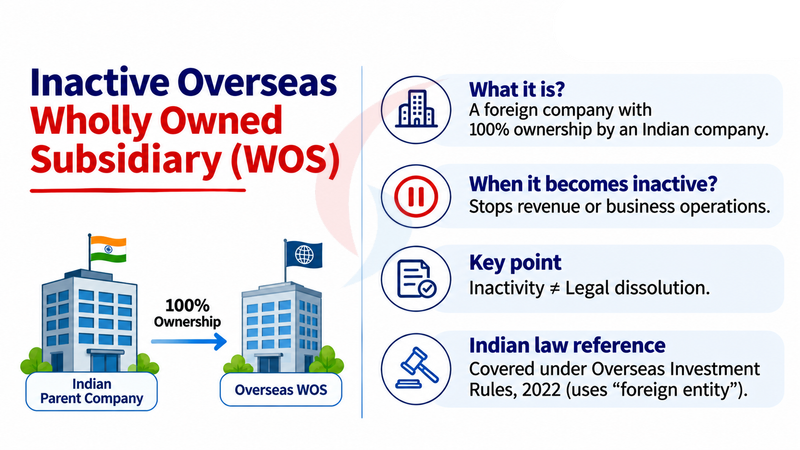
For example, a Singapore subsidiary with no sales may still retain its incorporation status, bank account, shareholders and obligations under Singapore law. Similarly, an inactive company in the United States may continue to have annual state filing or tax obligations. Under India's Overseas Investment Rules, 2022, the terminology generally uses “foreign entity” rather than the older distinction between joint ventures and wholly owned subsidiaries. However, WOS continues to be widely used in business and compliance discussions.
Read our guide on Overseas Direct Investment (ODI) in India to understand how Indian companies establish and invest in foreign subsidiaries.
Is FEMA Compliance Mandatory for an Inactive Overseas Subsidiary?
Yes, where the relevant reporting requirements continue to apply. An overseas subsidiary may have stopped trading, but the Indian company still owns its equity shares. That ownership represents an overseas investment until the relevant interests are lawfully transferred, extinguished or otherwise dealt with under the applicable regulations.
In particular, Regulation 10(4) of the Foreign Exchange Management (Overseas Investment) Regulations, 2022 prescribes annual performance reporting for qualifying ODI holdings. The regulation provides specified exemptions, including where the foreign entity is under liquidation. It does not provide a general exemption merely because the company has no revenue, employees or commercial activity.
|
Status of Overseas Subsidiary |
General FEMA Compliance Position |
|
Operating with revenue |
APR and other applicable reporting requirements continue. |
|
No revenue or transactions |
APR generally remains applicable. |
|
Dormant under foreign law |
Dormant status alone does not remove RBI reporting obligations. |
|
Loss-making subsidiary |
Losses do not automatically create an APR exemption. |
|
Under formal liquidation |
APR exemption may apply under Regulation 10(4). |
|
Legally dissolved |
Closure, disinvestment and outstanding reporting records must be reconciled. |
|
Partially sold subsidiary |
Remaining ODI and reporting obligations must be assessed. |
The RBI regulations expressly distinguish foreign entities under liquidation from other entities that continue to exist.
For additional guidance, see APR Filing for Inactive Foreign Companies: Is It Required?
Laws and Legal Provisions Governing Inactive Overseas WOS
Compliance for an inactive overseas subsidiary is governed by FEMA, the Overseas Investment Rules and Regulations, RBI directions, and applicable corporate laws.
|
Applicable Act or Regulations |
Important Provisions |
Legal Requirements |
|
Sections 6, 13 and 15 |
Governs overseas investments, contraventions and compounding. |
|
|
Rules 9, 17 and 18, as applicable |
Governs overseas investment conditions, disinvestment and restructuring. |
|
|
Regulations 9, 10, 11 and 12 |
Covers repatriation, APR and other reporting, delayed filings and restrictions on further commitments. |
|
|
Updated 1 April 2026 |
Provides operational guidance for overseas investment and AD banks. |
|
|
Sections 129, 134, 136 and 137 |
Covers applicable financial statements, consolidation and corporate disclosures. |
|
|
Rules 5 and 6 |
Governs AOC-1 disclosures and consolidated financial statements. |
These requirements apply alongside the laws of the country where the overseas subsidiary is incorporated. For example, an Indian company owning a subsidiary in Dubai must examine the Indian ODI rules as well as the relevant UAE corporate, licensing and tax obligations. Filing the necessary documents in the foreign jurisdiction does not automatically complete the Indian company's FEMA reporting.
Practical Story: An Indian Startup with an Inactive Singapore Subsidiary
Consider ABC Technologies Private Limited, a fictional software company based in Pune. In 2023, ABC Technologies invested Rs 80 lakh to establish a wholly owned subsidiary in Singapore. The subsidiary was expected to manage international software contracts and provide customer support to overseas clients. During its first year, the subsidiary obtained only a few small contracts. Its operating expenses exceeded its revenue, and by 2025, the Indian parent decided to stop expanding the business.
In 2026, the Singapore subsidiary records no sales and has no employees. Its bank account remains open, and ABC Technologies continues to hold 100% of its shares. The finance team assumes that APR filing is unnecessary because the foreign company has no business activity.
However, during the annual compliance review, the company's adviser explains that the subsidiary remains legally incorporated and the Indian parent continues to hold ODI. ABC Technologies must therefore assess the applicable APR obligation and prepare the required financial statements. It must also review its annual FLA Return, overseas investment records and Singapore compliance requirements. The management then considers whether to restart the international business or formally close the subsidiary.
Key Takeaway: An inactive overseas subsidiary may still require regulatory filings until the investment and the foreign entity's legal status have been properly addressed.
APR Filing Deadline in 2026
The ordinary APR deadline is 31 December. However, where the foreign entity's accounting year ends on 31 December, the APR is due by 31 December of the following year.
|
Overseas Financial Year-End |
Relevant APR Deadline |
|
31 March 2026 |
31 December 2026 |
|
30 June 2026 |
31 December 2026 |
|
31 December 2025 |
31 December 2026 |
|
31 December 2026 |
31 December 2027 |
The return is generally based on audited financial statements. The exception allowing certain unaudited financial statements is linked to investments without control and specified host-country audit conditions. A 100%-owned subsidiary should not automatically use unaudited accounts merely because the foreign jurisdiction does not require an audit.
For more information, read APR Filing: Common AD Bank Queries and How to Reply.
FLA Return for Indian Companies with Inactive Overseas WOS
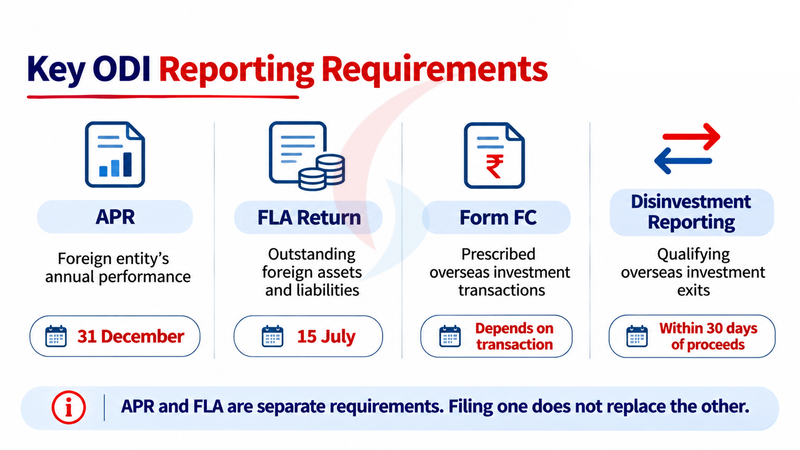
Apart from APR filing, an Indian company holding reportable ODI must examine its Annual Return on Foreign Liabilities and Assets (FLA Return) obligation. The FLA Return provides information about outstanding foreign financial assets and liabilities. It is submitted to RBI through the FLAIR portal and is generally due by 15 July annually.
For example, if an Indian company continues to own a Singapore subsidiary on 31 March 2026, the overseas equity investment may need to be reflected in its FLA Return for FY 2025–26, even when the subsidiary has no operating revenue.
|
Reporting Form |
Purpose |
General Deadline |
|
APR |
Reports the foreign entity's annual performance. |
31 December, subject to the year-end rule |
|
Reports outstanding foreign assets and liabilities. |
15 July |
|
|
Form FC |
Reports prescribed overseas investment transactions. |
Depends on the transaction |
|
Disinvestment Reporting |
Reports qualifying overseas investment exits. |
Generally within 30 days of receipt of proceeds |
APR and FLA are separate requirements. Filing one does not replace the other.
For further guidance, read our article on FLA Return Filing and Due Dates with Checklist.
Companies Act Compliance for Inactive Foreign Subsidiaries
An inactive overseas WOS may also affect the Indian parent company's financial reporting and disclosure requirements under the Companies Act, 2013. Section 129(3) requires applicable Indian holding companies to prepare consolidated financial statements incorporating their subsidiaries. The accompanying statement containing salient financial information is prescribed in Form AOC-1. Section 137 addresses the filing of financial statements with the Registrar of Companies and includes provisions relating to foreign subsidiaries.
|
Applicable Provision |
Compliance Requirement |
|
Section 129(3), Companies Act, 2013 |
Consolidated financial statements and relevant subsidiary disclosures. |
|
Section 134 |
Board approval and applicable financial reporting responsibilities. |
|
Section 136 |
Availability of financial statements and related documents, as applicable. |
|
Section 137 |
Filing of financial statements, including applicable foreign subsidiary records. |
|
Form AOC-1 |
Salient financial particulars of subsidiaries and other covered entities. |
An overseas subsidiary's inactivity does not automatically remove it from the Indian company's consolidation assessment. Where the foreign subsidiary is not required to have its accounts audited under its local law, Section 137 provides a specified filing treatment involving unaudited accounts and a declaration, subject to the applicable conditions. This Companies Act provision should not be confused with the different RBI rules governing the financial statements supporting APR.
Financial Statements Required for an Inactive WOS
Even where the overseas company has no commercial activity, the Indian parent may still need reliable financial information to complete its FEMA and corporate reporting. An inactive subsidiary may continue to have bank balances, outstanding professional fees, share capital, accumulated losses or liabilities. For example, a company with no revenue may still incur annual registration expenses, accounting costs or bank charges. These amounts must be properly reflected in its accounts.
|
Financial Information |
Purpose |
|
Share capital and ownership |
Confirms the Indian parent's holding. |
|
Balance sheet |
Identifies assets, liabilities and accumulated losses. |
|
Profit and loss statement |
Records operating expenses and financial results. |
|
Bank statements |
Verifies balances and transactions. |
|
Loans and advances |
Identifies outstanding financial commitments. |
|
Guarantees |
Helps reconcile non-fund-based commitments. |
|
Previous APR records |
Supports annual reporting continuity. |
If accounts are unavailable, the Indian parent should arrange appropriate financial records or statements from the foreign entity rather than treating missing information as evidence that no filing is necessary.
How to Close an Inactive Overseas Subsidiary
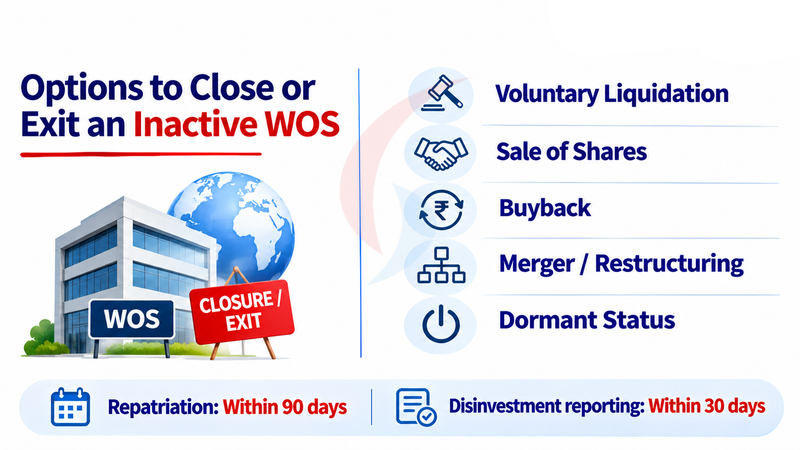
Where an inactive WOS no longer serves a business purpose, the Indian parent may consider formally closing or disposing of its overseas investment. The available options depend on the foreign jurisdiction, the subsidiary's financial condition, outstanding liabilities and the Indian ODI rules.
|
Closure or Exit Option |
Important Consideration |
|
Voluntary Liquidation |
Follow host-country liquidation requirements and collect final closure documents. |
|
Sale of Shares |
Examine the applicable disinvestment and pricing conditions. |
|
Buyback |
Review local corporate law and overseas investment reporting. |
|
Merger or Restructuring |
Examine the applicable ODI restructuring and approval requirements. |
|
Dormant Status |
The company remains legally in existence; reporting requirements must still be reviewed. |
For a qualifying full disinvestment by sale, Rule 17 generally requires the investor to have held the ODI for at least one year, subject to the prescribed exceptions. In addition, the investor must examine its outstanding investment-related dues before completing a full exit, except where the applicable provisions provide otherwise.
Where the subsidiary is liquidated, the Indian investor must comply with the applicable rules on repatriation of the net realisable value of assets distributed by the liquidator. The ordinary repatriation period is 90 days from the relevant statutory trigger, while applicable disinvestment reporting is generally required within 30 days of receipt of proceeds.
For a detailed explanation, read ODI Compliance: Exit Rules for Overseas Investments.
Practical Example: Closing an Inactive UK Subsidiary
Consider ABC Global Services Private Limited, a fictional Indian consulting company that established a wholly owned subsidiary in the United Kingdom. The company invested Rs 50 lakh in the overseas entity to develop its European client base. However, the business failed to obtain enough contracts, and the directors decided to close it after three years.
Before proceeding, ABC Global Services reviews the subsidiary's financial statements, outstanding liabilities and earlier ODI filings. It discovers that the UK subsidiary has an outstanding bank balance and has not submitted its previous year's APR information to the Indian parent.
The finance team first reconciles the missing reporting records and coordinates with its AD bank. The company then follows the applicable UK closure procedure, settles outstanding obligations and obtains formal documentation confirming the liquidation or dissolution. Any amounts distributable to the Indian parent must be repatriated in accordance with the applicable FEMA requirements. The Indian company also completes the prescribed ODI exit reporting. The example demonstrates why closing an overseas subsidiary requires both foreign-jurisdiction legal closure and Indian FEMA compliance.
Documents Required for WOS Compliance and Closure
The Indian parent company should maintain complete records of its overseas investment and the foreign subsidiary's activities, even when the entity is inactive.
|
Required Document |
Purpose |
|
Foreign Incorporation Certificate |
Establishes the subsidiary's legal existence. |
|
Original ODI and Form FC Records |
Confirms the investment and reporting history. |
|
Unique Identification Number (UIN) |
Identifies the foreign entity in RBI's overseas investment records. |
|
Foreign Share Certificates |
Supports the Indian company's ownership. |
|
Audited Financial Statements |
Supports applicable APR and corporate reporting. |
|
Previous APR Acknowledgements |
Establishes reporting history. |
|
Loan and Guarantee Details |
Identifies outstanding financial commitments. |
|
Board Resolutions |
Records the Indian parent's decisions regarding the subsidiary. |
|
Liquidation or Dissolution Documents |
Supports formal closure, where applicable. |
|
Repatriation Evidence |
Establishes receipt of relevant overseas investment proceeds. |
These documents are particularly important where the company has remained inactive for several years and the employees originally responsible for ODI reporting have left the organisation.
For additional guidance, read our article on ODI Compliance: Reporting Errors and How to Fix Them.
Latest RBI Updates for Overseas WOS Compliance in 2026
The RBI's Master Direction on Overseas Investment was updated on 1 April 2026. It continues to operate alongside the Foreign Exchange Management (Overseas Investment) Rules, 2022 and Regulations, 2022. The updated directions address overseas investment procedures, reporting, financial commitments, AD bank responsibilities and regulatory restrictions.
|
Regulatory Development |
Importance for Inactive WOS |
|
1 April 2026 – RBI Overseas Investment Master Direction Update |
Updated operational instructions for overseas investments and AD banks. |
|
APR Reporting under Regulation 10(4) |
Annual reporting continues unless a prescribed exemption applies. |
|
Liquidation Exemption |
Foreign entities under liquidation qualify for the specified APR exemption. |
|
Regulation 11 – Delayed Reporting |
Provides the applicable late submission mechanism. |
|
Regulation 12 – Reporting Defaults |
Restricts further financial commitments and transfers until reporting delays are regularised. |
|
RBI Compounding Master Direction – Updated 23 October 2026 |
Relevant to FEMA contraventions requiring formal regularisation. |
The April 2026 update should not be interpreted as granting a general reporting exemption to dormant or inactive overseas companies. In particular, the APR provisions remain linked to the existence of reportable ODI and the specific exemptions provided in Regulation 10(4). The RBI Master Directions index confirms the April 2026 overseas investment update and the October 2026 compounding update.
Penalties for Non-Compliance by Inactive Overseas Subsidiaries
An Indian company may face regulatory consequences if it fails to submit mandatory ODI reports because its overseas subsidiary has stopped operations. Under Regulation 11 of the Overseas Investment Regulations, 2022, eligible delayed reporting may be regularised through the RBI's Late Submission Fee (LSF) mechanism. The prescribed LSF for a delayed APR is generally Rs 7,500 per return, subject to the applicable RBI conditions.
|
Compliance Default |
Possible Consequence |
|
Delayed APR Filing |
Applicable LSF of Rs 7,500 per delayed return. |
|
Delayed Transaction Reporting |
Relevant amount-based LSF may apply. |
|
Missing Investment Evidence |
Separate reporting regularisation may be required. |
|
Unreported Disinvestment |
Delayed reporting or other FEMA consequences may arise. |
|
Substantive FEMA Violation |
Penalties or compounding may apply, depending on the facts. |
The LSF mechanism generally remains available for up to three years from the relevant reporting due date under the applicable regulations. Where the reporting default is not regularised, Section 13 of the Foreign Exchange Management Act, 1999 may become relevant. The company should not assume that payment of LSF automatically resolves a separate violation involving impermissible investment, guarantees or disinvestment conditions.
Why Choose Compliance Calendar LLP ?
At Compliance Calendar LLP, we assist Indian companies with overseas investment reporting, FEMA documentation and compliance-related matters.
|
Our Services |
How We Help |
|
WOS Compliance Review |
Examine the status of inactive overseas subsidiaries and applicable requirements. |
|
APR Filing Assistance |
Support preparation of Annual Performance Reports. |
|
ODI Documentation |
Assist with reviewing investment records and UIN-related information. |
|
FLA Return Filing |
Support applicable annual RBI reporting. |
|
Overseas Closure Compliance |
Assist with identifying FEMA obligations arising from liquidation or disinvestment. |
|
Delayed Filing Assistance |
Review overdue reports and applicable regularisation procedures. |
Businesses can explore our ODI Compliance Services and FEMA Due Diligence Services.
For assistance with WOS Compliance for Inactive Overseas Subsidiaries, contact Compliance Calendar LLP at 9988424211 or info@ccoffice.in.
Frequently Asked Questions (FAQs)
Q1. Is APR filing mandatory for an inactive overseas WOS?
Yes, in most cases. An inactive overseas wholly owned subsidiary generally remains subject to APR reporting where the Indian parent continues to hold ODI. The absence of sales or business activity does not automatically create an exemption.
Q2. Can a dormant foreign subsidiary avoid RBI reporting?
Not merely because it is dormant. The company's legal status and the specific RBI reporting exemptions must be examined. A foreign entity formally under liquidation may qualify for an APR exemption under Regulation 10(4).
Q3. What is the APR filing deadline for overseas subsidiaries in 2026?
The ordinary deadline is 31 December. Where the foreign entity's accounting year ends on 31 December, the APR is due by 31 December of the following year. Companies should identify the relevant foreign accounting year before calculating the deadline.
Q4. Is FLA Return required for an inactive overseas subsidiary?
An Indian company with reportable outstanding ODI generally must examine its annual FLA Return obligation. The ordinary deadline is 15 July. FLA reporting is separate from APR filing.
Q5. Can an Indian company close an overseas WOS without RBI approval?
Certain disinvestments and liquidations may proceed under general permission where the prescribed conditions are satisfied. However, particular transactions may require approval or additional procedures. Closure must also comply with the foreign jurisdiction's laws.
Q6. What happens if an overseas WOS has accumulated losses?
Accumulated losses do not automatically exempt the Indian parent from APR or FLA reporting. The company should prepare the relevant financial information and examine whether any proposed restructuring complies with Rule 18 of the Overseas Investment Rules, 2022.
Q7. Is audited financial information required for APR filing?
APR is generally based on audited financial statements. The regulations permit specified exceptions for qualifying investments without control where host-country auditing is not mandatory. A wholly owned subsidiary cannot automatically rely on that exception.
Q8. What is the penalty for delayed APR filing?
The applicable RBI Late Submission Fee is generally Rs 7,500 per delayed APR, subject to the prescribed conditions. Failure to regularise the default may also create restrictions on further overseas investment transactions.
Q9. Does an inactive WOS need to be included in consolidated financial statements?
The Indian parent must examine the consolidation and subsidiary disclosure requirements under Section 129(3) of the Companies Act, 2013 and the applicable accounting standards. Inactivity alone does not automatically remove a subsidiary from consolidation.
Q10. Can Compliance Calendar LLP assist with inactive overseas WOS compliance?
Ans: Yes. Compliance Calendar LLP assists Indian businesses with APR filings, ODI compliance reviews, FLA Returns, documentation and FEMA reporting requirements connected with inactive overseas subsidiaries.
Article last updated on : 20 Nov 2026.













































































_learn_crop10_thumb.jpg)