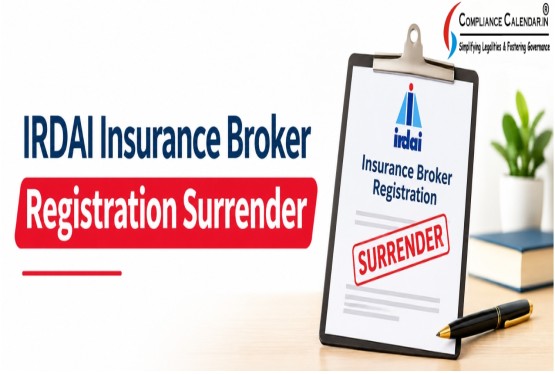



What Is Insurance Broker Registration?
Insurance Broker Registration is the regulatory authorisation required for an eligible business to undertake specified insurance broking activities in India. Insurance brokers assist customers in understanding insurance products, assessing risks, comparing coverage and obtaining suitable policies. Depending on their registration category, brokers may undertake direct insurance, reinsurance or both. The IRDAI (Insurance Brokers) Regulations, 2018, as amended, prescribe requirements concerning capital, net worth, personnel, professional qualifications, infrastructure and regulatory conduct.
Under Regulation 5, an applicant must submit the prescribed application and supporting documents. IRDAI evaluates the information before deciding whether registration should be granted. An incomplete application may lead to clarification requests, delays or eventual rejection. However, a request for additional documents should not automatically be treated as a formal rejection.
Companies applying for an Insurance Broker License must satisfy the applicable IRDAI registration conditions. Other insurance distribution businesses, including entities seeking a Corporate Agency License or Insurance Web Aggregator License, follow separate regulatory requirements. Similarly, organisations intending to underwrite insurance policies require Insurance Company Registration, which involves different capital, governance and licensing conditions.
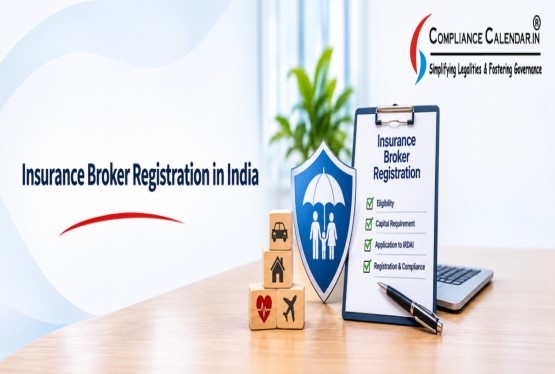
To understand the complete licensing process, eligibility criteria and application requirements, read our Insurance Broker Registration in India guide. It explains the important procedures applicants should follow before submitting their applications.
Legal Provisions Governing Insurance Broker Registration Rejection
The principal requirements arise from the Insurance Act, 1938 and the IRDAI (Insurance Brokers) Regulations, 2018, as amended.
| Legal provision | Key requirement |
|---|---|
| Insurance Act, 1938 – Section 42D | Registration and eligibility of insurance intermediaries |
| Regulation 5 | Submission of registration application |
| Regulation 6 | Completeness of application and rectification |
| Regulation 7 | Additional information and clarification |
| Regulation 8 | Assessment of applicant eligibility |
| Regulation 9 | Payment of prescribed fees |
| Regulation 10 | Issuance of Certificate of Registration |
| Regulation 12 | Rejection and right to be heard |
| Regulation 18 | Insurance broker company name requirements |
| Regulations 19, 22 and 23 | Capital, net worth and security deposits |
| Schedule I – Forms B and C | Application and supporting documents |
| Schedule I – Forms E, F and G | Personnel qualifications and suitability |
Regulation 8 is particularly important because it identifies the matters IRDAI considers when evaluating an applicant. Regulation 12 permits refusal where the relevant conditions are not satisfied, subject to the prescribed opportunity of being heard.
Applicants must satisfy the financial, operational and professional conditions prescribed by IRDAI before obtaining registration. Read our Conditions for Grant of Insurance Broker License in India article to understand these requirements.
Common Reasons for Rejection of Insurance Broker Registration
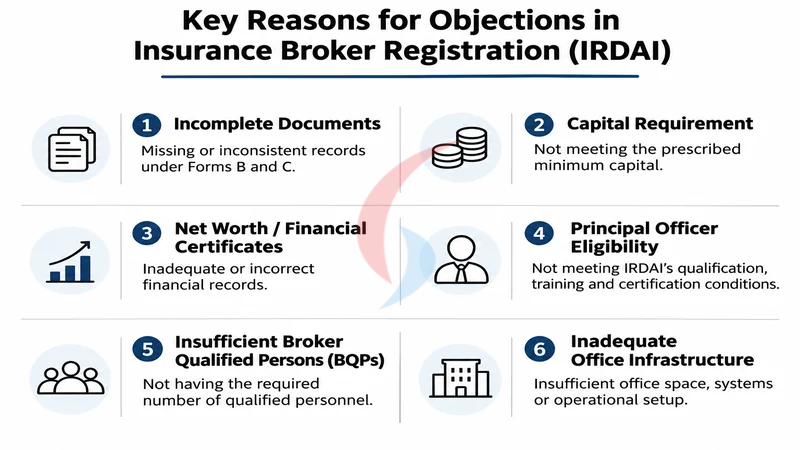
1. Incomplete or Incorrect Application Documents
Incomplete documentation is a common source of regulatory objections. Schedule I – Forms B and C prescribe the application particulars and supporting documentation required for registration. Problems may arise where incorporation documents, financial certificates, declarations or supporting records are missing or inconsistent.
How to avoid it: Review all documents before filing, reconcile company details and ensure that certificates and declarations reflect the same information.
2. Failure to Meet Minimum Capital Requirements
Insurance brokers must maintain the minimum capital prescribed for their category.
| Insurance broker category | Minimum capital |
|---|---|
| Direct Broker | Rs 75 lakh |
| Reinsurance Broker | Rs 4 crore |
| Composite Broker | Rs 5 crore |
Regulation 19 also restricts the use of borrowed funds for promoter investment in regulatory capital and requires the relevant capital interests to remain unencumbered. An applicant may face objections where capital is insufficient, improperly funded or inadequately documented.
How to avoid it: Maintain the prescribed capital and supporting bank, accounting and promoter-funding records.
3. Insufficient Net Worth or Incorrect Financial Certificates
Regulation 22 prescribes minimum net worth requirements for insurance brokers. IRDAI examines whether applicants satisfy the applicable financial conditions. For direct brokers, the minimum net worth is Rs 50 lakh. Reinsurance and composite brokers must satisfy a net worth requirement equivalent to 50% of their prescribed minimum capital. Problems may arise when a financial certificate contains incorrect calculations, outdated figures or insufficient supporting information.
How to avoid it: Obtain properly supported financial certificates and reconcile them with the company's audited or relevant accounting records.
4. Principal Officer Does Not Meet Eligibility Requirements
A Principal Officer must satisfy the qualifications, training, examination, certification and suitability conditions prescribed by IRDAI. Regulation 8 requires IRDAI to examine the Principal Officer's professional eligibility and experience.
How to avoid it: Verify educational eligibility, training certificates, examination results and fit-and-proper declarations before submission.
An eligible Principal Officer must meet the prescribed qualifications, training, certification and suitability requirements. Explore our IRDAI Principal Officer Requirements for Insurance Brokers guide for appointment and eligibility conditions.
5. Insufficient Broker Qualified Persons
Regulation 8(2)(c) of the published 2018 Regulations requires at least two Broker Qualified Persons with the prescribed qualifications and experience. Additional requirements apply to relevant branch offices. A company may face objections if it does not have adequately qualified personnel or cannot establish their employment and certification status.
How to avoid it: Recruit qualified personnel, verify their certificates and maintain proper employment and professional records.
6. Inadequate Office Infrastructure
IRDAI considers whether the applicant has suitable office space, trained manpower, equipment and information technology infrastructure. A company operating without an adequate business setup may be unable to demonstrate operational readiness.
How to avoid it: Prepare supporting evidence of office facilities, communication systems, staffing and customer-service arrangements.
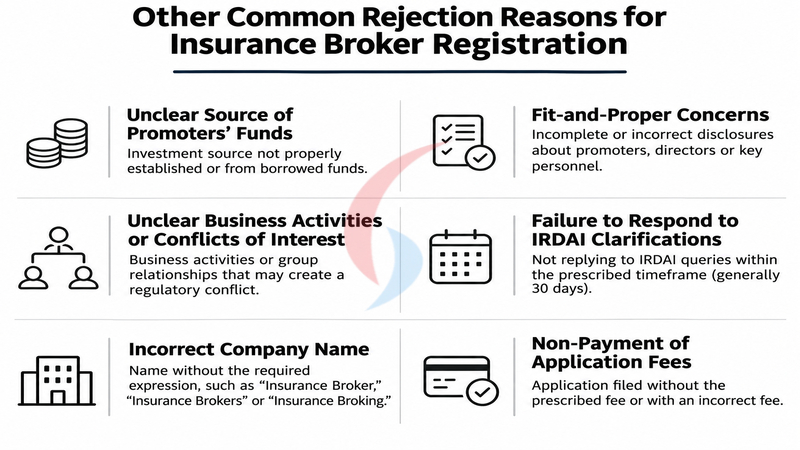
7. Unclear Source of Promoters' Funds
IRDAI examines whether promoters and investors are financially capable of investing in the proposed brokerage. Regulation 19 specifies that promoter investments must come from their own funds rather than borrowed funds.
How to avoid it: Maintain reliable funding records, supporting financial statements and appropriate explanations of investment sources.
Insurance broking companies must appoint appropriately qualified personnel to undertake regulated solicitation and procurement activities. Read our Qualified Persons in Insurance Broking article to understand their qualifications and professional duties.
8. Fit-and-Proper Concerns
IRDAI evaluates the suitability of promoters, directors, the Principal Officer and key management personnel. Schedule I – Form G contains the relevant fit-and-proper declaration. The assessment considers matters relating to integrity, professional conduct and regulatory history. Incomplete disclosures concerning previous regulatory action or other material facts may raise serious concerns.
How to avoid it: Provide complete, accurate declarations and disclose relevant circumstances rather than omitting inconvenient information.
9. Unclear Business Activities or Conflicts of Interest
Insurance broker applicants must operate within the business activities permitted under the regulations. Regulation 8 allows IRDAI to examine other business activities, relevant group relationships and possible conflicts of interest. For example, where an applicant has connections with another insurance intermediary, IRDAI may assess whether the proposed arrangement creates regulatory conflicts.
How to avoid it: Review the company's objects, group structure and related-party relationships before applying.
10. Failure to Respond to IRDAI Clarifications
Regulation 7 permits IRDAI to request additional information and explanations. Under the published 2018 provision, applicants are given an opportunity to respond within 30 days of receiving the communication. An applicant who ignores regulatory queries or submits incomplete explanations risks delaying or jeopardising the application.
How to avoid it: Monitor communications carefully, prepare point-wise responses and submit supporting documents within the applicable timeframe.
11. Incorrect Company Name
Regulation 18 requires the applicant's name to contain an appropriate insurance broker expression, such as “Insurance Broker,” “Insurance Brokers” or “Insurance Broking.” An applicant using a non-compliant name may face difficulties during registration.
How to avoid it: Check the proposed name against IRDAI nomenclature requirements before incorporation or application submission.
12. Non-Payment of Prescribed Application Fees
Regulation 9 requires applicants to pay the prescribed application fees. The Authority will not process an application that does not carry the required fee. Applicants should therefore verify the correct fee for their broker category and preserve payment evidence.
How to avoid it: Confirm the latest applicable fee schedule and ensure successful payment before submission.
Storytelling: When a Small Documentation Mistake Delayed an Insurance Broker License
Akansha, a finance professional from Faridabad, wanted to establish an insurance broking company. She had worked in the financial services industry for several years and believed there was a growing opportunity to help small businesses find suitable insurance policies. After discussing her plans with investors, she incorporated a company and started preparing an application for insurance broker registration.
Akansha arranged the initial capital, appointed a Principal Officer and collected the company's incorporation documents. She assumed that these preparations would be sufficient to obtain approval from the Insurance Regulatory and Development Authority of India (IRDAI).
However, during the application review, IRDAI requested additional clarification. The company's financial documents did not clearly establish the source of the promoters' investment, one employee's professional certification was incomplete, and the business plan did not adequately explain the proposed insurance distribution activities.
Akansha realised that having sufficient money and an incorporated company did not automatically guarantee registration. Every requirement had to be supported by accurate documents and appropriate regulatory arrangements.
This example demonstrates why understanding Insurance Broker Registration: Common Rejection Reasons is important for businesses entering India's insurance industry.
Common Registration Objections and Preventive Measures
Insurance broker registration applications may face objections from IRDAI due to incomplete documents, insufficient capital, incorrect net worth certificates, unqualified Principal Officers or discrepancies in shareholding details. Such issues can delay the approval process and require additional clarification. To avoid these objections, applicants should carefully verify eligibility, maintain accurate financial records, submit complete documentation and ensure compliance with applicable IRDAI regulations before filing their application.
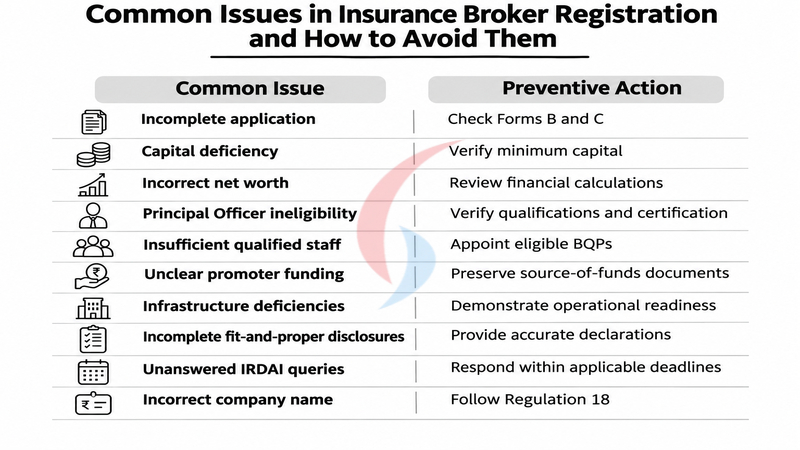
A systematic pre-application review can help identify these problems before IRDAI examines the submission.
What Happens When IRDAI Raises an Objection?
A clarification request does not necessarily mean that the insurance broker registration application has been rejected. IRDAI may request revised certificates, additional declarations, funding explanations or other supporting documents. Under Regulation 6 of the published 2018 Regulations, an applicant must receive a reasonable opportunity to complete an application and rectify errors before it is rejected for incompleteness. Regulation 7 also permits IRDAI to seek further information or require a personal representation involving the applicant and Principal Officer.
A formal refusal is governed by Regulation 12. The original provision requires an opportunity of being heard and communication of the grounds of rejection. An applicant aggrieved by the decision may appeal to the Securities Appellate Tribunal. The published Regulation 12 also provides for a one-year waiting period before reapplication in specified circumstances where the applicant does not appeal. Applicants should check the current amended provisions before deciding whether to appeal or submit a fresh application.
Applicants and registered brokers should understand the relevant online regulatory filing and reporting procedures. Our IRDAI BAP Portal: Filings and Reporting Requirements guide explains important portal-related compliance activities.
Process to Avoid Insurance Broker Registration Rejection
To avoid insurance broker registration rejection, applicants should carefully review IRDAI eligibility criteria, capital requirements and documentation before submitting the application. Proper verification of the Principal Officer's qualifications, net worth certificates and shareholding details is essential. Applicants should also ensure accurate filings and respond promptly to IRDAI queries to prevent unnecessary delays or objections.
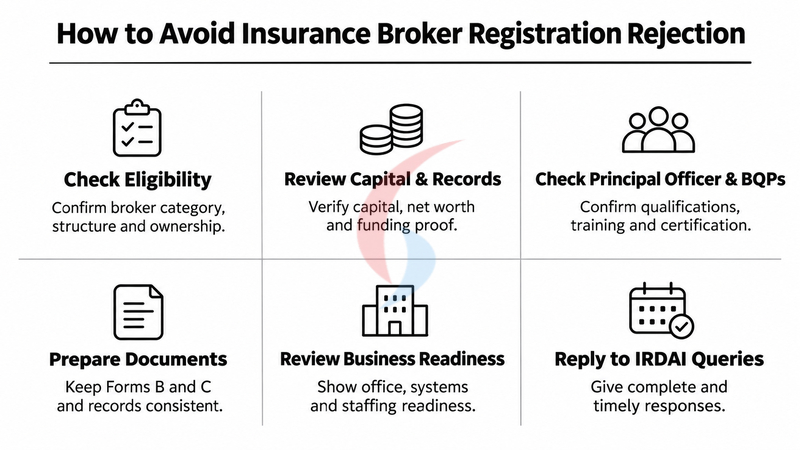
Step 1: Verify Registration Eligibility
Determine the appropriate broker category and its regulatory conditions. Examine the company's legal structure, business objects and ownership arrangements before filing.
Step 2: Review Capital and Financial Records
Confirm the prescribed capital, net worth and funding conditions. Ensure that the financial certificates and promoter investment documents accurately support the application.
Step 3: Verify the Principal Officer and Qualified Staff
Check the qualifications, training, examination and certification records of the Principal Officer and BQPs. Resolve any personnel deficiencies before seeking registration.
Step 4: Prepare the Application Documents
Collect the documents prescribed under Schedule I – Forms B and C. Ensure consistency across incorporation documents, financial statements, business plans and declarations.
Step 5: Review Business Readiness
Assess the proposed office infrastructure, customer-servicing arrangements, information technology systems and qualified manpower. Prepare supporting records demonstrating operational readiness.
Step 6: Respond to Regulatory Queries
Provide complete, point-wise answers to IRDAI clarifications within the applicable timeframe. Where a revised document is required, clearly identify the correction and attach the supporting evidence.
Applicants should verify the applicable professional training and examination procedures before nominating their personnel. Our IRDAI Broker or IMF Exam & Training: The Complete Guide explains the relevant training and examination process.
Latest IRDAI Registration Updates in 2026
On 30 July 2026, IRDAI notified the Insurance Intermediaries (Amendment) Regulations, 2026, introducing changes to the regulatory arrangements for insurance brokers and other intermediaries. These reforms included continuing validity arrangements for intermediary registrations, subject to prescribed conditions, and transition provisions for existing registration holders.
However, continuing validity of registration does not mean automatic approval for new applicants. New insurance broking businesses must still satisfy the applicable eligibility requirements, financial conditions and documentation obligations. Applicants should therefore read the 2018 Insurance Brokers Regulations together with the 2026 amendments and subsequent IRDAI directions.
Common Mistakes Applicants Should Avoid
Applicants sometimes assume that incorporating a company and depositing the prescribed capital automatically makes them eligible for registration. Others focus heavily on the financial requirements while overlooking professional qualifications, infrastructure or regulatory declarations. Another frequent difficulty is submitting inconsistent documents. Differences in shareholding percentages, financial figures, company addresses or employee records can lead to additional clarification requests.
Businesses should also avoid giving incomplete responses to regulatory observations. A short reply without supporting evidence may not resolve the underlying concern. The best approach is to examine the entire application before submission, maintain an organised document checklist and address all regulatory communications carefully.
Why Choose Compliance Calendar LLP?
Insurance Broker Registration requires careful assessment of financial eligibility, qualified personnel, infrastructure, corporate records and regulatory documentation.
Compliance Calendar LLP assists businesses with insurance broker registration, documentation and related IRDAI compliance requirements. Our team can help applicants understand the applicable eligibility conditions, prepare supporting records and address procedural concerns during the application process.
For businesses planning to establish an insurance brokerage, our Requirements and Procedure for Insurance Broker License guide explains the broader licensing process.
For professional assistance with insurance broker registration and compliance, contact Compliance Calendar LLP at +91 9988424211 or info@ccoffice.in
Frequently Asked Questions (FAQs)
Q1. What are the common reasons for insurance broker registration rejection?
Ans. Common reasons include incomplete documents, insufficient capital, ineligible personnel and incorrect financial information. IRDAI also examines infrastructure, promoter suitability and regulatory compliance. The actual grounds depend on the application.
Q2. Can IRDAI reject an incomplete insurance broker application?
Ans. Yes, Regulation 6 provides for rejection of applications that do not satisfy the prescribed requirements. However, applicants must be given a reasonable opportunity to complete the application and correct errors. Unresolved deficiencies may result in rejection.
Q3. What is the minimum capital required for insurance broker registration?
Ans. The prescribed minimum capital is Rs 75 lakh for direct brokers, Rs 4 crore for reinsurance brokers and Rs 5 crore for composite brokers. Applicants must also meet applicable net worth requirements. Capital must satisfy the prescribed funding conditions.
Q4. Can an insurance broker license be rejected due to an unqualified Principal Officer?
Ans. Yes, the Principal Officer's eligibility is an important consideration under Regulation 8. The proposed officer must satisfy the applicable qualification, training, examination and suitability requirements. Deficiencies may affect the application.
Q5. How many Broker Qualified Persons are required for registration?
Ans. The published 2018 Regulations require a minimum of two appropriately qualified BQPs. Additional staffing requirements may apply to branch offices. Applicants must verify their compliance with the latest applicable provisions.
Q6. What happens if an applicant does not reply to IRDAI queries?
Ans. Failure to provide requested information can delay the application and may contribute to rejection. Regulation 7 provides for additional information and clarifications. Applicants should respond within the applicable timeframe.
Q7. Can an applicant reapply after IRDAI rejects registration?
Ans. Yes, reapplication may be possible subject to the applicable waiting-period provisions. The published 2018 Regulation 12 provides for a one-year period in specified circumstances. Applicants should verify subsequent amendments before reapplying.
Q8. Is IRDAI required to provide reasons for rejection?
Ans. Regulation 12 of the 2018 Regulations requires communication of the grounds for refusing registration. Applicants are also entitled to a reasonable opportunity of being heard. An aggrieved applicant may pursue the prescribed appeal remedy.
Q9. Can incorrect promoter funding documents cause rejection?
Ans. Yes, IRDAI examines whether promoters have sufficient financial capacity and whether their investment satisfies regulatory conditions. Unexplained funding sources or inaccurate certificates can raise concerns. Applicants should preserve appropriate financial evidence.
Q10. How can applicants reduce the risk of registration rejection?
Ans. Applicants should verify financial eligibility, professional qualifications, infrastructure and documentary requirements before filing. All application information should be consistent and accurate. Regulatory queries should be addressed promptly with supporting evidence.
Article last updated on : 21 Nov 2026.













































































_learn_crop10_thumb.jpg)