


Starting a business is exciting, but building a team that believes in the business can be one of the biggest challenges for a founder. A young startup may have a promising product, ambitious plans and growing customer interest, yet struggle to offer the salaries that established companies can afford. This is where an Employee Stock Option Plan (ESOP) can make a meaningful difference. Instead of offering only a monthly salary, a startup can give employees an opportunity to become shareholders and benefit from the company's future growth.
However, an ESOP comes with an important question that many first-time founders overlook: How much ownership should be reserved for employees, and how will that affect the founders' shares? Creating an ESOP pool may seem like a straightforward decision, but its size and timing can significantly influence ownership, investor negotiations and future fundraising rounds.
For startups operating as a company through Private Limited Company Registration, understanding ESOP pool creation is especially important because employee stock options are governed by the Companies Act, 2013. Similarly, startups seeking Startup India Registration should understand how equity-based employee incentives fit into their long-term growth plans. This article explains what an ESOP pool means, how startups create one, how share dilution works, what investors generally expect, and the legal requirements applicable in India in 2026.
Startups planning employee equity incentives should first understand how stock options support hiring and long-term business growth. Our detailed guide on ESOP for Startups in India explains the benefits, challenges and important considerations before introducing an employee stock option scheme.
What Is an ESOP Pool in a Startup?
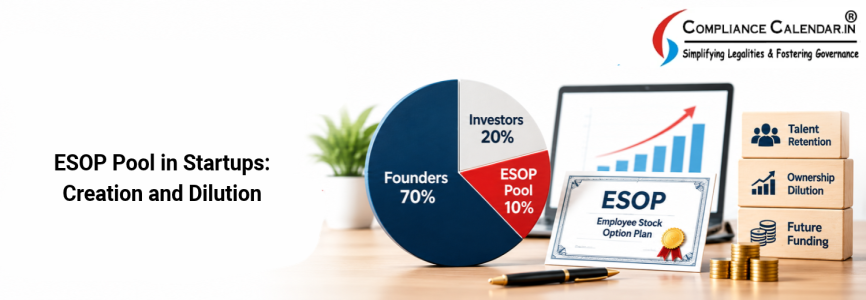
An ESOP pool is a portion of a startup's potential equity ownership reserved for eligible employees under an Employee Stock Option Scheme. It allows the company to grant employees the right to acquire shares in the future at a predetermined price, subject to conditions such as continued employment and completion of a vesting period.
For example, imagine a startup valued at Rs 5 crore that wants to hire experienced software developers, marketing professionals and a finance head. Instead of competing with larger companies solely through salaries, the founders decide to create an ESOP pool representing 10% of the company's fully diluted share capital. This pool can be used to offer stock options to selected employees as part of their compensation packages. One important distinction is that creating an ESOP pool does not automatically make employees shareholders. Initially, the company reserves a capacity for future option grants under its approved scheme. Employees become shareholders only after their options vest, they exercise those options and the company completes the applicable share allotment process. Until then, unexercised options generally do not carry shareholder voting rights or dividend entitlements. Startups often use professional ESOP Scheme Compliance services to structure the scheme, obtain necessary approvals and maintain the required statutory records.
Why Do Startups Create an ESOP Pool?
For an early-stage startup, cash is often its most valuable resource. Founders must spend money on product development, technology, marketing, regulatory requirements and day-to-day operations. Hiring experienced professionals at high salaries can put additional pressure on limited funds. An ESOP pool provides another way to reward employees by giving them an opportunity to participate in the company's future financial success. Consider a technology startup that needs a Chief Technology Officer but cannot match the salary offered by an established multinational company. The founders might offer a reasonable fixed salary along with stock options. The employee understands that these options have no guaranteed value, but if the startup becomes successful, the shares acquired through ESOPs could become financially rewarding.
ESOPs may also encourage employees to stay longer because stock options generally vest over time. Employees who contribute to the company's growth may benefit from the increase in its share value, provided they can eventually sell their shares. For founders, the objective is not simply to reduce salary costs but to build a committed team that shares the company's long-term goals. An ESOP pool also helps startups prepare for future hiring requirements. Investors often examine whether the business has sufficient equity incentives available to attract senior employees after receiving funding.
For growing businesses, employee stock options can play an important role in retaining talented professionals and encouraging long-term commitment. Founders can explore ESOPs for Employee Retention and Business Growth to understand how equity incentives can benefit both employers and employees.
How Much ESOP Pool Should a Startup Create?
There is no single ESOP pool percentage suitable for every startup. The appropriate size depends on the stage of the business, existing employee strength, future hiring requirements, fundraising plans and the amount of equity founders are comfortable allocating to employees.
In startup funding discussions, ESOP pools of approximately 5% to 15% are commonly considered, although the actual percentage may be smaller or larger depending on the company's needs. A startup hiring its first ten employees may require a different pool from a fast-growing company preparing to recruit a large management team.
|
Startup Stage |
Illustrative ESOP Pool Size |
Main Consideration |
|---|---|---|
|
Early-stage startup |
5%–10% |
Hiring important initial employees |
|
Seed-funded startup |
10%–15% |
Building the core team |
|
Growing startup |
10%–15% |
Recruiting senior management |
|
Mature startup |
Based on future needs |
Employee retention and replacement grants |
These percentages are commercial illustrations, not statutory requirements. Founders should ideally prepare a hiring plan and estimate the options needed for each proposed position before deciding the size of the pool. Creating a larger pool than necessary may cause avoidable dilution, while keeping it too small may require repeated shareholder approvals and additional negotiations with investors.
Before deciding the percentage of equity to reserve, founders should also examine how employee stock options affect their future investment plans. Our article on Startup Funding and ESOPs explains how startups can balance employee incentives with fundraising requirements and ownership dilution.
How Is an ESOP Pool Created in India?
Creating an ESOP pool involves more than deciding that employees should receive a certain percentage of the company. A startup must prepare a properly documented scheme, determine employee eligibility, obtain the required approvals and follow the applicable company-law procedures.
Step 1: Decide the Size of the ESOP Pool
The founders should begin by examining the company's current shareholding and future recruitment plans. They must decide how many options may be granted under the proposed scheme and how these options will affect ownership on a fully diluted basis. The calculation should consider existing shares, outstanding convertible securities, previously granted options and other relevant arrangements.
For example, if a startup expects to hire a technology head, sales director and five senior developers over the next two years, it can estimate the equity incentive requirement for each position. This makes the pool size more realistic and easier to justify during discussions with investors.
Step 2: Prepare the ESOP Scheme
The company must prepare an ESOP scheme specifying its important terms and conditions. These generally include the number of options available, categories of eligible employees, vesting conditions, exercise price, exercise period, treatment of options upon resignation and circumstances in which options may lapse. The scheme should also explain how options will be administered and how employees can exercise them. Clear documentation is especially important because employees may misunderstand stock options as an immediate ownership entitlement or a guaranteed financial benefit.
Step 3: Obtain Board and Shareholder Approval
The Board of Directors generally considers and approves the proposed ESOP scheme before recommending it to shareholders. Under Section 62(1)(b) of the Companies Act, 2013, read with Rule 12 of the Companies (Share Capital and Debentures) Rules, 2014, shareholder approval through a special resolution is generally required, subject to applicable statutory exemptions. The company must provide the prescribed disclosures in the explanatory statement accompanying the meeting notice. Relevant ROC filings, including Form MGT-14 where applicable, must also be completed within the prescribed timelines.
Step 4: Grant Options to Eligible Employees
After the scheme is approved, the company may grant options to eligible employees through individual grant letters. These documents typically specify the number of options, exercise price, vesting schedule and other important conditions applicable to the employee. The company should ensure that the grants remain within the approved pool and comply with the scheme. Where separate shareholder approval is required for particular grants, the necessary approval must be obtained before proceeding.
Step 5: Maintain Records and Complete Share Allotment
The company must maintain the prescribed Register of Employee Stock Options in Form SH-6 and update it as grants, vesting, exercises and lapses occur. When employees exercise vested options, the company must complete the applicable share issuance and allotment formalities, including Form PAS-3 where required.This is also the stage at which the company's issued share capital and actual shareholder ownership may change. A founder who tracks only existing issued shares, without maintaining a fully diluted capitalization table, may underestimate the potential effect of ESOPs on ownership.
A properly drafted ESOP scheme should clearly explain employee rights, exercise conditions and the responsibilities of the company. Businesses can refer to ESOPs Compliance Checklist and Procedure under the Companies Act, 2013 to better understand the documentation, approvals and compliance requirements involved.
What Is Share Dilution in an ESOP Pool?
Share dilution happens when the total number of shares, or potential shares considered on a fully diluted basis, increases and the percentage ownership of existing shareholders decreases. In simple words, founders may continue holding the same number of shares, but their percentage in the company becomes smaller because more shares are included in the ownership calculation.
For example, suppose two founders together own 100% of a startup. They decide to reserve 10% of the fully diluted ownership for employees through an ESOP pool. Their combined ownership on that basis becomes 90%, even though the options may not yet have been exercised and issued shares may remain unchanged. It is important to understand that dilution does not always mean financial loss. If the ESOP helps the company recruit talented employees, improve its product and increase its valuation, the founders may eventually own a smaller percentage of a much more valuable business.
Understanding the value of company shares is equally important when evaluating equity dilution. Startup founders can read Different Methods of Valuation of Shares to understand how share valuation works and why it matters during employee equity allocation and investment discussions.
How ESOP Pool Creation Affects Founder Ownership After Funding
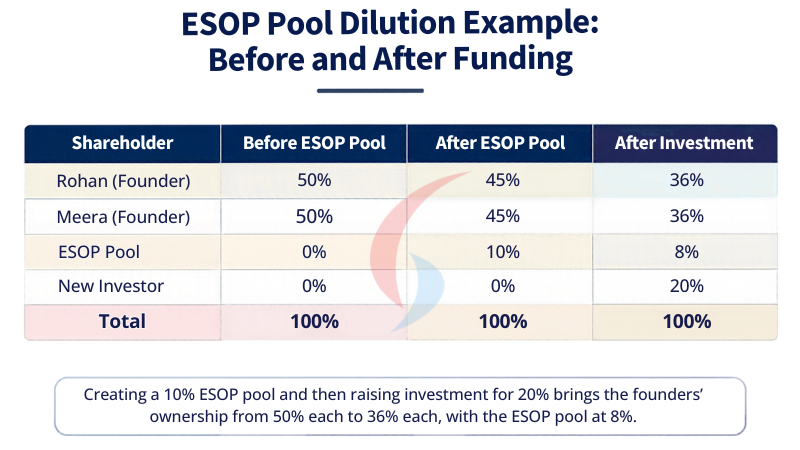
Consider a fictional startup called BrightPath Technologies Private Limited, founded by Rohan and Meera. Initially, both founders own equal shares in the company. After developing a successful software product, they decide to create an ESOP pool to attract skilled employees and later raise investment.
Assume the startup first creates an ESOP pool equal to 10% of its fully diluted ownership. Subsequently, it raises funds from an investor who acquires 20% of the company's post-investment equity. For this illustration, the existing ESOP pool is not increased during the funding round.
|
Shareholder |
Before ESOP Pool |
After ESOP Pool |
After Investment |
|---|---|---|---|
|
Rohan (Founder) |
50% |
45% |
36% |
|
Meera (Founder) |
50% |
45% |
36% |
|
ESOP Pool |
0% |
10% |
8% |
|
New Investor |
0% |
0% |
20% |
|
Total |
100% |
100% |
100% |
The founders initially owned 50% each, but after creating the ESOP pool, their fully diluted ownership declined to 45% each. When the investor acquired 20% of the company, their individual ownership declined further to 36%. The ESOP pool also reduced from 10% to 8% because it was diluted by the new investment.
This example shows why founders should calculate dilution before finalising an investment agreement. The ESOP pool and investor ownership must both be considered when examining the company's future shareholding pattern. The percentages shown are on a fully diluted basis, assuming the full ESOP pool is ultimately used.
Startup founders should also understand the compliance requirements that arise when external investors acquire shares in the company. Our guide on Compliances Applicable on Investment in Indian Startup Companies explains important corporate approvals, valuation considerations and legal obligations associated with startup investments.
What Is Pre-Money and Post-Money ESOP Pool Dilution?
One of the most important questions during startup fundraising is whether an ESOP pool will be created or increased before or after the investor's money enters the company. This can significantly affect how much dilution the founders and investors experience.
Pre-money ESOP pool creation means the required pool is included in the company's ownership calculation before the investment is completed. This arrangement generally places the additional dilution on the existing shareholders. Investors may prefer this approach because their negotiated ownership percentage is not reduced by the pool creation immediately after investment.
Post-money ESOP pool creation means the pool is created or increased after the investment, allowing the new investor to share in the resulting dilution along with existing shareholders. The final ownership percentages depend on the terms of the investment and how the transaction is structured.
For example, suppose a founder owns 100% of a startup, and an investor is negotiating a 20% stake. If the parties require a 10% ESOP pool after investment and agree that it will be created entirely before closing, the resulting fully diluted ownership may be 70% for the founder, 20% for the investor and 10% for the ESOP pool. Under a different arrangement where the investor first receives 20% and a 10% pool is created afterward, the resulting ownership would be 72% for the founder, 18% for the investor and 10% for the pool.
The difference may look small, but it can become financially significant as the startup's valuation increases. This negotiation is commonly known as the option pool shuffle.
The valuation agreed upon during a funding round can influence how much ownership founders retain after creating an ESOP pool. To understand how investors assess early-stage businesses, founders can read Determining the Valuation of a Startup in the Seed Funding Stage
Case Study: How an ESOP Pool Changed a Founder's Funding Decision
Imagine a Bengaluru-based software startup called XYZ Private Limited. Its founder, Arjun, started the company with personal savings and gradually built a team of eight employees. After two years, XYZ developed a promising business software product and received an investment offer from a venture capital firm.
The investor offered Rs 10 crore at a pre-money valuation of Rs 40 crore, meaning the company's agreed post-money valuation would be Rs 50 crore. Arjun was excited because the funding could help the company expand its operations and hire more employees. However, the investor included an additional condition in the term sheet: Nexora must have an ESOP pool representing 10% of its fully diluted share capital immediately after investment, and this pool had to be created before the investor subscribed for shares.
Arjun initially believed that the investment would simply reduce his ownership from 100% to 80%. After reviewing the capitalization table, he realised that the ESOP requirement would create additional dilution. Under the agreed transaction structure, the final ownership would be approximately 70% for Arjun, 20% for the investor and 10% for the ESOP pool.
Before signing the agreement, Arjun prepared a detailed hiring plan. He identified the positions for which the company needed equity incentives and discussed whether the proposed pool could support those hiring requirements. He also examined how future funding rounds might affect his ownership.
The investor eventually agreed to proceed with a clearly defined ESOP allocation plan, and Nexora established its employee stock option scheme with the required corporate approvals.
The important lesson from this fictional example is that founders should never negotiate valuation and investment percentage in isolation. The ESOP pool size, its timing and the fully diluted capitalization table can be just as important as the amount of funding received.
Key Legal Provisions Governing ESOP Pools in India
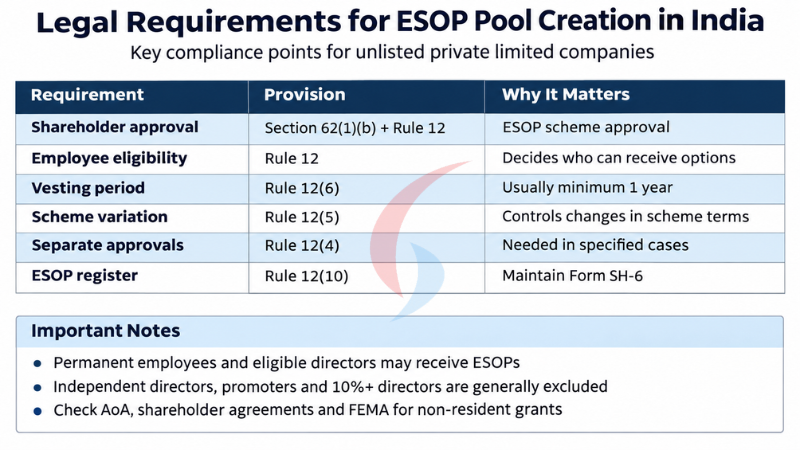
An ESOP pool must comply with the corporate laws governing the issuance of employee stock options. For an unlisted private limited company, the principal provisions are Section 62(1)(b) of the Companies Act, 2013 and Rule 12 of the Companies (Share Capital and Debentures) Rules, 2014.
Section 62(1)(b) allows companies to offer shares to employees under an employee stock option scheme, subject to the prescribed approvals and conditions. Rule 12 provides requirements concerning employee eligibility, shareholder approval, scheme disclosures, vesting, variation of scheme terms and maintenance of the statutory register.
The following requirements are particularly relevant:
|
Legal Requirement |
Applicable Provision |
Importance |
|---|---|---|
|
Shareholder approval |
Section 62(1)(b) and Rule 12 |
Approval of the ESOP scheme, subject to applicable exemptions |
|
Employee eligibility |
Rule 12 |
Determines who may receive options |
|
Vesting period |
Rule 12(6) |
Generally requires at least one year between grant and vesting |
|
Scheme variation |
Rule 12(5) |
Regulates changes to scheme terms |
|
Separate approvals |
Rule 12(4) |
Applies to specified grants and circumstances |
|
ESOP register |
Rule 12(10) |
Requires maintenance of Form SH-6 |
Under the general eligibility rules, permanent employees and qualifying directors may receive ESOPs, while independent directors are excluded. Promoters and directors holding more than 10% of the outstanding equity shares are also generally excluded, subject to specific relaxations, including those available to qualifying startups under applicable rules. The company must also examine its Articles of Association, existing shareholder agreements and investor consent requirements before implementing a scheme. Where options are granted to non-resident employees, applicable FEMA requirements must be considered.
Another important part of ESOP compliance is determining the value of employee stock options and maintaining appropriate valuation records. Companies can explore ESOP Valuation in India: Methods and Compliance to understand valuation methods and the related legal requirements.
How Does ESOP Vesting Affect Employees?
Vesting determines when employees earn the right to exercise the stock options granted to them. Startups generally introduce vesting conditions to encourage employees to remain with the business and contribute to its growth over time.
For example, a company may grant 4,000 options to an employee under a four-year vesting schedule. The scheme may provide that 25% of the options vest after the first year, with the remaining options vesting periodically over the next three years. This allows the employee to gradually earn the right to exercise all the granted options. A four-year vesting schedule with a one-year cliff is a common commercial arrangement, but it is not mandatory for every startup. Rule 12 ordinarily requires a minimum one-year period between grant and vesting, subject to applicable exceptions. The company may choose a longer vesting period or introduce performance-related conditions depending on its business needs and the terms of the approved scheme. If an employee resigns before completing the vesting period, unvested options generally lapse under the applicable statutory rules. Vested options are treated according to the scheme and the applicable law. Therefore, startups should clearly explain vesting and exit-related conditions when issuing grant letters.
Employees should understand what happens to their stock options when they leave the company or when their employment ends unexpectedly. Our detailed article on ESOPs on Resignation, Termination and Death explains how different employment situations can affect vested and unvested options.
Can a Startup Increase Its ESOP Pool Later?
Yes, a startup can increase its ESOP pool when its existing pool is insufficient to meet future employee requirements. This is commonly called an ESOP pool top-up. Growing companies often consider this when hiring senior management, expanding into new markets or preparing for another fundraising round.
For example, a startup may initially create a 5% ESOP pool and later realise that it requires a larger allocation to recruit experienced professionals. The company may propose increasing the pool to 10%, subject to necessary corporate approvals and changes to the approved scheme. However, an increase in pool size can create further dilution. The founders must understand whether the additional options will affect only existing shareholders in the negotiated fundraising calculations or whether incoming investors will also share the economic impact.
A pool increase should be supported by a hiring requirement rather than an arbitrary percentage. Companies should also check whether separate approvals, scheme amendments and fresh filings are required before granting options beyond the existing approved limit.
When startups expand their ESOP pool during fundraising, they should review both their equity structure and investment-related obligations. Founders can refer to Startup Funding Requirement and Importance of Funding for Startups to understand how different funding decisions can influence business growth and ownership planning.
Taxation of ESOPs in India
ESOPs can create tax obligations for employees even when they have not sold their shares. Generally, when an employee exercises options and receives shares, the difference between the prescribed fair market value of those shares and the exercise price is treated as a taxable salary perquisite. A subsequent sale of the shares may create a separate capital gains tax obligation.
For example, suppose an employee exercises 1,000 options at Rs 100 per share when the applicable fair market value is Rs 500 per share. The resulting taxable perquisite would ordinarily be Rs 4,00,000, subject to the applicable valuation and tax rules. If the employee later sells those shares at a higher value, capital gains taxation must also be considered.
Eligible startups may qualify for special deferment provisions relating to ESOP perquisite tax. However, DPIIT recognition alone does not automatically establish eligibility for every tax benefit. The company must satisfy the specific conditions applicable to the relevant provision. As of 2026, startups should also account for the Income-tax Act, 2025, effective from 1 April 2026, and the corresponding updated statutory references when preparing tax documentation and employee communications. The Income Tax Department's official ESOP Taxation Guide explains the perquisite and capital gains treatment.
Since ESOP taxation can arise at the time of exercise and again when shares are sold, employees should understand the applicable tax treatment before making financial decisions. Our guide on ESOP Taxation for Employees and Startups in India explains taxable perquisites, capital gains and important compliance considerations.
Common Mistakes Startups Make While Creating an ESOP Pool
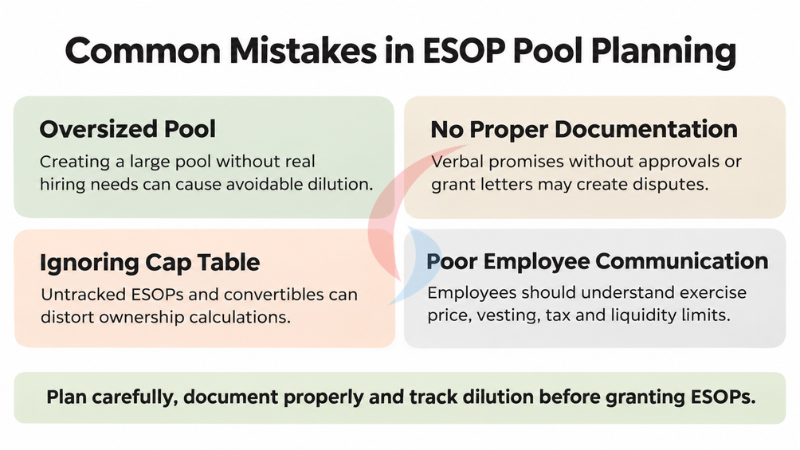
One common mistake is creating a large ESOP pool without examining the actual hiring requirements. Founders may agree to an investor's proposed percentage without understanding how much equity the company genuinely needs for employee incentives. This can lead to unnecessary dilution and make future fundraising negotiations more complicated. Another mistake is offering stock options verbally without completing the necessary approvals and documentation. Employees may believe they have received a definite ownership entitlement, while the company may not have properly approved the scheme or issued formal grant letters. Such misunderstandings can create disputes when employees resign or the company receives investment.
Startups also sometimes overlook the importance of maintaining an updated capitalization table. If outstanding ESOP grants, convertible instruments and future allocations are not considered, founders may present inaccurate ownership percentages to investors. Finally, employees should be informed about exercise prices, vesting periods, taxation and liquidity limitations. Receiving stock options does not guarantee that an employee will be able to sell the resulting shares immediately or earn a profit from them.
Many ESOP-related disputes arise because employees do not fully understand their options, vesting schedules or exercise rights. Startups can share our guide on ESOPs for Employees: What It Is, How It Works and Advantages with their teams to explain employee stock options in simple terms.
Why Choose Compliance calendar LLP?
An ESOP pool can be a valuable growth tool for Indian startups because it allows founders to reward employees with the opportunity to participate in the company's future success. However, deciding how much ownership to allocate should never be treated as a routine administrative exercise. Every percentage reserved for employees affects the company's fully diluted ownership and may influence future fundraising negotiations.
The most effective approach is to create an ESOP pool that reflects realistic hiring needs, obtain the necessary legal approvals and maintain transparent records of employee grants and potential dilution. Founders should also consider vesting conditions, tax consequences and the long-term effect of future funding rounds before finalising the scheme.
For assistance with ESOP pool creation, scheme drafting, statutory approvals and ongoing compliance, businesses can contact Compliance Calendar LLP at +91 9988424211 or info@ccoffice.in.
Frequently Asked Questions (FAQs)
Q1. What is an ESOP pool in a startup?
Ans. An ESOP pool is a portion of a startup's fully diluted equity reserved for employee stock options. It allows eligible employees to acquire company shares in the future under an approved scheme, subject to vesting and exercise conditions.
Q2. What is the ideal ESOP pool size for a startup?
Ans. Many startups consider pools in the range of 5% to 15%, but there is no universal legal percentage. The appropriate size depends on the company's hiring requirements, growth stage, existing shareholding and fundraising plans.
Q3. Does creating an ESOP pool dilute founder ownership?
Ans. Creating an ESOP pool reduces founders' ownership percentages on a fully diluted basis when the pool represents additional potential shares. Actual issued-share dilution generally occurs when options are exercised and new shares are allotted.
Q4. Is shareholder approval required for creating an ESOP pool?
Ans. Generally, yes. Section 62(1)(b) of the Companies Act, 2013 and Rule 12 require shareholder approval through a special resolution for an ESOP scheme, subject to applicable statutory exemptions. Companies must also comply with prescribed disclosures and filing requirements.
Q5. Can a startup create an ESOP pool before receiving funding?
Ans. Yes. A startup may establish an ESOP scheme before raising external investment, provided the applicable legal requirements are satisfied. Early planning can help the company recruit key employees and negotiate future investment terms more effectively.
Q6. What happens to an ESOP pool after a funding round?
Ans. The existing ESOP pool may be diluted when new shares are issued to investors. Investors may also require the startup to increase its pool before or after investment. The final percentage depends on the negotiated transaction structure.
Q7. Can employees sell their ESOP shares immediately?
Ans. Not necessarily. Employees must first satisfy the vesting and exercise conditions and become shareholders. Their ability to sell the shares may then be restricted by the company's Articles of Association, shareholder agreements and the availability of a buyer or liquidity event.
Q8. What is the minimum vesting period for ESOPs in India?
Ans. For unlisted companies governed by Rule 12, there is generally a minimum one-year period between the grant and vesting of stock options, subject to applicable exceptions. Companies may prescribe longer vesting schedules in their schemes.
Q9. Can founders receive ESOPs in their own startup?
Ans. Promoters and directors holding more than 10% of the outstanding equity shares are generally excluded from ESOP eligibility, but qualifying startups may benefit from specific statutory relaxations. Eligibility must be examined against the company's status and applicable legal provisions.
Q10. Is ESOP pool creation compulsory for every startup?
Ans. No. Indian law does not require every startup to establish an ESOP pool. It is a voluntary employee incentive arrangement that may be useful for businesses seeking to attract and retain talented professionals.
Article last updated on : 19 Nov 2026.













































































_learn_crop10_thumb.jpg)