




What Is a Change in Shareholding of an IRDAI-Registered Broker?
A change in shareholding occurs when the ownership percentage of shareholders in an insurance broking company changes. It may happen through the transfer of existing shares, allotment of new equity shares, introduction of investors or a restructuring involving existing promoters. An insurance broker is a regulated intermediary authorised to carry out specified insurance broking activities. Because ownership can influence management decisions, financial stability and customer interests, IRDAI supervises certain changes in the broker's shareholding and control.
The rules for ownership changes also depend on the category of insurance business and the registration held by the entity. Businesses operating under an Insurance Broker License, Corporate Agency License, or Insurance Web Aggregator License must follow their respective IRDAI regulations. Similarly, entities engaged in underwriting insurance risks require separate Insurance Company Registration. Since each category has different ownership, approval and compliance requirements, businesses should review the applicable regulations before making changes to their shareholding structure.
Not every share transfer automatically requires the same regulatory procedure. The applicable requirement depends on factors such as the number of shares transferred, the percentage acquired by the proposed investor, the identity of the transferee and whether the transaction changes ownership or control. For example, a small transfer between existing shareholders may be treated differently from a transaction where an outside investor acquires 30% of the insurance broker. Therefore, each proposed transaction should be examined before executing the transfer.
Legal Provisions Governing Change in Shareholding of Insurance Brokers
The change in shareholding of an insurance broker is primarily governed by the Insurance Act, 1938, the IRDAI Act, 1999 and the IRDAI (Insurance Brokers) Regulations, 2018, as amended. Regulation 25 and Schedule II – Form T are particularly important because they address ownership, control, share transfers and prior approval requirements.
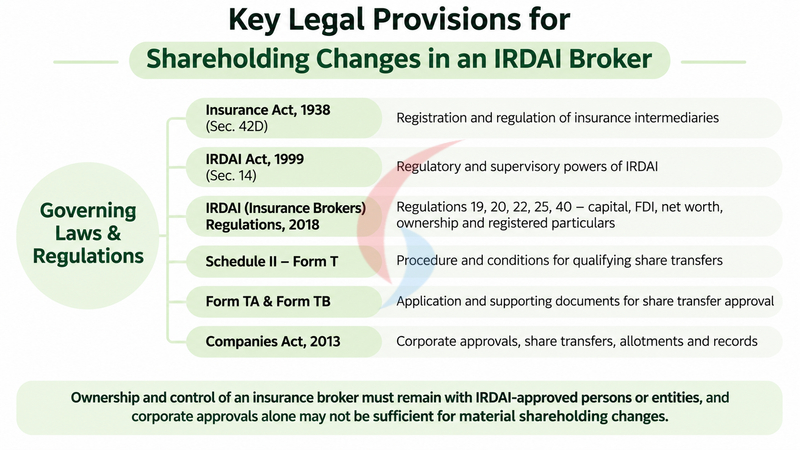
| Legal provision | Relevance |
| Section 42D, Insurance Act, 1938 | Registration and regulation of insurance intermediaries |
| Section 14, IRDAI Act, 1999 | Regulatory and supervisory powers of IRDAI |
| Regulation 19, Insurance Brokers Regulations, 2018 | Capital requirements and conditions relating to promoter funds |
| Regulation 20 | Foreign-investment-related capital provisions |
| Regulation 22 | Continuing minimum net worth |
| Regulation 25 | Ownership and control of shares |
| Schedule II – Form T | Procedure and conditions for qualifying share transfers |
| Form TA | Application seeking approval for transfer or issue of shares |
| Form TB | Particulars and supporting documents of the proposed transferee |
| Regulation 40 | Changes in registered particulars and related approval requirements |
| Companies Act, 2013 | Corporate approvals, share transfers, allotments and statutory records |
The regulations recognise that ownership and control of an insurance broker must remain with the persons or entities approved by IRDAI. Consequently, corporate approvals alone may not satisfy the regulatory requirements for material shareholding changes.
For ownership acquisitions and regulatory approval requirements, explore our IRDAI Approval for Insurance Broker Takeover.
When Is IRDAI Approval Required for a Change in Shareholding?
One of the most important questions is whether an insurance broking company must obtain prior IRDAI approval before transferring shares. Under Regulation 25(2), read with Schedule II – Form T of the 2018 Regulations, prior approval is required for a transfer of shares or issue of equity capital resulting in a shareholding change where:
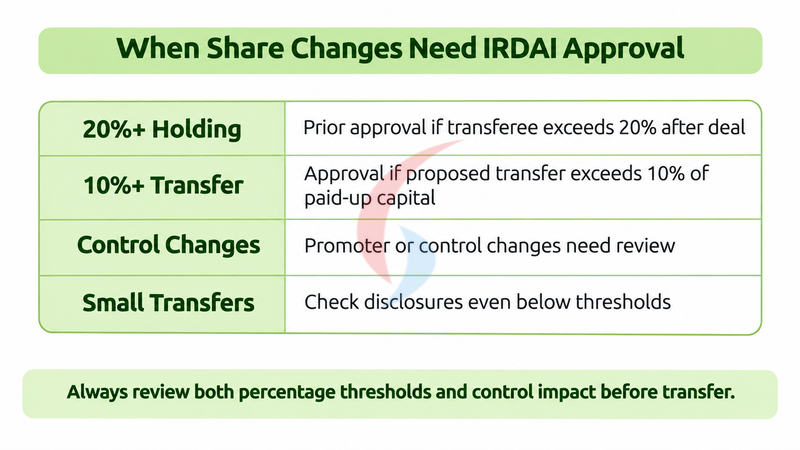
- The proposed transferee's total holding after the transaction is likely to exceed 20% of the insurance broker's paid-up capital.
- The nominal value of the shares proposed to be transferred by an individual, group or body corporate under the same management, jointly or severally, exceeds 10% of the paid-up capital.
These are separate conditions. The 20% threshold concerns the proposed transferee's holding after the transaction, while the 10% condition concerns the nominal value of the proposed share transfer. The regulations also require attention to the broader ownership and control position. Even where a transaction appears to fall below the numerical thresholds, changes involving promoters, beneficial ownership, management or other registered particulars should be independently reviewed.
Examples of Shareholding Changes Requiring IRDAI Approval
Different transactions can produce different regulatory consequences. Consider the following simplified examples.
| Proposed transaction | IRDAI approval position |
| New investor acquires 25% of a broker's shares | Prior approval required |
| Existing investor increases holding from 15% to 30% | Prior approval required |
| Investor acquires 15% through a single qualifying share transfer | Prior approval required under the 10% transfer condition |
| Existing shareholder transfers 5% to another investor | Examine the transaction and any related control or disclosure requirements |
| New investor acquires 60% of the company | Prior approval required |
| Share transfer results in a change of controlling promoter | Prior approval and other applicable governance requirements must be examined |
These examples assume ordinary equity shares with consistent nominal values. Actual transactions must be evaluated using the regulatory wording, paid-up capital, shareholding history and relevant corporate documents. The numerical thresholds are not a universal exemption for transactions below those percentages. Other IRDAI approvals, intimations or restrictions may still apply.
Difference Between Share Transfer and Fresh Share Allotment
A share transfer takes place when an existing shareholder transfers ownership of shares to another person or entity. The total number of issued shares generally remains unchanged, although the ownership pattern changes. A fresh share allotment occurs when the company issues additional equity shares, such as through a preferential allotment or private placement. This may increase paid-up share capital and dilute the percentage holding of existing shareholders.
Suppose Ravi owns 70% of his company and another shareholder owns 30%. If Ravi transfers 20% of the company's shares to Amit, Rajesh's holding falls to 50%, while Amit becomes a 20% shareholder. Alternatively, the company could issue fresh equity shares to Amit. In that situation, the number of shares increases, and the resulting percentage holdings must be recalculated. Both transactions can require IRDAI approval depending on the circumstances. Form TA specifically addresses applications for transfers of promoter or investor shares and allotments through preferential private placement.
IRDAI Share Transfer Approval Process: Step-by-Step
The approval process should begin before the insurance broker implements the proposed shareholding change. The following steps explain the procedure in simple language, with each step described in three short lines.
Step 1: Review the Existing Shareholding Pattern
First, examine the broker's present shareholders, share capital and ownership percentages. Identify the proposed seller, buyer, number of shares and consideration involved. Compare the existing and proposed shareholding structures to determine the regulatory impact.
Step 2: Determine Whether IRDAI Approval Is Required
Check whether the proposed transaction crosses the 20% holding or 10% transfer threshold. Examine whether the change affects promoters, beneficial ownership, management or control. Identify all required IRDAI approvals and intimations before implementing the transaction.
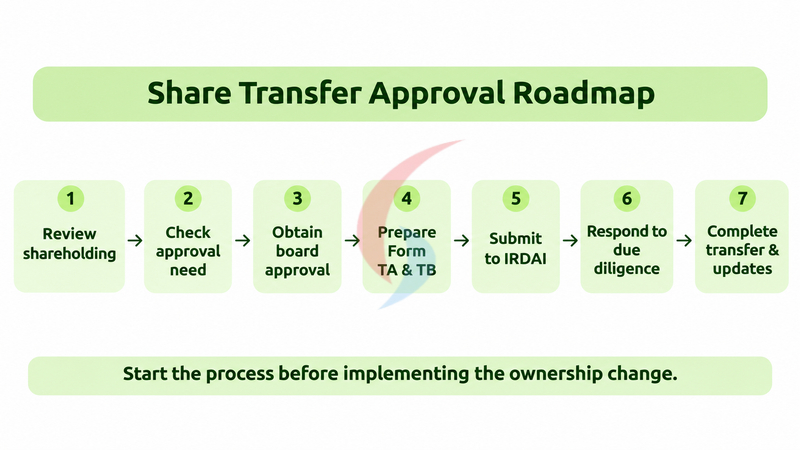
Step 3: Obtain Corporate Approvals
Prepare the proposed transaction documents and obtain relevant board approvals. Ensure that the company's Articles of Association and contractual restrictions are respected. Record the commercial terms, proposed ownership structure and any necessary conditions precedent.
Step 4: Prepare Form TA and Form TB
Complete Form TA with the broker's registration details and proposed shareholding changes. Prepare Form TB with the proposed transferee's identity, financial and regulatory information. Attach supporting declarations, board resolutions, financial documents and applicable approvals.
Step 5: Submit the Application to IRDAI
Submit the required share transfer approval application through the prescribed IRDAI procedure. Upload or furnish the supporting documents through the applicable regulatory filing channel. Keep the submission acknowledgement and application documents for future correspondence.
Step 6: Complete IRDAI Due Diligence
IRDAI examines the proposed transferee's financial capacity, ownership and regulatory background. The Authority may seek clarifications about investment funds, control or existing business interests. Submit accurate responses and additional documents whenever required.
Step 7: Obtain Approval and Complete the Transfer
Complete the share transfer or allotment after obtaining the necessary prior IRDAI approval. Follow any conditions mentioned in the approval and applicable Companies Act provisions. Update the company's shareholding records, beneficial ownership details and statutory registers.
Step 8: Complete Post-Transfer Compliance
Make applicable MCA filings and update the company's internal and statutory records. Inform IRDAI of completed changes or related events wherever the regulations require. Continue meeting the prescribed capital, net worth, governance and reporting requirements. This process follows the structure of Schedule II – Form T, including Forms TA and TB, with related company law steps added for practical implementation.
For online applications and regulatory submissions, refer to our IRDAI BAP Portal: Filings and Reporting Requirements.
Documents Required for Change in Shareholding of an Insurance Broker
IRDAI examines supporting documents to understand the identity of the proposed transferee, source of investment, ownership structure and financial suitability. The precise documentation depends on whether the investor is an individual, corporate entity or another permitted investor. Schedule II – Form TB provides the relevant information requirements, including additional documents for transfers involving more than 20% of paid-up capital.
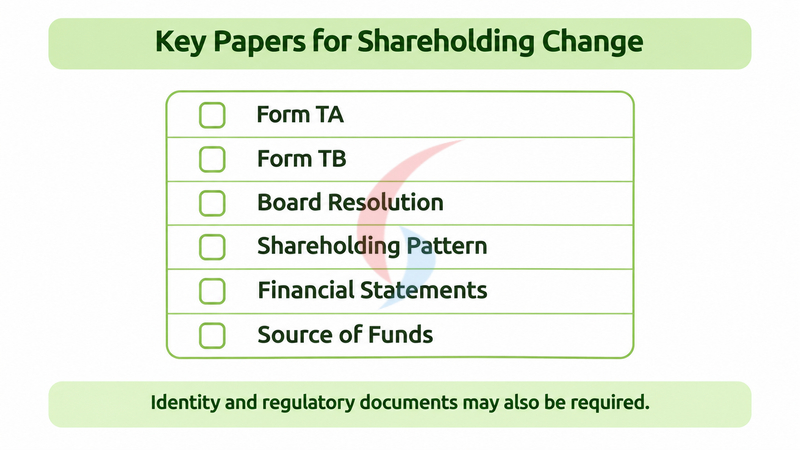
| Document | Purpose |
| IRDAI Certificate of Registration | Establishes the broker's registration details |
| Form TA | Application for the proposed shareholding change |
| Form TB | Details and declarations of the proposed transferee |
| Board Resolution | Records corporate approval for the transaction |
| Existing and Proposed Shareholding Pattern | Shows the ownership changes before and after transfer |
| Share Purchase or Subscription Agreement | Explains the proposed transaction terms |
| PAN and Identity Documents | Establishes the proposed investor's identity |
| Audited Financial Statements | Supports the financial review of corporate investors |
| Net Worth Certificate | Demonstrates financial capacity where applicable |
| Source of Funds Declaration | Explains how the investor will finance the acquisition |
| Fit and Proper Declaration | Discloses relevant regulatory and legal history |
| FEMA and Other Regulatory Approvals | Applicable where foreign investment or sector-specific approvals are involved |
For example, where Amit acquires shares personally, IRDAI may examine his net worth certificate, income-tax returns, source of funds and relevant declarations. If an investment company acquires the shares, the supporting documents can include its audited financial statements, board resolution, shareholding pattern and details of associated businesses. Proper documentation is important because incomplete information can delay regulatory examination even when the proposed transaction is commercially acceptable.
To understand the eligibility and documentation requirements, read our Conditions for Grant of Insurance Broker License in India.
How Does IRDAI Examine the Proposed Shareholder?
IRDAI's due diligence is intended to establish whether the new shareholder or promoter is suitable to participate in the ownership of a regulated insurance intermediary. The review may consider the investor's identity, financial position, source of funds, relevant business interests and previous regulatory history. Where the investor is a company, the Authority may examine its directors, shareholders and associated entities.
For example, suppose Amit's investment is being funded through another financial services company. IRDAI may require information about the company's ownership, financial statements and relevant regulatory approvals. An investor who has previously faced serious regulatory action may receive additional scrutiny. Similarly, unexplained investment funds or incomplete beneficial ownership information can create difficulties during the approval process. The proposed investor should therefore complete financial and legal due diligence before committing to the transaction.
Foreign Investment in an IRDAI-Registered Insurance Broker
Foreign investors may invest in Indian insurance intermediaries subject to applicable Indian insurance laws, foreign investment rules, FEMA provisions and IRDAI requirements. A shareholding transaction involving a foreign individual or corporate investor requires examination of the applicable investment conditions, beneficial ownership structure and relevant reporting obligations.
The Sabka Bima Sabki Raksha (Amendment of Insurance Laws) Act, 2025 and subsequent regulatory changes affected foreign investment provisions in the insurance sector. The IRDAI Insurance Intermediaries Amendment Regulations, 2026 also introduced changes aligning intermediary regulations with the revised insurance laws. However, the rules governing investment in an insurance company should not automatically be treated as identical to those applying to an insurance intermediary. The nature of the regulated entity must be identified before determining the applicable conditions.
For regulatory obligations relating to foreign investment and ownership, explore our IRDAI Insurance Broker Compliance.
Companies Act Compliance After IRDAI Share Transfer Approval
IRDAI approval does not replace the statutory requirements under the Companies Act, 2013. Once the required regulatory approval has been obtained, the company must complete the transfer or allotment in accordance with applicable corporate law. For a transfer of existing shares, Section 56 and the relevant rules govern the applicable transfer formalities. For fresh allotments, provisions such as Sections 42 and 62 may become relevant depending on the transaction structure.
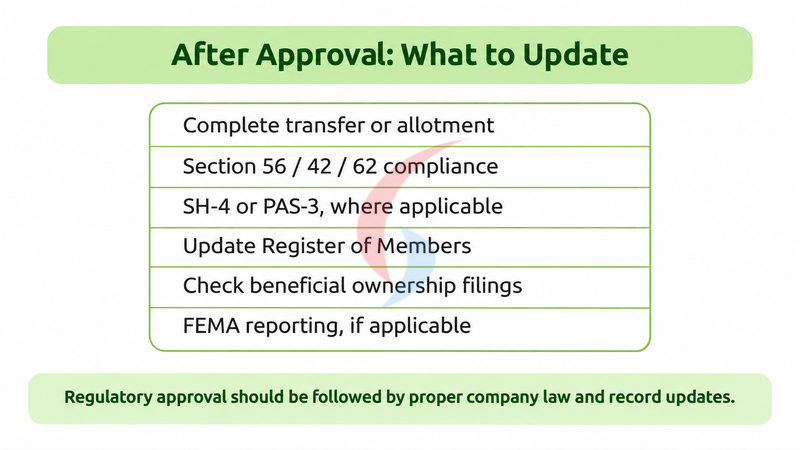
| Corporate compliance | Applicability |
| Board approval | As required for the proposed transaction |
| Section 56 | Transfer of existing securities |
| Sections 42 and 62 | Applicable private placement or preferential allotment |
| Form SH-4 | Where applicable for physical share transfers |
| Form PAS-3 | Return of allotment, where required |
| Register of Members | Update shareholding records |
| Beneficial Ownership Disclosures | Applicable under Sections 89 and 90 |
| FEMA Reporting | Where applicable to foreign investment transactions |
The company must also consider whether the securities are held in dematerialised form and whether any applicable exemptions or additional requirements apply. A properly executed transaction should have consistent information across corporate records, regulatory submissions and the company's updated shareholding pattern.
To understand other governance changes requiring regulatory approval, read our IRDAI Changes in Insurance Broking Companies.
Does a Small Shareholding Change Require IRDAI Intimation?
A smaller share transfer does not automatically attract the same prior approval requirements as a major ownership transaction. However, the company must still consider whether the change affects promoter status, beneficial ownership, control or any other registered information. For instance, assume an existing shareholder transfers 4% of a direct insurance broking company to another investor. If the transaction does not cross the relevant regulatory thresholds and does not involve any separately regulated change, a Form TA prior approval may not be triggered solely by its size.
However, the broker should still examine its applicable disclosure obligations, regulatory directions and corporate filings. This distinction is important because companies should neither assume that every small transfer requires prior approval nor presume that all transactions below a percentage threshold are automatically exempt.
Important 2026 Updates for Insurance Broker Shareholding Changes
The regulatory environment changed following the Sabka Bima Sabki Raksha (Amendment of Insurance Laws) Act, 2025. The amendments affected various aspects of insurance regulation, including insurance intermediaries. On 30 July 2026, IRDAI notified the Insurance Intermediaries (Amendment) Regulations, 2026, introducing changes relating to intermediary registration, annual fees, regulatory accountability and disclosure requirements.
For an insurance broker planning a shareholding change, the practical priority remains identifying the correct approval procedure under the Insurance Brokers Regulations, 2018, as amended. The relevant transaction must also comply with applicable ownership conditions, company law requirements and foreign investment provisions. The 2026 intermediary amendments should not be interpreted as eliminating the Regulation 25 share transfer approval mechanism. Businesses should refer to the consolidated regulations and the latest IRDAI directions before completing a transaction.
For updated intermediary regulations and reporting obligations, refer to our IRDAI Compliance Requirements for Insurance Intermediaries.
What Happens If an Insurance Broker Transfers Shares Without IRDAI Approval?
Completing a share transfer without obtaining mandatory approval can result in regulatory non-compliance. IRDAI may examine the circumstances, seek explanations, issue directions or initiate appropriate regulatory proceedings. A useful example comes from an IRDAI enforcement matter involving an insurance broker that made share allotments in March and September 2023. The Authority found that cumulative changes crossed the applicable 10% threshold without prior approval. In that matter, IRDAI issued a warning and required the broker to take corrective compliance measures. The outcome illustrates why even transactions involving existing promoters should be examined carefully before allotment or transfer.
Storytelling: When a New Investor Wanted to Join an Insurance Brokerage Company
Imagine Rajesh, who runs an IRDAI-registered direct insurance broking company in Delhi. His business helps companies select insurance policies, compare coverage and manage policy-related documentation. After several years of operations, Rajesh has developed a loyal client base, but he wants to expand his business into Mumbai and Bengaluru.
One day, Amit, an investor with experience in financial services, approaches Rajesh with an offer. Amit wants to acquire a 30% shareholding in Rajesh's insurance broking company and provide funds for its expansion. Rajesh believes this investment could help him recruit employees, improve technology and grow his business.
Both parties discuss the investment amount, prepare a share purchase agreement and approach their Chartered Accountant to complete the transaction. However, their compliance advisor identifies an important issue: because the company holds an IRDAI registration, the proposed ownership change may require prior approval from the Insurance Regulatory and Development Authority of India.
Rajesh initially assumes that passing a board resolution and updating the company's shareholding records would be enough. His advisor explains that Change in Shareholding of an IRDAI-Registered Broker involves separate insurance regulatory requirements in addition to ordinary company law formalities.
This situation is common when an existing insurance broker brings in investors, transfers promoter shares or restructures its ownership. Understanding the IRDAI share transfer approval process can help businesses avoid regulatory problems and unnecessary transaction delays.
Common Mistakes During Insurance Broker Shareholding Changes
One common mistake is completing the share transfer before determining whether prior IRDAI approval is required. Businesses may assume that a board resolution, share purchase agreement or approval under the Companies Act is sufficient. Another mistake is calculating ownership percentages without considering the complete post-transaction shareholding structure. Transactions involving several shareholders, fresh equity issuance or related investors require careful examination.
Applicants may also face delays because of incomplete Form TB declarations, inconsistencies in shareholding records, missing financial documents or insufficient explanation of the investor's source of funds. The best approach is to assess the regulatory impact before finalising the transaction, prepare accurate supporting documents and complete all applicable regulatory and corporate requirements in the correct sequence.
For post-approval obligations and ongoing compliance, read our Insurance Broker Compliances in India.
Why Choose Compliance Calendar LLP for IRDAI Shareholding Change Compliance?
A change in shareholding of an IRDAI-registered insurance broker involves several legal and procedural requirements. The company must review the applicable share transfer thresholds, prepare the necessary documents, obtain regulatory approvals and complete relevant corporate formalities.
Compliance Calendar LLP assists insurance intermediaries in understanding IRDAI regulatory requirements, preparing applications, reviewing corporate documentation and identifying applicable post-approval compliance obligations.
Our team can support businesses with regulatory documentation, shareholding structure reviews, Form TA and Form TB preparation, related IRDAI filings and compliance coordination.
For professional assistance with insurance broker registration and compliance requirements, contact Compliance Calendar LLP at +91 9988424211 or info@ccoffice.in.
Frequently Asked Questions (FAQs)
Q1 Is IRDAI approval mandatory for changing the shareholding of an insurance broker?
Ans. Prior IRDAI approval is mandatory when the applicable share transfer thresholds are crossed.
Under Schedule II – Form T, the relevant conditions include 20% post-transfer holding and transfers exceeding 10% of paid-up capital. Other changes involving ownership or control may require separate examination.
Q2 Which regulation governs share transfers in insurance broking companies?
Ans. Regulation 25 of the IRDAI (Insurance Brokers) Regulations, 2018 governs ownership and control. Schedule II – Form T provides the procedure for qualifying share transfers. The provisions must be read with subsequent amendments and applicable directions.
Q3 What are Form TA and Form TB under IRDAI regulations?
Ans. Form TA is used to seek approval for qualifying share transfers or equity issuances. Form TB contains information and supporting documents relating to the proposed transferee. Both are relevant to the application process under Schedule II – Form T.
Q4 Can an insurance broker transfer 5% of its shares without approval?
Ans. A 5% transfer does not automatically trigger the specific 10% transfer threshold. However, the post-transaction holding, control changes and other regulatory requirements must be checked. Applicable corporate filings and IRDAI disclosures must also be completed.
Q5 Can foreign investors acquire shares in an insurance broking company?
Ans. Yes, subject to applicable foreign investment rules and IRDAI requirements. The proposed investment structure must comply with FEMA and relevant insurance regulations. Required approvals and reporting obligations should be examined before the transaction.
Q6 Is a board resolution sufficient for changing broker shareholding?
Ans. No, a board resolution alone does not replace mandatory IRDAI approval. The company must also comply with Regulation 25 and applicable corporate law provisions. The transaction should be implemented only after satisfying the relevant requirements.
Q7 What documents are required for IRDAI share transfer approval?
Ans. The application generally requires Form TA, Form TB and shareholding details.
Relevant board resolutions, financial documents and investor declarations may also be necessary. Additional documents depend on the identity of the proposed transferee and transaction structure.
Q8 How long does IRDAI share transfer approval take?
Ans. There is no universal guaranteed approval timeline for every shareholding transaction. Processing depends on the documents, proposed investor and regulatory examination. Incomplete applications or additional IRDAI queries may extend the process.
Q9 Can an investor acquire 30% of an insurance broker?
Ans. A proposed 30% acquisition requires prior IRDAI approval under the applicable shareholding threshold. The transaction must also satisfy investor eligibility, ownership restrictions and other regulatory conditions. Approval should be obtained before completing the acquisition.
Q10 What happens if shares are transferred without mandatory IRDAI approval?
Ans. An unauthorised transfer can result in regulatory scrutiny and compliance proceedings.
IRDAI may issue directions, require corrective measures or take other action under applicable law. The consequences depend on the circumstances and seriousness of the violation.
Article last updated on : 19 Nov 2026.













































































_learn_crop10_thumb.jpg)


























































































































































































































