




What Are Insurance Broker Net Worth and Security Deposit Rules?
The Insurance Regulatory and Development Authority of India (IRDAI) prescribes financial requirements for entities engaged in insurance broking activities. These requirements ensure that registered brokers maintain sufficient financial resources to operate responsibly and meet their regulatory obligations. The three important financial requirements are paid-up capital, net worth and security deposit. Paid-up capital represents the amount contributed by shareholders, net worth reflects the financial strength of the business, and a security deposit is the prescribed amount maintained with a scheduled bank under applicable regulatory conditions.
Businesses planning to enter the insurance sector must understand that financial and regulatory requirements differ depending on the nature of their activities. Entities intending to undertake insurance business can explore Insurance Company Registration, while those planning to act as intermediaries between insurers and customers must obtain an Insurance Broker License from IRDAI. Both categories have separate capital, eligibility and compliance requirements. Understanding these differences helps businesses select the appropriate registration category and prepare for their financial obligations before commencing operations.
To understand IRDAI eligibility and licensing requirements, read our Insurance Broker Registration in India.
Legal Provisions Governing Insurance Broker Financial Requirements
Insurance broker capital, net worth and deposit requirements are primarily governed by the Insurance Act, 1938, the IRDAI Act, 1999 and the IRDAI (Insurance Brokers) Regulations, 2018, as amended. The following provisions are particularly relevant.
| Legal provision | Requirement |
| Regulation 19 | Minimum paid-up capital or contribution |
| Regulation 20 | Calculation of equity capital held by foreign investors |
| Regulation 21A | Applicable foreign-investment requirements |
| Regulation 22 | Minimum net worth and its continuing maintenance |
| Regulation 23 | Security deposit with a scheduled bank |
| Regulation 24 | Professional Indemnity Insurance |
| Regulation 25 | Ownership and control of shares |
| Regulation 39 | Auditor certificates and periodic regulatory reporting |
These requirements operate alongside applicable provisions of the Companies Act, 2013 and other relevant financial and corporate laws. The financial conditions are not merely one-time requirements for obtaining registration; continuing compliance is also important. The IRDAI (Insurance Intermediaries) (Amendment) Regulations, 2026, notified on 30 July 2026, introduced further changes affecting intermediary registration and compliance. The financial thresholds discussed below are those prescribed under Regulations 19, 22 and 23 of the Insurance Brokers Regulations, 2018, as verified against the published provisions.
Minimum Capital, Net Worth and Security Deposit for Insurance Brokers
The amounts depend on the category of insurance broking registration. Direct insurance brokers, reinsurance brokers and composite brokers have different financial requirements because their authorised activities and operational responsibilities differ.
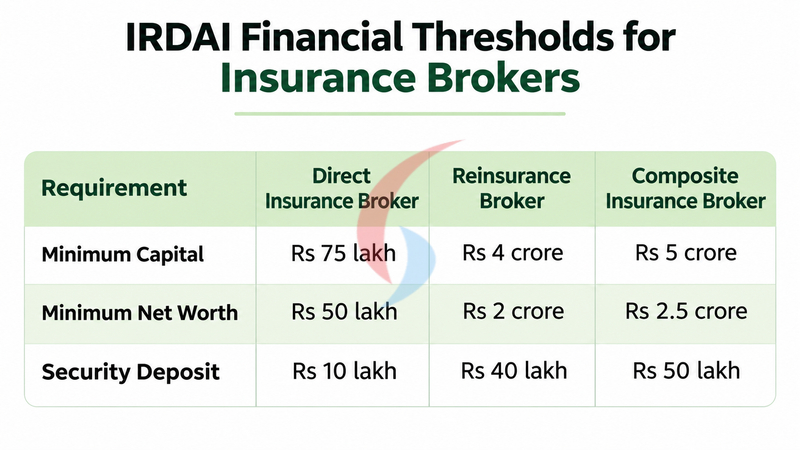
| Insurance broker category | Minimum capital | Minimum net worth | Security deposit |
| Direct Insurance Broker | Rs 75 lakh | Rs 50 lakh | Rs 10 lakh |
| Reinsurance Broker | Rs 4 crore | Rs 2 crore | Rs 40 lakh |
| Composite Insurance Broker | Rs 5 crore | Rs 2.5 crore | Rs 50 lakh |
The net worth thresholds for reinsurance and composite brokers are calculated at 50% of their prescribed minimum capital. The corresponding security deposits are 10% of minimum capital, while direct insurance brokers must maintain Rs 10 lakh. These figures should not be confused with professional indemnity insurance coverage, annual regulatory fees or other operational expenses. Each is a separate financial requirement under the applicable regulations.
Learn how financial requirements differ between categories in our Types of Insurance Brokers: Direct vs Reinsurance
Minimum Paid-Up Capital Requirement Under Regulation 19
Regulation 19 specifies the minimum capital or contribution required for an applicant seeking insurance broker registration. A direct insurance broker must maintain the prescribed capital of Rs 75 lakh, while the minimum amounts are substantially higher for reinsurance and composite brokers. For a company limited by shares, the capital must be in the form of equity shares. Where an eligible LLP applies for registration, the partners' capital contribution must be made in cash. Another important condition concerns the source of investment. Under Regulation 19(7), the investment contributed by promoters, shareholders or partners must come from their own funds. Funds arranged through borrowings or loans do not qualify as own funds for this purpose.
For example, suppose Ranjan plans to establish a direct insurance brokerage company and arranges Rs 75 lakh through capital contributions. If part of this amount is funded through borrowed money in a manner inconsistent with Regulation 19, the investment may not satisfy IRDAI's capital requirements. The regulation also restricts pledging the shares or contributions representing the broker's capital to secure loans or other credit facilities. Applicants should therefore examine the source and legal status of the funds before filing their application.
Insurance Broker Net Worth Requirements Under Regulation 22
Regulation 22 provides that the net worth of an insurance broker must not fall below the prescribed amount at any time during its registration. For direct insurance brokers, the minimum net worth is Rs 50 lakh. For reinsurance and composite brokers, the amount is 50% of the applicable minimum capital requirement.
Unlike paid-up capital, net worth is affected by the financial results of the business. A company may have adequate share capital but still experience a reduction in net worth because of accumulated losses or other relevant accounting adjustments. Consider Rajesh's company again. Assume it starts with paid-up capital of Rs 75 lakh and subsequently incurs accumulated losses of Rs 30 lakh, with no other relevant adjustments. For this simplified example, its net worth would fall to Rs 45 lakh.
Although the company originally satisfied the capital requirement, it would now be Rs 5 lakh below the minimum net worth prescribed for a direct insurance broker. Under Regulation 22(2), the broker must immediately restore the deficient net worth to the prescribed limit and report compliance to IRDAI.
For ongoing financial and regulatory obligations, explore our Insurance Broker Compliances in India.
How Is Insurance Broker Net Worth Calculated?
Net worth is determined according to the definition under the Companies Act, 2013, as applicable. Broadly, the calculation considers paid-up share capital and qualifying reserves or accumulated profits after making the deductions prescribed by law.
For an incorporated company, Section 2(57) of the Companies Act, 2013 provides the relevant definition. The computation should account for accumulated losses, deferred expenditure and miscellaneous expenditure not written off, along with the treatment of reserves specified in that provision. The following is a simplified illustration, assuming no other relevant adjustments.
| Financial particulars | Amount |
| Paid-up equity share capital | Rs 75 lakh |
| Qualifying reserves | Rs 5 lakh |
| Accumulated losses | Rs 25 lakh |
| Illustrative net worth | Rs 55 lakh |
| Minimum required net worth | Rs 50 lakh |
| Amount above minimum | Rs 5 lakh |
In this example, the company maintains net worth above the prescribed minimum. However, a further loss exceeding the available margin could create a compliance problem. The statutory calculation may differ depending on the company's financial statements and the nature of its reserves and deductions. Therefore, the actual computation should be reviewed by the auditor rather than relying only on a simplified accounting formula.
What Is the Insurance Broker Security Deposit Under Regulation 23?
A security deposit is a prescribed amount that an insurance broker must maintain with a scheduled bank before commencing business. This requirement is separate from the minimum paid-up capital and continuing net worth obligations. Under Regulation 23, a direct insurance broker must maintain a deposit of Rs 10 lakh. Reinsurance and composite brokers must maintain deposits equal to 10% of their prescribed minimum capital or contribution. These deposits are subject to IRDAI's regulatory control. They cannot be freely withdrawn or used as ordinary working capital because the regulations impose restrictions on their release and utilisation.
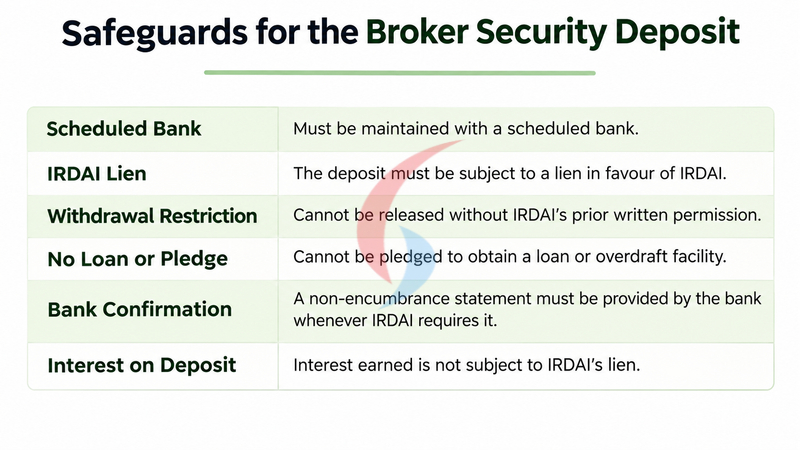
For example, if Rajesh maintains a Rs 10 lakh fixed deposit to satisfy his direct broker registration requirements, he cannot simply withdraw it to pay employee salaries or office rent. The deposit is maintained for a specific regulatory purpose, and its release requires compliance with the applicable conditions. The security deposit also has a different role from Professional Indemnity Insurance. The latter provides specified insurance coverage against professional liabilities, while the deposit fulfils a prescribed financial requirement.
Along with security deposits, brokers must understand Professional Indemnity Insurance for Insurance Brokers.
Important Conditions for Maintaining the Security Deposit
| Requirement | Details |
|---|---|
| Scheduled Bank | The prescribed deposit must be maintained with a scheduled bank. |
| IRDAI Lien | The deposit must be subject to a lien in favour of IRDAI. |
| No Unauthorised Withdrawal | The fixed deposit cannot be released without IRDAI's prior written permission. |
| No Loan Against Deposit | The broker cannot pledge the deposit to obtain a loan or overdraft facility. |
| Bank Confirmation | A non-encumbrance statement from the scheduled bank must be submitted whenever IRDAI requires it. |
| Interest on Deposit | Under Regulation 23(5), interest earned on the deposit is not subject to IRDAI's lien |
These conditions are especially important for finance teams because a fixed deposit appearing in the company's balance sheet is not necessarily available for routine business expenditure.
Difference Between Capital, Net Worth and Security Deposit
Many new insurance brokerage applicants confuse these three financial requirements. They serve different purposes and must be assessed separately.
| Particulars | Paid-up capital | Net worth | Security deposit |
| Meaning | Amount contributed by owners | Financial position calculated under law | Restricted bank deposit |
| Governing provision | Regulation 19 | Regulation 22 | Regulation 23 |
| Primary requirement | Prescribed minimum contribution | Maintain minimum continuously | Maintain prescribed deposit |
| Affected by business losses | Capital itself may remain unchanged | Yes | Not ordinarily through operating losses |
| Available for routine expenditure | Subject to capital maintenance rules | Not a separate cash balance | Restricted |
| Evidence | Capital records and supporting documents | Auditor-certified net worth certificate | Bank deposit and lien documents |
For example, a direct broker may have Rs 75 lakh in paid-up capital, Rs 55 lakh in net worth and a separate Rs 10 lakh security deposit. These amounts represent different aspects of its financial compliance and must not be described as interchangeable.
What Happens If an Insurance Broker's Net Worth Falls Below the Minimum?
Suppose Rajesh's company expands into three cities and incurs substantial marketing and employee expenses. Its financial statements later reveal that net worth has fallen from Rs 58 lakh to Rs 46 lakh. His accountant identifies a shortfall of Rs 4 lakh against the minimum Rs 50 lakh requirement. Rajesh cannot ignore this problem merely because the company holds an IRDAI registration certificate or maintains the required security deposit.
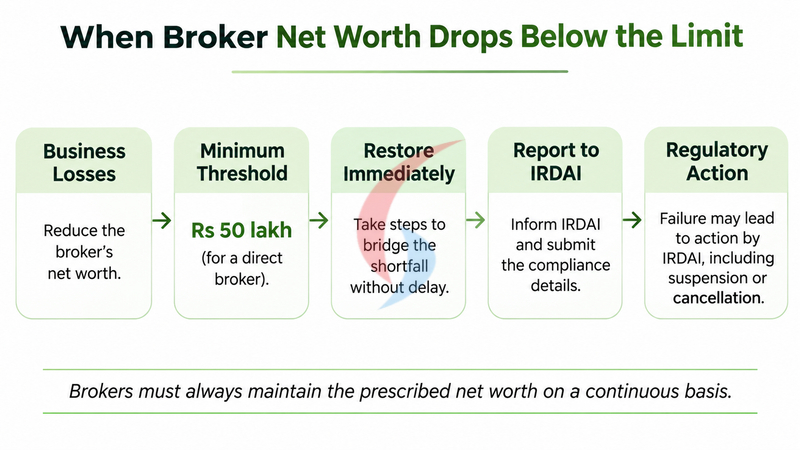
Under Regulation 22(2), the broker must immediately restore net worth and report compliance to IRDAI. Depending on the circumstances, restoration may require an appropriate infusion of additional capital or another legally permissible financial measure. The company should calculate the shortfall accurately, involve its auditor and preserve supporting documentation. It should also assess whether the financial deterioration affects other regulatory obligations.
Failure to maintain prescribed capital, net worth or deposit requirements is specifically recognised as a ground for regulatory action under the Insurance Brokers Regulations, including possible suspension or cancellation after the applicable procedure.
Auditor Certificates and Half-Yearly Reporting
Financial compliance does not end when the broker deposits the required amount or receives its registration certificate. Brokers must also demonstrate that the applicable financial conditions continue to be satisfied. Regulation 22(3) requires an auditor-certified net worth certificate every half-year. Regulation 39 further provides for periodic auditor certificates relating to capital, net worth, deposits, professional indemnity insurance and other specified matters.
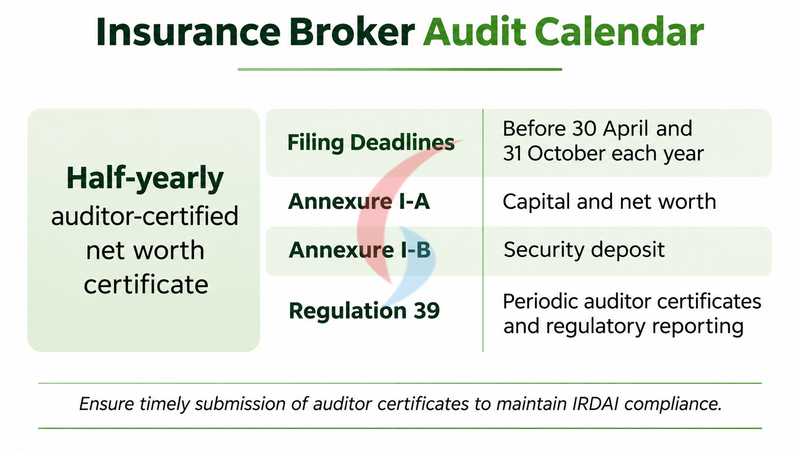
Under the 2018 Regulations, the prescribed half-yearly certificates are to be furnished before 30 April and 31 October each year. The applicable forms include Annexure I-A for capital and net worth and Annexure I-B for the security deposit. The auditor's review should consider the supporting accounting and banking documents, including share capital records, the net worth computation and confirmation of the regulatory deposit. In addition, brokers must comply with the applicable electronic reporting arrangements and any subsequent IRDAI directions affecting forms, filing procedures or timelines.
Understand regulatory submissions and reporting procedures through our IRDAI BAP Portal: Filings and Reporting Requirements.
Documents Required to Prove Capital, Net Worth and Security Deposit
During registration or subsequent compliance reviews, IRDAI may require documentary evidence of the broker's financial position. Applicants should maintain consistent figures across their financial statements, capital records, bank confirmations and regulatory declarations.
| Document | Purpose |
| Certificate of Incorporation and constitutional documents | Establish legal identity and structure |
| Share capital or LLP contribution records | Establish capital contribution |
| Bank statements and source-of-funds evidence | Support verification of funds |
| Audited financial statements | Establish financial position |
| Auditor-certified net worth certificate | Confirm continuing net worth |
| Fixed deposit receipt | Demonstrate prescribed deposit |
| Bank lien confirmation | Establish IRDAI's interest in the deposit |
| Non-encumbrance statement | Confirm the deposit is not improperly pledged |
| Relevant board resolutions and declarations | Support regulatory submissions |
The actual documents depend on the application, the broker's category and directions issued by IRDAI. Where an applicant's capital position changes after the latest audited financial statements, additional financial records may be necessary.
For eligibility conditions and supporting documents, refer to Conditions for Grant of Insurance Broker License in India.
Latest IRDAI Updates Affecting Insurance Brokers in 2026
India's insurance regulatory environment changed following the Sabka Bima, Sabki Raksha (Amendment of Insurance Laws) Act, 2025. The amendments to the Insurance Act became effective on 5 February 2026, introducing changes affecting insurance intermediaries, including aspects of registration and annual-fee compliance. On 30 July 2026, IRDAI notified the Insurance Intermediaries (Amendment) Regulations, 2026. These amended several intermediary regulations, including the Insurance Brokers Regulations, 2018.
The 2026 changes address areas such as registration-related requirements, accountability, disclosures and operational compliance. In particular, additional declarations and financial or ownership-related obligations may be relevant depending on the broker's circumstances. However, these developments should not be confused with a general reduction in all broker capital or deposit requirements. The figures stated in this article are based on the verified provisions of Regulations 19, 22 and 23. Businesses should check subsequent notifications before relying on them for a new application or major investment decision.
For updated registration and compliance obligations, read our IRDAI Compliance Requirements for Insurance Intermediaries.
Common Mistakes Insurance Brokers Should Avoid
One of the most common mistakes is assuming that arranging the minimum share capital at incorporation permanently satisfies IRDAI's financial requirements. In reality, continuing net worth compliance can be affected by losses, distributions and other financial developments.
Another mistake is treating the security deposit as readily available working capital. Brokers may also face problems when fixed deposit documentation does not clearly establish the required lien or when capital contributions are supported by funds that do not meet the regulatory conditions.
Late preparation of half-yearly net worth certificates, inconsistent financial statements and incomplete bank confirmations can also create regulatory difficulties. A practical approach is to review the financial position regularly, rather than discovering a shortfall only when an auditor prepares the next certificate.
Storytelling: When a Growing Insurance Broker Faced a Financial Compliance Problem
Imagine Akansh a, who started a direct insurance broking company in Delhi after spending several years working in the insurance sector. He had good relationships with insurance companies, understood different insurance products and knew how to help businesses choose suitable policies.
When Akansha started his company, he arranged the required capital, completed the registration formalities and maintained the prescribed security deposit with a scheduled bank. His company began receiving clients from Delhi, Gurugram and Noida, and the business gradually expanded.
After a few months, Akansha hired more employees, rented a bigger office and invested in a customer management system. These expenses were necessary for growth, but the company's revenue was still developing. As a result, its accumulated losses started affecting its financial position.
One day, while preparing the company's half-yearly financial records, his Chartered Accountant noticed that its net worth had fallen below the regulatory minimum. Akansha was surprised because the company still had its original paid-up share capital.
His accountant explained that having the required paid-up capital does not automatically mean the business continues to meet the minimum net worth requirement. Accumulated losses and other financial adjustments can reduce net worth even when the original capital amount remains unchanged.
This is where the Insurance Broker Net Worth and Security Deposit Rules become important. Under IRDAI regulations, brokers must satisfy separate requirements relating to capital, continuing net worth and regulatory deposits.
Understanding these differences can help new applicants avoid registration problems and existing brokers prevent financial compliance violations.
Before starting an insurance brokerage business, understand the Requirements and Procedure for Insurance Broker License.
Why Choose Compliance Calendar LLP for Insurance Broker Compliance?
Obtaining an Insurance Broker License involves more than submitting an application. Applicants must understand their category-specific capital requirements, maintain the prescribed net worth, arrange the security deposit and prepare appropriate financial documentation.
Compliance Calendar LLP assists businesses with insurance broker registration and related compliance requirements. Our professional team can guide applicants through eligibility assessment, documentation review, capital-related requirements and regulatory filing procedures.
For existing insurance brokers, reviewing the financial requirements alongside periodic reporting and other statutory obligations is particularly important. A timely compliance review can help identify gaps before they develop into regulatory problems.
For professional assistance with insurance broker registration and compliance requirements, contact Compliance Calendar LLP at +91 9988424211 or info@ccoffice.in.
Frequently Asked Questions (FAQs)
Q1 What is the minimum net worth required for a direct insurance broker?
Ans. A direct insurance broker must maintain a minimum net worth of Rs 50 lakh. This requirement is prescribed under Regulation 22 of the IRDAI Insurance Brokers Regulations, 2018. The minimum must be maintained continuously.
Q2 What is the minimum capital for Insurance Broker Registration?
Ans. The minimum capital is Rs 75 lakh for a direct broker, Rs 4 crore for a reinsurance broker and Rs 5 crore for a composite broker. These requirements are prescribed under Regulation 19. Applicants must satisfy the applicable capital conditions before registration.
Q3 Is a security deposit mandatory for insurance brokers?
Ans. Yes. Regulation 23 requires insurance brokers to maintain the prescribed deposit with a scheduled bank before commencing business. The deposit amount depends on the category of registration.
Q4 How much security deposit does a direct insurance broker need?
Ans. A direct insurance broker must maintain a security deposit of Rs 10 lakh. The deposit is subject to the regulatory conditions prescribed by IRDAI. It cannot be freely withdrawn or pledged for loans.
Q5 Can an insurance broker withdraw its fixed deposit?
Ans. The regulatory deposit cannot be released without IRDAI's prior written permission. It is also subject to a lien in favour of the Authority. Brokers must comply with the conditions prescribed under Regulation 23.
Q6 What happens if an insurance broker's net worth falls below the minimum?
Ans. The insurance broker must immediately restore its net worth to the prescribed level. It must also report compliance to IRDAI. Failure to maintain the minimum may attract regulatory action.
Q7 Is a CA-certified net worth certificate mandatory?
Ans. An auditor-certified net worth certificate is required every half-year under Regulation 22(3). The certificate demonstrates compliance with the prescribed financial requirements. Brokers should also maintain supporting accounting records.
Q8 Can borrowed funds be used for insurance broker capital?
Ans. Regulation 19 requires promoters, shareholders or partners to invest from their own funds. Borrowings and loans do not qualify as own funds for this purpose. Applicants should maintain evidence of the source of capital.
Q9 What is the security deposit requirement for a composite broker?
Ans. A composite insurance broker must maintain a deposit equal to 10% of its minimum capital. Based on the prescribed Rs 5 crore capital requirement, the deposit is Rs 50 lakh. The amount must comply with the applicable banking and regulatory conditions.
Q10 Are net worth and security deposit the same?
Ans. No. Net worth represents the broker's financial position calculated under applicable law. A security deposit is a prescribed amount maintained with a scheduled bank under IRDAI's regulatory restrictions.
Article last updated on : 19 Nov 2026.













































































_learn_crop10_thumb.jpg)


























































































































































































































