



A Bengaluru startup has secured an investment commitment of Rs 6 crore from a Singapore-based venture capital fund. The founders are excited because the funding will help them expand their technology team, launch new products and enter international markets. However, the investor does not intend to transfer the entire amount immediately. Instead, the money will arrive in three instalments over the next nine months.
The first Rs 2 crore will be released after signing the investment agreement, the second Rs 2 crore after achieving a revenue target, and the final Rs 2 crore after launching a new product.
The founders assume that because the investment is covered under one agreement, they can complete all RBI reporting after receiving the final instalment. During a compliance review, their Company Secretary explains that this approach could create serious difficulties.
Under FEMA, foreign investment received in multiple tranches must be examined according to the actual receipt of funds, issuance of equity instruments and applicable reporting requirements. A single investment agreement does not automatically create one common deadline for every instalment.
FEMA compliance for startup investment in tranches involves several important considerations, including foreign investment eligibility, valuation, permitted payment methods, share allotment, FC-GPR reporting and annual RBI compliance.
What is Startup Investment in Tranches?
Investment in tranches means that an investor provides funding in separate instalments instead of transferring the entire committed investment amount at once. This arrangement is common among startups because investors often prefer to release funds according to the company's growth, performance or achievement of specified milestones. For example, an investor may commit Rs 5 crore to an Indian technology startup but agree to release Rs 2 crore immediately, Rs 1.50 crore after six months and another Rs 1.50 crore after twelve months.
The investment agreement may connect these instalments to revenue growth, product development, regulatory approvals or other business milestones. This allows the startup to access funding gradually while giving investors an opportunity to review the company's progress.
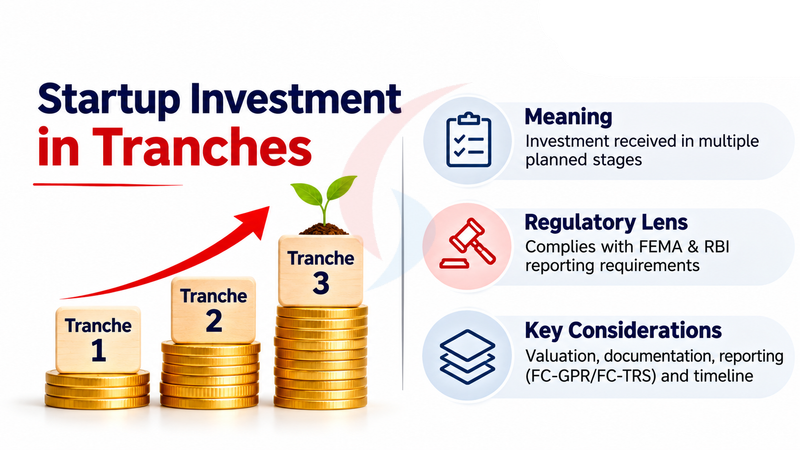
However, when the investor is a person resident outside India, the arrangement must comply with the Foreign Exchange Management Act, 1999, and the applicable RBI regulations. Each receipt of foreign investment must be properly identified and linked to the relevant issuance of equity instruments.
Businesses exploring overseas funding can read our article on Compliances Applicable on Investment in Indian Startup Companies, which explains important corporate and foreign investment requirements.
Is Foreign Investment in Multiple Tranches Allowed Under FEMA?
Yes. Foreign investors may fund eligible Indian startups through multiple instalments, provided each investment complies with the applicable foreign investment rules.
There is no universal FEMA rule requiring an ordinary foreign equity investment commitment to be transferred in a single payment. However, each actual remittance and the corresponding issuance of equity instruments must satisfy the applicable legal conditions.
For ordinary FDI subscriptions under Schedule I, the RBI regulations generally require an Indian company to issue the equity instruments within 60 days of receiving the consideration. If the instruments are not issued within that period, the amount must generally be refunded within 15 days after the 60-day period expires.
Where an issue constitutes reportable FDI, Form FC-GPR must ordinarily be filed within 30 days of issuing the equity instruments. These are separate requirements. Receiving foreign funds and issuing shares are two different events, each with its own compliance consequences.
|
Compliance Requirement |
General Timeline |
|
Receipt of foreign investment |
Through a permitted banking or account arrangement |
|
Issue of equity instruments |
Within 60 days of receipt of consideration |
|
Refund if instruments are not issued |
Within 15 days after expiry of the 60-day period |
|
FC-GPR reporting |
Within 30 days of the reportable issue |
|
PAS-3 filing |
Within the applicable Companies Act deadline |
|
Annual FLA Return |
Generally by 15 July, where applicable |
The 60-day allotment requirement must be examined for each separate receipt of ordinary equity subscription money. A later instalment does not automatically extend the deadline relating to an earlier receipt.
Laws and Legal Provisions Governing Startup Investment in Tranches
Foreign startup investments must comply with FEMA, RBI reporting regulations and applicable company law requirements. The relevant provisions depend on the instrument issued and the investment structure.
|
Applicable Act or Regulations |
Important Provisions |
Legal Requirements |
|
Sections 6, 13 and 15 |
Governs foreign investment transactions, contraventions and compounding. |
|
|
Rules 6, 9, 21 and applicable schedules |
Governs foreign investment eligibility, equity instruments, transfers and pricing. |
|
|
FEMA (Mode of Payment and Reporting of Non-Debt Instruments) Regulations, 2019 |
Regulations 3 and 4 |
Prescribes payment methods, issuance timelines and reporting requirements. |
|
Sections 42, 55 and 62 |
Governs private placement, preference shares and further issues of share capital. |
|
|
Companies (Prospectus and Allotment of Securities) Rules, 2014 |
Rules 12 and 14 |
Prescribes relevant allotment reporting and private placement procedures. |
|
Applicable share capital provisions |
Regulates preference shares and other relevant corporate requirements. |
Practical Example: A Startup Receiving Rs 6 Crore in Three Tranches
Consider xyx Private Limited, a fictional software startup based in Hyderabad. The company signs an investment agreement with a venture capital fund incorporated in Singapore. The fund commits Rs 6 crore, payable in three instalments. The parties agree that each instalment will be used to subscribe for equity shares at the applicable agreed price, subject to compliance with FEMA valuation requirements.
|
Investment Tranche |
Illustrative Receipt Date |
Amount |
Business Milestone |
|
First tranche |
10 January 2026 |
Rs 2 crore |
Signing of investment agreement |
|
Second tranche |
10 May 2026 |
Rs 2 crore |
Achievement of revenue target |
|
Third tranche |
10 September 2026 |
Rs 2 crore |
Product launch |
|
Total |
Rs 6 crore |
After receiving the first Rs 2 crore, InnoBridge must comply with the applicable issuance deadline for that receipt. It cannot simply retain the money as unallotted subscription consideration until September because the agreement mentions three instalments.
Suppose the company issues equity shares on 30 January 2026 against the first instalment. It must then complete FC-GPR within 30 days of that issue, where the issuance is reportable FDI. The same exercise is repeated for the second and third investments, based on their actual receipt dates and corresponding allotments.
Does Every Investment Tranche Require Separate FC-GPR Filing?
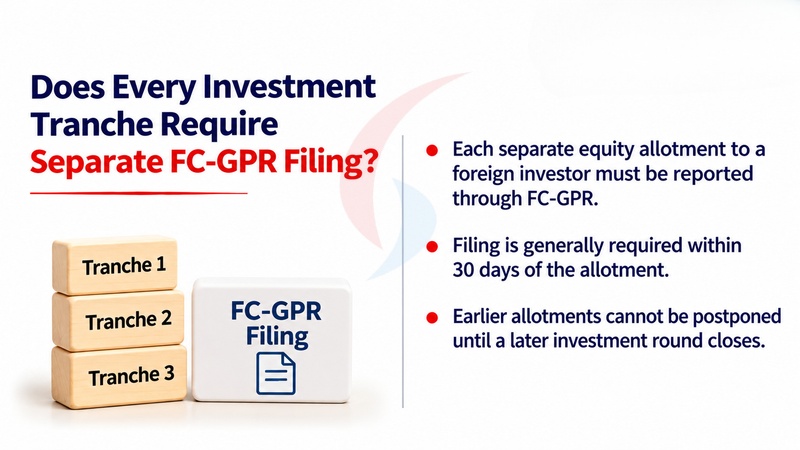
When an Indian company makes separate reportable equity allotments to foreign investors, each allotment must be properly reported under the applicable FC-GPR requirements.
The reporting obligation under Regulation 4(1) of the FEMA (Mode of Payment and Reporting of Non-Debt Instruments) Regulations, 2019 arises from the issuance of qualifying equity instruments.
For example, if an overseas investor transfers Rs 50 lakh in April and the company allots shares in May, FC-GPR must generally be completed within 30 days of the May allotment. If another Rs 50 lakh is received and shares are allotted in August, that later issue creates its own reporting obligation.
Conversely, multiple receipts may be associated with a single allotment where the structure and timing comply with the applicable rules. The company should follow the current FIRMS reporting instructions and AD bank guidance on documenting the underlying remittances.
The critical point is that the company cannot postpone reporting earlier completed allotments until a later investment round closes.
For a detailed explanation, read our article on FC-GPR and FLA Return: Filing Rules and Penalties, which explains transaction-based reporting and annual foreign investment compliance.
FEMA Pricing Guidelines for Investments Received in Tranches
A startup's valuation may change between investment instalments, particularly when its revenue, customer base or business performance improves. However, foreign investors cannot subscribe to shares at any price chosen by the founders without considering FEMA pricing requirements.
Under Rule 21 of the FEMA (Non-Debt Instruments) Rules, 2019, equity instruments issued by an unlisted Indian company to a foreign investor are generally subject to a prescribed minimum pricing requirement. The valuation must follow an internationally accepted methodology on an arm's-length basis and be certified by an eligible professional.
RBI's Foreign Investment Master Direction also specifies that the valuation certificate used for applicable pricing guidelines should generally not be more than 90 days old on the investment date, subject to the relevant exceptions.
For example, suppose a startup agrees to receive Rs 4 crore in two instalments. When the first investment is completed, its fair value is Rs 100 per share. Six months later, the company's performance has improved and its fair value is Rs 150.
The second allotment must be reviewed against the applicable pricing requirements at that stage. The parties cannot assume that an older valuation certificate will remain sufficient merely because both instalments were mentioned in the original agreement.
For further guidance, read our article on Need of Valuation Report under FEMA Law to understand the valuation requirements for foreign investment transactions.
Can Startups Receive Tranche Funding Through CCPS or CCDs?
Yes. Indian startups may receive qualifying foreign investment through fully paid, compulsorily and mandatorily convertible preference shares (CCPS) or debentures (CCDs), subject to applicable FEMA and Companies Act conditions. These instruments are frequently used where investors want participation rights or conversion terms linked to the company's financing arrangements.
For CCPS and CCDs, the conversion price or formula must be determined upfront when the instruments are issued. The final conversion must comply with the applicable FEMA pricing floor.
Consider a startup that raises Rs 3 crore through CCPS, with the investment divided into two instalments. The investor subscribes to one batch of CCPS in April and another batch in October. The company must review the terms, valuation and reporting requirements of each issuance.
The startup should also distinguish between the original reporting of CCPS and their subsequent conversion into ordinary equity shares.
Our article on FC-GPR Filing After CCPS Conversion into Equity explains the relevant documentation, conversion conditions and reporting considerations.
Special FEMA Rules for Convertible Notes: The Rs 25 Lakh Single-Tranche Requirement
Convertible notes require separate attention because their legal treatment differs from ordinary equity and CCPS. Under the FEMA (Non-Debt Instruments) Rules, 2019, an eligible Indian startup may issue convertible notes to permitted foreign investors. The instrument initially evidences money received as debt and may be repaid or converted into equity shares according to the applicable terms.
For an eligible foreign investor, the investment in convertible notes must be Rs 25 lakh or more in a single tranche. The instrument must also comply with the prescribed terms, including a conversion or repayment period not exceeding ten years from its issue.
This requirement is particularly important for startups planning small, milestone-based instalments. For example, suppose a recognised startup wants to issue convertible notes to a foreign investor against three payments of Rs 10 lakh each. Although the total investment would be Rs 30 lakh, the startup cannot simply assume the arrangement satisfies the Rs 25 lakh single-tranche condition.
It must structure the transaction in accordance with the convertible-note provisions or examine another legally permissible funding instrument. An Indian startup issuing convertible notes to a foreign investor must also submit Form CN within 30 days of the issue. The applicable entry-route, sectoral and pricing conditions must be checked, including at conversion.
Documents Required for FEMA Compliance in Tranche-Based Startup Funding
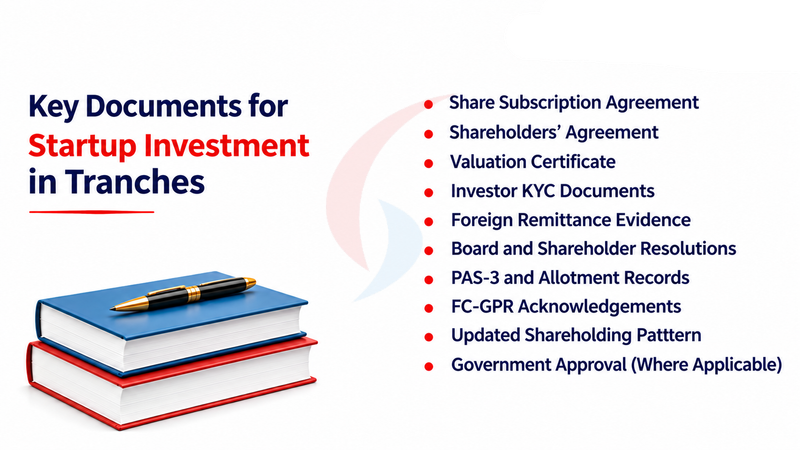
The company must maintain records connecting each incoming payment with the investment agreement and corresponding share allotment.
|
Required Document |
Purpose |
|
Share Subscription Agreement |
Establishes the total investment commitment and tranche conditions. |
|
Shareholders' Agreement |
Records investor rights and relevant commercial terms. |
|
Valuation Certificate |
Supports compliance with FEMA pricing requirements. |
|
Investor KYC Documents |
Verifies the foreign investor and relevant ownership details. |
|
Foreign Remittance Evidence |
Establishes the amount and date of each payment. |
|
Board and Shareholder Resolutions |
Supports the applicable corporate approvals. |
|
PAS-3 and Allotment Records |
Establishes the relevant share issuances. |
|
FC-GPR Acknowledgements |
Confirms reporting of qualifying foreign investment allotments. |
|
Updated Shareholding Pattern |
Records ownership following each allotment. |
|
Government Approval, Where Applicable |
Supports investments subject to approval conditions. |
The exact documents may vary according to the investment instrument, company structure, sector and AD bank requirements. For example, if the second investment instalment is received from a different overseas entity within the same investor group, the company should not assume that the original investor's KYC is sufficient. The legal identity and beneficial ownership of the actual investing entity must be examined.
Step-by-Step FEMA Compliance Process for Startup Investment in Tranches
Startups should complete a separate compliance review at each funding milestone instead of treating the entire investment commitment as a single completed transaction.
|
Step |
Particular |
Compliance Procedure |
|
Step 1 |
Verify FDI Eligibility |
Check the startup's sector, foreign investment limits, entry route and investor eligibility. |
|
Step 2 |
Finalise Investment Terms |
Define the total commitment, tranche amounts, instrument type and conditions. |
|
Step 3 |
Obtain Valuation |
Verify the applicable FEMA issue price and certification. |
|
Step 4 |
Receive Funds |
Accept each investment through a permitted banking arrangement. |
|
Step 5 |
Complete Share Allotment |
Issue the relevant equity instruments within the applicable deadline. |
|
Step 6 |
Complete MCA Filings |
File PAS-3 and other applicable corporate documents. |
|
Step 7 |
File RBI Returns |
Submit FC-GPR or the relevant reporting form within the prescribed timeline. |
|
Step 8 |
Reconcile Records |
Match remittances, allotments, investor holdings and RBI acknowledgements. |
|
Step 9 |
Repeat for Later Tranches |
Reassess pricing, approvals, documents and deadlines before subsequent investments. |
For private placements, Section 42 of the Companies Act, 2013 also contains specific requirements relating to the receipt of subscription money, allotment and return of allotment. In particular, the applicable private placement return must be filed within 15 days of allotment under Section 42(8). A startup should not assume that every PAS-3 filing has the same deadline. The applicable corporate procedure must be identified before completing the allotment.
Penalties for Delayed FEMA Compliance in Tranche Funding
Delays in mandatory reporting may attract RBI's Late Submission Fee (LSF) under the applicable FEMA directions. The fee depends on the reporting form, amount involved and period of delay. For relevant transaction-based filings, including FC-GPR, the published LSF formula is:
LSF = Rs 7,500 + (0.025% × A × n)
Here, A is the relevant transaction amount and n is the delay period calculated under RBI instructions. The calculation is subject to applicable conditions and caps.
However, a delay in filing and a failure to issue equity instruments within the prescribed period are different compliance problems. Paying the reporting LSF does not automatically regularise a separate violation involving delayed allotment, prohibited investment or incorrect pricing.
Serious contraventions may require action under Sections 13 and 15 of the Foreign Exchange Management Act, 1999, including applicable compounding procedures.
For detailed guidance, read our article on Compounding Procedures for Form FC-GPR Violations under FEMA.
Latest RBI and FEMA Updates Affecting Startup Investments in 2026
Several important regulatory developments should be considered when structuring foreign investments in Indian startups.
|
Regulatory Development |
Relevance |
|
RBI Foreign Investment Master Direction – Updated 15 June 2026 |
Provides guidance on equity instruments, pricing, investment conditions and permitted transactions. |
|
FEMA Reporting Amendment – 13 June 2026 |
Updated specified payment and reporting provisions, particularly for certain non-resident and international exchange investments. |
|
RBI Reporting Regulations – Consolidated June 2026 |
Continue to prescribe FC-GPR and other reporting requirements. |
|
RBI Reporting Master Direction – Updated October 2026 |
Relevant to the administration of prescribed FEMA returns. |
|
RBI Compounding Guidance – Updated October 2026 |
Relevant to the treatment of qualifying FEMA contraventions. |
The 13 June 2026 amendment, Notification FEMA 395(4)/2026-RB, revised specified payment and remittance provisions under Schedules III and XI, along with reporting for individual foreign investors on recognised stock exchanges. It did not introduce a general exemption allowing startups to postpone ordinary FC-GPR reporting until the last investment tranche arrives.
Why Choose Compliance Calendar LLP ?
Foreign investment received in instalments requires careful coordination between founders, investors, banks and compliance professionals. At Compliance Calendar LLP, we assist Indian startups with FEMA reporting, FDI documentation, valuation-related compliance and corporate filings.
|
Our Services |
How We Help |
|
FDI Applicability Review |
Examine the investor, sector, entry route and applicable foreign investment conditions. |
|
Tranche-Wise Compliance Planning |
Help identify allotment and reporting deadlines for each investment instalment. |
|
FC-GPR Filing Assistance |
Support reporting of qualifying foreign equity issuances through RBI FIRMS. |
|
Valuation Compliance |
Assist with documentation for the applicable FEMA pricing requirements. |
|
MCA and RBI Documentation |
Support preparation and reconciliation of investment-related records. |
|
Delayed Filing Assistance |
Help identify reporting defaults and available regularisation procedures. |
Businesses can also explore our FEMA Due Diligence Services and FEMA/RBI Compliance Checklist for Indian Companies with FDI.
If your startup is planning to receive foreign investment in multiple tranches and needs assistance with FEMA reporting, contact Compliance Calendar LLP at 9988424211 or info@ccoffice.in.
Frequently Asked Questions (FAQs)
Q1. Can a foreign investor invest in an Indian startup in multiple tranches?
Ans:Yes. Foreign investors may provide funding in separate instalments where the investment is otherwise permitted under FEMA. The startup must comply with applicable entry-route, pricing, allotment and reporting conditions. Different funding instruments may have additional requirements.
Q2. Is FC-GPR filing required for every investment tranche?
Ans:FC-GPR is required for qualifying foreign direct investment issuances. Where separate instalments result in separate reportable allotments, the corresponding issuances must be reported within the prescribed deadlines. The treatment of multiple remittances against one allotment should follow RBI instructions.
Q3. What is the deadline for issuing shares against foreign investment?
Ans:For ordinary equity subscriptions covered by Schedule I, equity instruments must generally be issued within 60 days of receiving the consideration. If the company does not issue the instruments within that period, the applicable refund requirement must be followed.
Q4. Can a startup use the same valuation report for all investment tranches?
Ans:Not automatically. The applicable FEMA valuation certificate generally must be no more than 90 days old on the relevant investment date. A startup receiving instalments over several months should review the valuation requirements before each subsequent issuance.
Q5. What happens if the second tranche is delayed?
Ans:If the investor has not transferred the second instalment, the ordinary 60-day issuance period for that payment has not begun merely because the investment agreement specifies a payment date. However, contractual conditions and valuation requirements may still need review.
Q6. Can a foreign investor invest Rs 10 lakh in convertible notes?
Ans:The applicable foreign investment provisions generally require at least Rs 25 lakh in a single tranche for a qualifying foreign investor's subscription to startup convertible notes. An investment of Rs 10 lakh alone would not satisfy that condition.
Q7. Is PAS-3 required for foreign startup investments?
Ans:Where shares are allotted, the company must comply with the applicable return-of-allotment requirements under the Companies Act, 2013. For private placements under Section 42, the prescribed filing deadline is generally 15 days from allotment.
Q8. Is FLA Return required after receiving foreign investment?
Ans:An Indian startup with reportable outstanding FDI generally must examine its annual FLA Return obligation. The return is ordinarily due by 15 July and is separate from transaction-based reporting through FC-GPR.
Q9. What is the penalty for delayed FC-GPR reporting?
Ans:Delayed mandatory FC-GPR reporting may attract the RBI's Late Submission Fee mechanism. Other FEMA violations, such as failure to comply with issuance or pricing requirements, may require separate examination and regularisation.
Q10. Can Compliance Calendar LLP assist with tranche-based startup investments?
Ans: Yes. Compliance Calendar LLP assists startups with foreign investment documentation, FEMA applicability, valuation-related compliance, FC-GPR filing, AD bank coordination and related corporate reporting requirements.
Article last updated on : 19 Nov 2026.













































































_learn_crop10_thumb.jpg)


























































































































































































































