


Imagine a manufacturing company in India that proudly claims to follow sustainable business practices. Its website mentions environmental protection, employee welfare and ethical management. However, when a major investor requests its ESG policy, the management discovers that these commitments exist only in presentations and marketing materials. There is no approved policy explaining who monitors pollution control, how employee complaints are handled or how environmental targets are reviewed.
This situation is increasingly relevant for Indian businesses. Investors, large customers and regulatory authorities expect companies to demonstrate that responsible business practices are supported by internal policies, proper documentation and actual implementation.
What Is an ESG Policy for Companies?
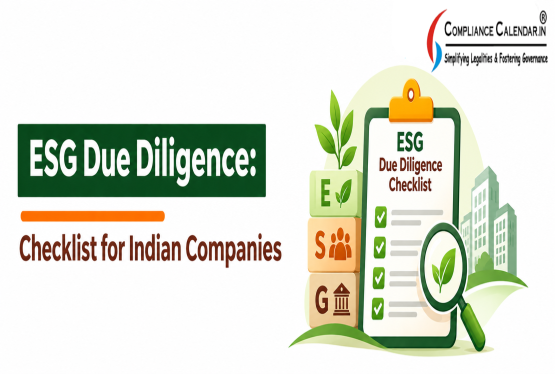
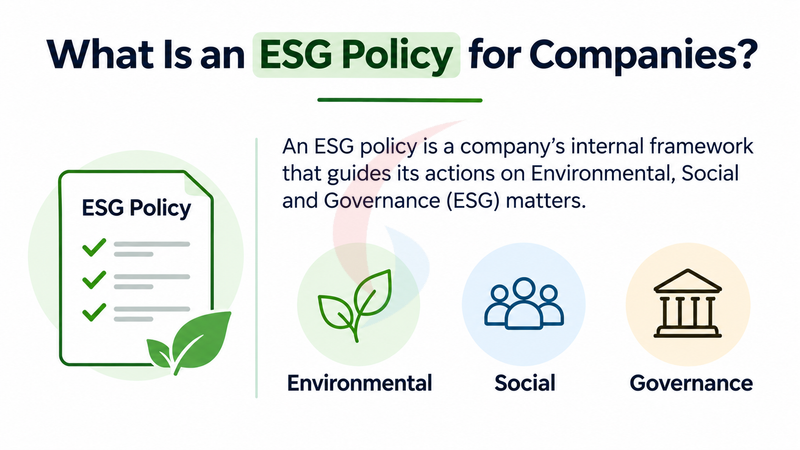
An ESG Policy is a written document explaining a company's commitments, responsibilities and internal procedures relating to environmental protection, social welfare and corporate governance. It provides direction to directors, management, employees and relevant stakeholders on responsible business conduct.
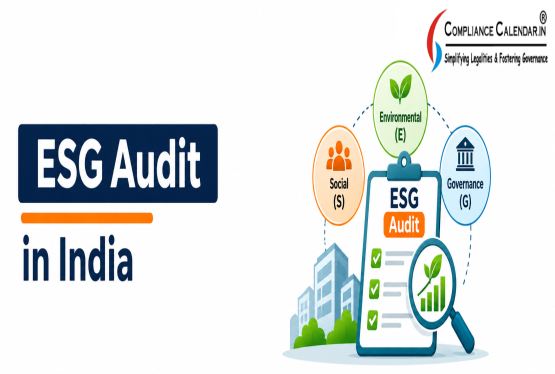
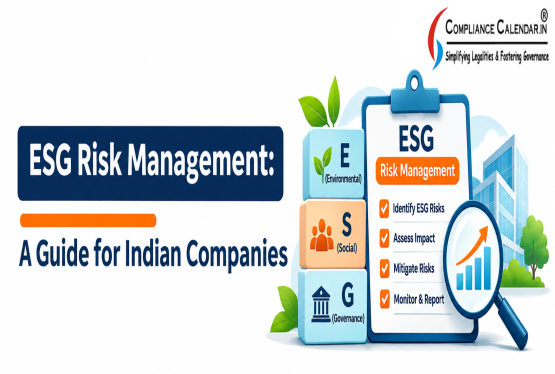
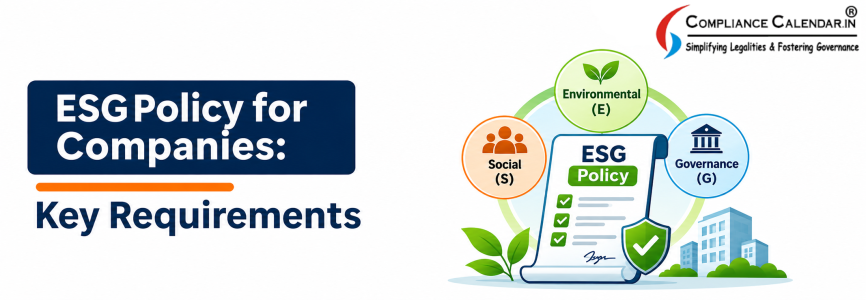
The environmental component generally addresses energy conservation, greenhouse gas emissions, water management, pollution prevention and waste disposal. The social component covers employee wellbeing, workplace safety, fair employment practices, human rights and customer protection. Governance focuses on ethical business conduct, board accountability, anti-corruption measures and transparency.
For example, a manufacturing company's ESG policy may establish procedures for monitoring electricity consumption, reviewing industrial waste disposal, conducting workplace safety training and reporting compliance issues to management.
An ESG policy should not be confused with an ESG report. A policy explains what the company intends to do and how responsibilities are assigned, while an ESG report discloses relevant performance and outcomes.
Companies can explore ESG Compliance in India: Laws, Rules and Requirements to understand the wider statutory responsibilities connected with ESG practices.
Is an ESG Policy Mandatory for Indian Companies?
There is no single law requiring every registered company in India to prepare one standard document titled "ESG Policy". Applicability depends on listing status, business activities, company size and specific statutory requirements.
For listed entities covered by SEBI's Business Responsibility and Sustainability Report (BRSR), disclosures about policies and management processes aligned with the nine National Guidelines on Responsible Business Conduct (NGRBC) principles are particularly important.
However, an unlisted private limited company is not automatically required to adopt SEBI's complete BRSR policy structure. It may nevertheless need separate policies and procedures under applicable labour, environmental, corporate governance and other laws.
ESG Policy Applicability in India
|
Company Category |
ESG Policy Requirements |
|
Top 1,000 listed entities |
BRSR disclosures covering applicable policies, management processes and sustainability practices. |
|
Other listed companies |
Applicable SEBI governance and disclosure obligations; voluntary ESG commitments where appropriate. |
|
Unlisted public companies |
Relevant company law, CSR and operational compliance policies. |
|
Applicable environmental, workplace and governance policies based on legal requirements. |
|
|
Business-specific ESG policies, often adopted voluntarily or in response to investor and customer requirements. |
For example, a private packaging company may not have mandatory BRSR obligations, but it may need waste management procedures, workplace safety arrangements and other statutory compliance systems.
Legal Provisions Governing ESG Policy in India
India does not have a comprehensive ESG Policy Act. Instead, different laws regulate environmental responsibilities, employee welfare and corporate governance. A properly drafted ESG policy should reflect the requirements applicable to the company's operations.
|
Applicable Law / Regulation |
Relevant Provisions |
ESG Policy Requirements |
|
Regulation 34(2)(f) |
BRSR reporting and disclosures about responsible business policies. |
|
|
BRSR Sections A, B and C |
Policy commitments, management processes and ESG performance disclosures. |
|
|
Sections 134, 135, 166, 177 and 188 |
Board accountability, CSR, directors' duties and governance requirements. |
|
|
Sections 3 and 5 and applicable rules |
Environmental protection and compliance with regulatory standards. |
|
|
Applicable consent provisions |
Pollution control permissions, monitoring and environmental compliance. |
|
|
Applicable provisions and rules |
Wages, employee welfare, social security and workplace safety. |
|
|
Sections 4 and 19 and related provisions |
Workplace sexual harassment prevention and redressal mechanisms. |
|
|
Provisions according to phased commencement |
Personal data protection and governance obligations. |
These laws should be read with current rules, notifications and industry-specific requirements. Adopting an ESG policy does not remove the need to obtain regulatory permissions or make statutory filings.
Key Components of an ESG Policy for Companies
An effective ESG policy should cover environmental responsibilities, employee welfare, corporate governance and regular compliance monitoring. It must reflect the company's actual business operations and applicable legal requirements.
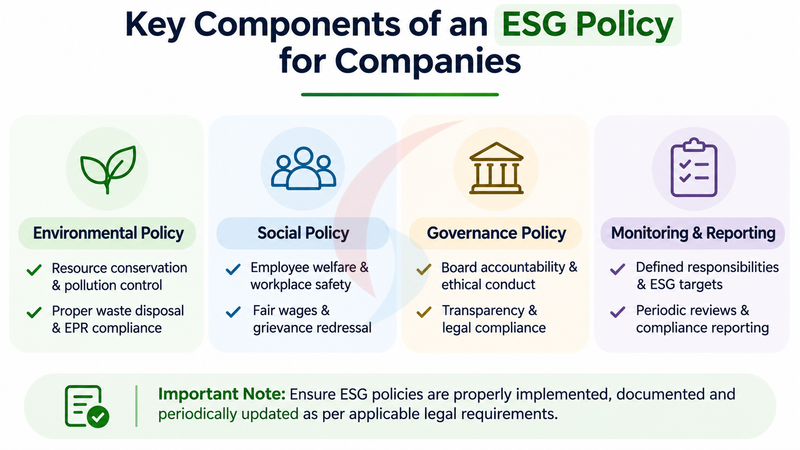
|
ESG Component |
Key Policy Requirements |
Practical Implementation |
|---|---|---|
|
Environmental Policy |
Energy conservation, water management, emission control, waste disposal and applicable EPR compliance. |
Monitor resource consumption, maintain pollution control equipment and ensure proper waste disposal. |
|
Social Policy |
Employee wellbeing, fair wages, workplace safety, human rights and grievance redressal. |
Conduct safety training, maintain wage records and implement POSH compliance procedures. |
|
Governance Policy |
Board accountability, ethical conduct, transparency, conflicts of interest and legal compliance. |
Review related-party transactions, maintain statutory records and establish misconduct reporting procedures. |
|
Monitoring and Reporting |
Defined responsibilities, measurable ESG targets, periodic reviews and compliance reporting. |
Assign responsible personnel, monitor ESG performance and review policy implementation regularly. |
Important Note: Companies should ensure that their ESG policies are properly implemented, supported by documentation and periodically updated according to applicable legal requirements.
ESG Policy Requirements Under SEBI BRSR Regulations
SEBI's BRSR framework is particularly important for companies required to disclose information about their ESG policies.
Under Regulation 34(2)(f) of the SEBI LODR Regulations, covered listed entities must include BRSR in their annual reports, subject to applicable provisions.
BRSR is based on the nine NGRBC principles. Section B of the prescribed format focuses on Management and Process Disclosures, including policy commitments, governance arrangements and implementation mechanisms.
Companies are required to disclose relevant information about their responsible business policies and management processes in the prescribed format. This helps stakeholders understand whether sustainability commitments are supported by suitable governance arrangements.
For example, a listed company may disclose whether it has policies addressing employee safety, environmental protection, human rights and ethical business conduct. It must provide the relevant explanations required by the BRSR format, rather than assume that every sustainability statement demonstrates full compliance.
For additional details, read BRSR Reporting: Applicability, Format and Due Dates.
Nine NGRBC Principles Relevant to ESG Policy
The Ministry of Corporate Affairs introduced the National Guidelines on Responsible Business Conduct in 2019. These principles provide a basis for responsible business practices and SEBI's BRSR disclosures.
|
NGRBC Principle |
ESG Policy Focus |
|
Principle 1 |
Ethical, transparent and accountable business conduct. |
|
Principle 2 |
Sustainable and safe products and services. |
|
Principle 3 |
Employee and worker wellbeing. |
|
Principle 4 |
Stakeholder interests and engagement. |
|
Principle 5 |
Respect and promotion of human rights. |
|
Principle 6 |
Environmental protection and restoration. |
|
Principle 7 |
Responsible engagement in public policy. |
|
Principle 8 |
Inclusive growth and equitable development. |
|
Principle 9 |
Responsible consumer engagement. |
These principles help companies organise their policies across different business functions. A company may maintain one consolidated ESG policy, several specialised policies or a combination, depending on its requirements.
Environmental Compliance Requirements in an ESG Policy
Environmental policies must align with applicable Indian environmental laws and cover pollution control, waste management, resource conservation and regulatory compliance.
|
Environmental Requirement |
Applicable Law / Rules |
Key Compliance Requirements |
|---|---|---|
|
Environmental Protection |
Follow prescribed environmental standards and regulatory directions. |
|
|
Pollution Control Permissions |
Obtain Consent to Establish (CTE) and Consent to Operate (CTO), where applicable. |
|
|
Waste Management |
Plastic Waste, E-Waste and Battery Waste Management Rules |
Comply with applicable EPR registration, recycling and waste disposal obligations. |
|
Water and Wastewater Management |
Maintain wastewater treatment facilities and monitoring records as required. |
|
|
Environmental Auditing |
Follow applicable environmental audit and verification requirements, including the use of registered auditors where prescribed. |
Example: A textile dyeing unit may require valid pollution control permissions, wastewater treatment facilities and discharge monitoring records to demonstrate environmental compliance.
Social and Workplace Policies Under Indian Labour Laws
The social component of an ESG policy focuses on employee rights, workplace safety, fair wages, social security and grievance redressal under applicable Indian labour laws.
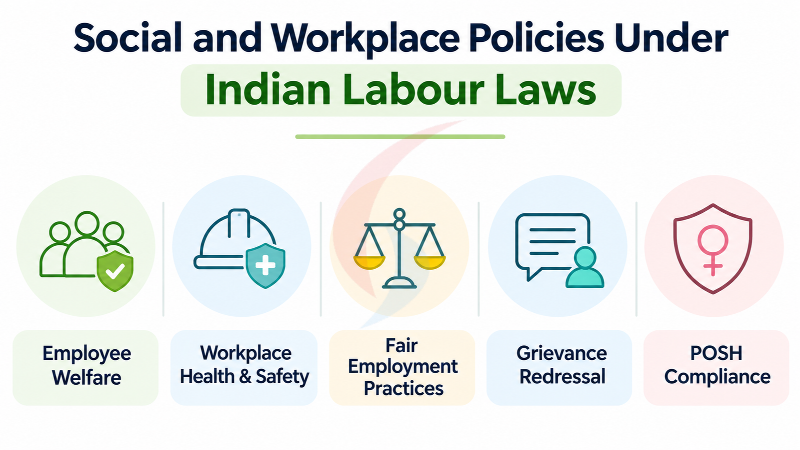
|
Applicable Law |
Key Legal Requirements |
ESG Policy Requirements |
|---|---|---|
|
Minimum wages, timely salary payments and equal remuneration. |
Ensure fair wages, timely payments and proper wage records. |
|
|
Industrial disputes, employment relations and worker representation. |
Maintain fair employment practices and grievance procedures. |
|
|
Applicable PF, ESI, gratuity and other social security benefits. |
Maintain employee benefit records and ensure statutory contributions. |
|
|
Occupational Safety, Health and Working Conditions Code, 2020 |
Workplace safety, employee health and working conditions. |
Conduct safety training, maintain safety records and prevent workplace hazards. |
|
Prevention and redressal of workplace sexual harassment. |
Establish an Internal Committee where required, conduct awareness training and provide complaint mechanisms. |
Important Note: The four Labour Codes came into effect from November 21, 2025, subject to notified provisions, transitional arrangements and applicable Central and State rules. Companies must maintain proper employment records and implement workplace policies according to their applicable legal obligations.
How to Draft and Implement an ESG Policy in India
Drafting an ESG policy should begin with understanding the company's operations and applicable legal obligations. A technology company, chemical manufacturer and financial services business will have different ESG risks.
Step 1 – Identify Applicable Laws: Review relevant SEBI regulations, company law provisions, environmental requirements, labour laws and contractual obligations.
Step 2 – Assess Business Risks: Examine energy consumption, pollution exposure, workforce conditions, governance practices and supplier relationships.
Step 3 – Draft Policy Commitments: Clearly describe the company's environmental, social and governance objectives and the procedures through which they will be implemented.
Step 4 – Assign Responsibilities: Identify the directors, senior management personnel and departments responsible for monitoring compliance and reporting concerns.
Step 5 – Obtain Appropriate Approval: The policy should be approved by the competent authority under the company's governance arrangements. Board approval may be appropriate or legally required depending on the particular policy and applicable rules.
Step 6 – Communicate and Implement: Employees and relevant departments should receive suitable instructions and training. Necessary records and internal controls should be established.
Step 7 – Review and Update: Management should periodically examine legal changes, operational performance and identified compliance gaps.
The company should also maintain evidence that its ESG commitments are being implemented. A written policy without operating procedures or supporting records may provide little protection against compliance failures.
Case Study: How an ESG Policy Helped a Manufacturing Company
Consider the fictional example of GreenFuture Packaging Pvt. Ltd., a packaging manufacturer operating in Haryana. The company generated annual revenue of Rs 90 crore and supplied products to several consumer goods businesses. When a major customer requested information about the company's environmental and employee welfare practices, management realised that ESG responsibilities were handled separately by different departments.
The company decided to prepare a consolidated ESG policy and introduced regular monitoring of energy consumption, waste disposal and employee safety training.
|
ESG Area |
Problem Identified |
Policy-Based Improvement |
|
Energy Consumption |
Annual electricity usage of 12 lakh units. |
Introduced efficiency measures and reduced usage to 10.5 lakh units. |
|
Waste Management |
Inconsistent waste disposal records. |
Established centralised waste tracking procedures. |
|
Employee Safety |
Training records maintained separately. |
Introduced standardised safety documentation. |
|
Governance |
Unclear ESG responsibilities. |
Assigned monitoring duties to designated managers. |
At an illustrative electricity cost of Rs 8 per unit, the reduction of 1.5 lakh units could represent potential annual savings of Rs 12 lakh, excluding implementation expenses. The company was not automatically subject to SEBI's BRSR requirement because it was unlisted. However, its ESG policy helped improve internal accountability and respond to customer sustainability requests.
This fictional example shows that an ESG policy can support practical business improvements even where a comprehensive ESG report is not mandatory.
Latest ESG Policy Regulatory Updates in India for 2026
Companies reviewing ESG policies in November 2026 should consider recent changes in sustainability reporting, environmental auditing, employment laws and data protection.
|
Regulatory Development |
Important Update |
|
BRSR Core Verification |
SEBI permits assessment or assurance under its March 28, 2025 amendments. |
|
FY 2026–27 Applicability |
Phased BRSR Core verification extends to the top 1,000 listed entities. |
|
Value Chain ESG Disclosures |
Voluntary for the top 250 listed entities from FY 2025–26. |
|
Green Credit Disclosures |
Voluntary leadership indicator introduced under BRSR Principle 6. |
|
Environment Audit Rules, 2025 |
Established certification and registration arrangements for environmental auditors. |
|
Labour Codes |
Applicable provisions commenced from November 21, 2025, subject to transitional requirements. |
|
DPDP Act and Rules |
Personal data protection obligations are subject to phased commencement. |
Under SEBI's March 28, 2025 amendments, the assessment or assurance framework offers greater flexibility for covered entities. The changes also make specified value chain ESG disclosures voluntary.
The Digital Personal Data Protection Act, 2023 and Rules, 2025 also deserve attention, but companies should distinguish provisions already in force from those scheduled to commence later. Not all substantive data protection obligations were operational in November 2026.
Documents Required for Preparing an ESG Policy
A company should examine its existing records before finalising an ESG policy. This helps ensure that the commitments are practical and supported by relevant operating procedures.
|
Document Category |
Relevant Documents |
|
Corporate Records |
Certificate of Incorporation, Board minutes and governance policies. |
|
Environmental Records |
Pollution control permissions, waste management records and utility data. |
|
Employee Records |
Employment policies, wage records, safety registers and training documentation. |
|
Governance Records |
Related-party transaction records, conflict declarations and applicable statutory registers. |
|
ESG Disclosures |
BRSR reports, ESG performance information and verification records, where applicable. |
The documents required depend on the company's operations. A service-based business may place greater emphasis on workforce policies and data protection, while a manufacturer may need detailed environmental and safety records.
Why Choose Compliance Calendar LLP for ESG Policy Support?
Preparing an ESG policy requires an understanding of environmental regulations, employee welfare obligations, corporate governance and sustainability reporting requirements.
Compliance Calendar LLP provides professional support for corporate compliance, ESG advisory and regulatory matters. Businesses can seek assistance in identifying applicable requirements, reviewing existing practices, organising compliance documentation and developing appropriate internal procedures.
For professional assistance, contact Compliance Calendar LLP at 9988424211 or email info@ccoffice.in
Frequently Asked Questions (FAQ’S)
Q1. What is an ESG Policy for Companies?
Ans. An ESG policy is a written document describing a company's approach to environmental protection, employee welfare and corporate governance. It establishes responsibilities, procedures and commitments for responsible business practices.
Q2. Is an ESG Policy mandatory in India?
Ans. There is no universal requirement for every company to adopt one consolidated ESG policy. However, specified listed entities must make BRSR policy disclosures, and other companies must maintain policies and procedures required under applicable laws.
Q3. Is ESG Policy mandatory for private limited companies?
Ans. Private limited companies are not automatically required to adopt SEBI's BRSR policy structure. However, they must comply with applicable environmental, labour, governance and other statutory requirements.
Q4. What are the three main components of an ESG Policy?
Ans. The three main components are Environmental, Social and Governance. They address resource management, employee and stakeholder welfare, and ethical corporate management.
Q5. Which law governs ESG Policy in India?
Ans. No single law governs every ESG policy. Relevant requirements arise from SEBI regulations, the Companies Act, 2013, environmental legislation, labour laws and other applicable statutes.
Q6. What is the role of SEBI in ESG Policy compliance?
Ans. SEBI prescribes BRSR disclosures for covered listed entities. The reporting format includes information about responsible business policies, management processes and sustainability performance.
Q7. Who should approve an ESG Policy?
Ans. Approval depends on the company's governance arrangements and the nature of the policy. Board approval is often appropriate, particularly for comprehensive corporate policies, but specific statutory approval requirements must be examined separately.
Q8. How often should companies update their ESG Policy?
Ans. There is no universal annual revision deadline for all ESG policies. Companies should review their policies periodically and whenever significant legal, operational or business changes occur.
Q9. What documents support ESG Policy implementation?
Ans. Relevant documents may include environmental permissions, employment records, safety registers, governance policies, statutory filings, sustainability data and compliance monitoring reports.
Q10. Can an ESG Policy help attract investors?
Ans. An appropriately implemented ESG policy can help investors understand how a company manages environmental, social and governance risks. However, the policy should be supported by reliable records and actual business practices.
Article last updated on : 21 Nov 2026.







































































_learn_crop10_thumb.jpg)