


Imagine a manufacturing company in Gujarat preparing to approach investors for Rs 100 crore in funding. Its management has developed an attractive sustainability report highlighting tree plantation activities, water conservation projects and the installation of solar panels. The company believes the report will satisfy every investor's environmental and social disclosure requirements.
However, during due diligence, an institutional investor asks for specific figures: What are the company's Scope 1 and Scope 2 carbon emissions? How many workplace accidents occurred during the year? What is the percentage of renewable energy consumption? Are sustainability disclosures independently verified?
Although the company has published a detailed sustainability report, it cannot immediately answer these questions in a consistent format. This situation highlights an important distinction between ESG Reporting and Sustainability Reporting in India.
What Is ESG Reporting in India?
ESG Reporting refers to the disclosure of information about a company's Environmental, Social and Governance performance. It helps investors, lenders, regulators and other stakeholders evaluate how responsibly a company conducts its business and manages relevant risks.
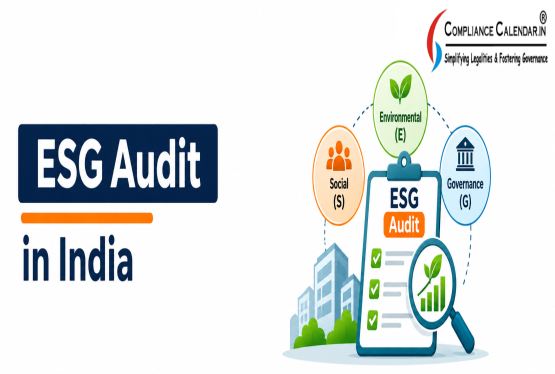
Environmental disclosures may include greenhouse gas emissions, energy consumption, water usage and waste management. Social disclosures cover employee wellbeing, workplace safety, human rights and customer protection. Governance disclosures concern board accountability, business ethics, internal controls and transparency.
For example, a listed automobile manufacturer may disclose its annual electricity consumption, emissions, workplace safety incidents and related-party transactions. These disclosures help stakeholders understand issues that financial statements alone may not explain.
In India, the principal mandatory ESG disclosure mechanism for covered listed entities is the Business Responsibility and Sustainability Report (BRSR) under the SEBI Listing Obligations and Disclosure Requirements Regulations, 2015.
For detailed applicability rules, companies can read ESG Reporting in India: Applicability and Requirements.
What Is Sustainability Reporting?
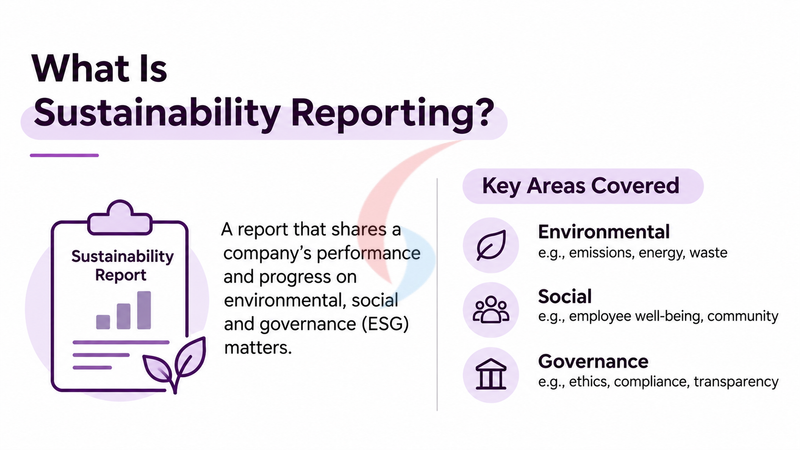
Sustainability Reporting is the process of disclosing how a company's activities affect the environment, people and the economy, along with relevant sustainability-related risks, opportunities and management responses.
A sustainability report may explain the company's approach to resource conservation, climate change, labour practices, community development, responsible sourcing and long-term business sustainability.
For example, a food processing company may publish a sustainability report explaining how it reduced food waste, improved water recycling, supported farmers and adopted energy-efficient equipment.
Companies often use international reporting standards such as the Global Reporting Initiative (GRI) Standards. These standards place particular emphasis on an organisation's significant impacts on the economy, environment and people.
Unlike a prescribed SEBI BRSR filing, a standalone sustainability report does not automatically have one uniform statutory format or filing deadline for every Indian company.
However, sustainability reporting should not be described as entirely separate from ESG Reporting. The two approaches substantially overlap, and a single report may satisfy multiple reporting objectives when the appropriate disclosures and standards are followed.
ESG Reporting vs Sustainability Reporting: Key Differences
Although ESG Reporting and Sustainability Reporting are closely related, their emphasis can vary according to the reporting standards selected and the information needs of stakeholders.
|
Basis |
ESG Reporting |
Sustainability Reporting |
|
Meaning |
Disclosure of environmental, social and governance information. |
Disclosure of sustainability impacts, risks, opportunities and performance. |
|
Primary Focus |
ESG indicators, risk management and governance performance. |
Sustainable development, organisational impacts and long-term performance. |
|
Main Audience |
Investors, lenders, regulators and other stakeholders. |
Employees, communities, customers, investors and other stakeholders. |
|
Common Standards |
SEBI BRSR, BRSR Core and other ESG disclosure standards. |
GRI Standards, ISSB Standards and other relevant reporting approaches. |
|
Legal Applicability in India |
Mandatory BRSR for specified listed entities. |
Standalone reports are generally voluntary unless another requirement applies. |
|
Verification |
BRSR Core assessment or assurance is required for covered listed entities. |
Independent assurance depends on the applicable standard, law or contractual requirement. |
|
Reporting Format |
Prescribed BRSR format where SEBI requirements apply. |
Format depends on the selected standards and reporting objectives. |
|
Example |
Reporting emissions, employee safety indicators and governance information. |
Explaining resource conservation, community impacts and sustainability performance. |
Important Distinction: ESG Reporting is not always limited to investors, and Sustainability Reporting is not always voluntary. The actual requirements depend on the jurisdiction, reporting standard and applicable regulatory obligations.
Legal Framework for ESG and Sustainability Reporting in India
India does not have a single comprehensive Sustainability Reporting Act applicable to all registered companies. Instead, reporting and related compliance obligations arise from securities regulations, the Companies Act, environmental legislation and other applicable laws.
|
Applicable Law / Regulation |
Relevant Provision |
Reporting Requirement |
|
Regulation 34(2)(f) |
Mandatory BRSR for covered listed entities. |
|
|
Prescribed BRSR format |
Structured sustainability disclosures aligned with NGRBC principles. |
|
|
BRSR Core framework |
Selected ESG indicators and phased independent verification. |
|
|
Amended BRSR requirements |
Assessment or assurance options and voluntary value chain disclosures. |
|
|
Sections 134, 135 and 166 |
Board reporting, CSR responsibilities and directors' duties. |
|
|
Rule 14 |
Environmental statement in Form V for covered operations. |
These laws establish different obligations. A voluntary sustainability report cannot replace mandatory BRSR disclosures, environmental statements, pollution control returns or other legally prescribed filings.
SEBI BRSR Reporting Requirements in India
SEBI introduced BRSR through its May 10, 2021 circular to improve sustainability disclosures by listed entities. The reporting requirements are governed by Regulation 34(2)(f) of the SEBI LODR Regulations, 2015.
|
Particulars |
BRSR Reporting Requirements |
|---|---|
|
Regulatory Authority |
Securities and Exchange Board of India (SEBI) |
|
Legal Provision |
Regulation 34(2)(f), SEBI LODR Regulations, 2015 |
|
Applicability |
Top 1,000 listed entities by market capitalisation, subject to applicable provisions |
|
Mandatory From |
FY 2022–23 |
|
Reporting Principles |
Nine NGRBC principles issued by the Ministry of Corporate Affairs |
|
Section A |
General Disclosures – Company details and business operations |
|
Section B |
Management and Process Disclosures – Policies and governance practices |
|
Section C |
Principle-wise Performance Disclosures – Environmental, social and governance performance |
|
Additional Reporting |
Companies may publish separate sustainability reports, but mandatory SEBI BRSR disclosures must still be fulfilled. |
Example: A listed textile manufacturer reports energy consumption, water usage, workforce safety, environmental performance and governance practices.
For more information, read BRSR Reporting: Applicability, Format and Due Dates.
BRSR Core and Independent Verification Requirements
BRSR Core is a subset of BRSR containing selected Key Performance Indicators under nine ESG attributes. SEBI introduced it through the July 12, 2023 circular to improve the reliability and comparability of sustainability disclosures.
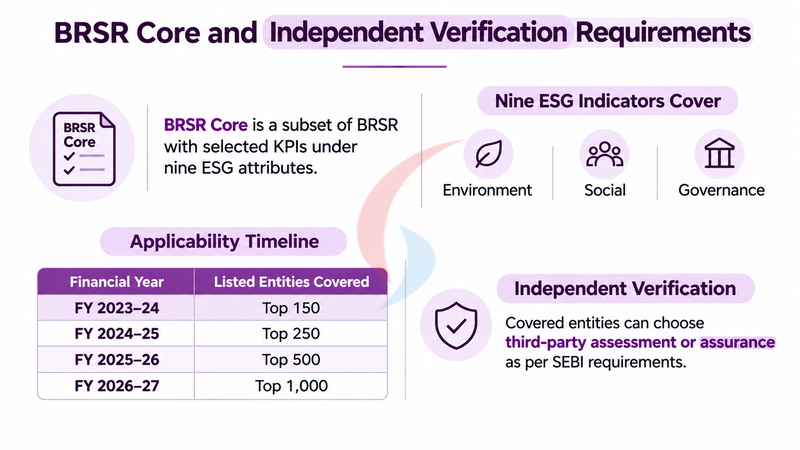
The indicators cover greenhouse gas emissions, energy, water, waste management, employee wellbeing, gender diversity, inclusive development, fairness in customer and supplier relationships, and business transparency.
BRSR Core Applicability Timeline
|
Financial Year |
Listed Entities Covered |
|
FY 2023–24 |
Top 150 |
|
FY 2024–25 |
Top 250 |
|
FY 2025–26 |
Top 500 |
|
FY 2026–27 |
Top 1,000 |
Under the amended provisions, covered listed entities can choose between third-party assessment and assurance, subject to applicable SEBI requirements.
For FY 2026–27, the phased verification requirement extends to the top 1,000 listed entities by market capitalisation, subject to the relevant applicability and transition provisions.
Companies can refer to BRSR Core: Requirements and Key Indicators for further information.
Sustainability Reporting Standards Used by Indian Companies
Indian companies may follow internationally recognised sustainability reporting standards based on their reporting objectives, investor expectations and applicable legal requirements.
|
Reporting Standard |
Key Requirements |
Reporting Focus |
Example |
|---|---|---|---|
|
Global Reporting Initiative (GRI) |
Reports significant impacts on the economy, environment, people and human rights. |
Environmental and social impacts, stakeholder interests and sustainability performance. |
A cement company reports emissions, resource consumption, worker safety and community development. |
|
IFRS S1 |
Discloses sustainability-related risks and opportunities that could affect a company's financial prospects. |
Sustainability-related financial risks and opportunities. |
A manufacturing company reports how water scarcity could affect future operations and costs. |
|
IFRS S2 |
Provides climate-related disclosures, including risks, opportunities and relevant climate performance information. |
Climate-related risks, emissions and financial implications. |
A company reports carbon emissions, climate risks and emission reduction plans. |
Important Note: GRI, IFRS S1 and IFRS S2 are not automatically mandatory for all Indian companies. Their applicability depends on the relevant regulatory requirements, voluntary adoption or contractual commitments. Companies covered by SEBI's mandatory BRSR requirements must comply with the prescribed Indian reporting framework.
Is ESG or Sustainability Reporting Mandatory for Private Companies and MSMEs?
Private limited companies, unlisted public companies, MSMEs and startups are not automatically required to prepare SEBI BRSR solely because of their incorporation status.
However, they remain subject to environmental, labour, company law and other statutory obligations relevant to their operations.
A small packaging manufacturer, for example, may not need to publish BRSR but may require pollution control permissions, waste management records and applicable Extended Producer Responsibility registrations.
A large corporate customer may also request sustainability information from suppliers, including details about electricity consumption, labour practices and waste disposal.
Such requests do not necessarily create an independent SEBI BRSR filing obligation for the supplier. However, maintaining accurate sustainability records may help satisfy legitimate commercial and investor information needs.
Companies can explore ESG Regulations for Companies in India to understand the wider legal obligations.
ESG Reporting vs Sustainability Reporting: A Practical Company Example
Consider the fictional example of GreenLeaf Textiles Ltd., a textile manufacturer operating factories in Gujarat and Maharashtra. The company had annual revenue of Rs 600 crore and was preparing sustainability information for investors and overseas customers.
Management initially published a sustainability report explaining its water conservation initiatives, solar energy installations and employee welfare programmes. However, the company also needed structured ESG disclosures to meet applicable investor and regulatory information requirements.
During the reporting exercise, management identified differences between its sustainability statements and the available operational data.
|
Reporting Area |
Sustainability Report |
ESG Reporting |
|
Water Management |
Explained water conservation projects. |
Disclosed actual water consumption and relevant indicators. |
|
Energy Consumption |
Highlighted solar energy initiatives. |
Reported renewable and non-renewable energy data. |
|
Employee Welfare |
Described worker training programmes. |
Presented prescribed workforce and safety information. |
|
Governance |
Explained ethical business commitments. |
Disclosed relevant governance practices and indicators. |
After reviewing the information, the company introduced a centralised reporting system and assigned responsibilities to its HR, finance, production and compliance departments.
Suppose the company reduced annual electricity consumption from 20 lakh to 18 lakh units. At an illustrative tariff of Rs 8 per unit, this could represent potential annual savings of Rs 16 lakh, excluding implementation costs.
The company could explain the initiative in its sustainability report while disclosing the relevant quantitative information in its applicable ESG reporting format.
This example shows that ESG Reporting and Sustainability Reporting can complement each other rather than operate as competing approaches. Both benefit from accurate data, consistent reporting boundaries and proper internal controls.
Latest ESG and Sustainability Reporting Updates in India for 2026
The regulatory position in November 2026 reflects SEBI's July 2023 BRSR Core framework, the December 2024 industry reporting standards, the March 28, 2025 amendments and the January 30, 2026 LODR Master Circular.
|
Regulatory Update |
Latest Requirement |
|
BRSR Core Assessment or Assurance |
Covered listed entities may choose the permitted independent verification approach. |
|
FY 2026–27 Applicability |
Phased BRSR Core verification extends to the top 1,000 listed entities. |
|
Industry Reporting Standards |
Applicable standardised BRSR Core reporting guidance must be followed. |
|
Value Chain ESG Disclosures |
Voluntary for the top 250 listed entities from FY 2025–26. |
|
Value Chain Verification |
Assessment or assurance is voluntary from FY 2026–27. |
|
Green Credits |
Voluntary leadership indicator under BRSR Principle 6. |
SEBI's March 28, 2025 amendments also revised value chain reporting criteria. Relevant upstream and downstream partners are identified using prescribed purchase and sales thresholds, and voluntary disclosures may follow the permitted coverage limits.
These changes provide flexibility in certain reporting obligations while maintaining the importance of reliable sustainability data.
ESG Reporting and Sustainability Reporting: Compliance Process
Preparing either report requires a structured approach. Companies should first identify applicable legal obligations, intended readers and the reporting standards they wish to follow.
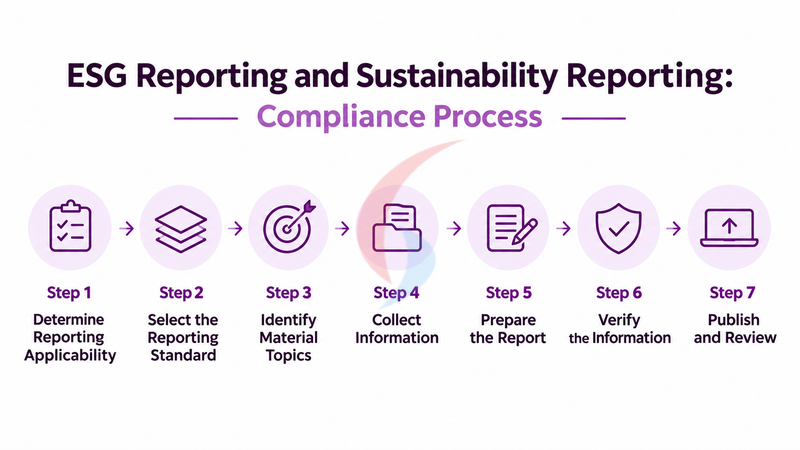
Step 1 – Determine Reporting Applicability: Check whether mandatory BRSR applies, whether BRSR Core assessment or assurance is required and whether additional sustainability reporting has been requested by investors or customers.
Step 2 – Select the Reporting Standard: Use the prescribed SEBI BRSR format where applicable. For additional reporting, consider GRI, ISSB or other suitable standards.
Step 3 – Identify Material Topics: Examine environmental, social and governance issues relevant to the selected standard and the company's operations. Materiality should be assessed using the criteria applicable to that reporting approach.
Step 4 – Collect Information: Obtain electricity bills, emissions calculations, water records, waste disposal documents, employee safety data, governance records and other relevant information.
Step 5 – Prepare the Report: Compile the disclosures using the required format, reporting boundaries, calculation methods and supporting explanations.
Step 6 – Verify the Information: Conduct internal reviews and obtain independent assessment or assurance where required.
Step 7 – Publish and Review: Submit mandatory disclosures within applicable timelines and publish voluntary reports according to the company's reporting commitments.
Companies should maintain consistency between financial statements, BRSR disclosures and sustainability reports, while clearly explaining any differences arising from reporting boundaries or methodologies.
ESG Reporting vs Sustainability Reporting: Due Dates in India
The reporting deadlines for ESG and Sustainability Reporting depend on the applicable SEBI regulations, statutory requirements and company reporting practices.
|
Reporting Type |
Applicable Companies |
Due Date / Timeline |
|---|---|---|
|
ESG Reporting (BRSR) |
Top 1,000 listed entities by market capitalisation, subject to applicable provisions. |
Annual report must be submitted to stock exchanges no later than the commencement of dispatch to shareholders under Regulation 34(1). |
|
BRSR Core Assessment or Assurance |
Specified listed entities under SEBI's phased applicability schedule. |
Completed in accordance with the applicable annual reporting and verification requirements. |
|
Voluntary Sustainability Reporting |
Companies voluntarily adopting sustainability reporting standards. |
As determined by the company, unless another legal or contractual deadline applies. |
|
Environmental Statement (Form V) |
Industries covered under Rule 14 of the Environment (Protection) Rules, 1986. |
Annually by September 30 for the financial year ending March 31. |
|
Companies covered under Section 135 of the Companies Act, 2013. |
As prescribed under applicable annual reporting and CSR filing requirements. |
Important Note: There is no universal September 30 deadline for BRSR Reporting. Mandatory BRSR disclosures follow the applicable SEBI annual report submission requirements, while voluntary sustainability reports may follow company-selected reporting schedules.
Legal Consequences of Incorrect ESG Reporting
There is no single penalty applicable to every ESG or sustainability reporting error in India.
For covered listed entities, non-compliance with prescribed BRSR requirements may lead to regulatory scrutiny or enforcement action under applicable SEBI provisions.
Misleading disclosures may also create legal or regulatory risks depending on their content, context and the applicable law.
Voluntary sustainability reporting does not generally create the same statutory filing obligations as mandatory BRSR. However, false or misleading statements may still have consequences under applicable securities, consumer protection, contractual or other laws.
Companies should therefore ensure that published sustainability claims can be supported by appropriate evidence.
How Compliance Calendar LLP Can Help with ESG and Sustainability Reporting
Understanding ESG Reporting and Sustainability Reporting can be challenging because businesses must consider SEBI regulations, reporting standards, environmental laws, governance requirements and investor expectations.
Compliance Calendar LLP provides professional support relating to ESG advisory, sustainability compliance and corporate regulatory requirements. Businesses can seek guidance in identifying reporting obligations, reviewing documentation, understanding BRSR applicability and organising relevant compliance processes.
For professional assistance with ESG Reporting and Sustainability Reporting in India, contact 9988424211 or email info@ccoffice.in
Frequently Asked Questions (FAQ’S)
Q1. What is the difference between ESG Reporting and Sustainability Reporting?
Ans. ESG Reporting focuses on environmental, social and governance information, often for investors and regulatory disclosures. Sustainability Reporting may place greater emphasis on an organisation's impacts on people, the environment and the economy. The approaches substantially overlap.
Q2. Is ESG Reporting mandatory in India?
Ans. Yes, SEBI's BRSR reporting is mandatory for the top 1,000 listed entities by market capitalization, subject to applicable provisions and transition requirements.
Q3. Is Sustainability Reporting mandatory for all Indian companies?
Ans. No. India does not prescribe one universal standalone sustainability report for every company. However, certain entities must make BRSR or other sustainability-related disclosures under applicable laws.
Q4. What is BRSR in ESG Reporting?
Ans. BRSR stands for Business Responsibility and Sustainability Report. It is the reporting format prescribed by SEBI for covered listed entities to disclose information aligned with the nine NGRBC principles.
Q5. What is BRSR Core?
Ans. BRSR Core is a subset of BRSR containing selected Key Performance Indicators under nine ESG attributes. It is subject to phased independent assessment or assurance requirements.
Q6. Can a company prepare both ESG and Sustainability Reports?
Ans. Yes. Companies may prepare both reports or combine relevant disclosures where permitted. They should ensure consistency and satisfy every applicable mandatory reporting requirement.
Q7. What are GRI Standards in Sustainability Reporting?
Ans. GRI Standards are international standards used to report an organisation's significant impacts on the economy, environment and people. They can support transparent sustainability reporting across different industries.
Q8. Are IFRS S1 and IFRS S2 mandatory in India?
Ans. They are not automatically mandatory for all Indian companies. Applicability depends on whether the relevant regulatory authority adopts or requires them, or whether the company chooses to use them voluntarily or contractually.
Q9. What is the ESG Reporting deadline in India?
Ans. For covered listed entities, BRSR forms part of the annual report and follows the applicable SEBI annual report submission requirements. Voluntary sustainability reports may follow company-selected publication schedules.
Q10. Which reporting approach is better for Indian companies?
Ans. The appropriate approach depends on the company's legal obligations and reporting objectives. Covered listed entities must satisfy BRSR requirements, while businesses seeking broader stakeholder disclosures may also use suitable sustainability reporting standards.
Article last updated on : 21 Nov 2026.













































































_learn_crop10_thumb.jpg)