


Who Is a Principal Officer in an Insurance Broking Company?
A Principal Officer is a designated senior executive responsible for carrying out the functions of an insurance broker and ensuring compliance with applicable regulatory obligations. The position combines managerial authority, professional supervision and accountability for the brokerage company's regulated activities.
Regulation 2(1)(n) of the IRDAI (Insurance Brokers) Regulations, 2018 defines the Principal Officer as an officer in an executive role. The person may be a Chief Executive Officer, whole-time director, Managing Director, Managing Partner, Managing Trustee or an individual appointed or engaged exclusively to perform insurance broking functions.
Companies applying for an Insurance Broker License must appoint an eligible Principal Officer. Similar leadership requirements exist under separate regulations for entities obtaining a Corporate Agency License or Insurance Web Aggregator License. Businesses intending to underwrite insurance policies require separate Insurance Company Registration, with different management and regulatory requirements.
Legal Provisions Governing Principal Officer Requirements
Principal Officer eligibility is primarily governed by the Insurance Act, 1938, the IRDAI Act, 1999 and the IRDAI (Insurance Brokers) Regulations, 2018, as amended.
| Legal provision | Requirement |
| Regulation 2(1)(n) | Definition of Principal Officer |
| Regulation 8(2)(f) | Qualification, training, examination and certification |
| Regulation 8(2)(g) | Suitability and professional experience |
| Regulation 8(2)(h) | Fit-and-proper assessment |
| Schedule I – Form E | Educational qualifications, training and examination |
| Schedule I – Form F | Personal, professional and employment particulars |
| Schedule I – Form G | Fit-and-proper declaration |
| Schedule I – Form H | Code of Conduct |
| Regulation 40 | Prior approval for change of Principal Officer |
| IRDAI Intermediaries Amendment Regulations, 2026 | Updated intermediary compliance requirements |
IRDAI assesses the proposed Principal Officer's qualifications and suitability while considering an insurance broker's registration application. The regulator also examines relevant experience, professional history and the applicant's arrangements for conducting insurance broking business. These requirements apply alongside the company's financial, operational and staffing obligations.
Educational Qualifications Required for a Principal Officer
Schedule I – Form E prescribes the educational and professional qualifications recognised for Principal Officers. A candidate does not necessarily need a specialised insurance degree, provided the person possesses another qualification recognised under the regulations. The qualifications include a bachelor's degree in arts, science, social sciences, commerce, engineering or law from a recognised institution. An MBA or equivalent recognised qualification may also satisfy the educational requirement.
Certain professional qualifications are expressly recognised, including specified qualifications from the Insurance Institute of India, Institute of Risk Management, Institute of Chartered Accountants of India, Institute of Company Secretaries of India, actuarial institutions and other recognised bodies.
| Qualification category | Examples |
| Bachelor's degree | Commerce, science, engineering, law, arts |
| Postgraduate qualification | MBA or equivalent recognised qualification |
| Insurance qualification | Associate or Fellow of the Insurance Institute of India |
| Risk management | Recognised risk management qualifications |
| Professional qualification | CA, CS, CMA or specified equivalent |
| Actuarial qualification | Recognised actuarial professional qualifications |
| Other qualifications | As recognised by IRDAI |
An eligible degree does not automatically authorise a person to work as a Principal Officer. The candidate must also complete the applicable training, examination and certification requirements.
To understand the requirements for other certified brokerage personnel, read our Qualified Persons in Insurance Broking
Principal Officer Training Requirements Under IRDAI
Professional training is an important eligibility condition because a Principal Officer must understand insurance products, regulatory requirements, risk assessment and professional conduct. Under Schedule I – Form E of the 2018 Regulations, the general initial training requirement is 50 hours of theoretical and practical training through an institution recognised by IRDAI.
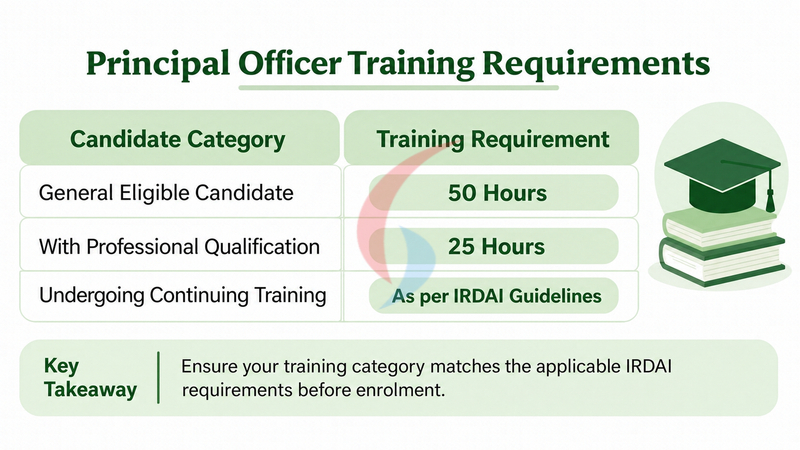
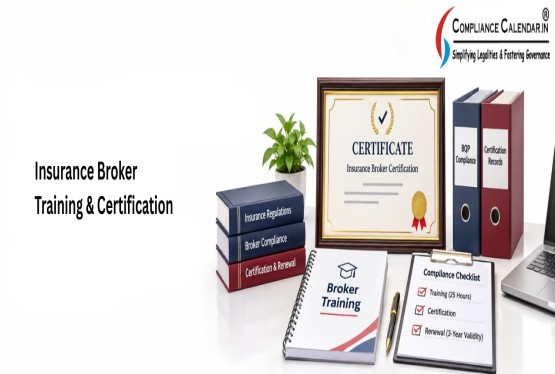
A reduced 25-hour training route is available for certain candidates possessing specified professional qualifications. These include eligible insurance, risk management, actuarial, chartered accountancy, company secretarial and other recognised professional qualifications.
| Candidate category | Initial training under the 2018 Regulations |
| General eligible candidate | 50 hours |
| Candidate qualifying for a professional exemption | 25 hours |
| Candidate undergoing continuing training | As prescribed under applicable current certification rules |
For example, a commerce graduate may follow the general training route, while a qualified Chartered Accountant meeting the specified conditions may be eligible for the reduced training programme. Candidates should confirm their applicable training category before enrolling. The regulatory requirements and recognised training arrangements should also be checked against current IRDAI instructions.
IRDAI Principal Officer Examination Requirements
After completing the required training, the candidate must pass the prescribed insurance brokers' examination conducted by the National Insurance Academy, Pune, or another examining body recognised by IRDAI. The examination assesses the candidate's understanding of insurance principles, insurance broking operations, risk management, regulatory responsibilities and professional standards.
The Principal Officer should be capable of understanding insurance business beyond individual product sales. For example, a person supervising a commercial insurance brokerage must understand the importance of suitable coverage, exclusions, client mandates and regulatory disclosures. The recognised examination body determines the applicable examination arrangements, schedule, fees and other administrative requirements. Candidates should confirm these details before applying.
Fit and Proper Criteria for Insurance Broker Principal Officers
Educational qualifications and examination results are not the only conditions for appointment. IRDAI also considers whether the proposed Principal Officer is fit and proper to carry out the responsibilities of a regulated insurance intermediary. Schedule I – Form G contains the relevant declaration and undertaking. The assessment examines professional conduct, integrity, regulatory history and other circumstances affecting the person's suitability.
For example, a candidate with extensive experience may still face regulatory scrutiny if there are serious unresolved issues involving professional misconduct, dishonesty or relevant regulatory action. The applicant must provide truthful and complete information. Incorrect declarations or concealment of material facts may affect the approval process and create subsequent compliance problems.
To understand the wider responsibilities of regulated intermediaries, explore IRDAI Compliance Requirements for Insurance Intermediaries
Duties and Responsibilities of a Principal Officer
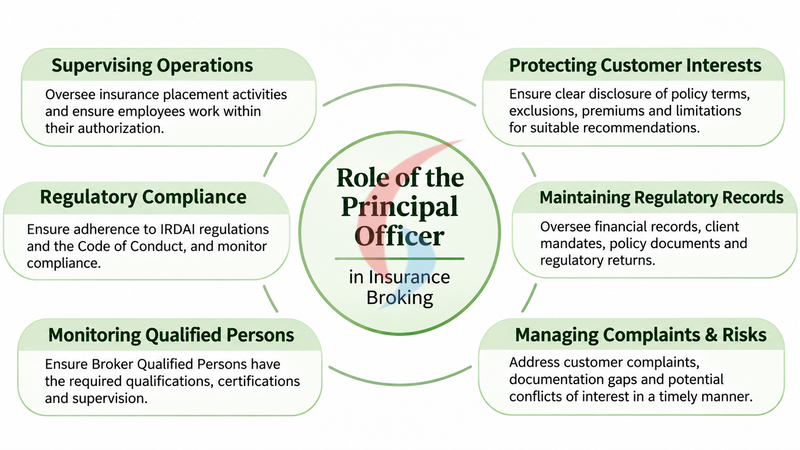
The Principal Officer plays a central role in supervising insurance broking operations. Although certain activities may be assigned to qualified employees, the company must maintain effective oversight of its regulated business.
-
Supervising Insurance Broking Operations
The Principal Officer oversees the company's insurance placement activities and ensures that employees perform their duties within their authorization. This includes monitoring how customers are approached, how insurance requirements are assessed and how suitable policies are recommended.
-
Ensuring IRDAI Regulatory Compliance
The Principal Officer helps ensure that the brokerage follows applicable IRDAI regulations and the prescribed Code of Conduct. Regulatory correspondence, compliance monitoring and escalation of material issues are important parts of the role.
-
Monitoring Broker Qualified Persons
Broker Qualified Persons must possess the prescribed qualifications and certifications before undertaking regulated activities. The Principal Officer should ensure that the company maintains appropriate staffing, professional supervision and relevant certification records.
-
Protecting Customer Interests
The brokerage should explain material policy terms, coverage exclusions, premiums and relevant limitations accurately. The Principal Officer helps maintain professional standards so that customer recommendations are not improperly influenced by commercial incentives.
-
Maintaining Regulatory Records
Insurance brokers must maintain financial records, client mandates, policy documentation and applicable regulatory returns. The Principal Officer should oversee procedures ensuring that documents are accurately maintained and available when required.
-
Managing Complaints and Operational Risks
Customer complaints, documentation deficiencies and potential conflicts of interest require appropriate attention. The Principal Officer should ensure that significant matters are examined and escalated through the company's internal compliance arrangements.
Step-by-Step Process to Appoint a Principal Officer
Insurance broking companies should assess the proposed candidate's eligibility before submitting appointment particulars to IRDAI. The following process explains the major steps.
Step 1: Identify an Eligible Candidate
Select a person who meets the executive-role requirements under Regulation 2(1)(n). Review their educational background, relevant experience and ability to supervise the brokerage business. Confirm that the proposed role is compatible with applicable IRDAI restrictions.
Step 2: Verify Qualifications and Training
Examine the candidate's educational and professional certificates. Determine whether the 50-hour or eligible 25-hour initial training route applies. Ensure the candidate has completed the required training through a recognised institution.
Step 3: Complete the Examination and Certification
Confirm that the candidate has passed the prescribed insurance brokers' examination. Obtain the necessary certificate from the recognised examining body. Verify its validity and sponsoring-broker details.
Step 4: Prepare Appointment Documents
Prepare the corporate resolution and proposed appointment details. Complete the applicable Form F particulars and Form G fit-and-proper declaration. Collect the supporting qualification, training, experience and identification documents.
Step 5: Obtain Regulatory Approval
For a replacement Principal Officer, Regulation 40(3) of the 2018 Regulations requires prior IRDAI approval. Submit the application through the prescribed procedure with supporting documents. Respond to regulatory queries and implement the appointment in accordance with the applicable approval requirements.
Step 6: Complete Internal Compliance
Update the company's personnel records and regulatory information. Communicate the approved responsibilities to relevant employees and insurers. Establish a clear reporting structure for ongoing compliance supervision. The 2018 Regulations expressly require prior approval for a change of Principal Officer; applicants should also verify the applicable procedure under subsequent amendments and IRDAI directions.
To understand the process for reporting governance and personnel changes, refer to IRDAI Changes in Insurance Broking Companies
Documents Required for Principal Officer Appointment
| Document | Purpose |
| Educational qualification certificates | Establish academic eligibility |
| Professional qualification certificates | Support recognised professional eligibility |
| Training completion certificate | Demonstrate completion of prescribed training |
| Examination pass certificate | Establish professional examination compliance |
| Principal Officer certification | Demonstrates applicable certification |
| Resume and experience records | Supports evaluation of professional suitability |
| PAN and acceptable identity documents | Verify candidate identity |
| Schedule I – Form F | Provides prescribed personal and professional particulars |
| Schedule I – Form G | Fit-and-proper declaration |
| Board resolution or appointment document | Records proposed corporate appointment |
| Previous employer's NOC | Where applicable to a change of sponsoring broker |
The actual documentation may vary depending on whether the business is applying for its first insurance broker registration or replacing an existing Principal Officer.
Principal Officer vs Broker Qualified Person
A common mistake is assuming that a Principal Officer and a Broker Qualified Person perform exactly the same role. Although both must satisfy applicable professional requirements, their responsibilities are different.
| Principal Officer | Broker Qualified Person |
| Holds a designated executive role | Performs authorised insurance solicitation and procurement |
| Supervises broader brokerage operations | Handles assigned client-facing insurance activities |
| Oversees regulatory compliance | Follows applicable professional conduct requirements |
| Requires prescribed training and certification | Requires applicable BQP training and certification |
| Subject to specific appointment approval requirements | Subject to applicable qualification and personnel requirements |
A qualified BQP should not automatically be treated as an eligible Principal Officer without independently checking the requirements for the senior role.
To understand how different insurance distribution models operate, read Insurance Broker vs Corporate Agent
What Happens When a Principal Officer Resigns?
The resignation of a Principal Officer can create compliance difficulties if the brokerage has not identified a qualified replacement. Consider Rajesh's company again. Its existing Principal Officer has served notice, but the proposed replacement has not yet completed the required examination. Appointing that employee immediately may create a regulatory problem rather than resolve the staffing gap.
Rajesh should examine the applicable approval procedure, identify a suitable candidate and communicate with IRDAI as required. The company should not assume that a temporary internal designation automatically satisfies the regulations. Having a succession plan is therefore important. Insurance brokers can reduce operational disruption by regularly reviewing the availability of appropriately qualified senior personnel.
Principal Officer Certification Validity and Renewal Training
Schedule I – Form E of the 2018 Regulations provided for a three-year validity period for Principal Officer and BQP certificates. It also addressed continuing training and changes in sponsoring insurance brokers. Where a certified Principal Officer moves from one insurance brokerage company to another, the 2018 provisions prescribe a process involving the proposed sponsoring broker and a no-objection certificate from the existing employer.
The July 2026 intermediary amendments changed aspects of insurance intermediary registration and ongoing compliance. Therefore, the historical three-year individual certification requirements should be distinguished from the revised continuing-validity arrangements applicable to broker registrations. Companies should verify current certification, continuing-training and sponsorship instructions before initiating a new appointment or employee transfer.
Latest IRDAI Updates Affecting Principal Officers
On 30 July 2026, IRDAI notified the Insurance Intermediaries (Amendment) Regulations, 2026. These amendments introduced changes relating to intermediary registration, governance, disclosures and accountability.
One notable development involves digital insurance solicitation. Where an insurance policy is solicited directly through an insurance broker's digital platform without the involvement of a BQP or another specified authorised salesperson, the amended provisions require the Principal Officer's telephone number and email address to appear on the relevant proposal form, policy document and certificate of insurance.
This creates an additional operational consideration for brokerage businesses offering digital customer journeys. Principal Officers should ensure that relevant digital documentation and customer contact arrangements satisfy the applicable requirements. The amendment also provides for strengthened identification of personnel associated with insurance solicitation, including changes scheduled to operate from January 2027.
Case Study: How Rajesh Managed a Principal Officer Transition
Returning to Akansha’s Faridabad insurance brokerage, the existing Principal Officer has announced her resignation. Instead of assigning the position to an unqualified senior executive, Akansha reviews the company's personnel records.
He identifies an employee with substantial insurance experience who has already completed the prescribed training and examination. The compliance team verifies the employee's qualifications and certification, prepares the relevant declarations and reviews the requirements for prior IRDAI approval.
The company submits the proposed replacement for regulatory consideration and addresses the necessary documentation. It also prepares a handover of regulatory correspondence, client complaints, reporting responsibilities and internal compliance records.
After completing the applicable approval and appointment formalities, the new Principal Officer assumes the designated responsibilities. Rajesh subsequently introduces an internal succession policy to ensure that the company is better prepared for future leadership changes.
This fictional example demonstrates that the Principal Officer's role is not simply a designation. It is an important component of the governance and regulatory accountability of an insurance brokerage company.
Common Mistakes During Principal Officer Appointment
Insurance brokerage businesses sometimes select a senior employee based solely on management experience without verifying the prescribed qualifications, training and examination requirements. Another mistake is treating the appointment as an ordinary human resources decision and overlooking the need for prior approval when changing the Principal Officer. Incomplete fit-and-proper declarations and missing certification documents may also delay the process.
Businesses may additionally fail to monitor certificate validity, sponsorship details or changes in professional responsibilities. Regular personnel reviews, accurate documentation and a clear succession plan can help avoid these compliance problems.
Why Choose Compliance Calendar LLP?
Appointing a Principal Officer involves educational eligibility, regulatory certification, fit-and-proper declarations and IRDAI approval requirements. These conditions must be understood alongside the company's wider registration and compliance obligations.
Compliance Calendar LLP assists businesses in understanding insurance broker registration and related regulatory documentation. Our team can guide applicants in reviewing eligibility requirements, preparing supporting records and identifying relevant IRDAI procedures.
For professional assistance with insurance broker registration and compliance requirements, contact Compliance Calendar LLP at +91 9988424211 or info@ccoffice.in
Frequently Asked Questions (FAQs)
Q1 Is a Principal Officer mandatory for insurance brokers?
Ans. Yes, an insurance broker must have a designated Principal Officer satisfying IRDAI requirements. The person is responsible for specified management and regulatory functions. The appointment must comply with the applicable Insurance Brokers Regulations.
Q2 What qualification is required for an insurance broker Principal Officer?
Ans. A recognised bachelor's degree or another qualification prescribed under Schedule I – Form E is required. Eligible professional qualifications include specified CA, CS and insurance qualifications. The person must also meet training, examination and suitability requirements.
Q3 How many hours of training are required for a Principal Officer?
Ans. The general initial training requirement under the 2018 Regulations is 50 hours. Certain qualified professionals may be eligible for a reduced 25-hour programme. Current training arrangements should be verified with the recognised institution.
Q4 Who conducts the Principal Officer examination?
Ans. The prescribed examination is conducted by the National Insurance Academy, Pune, or another IRDAI-recognised body. Candidates must complete the applicable training before qualifying through the examination process. The current schedule and fees should be confirmed with the examining institution.
Q5 Is IRDAI approval required to change the Principal Officer?
Ans. Regulation 40(3) of the 2018 Regulations requires prior IRDAI approval for a change of Principal Officer. The broker must submit the relevant candidate details and supporting documents. The latest applicable approval procedure should be followed.
Q6 Can a Chartered Accountant become a Principal Officer?
Ans. Yes, an appropriately qualified Chartered Accountant may meet the prescribed educational eligibility. The candidate must also satisfy the applicable training, examination and certification requirements. Professional qualifications alone do not automatically authorise the appointment.
Q7 Can a Broker Qualified Person become a Principal Officer?
Ans. Yes, provided the person independently satisfies the requirements for the Principal Officer role. Relevant training, certification, experience and fit-and-proper conditions must be examined. The company must also complete the applicable approval formalities.
Q8 What happens if a Principal Officer leaves the company?
The broker should identify a suitably qualified replacement and follow the prescribed IRDAI procedure. The company must address any resulting regulatory and operational compliance risks. A succession plan can help minimize disruption.
Q9 Can a Principal Officer work for more than one insurance broking company?
Ans. A Principal Officer must comply with IRDAI requirements concerning professional responsibilities, exclusivity and conflicts of interest. The individual is expected to supervise the insurance broking company's operations. Any additional employment or professional engagement must comply with applicable regulatory conditions.
Q10 What is the validity of a Principal Officer's certification?
Ans. Under the IRDAI (Insurance Brokers) Regulations, 2018, Principal Officer certification was generally valid for three years. Continuing training and renewal requirements apply as prescribed. Brokers should verify the latest IRDAI instructions before renewing or updating certification.
Article last updated on : 21 Nov 2026.














































_learn_crop10_thumb.jpg)