


What Is Surrender of Insurance Broker Registration?
Surrender of insurance broker registration is the formal process through which a registered insurance broker voluntarily requests IRDAI to accept the surrender of its Certificate of Registration. The procedure applies when a business decides to discontinue insurance broking operations for commercial, financial, organisational or other reasons. Under Regulation 57 of the IRDAI (Insurance Brokers) Regulations, 2018, a broker may submit a voluntary surrender application. IRDAI considers the application on its merits and may pass an order accepting the surrender. This means surrender is not automatic merely because the company submits a request or stops procuring insurance policies. The broker must also address existing customer obligations and satisfy the documentation requirements prescribed under Schedule III – Form AA.
Companies operating under an Insurance Broker License must comply with broker-specific surrender requirements. Other intermediaries, including businesses holding a Corporate Agency License or Insurance Web Aggregator License, are governed by their respective regulations. Similarly, insurers operating under Insurance Company Registration follow a different regulatory process for discontinuing insurance operations.
To understand the licensing process and eligibility conditions before an insurance broker begins operations, read our detailed guide on Insurance Broker Registration in India. It explains the registration procedure and initial regulatory obligations.
Legal Provisions for Surrender of Insurance Broker License
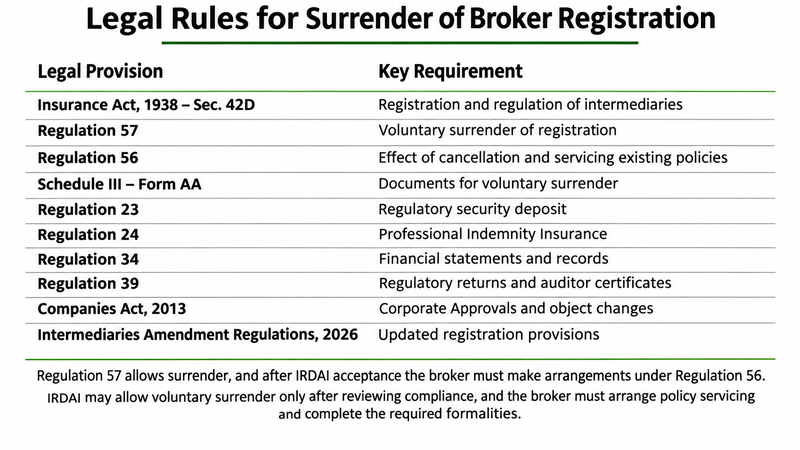
The surrender procedure is primarily governed by the Insurance Act, 1938 and the IRDAI (Insurance Brokers) Regulations, 2018, as amended.
When Can an Insurance Broker Apply for Voluntary Surrender?
An insurance broker may consider voluntary surrender when continuing its regulated operations is no longer commercially or operationally practical. Common reasons include persistent financial losses, a decision to discontinue insurance distribution, changes in business strategy, restructuring of group businesses or the departure of key promoters. For example, Rajesh may choose to surrender his registration because his company no longer generates enough insurance business to support its regulatory and operating expenses.
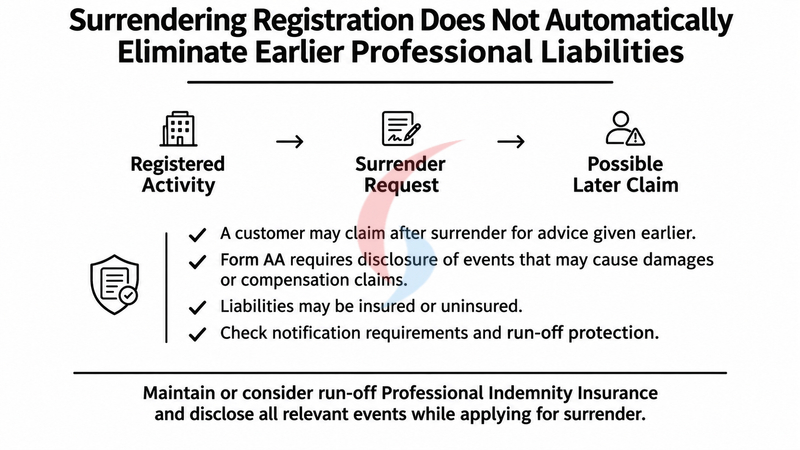
However, outstanding customer policies, complaints and potential professional liabilities remain relevant. These matters must be disclosed or appropriately addressed as required under the regulations and IRDAI's directions. A financially inactive brokerage should therefore not assume that it can avoid compliance obligations simply by discontinuing new business.
Documents Required for Surrender of Insurance Broker Registration
Schedule III – Form AA provides the principal documentary requirements for voluntary surrender.
| Required document or information | Purpose |
|---|---|
| Proof of annual fee payments | Confirms fees for preceding financial years have been paid |
| Certified Board Resolution | Records the reasons for surrender |
| Principal Officer confirmation | Confirms that no fresh business will be placed after the surrender request |
| Original Registration Certificate | Submission of the existing certificate or licence |
| Directors' undertaking | Confirms arrangements for servicing existing policyholders |
| ROC compliance evidence | Demonstrates steps to amend company objects or deregister the company |
| Claims and premium statistics | Provides prescribed data for the preceding three financial years |
| Professional liability information | Discloses events that may create compensation liabilities |
| Additional information | Any further details required by IRDAI |
The liability disclosure is especially important. Form AA requires details of events that may result in damages or compensation claims against the broker, regardless of whether they are covered by Professional Indemnity Insurance. The disclosure includes the incident date, affected customer, nature of the claim, estimated liability, amount provided in the company's accounts and current status.
Accurate financial statements and historical policy records help support the surrender documentation submitted to IRDAI. Read our Insurance Broker Audit and Record-Keeping Requirements article for record-maintenance obligations.
Step-by-Step Process for Surrender of Insurance Broker Registration
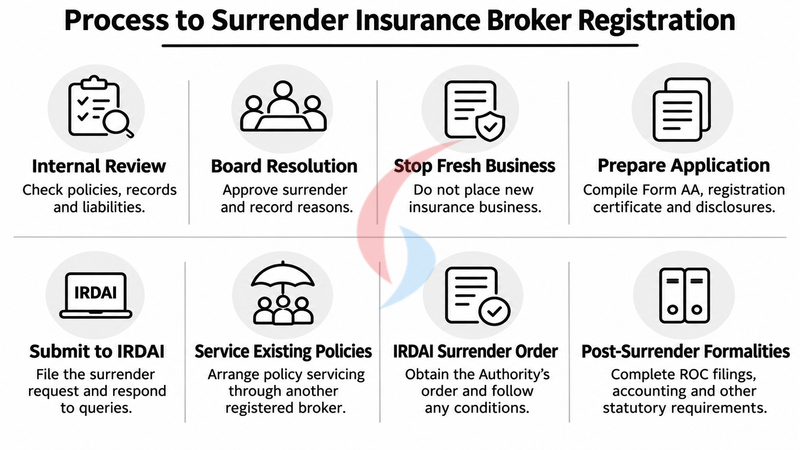
Step 1: Conduct an Internal Compliance Review
Before submitting the surrender application, the company should examine its existing policies, customer complaints, financial records and regulatory obligations. The review should identify unpaid fees, unresolved liabilities and insurance policies requiring continued servicing.
Step 2: Pass a Board Resolution
The company's Board of Directors should approve the proposed surrender and record the reasons for discontinuing insurance broking operations. A certified copy of the resolution must be prepared for submission to IRDAI under Schedule III – Form AA.
Step 3: Stop Placing Fresh Insurance Business
Form AA requires confirmation from the Principal Officer that the brokerage will not place fresh business from the date of its surrender request. The company should therefore establish internal controls to prevent new policy solicitation or placement contrary to this undertaking.
Step 4: Prepare the Surrender Application
The broker should compile the prescribed Form AA documents, original registration certificate, business statistics and liability disclosures. All information should be accurate and supported by the company's financial and operational records.
Step 5: Submit the Application to IRDAI
The surrender request must be submitted through the procedure prescribed by IRDAI. The Authority may seek clarification or additional information before deciding whether to accept the application.
Step 6: Arrange Servicing of Existing Policies
The broker must make appropriate arrangements for existing insurance contracts in accordance with Regulation 56. This includes identifying another registered insurance broker that can take over relevant policy-servicing responsibilities.
Step 7: Obtain IRDAI's Surrender Order
IRDAI considers the request on its merits and may issue an order accepting the surrender. The company should preserve the order and comply with any conditions or directions specified by the Authority.
Step 8: Complete Post-Surrender Formalities
After acceptance, the company should address applicable ROC filings, accounting matters, pending liabilities and other statutory requirements. The business should also maintain records necessary for responding to future claims, enquiries or regulatory proceedings.
For information about regulatory applications, changes in company details and voluntary surrender filings, explore IRDAI Changes in Insurance Broking Companies. The article also discusses the IRDAI BAP Portal procedure.
What Happens to Existing Insurance Policies After Surrender?
One of the most important considerations is protecting customers who purchased insurance through the surrendering broker. Under Regulation 56, read with Regulation 57(3), a broker whose registration has been surrendered must address the servicing of existing contracts. The published provisions provide for a six-month servicing period during which suitable arrangements must be made for another registered insurance broker to attend to the existing contracts.
For example, if Rajesh's company has arranged commercial insurance policies that remain active, those customers should not be abandoned merely because his brokerage has decided to close. The policyholder's insurance contract is with the insurer. Surrender of the broker's registration does not, by itself, mean that the customer's underlying insurance policy is cancelled.
Treatment of Security Deposit After Surrender
Insurance brokers maintain prescribed security deposits under Regulation 23. These deposits form part of the financial safeguards imposed on registered intermediaries. When a broker applies for surrender, it should examine the process for releasing the regulatory deposit and removing the applicable bank lien. The deposit should not be withdrawn automatically merely because the surrender application has been filed. The broker must obtain the relevant regulatory permission and satisfy applicable conditions. IRDAI may consider outstanding liabilities, regulatory obligations and other relevant circumstances before permitting the release of funds.
Before requesting the release of a regulatory deposit, brokers should understand the financial safeguards prescribed by IRDAI. Our Insurance Broker Net Worth and Security Deposit Rules guide explains these requirements.
Storytelling: When an Insurance Broker Decided to Close His Business
Rajesh established an insurance broking company in Delhi with the intention of helping businesses find suitable insurance coverage. His company obtained the required IRDAI registration, hired qualified employees and began serving manufacturing companies, startups and commercial establishments.
For several years, the business operated successfully. However, rising operational expenses, increasing competition and changes in Rajesh's business plans made it difficult to continue. He eventually decided to discontinue insurance broking activities and focus on another business opportunity.
Rajesh initially believed that closing his office and informing insurance companies would be sufficient. However, his compliance advisor explained that an IRDAI-registered broker cannot simply stop operating and treat its registration as surrendered.
The company needed to submit a formal surrender application, provide prescribed documents, address pending liabilities and make arrangements for customers whose insurance policies remained active.
This situation explains why understanding the Surrender of Insurance Broker Registration with IRDAI is important for businesses planning to exit the insurance distribution sector.
Professional Indemnity Insurance and Pending Claims
Professional Indemnity Insurance is particularly important during the surrender process because liabilities may arise from advice or services provided before the brokerage discontinued its activities. For instance, a customer may allege that Rajesh's company failed to explain an important policy exclusion. Even if the complaint arises after the surrender request, the underlying professional activity may have occurred while the company was registered.
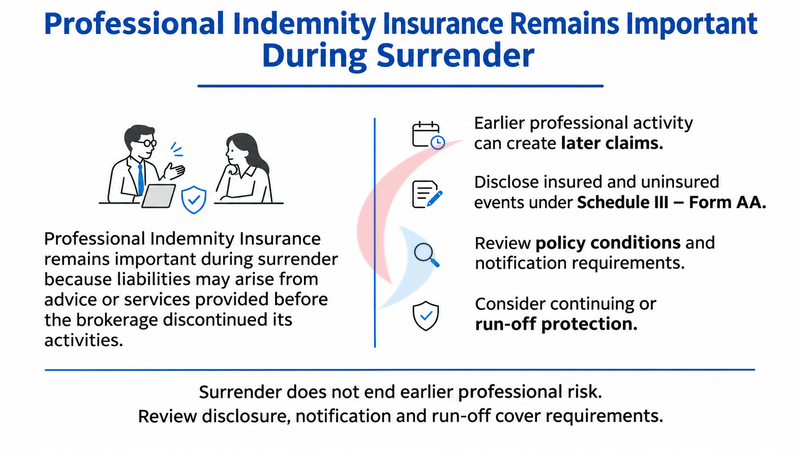
Schedule III – Form AA requires disclosure of events that could give rise to damages or compensation claims, whether insured or uninsured. A broker should review policy conditions, notification requirements and the need for continuing or run-off protection with its insurer. Surrendering registration does not automatically eliminate earlier professional liabilities.
Professional liabilities may continue even after a broker decides to discontinue operations. Explore Professional Indemnity Insurance for Insurance Brokers to understand coverage requirements and relevant compliance considerations.
ROC and Companies Act Compliance After Surrender
The surrender of IRDAI registration and closure of the company are separate legal matters. Schedule III – Form AA requires brokers to notify the Registrar of Companies and comply with requirements for deleting insurance broking objects from the Memorandum or Articles of Association, or provide evidence of steps taken to deregister the company. The appropriate procedure depends on whether the company intends to continue another permitted business or proceed towards closure. The company should not continue regulated insurance broking activities after the surrender becomes effective.
Common Mistakes During Insurance Broker Registration Surrender
Insurance brokers sometimes assume that their registration will automatically terminate when they stop generating new insurance business. Others submit a surrender request without settling annual fees or preparing the required Board Resolution. Another common mistake is overlooking existing policyholders. Failure to arrange appropriate servicing may create difficulties for customers and lead to regulatory concerns. Businesses may also attempt to withdraw security deposits prematurely, overlook potential professional liabilities or confuse registration surrender with company closure. Proper planning, accurate documentation and timely communication can help avoid these problems.
Why Choose Compliance Calendar LLP?
The surrender of an insurance broker registration involves regulatory documentation, Board approvals, existing policyholder arrangements, financial records and applicable corporate compliance.
Compliance Calendar LLP assists businesses in understanding IRDAI registration and compliance requirements, preparing relevant documentation and identifying the procedures applicable to regulated insurance intermediaries.
For professional assistance with insurance broker registration and related compliance matters, contact Compliance Calendar LLP at +91 9988424211 or info@ccoffice.in
Frequently Asked Questions (FAQs)
Q1. Can an insurance broker voluntarily surrender its IRDAI registration?
Ans. Yes, Regulation 57 permits registered insurance brokers to apply for voluntary surrender. IRDAI considers the application on its merits and may issue an acceptance order. Submission of an application does not automatically terminate registration.
Q2. Which regulation governs surrender of an insurance broker license?
Ans. Regulation 57 of the IRDAI (Insurance Brokers) Regulations, 2018 governs voluntary surrender. Schedule III – Form AA specifies the relevant documentation. Regulation 56 addresses arrangements for servicing existing contracts.
Q3. Is a Board Resolution mandatory for voluntary surrender?
Ans. Yes, Schedule III – Form AA requires a certified Board Resolution recording the reasons for surrender. The resolution should formally approve the proposed discontinuation of insurance broking activities. It must be included with the relevant application documents.
Q4. Can an insurance broker continue accepting new business after applying for surrender?
Ans. Form AA requires confirmation from the Principal Officer that no fresh business will be placed from the date of the surrender request. The broker must follow this undertaking. Existing policy-servicing responsibilities are addressed separately.
Q5. What happens to existing policies after surrender?
Ans. Existing insurance policies do not automatically terminate because the broker surrenders its registration. The broker must make appropriate servicing arrangements under Regulation 56. Another registered broker may take over relevant servicing responsibilities.
Q6. How long can a broker service existing contracts after surrender?
Ans. The published Regulation 56 provides a six-month period for servicing existing contracts and arranging their transfer. The surrendering broker must comply with the applicable regulatory directions. Customers should receive appropriate continuity of service.
Q7. Is the security deposit automatically refunded after surrender?
Ans. No, surrender does not automatically release the broker's regulatory security deposit. The applicable IRDAI permission and banking formalities must be completed. Outstanding regulatory or financial obligations may be relevant to the process.
Q8. Can an insurance broker close its company after surrender?
Ans. Yes, subject to applicable Companies Act procedures and other legal obligations. IRDAI registration surrender and corporate closure are different processes. The company must address pending liabilities and statutory requirements.
Q9. What is Schedule III – Form AA?
Ans. Form AA contains the prescribed documentation requirements for voluntary surrender. It covers fee payments, Board approval, the Principal Officer's confirmation, existing clients and potential liabilities. The broker must also provide further information requested by IRDAI.
Q10. Can a broker apply for registration again after surrender?
Ans. A fresh application may be possible subject to the applicable waiting-period and eligibility provisions. The original 2018 Regulation 10(5) provides a one-year restriction in specified circumstances. Applicants should verify the amended provisions and IRDAI's current requirements before reapplying.
Article last updated on : 21 Nov 2026.













































































_learn_crop10_thumb.jpg)