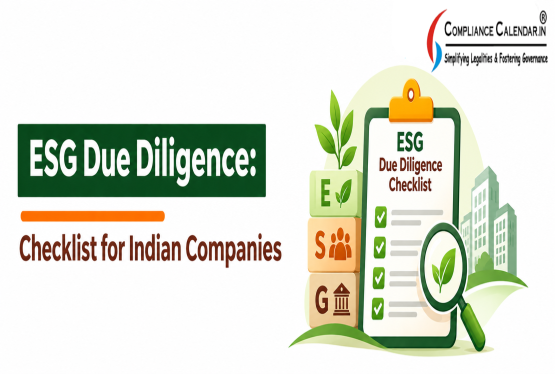



Imagine a manufacturing company in India preparing to raise Rs 100 crore from investors. Its financial statements show steady profits, and the management expects the investment process to go smoothly. However, during due diligence, investors ask questions that have little to do with revenue. Does the company have valid pollution control permissions? How are industrial waste and employee safety managed? Are related-party transactions properly disclosed? Can the company provide reliable information about its carbon emissions?
The management soon realises that financial performance alone is not enough to demonstrate responsible business practices. This is where ESG Regulations for Companies in India become important. Environmental, Social and Governance (ESG) compliance examines how companies manage environmental risks, treat employees and stakeholders, and maintain ethical business practices.
India does not have a single ESG Act applicable to every company. Instead, ESG obligations arise from SEBI regulations, the Companies Act, 2013, environmental legislation, labour laws and other sector-specific requirements. In 2026, these obligations are especially relevant because of developments in BRSR Core verification, labour law implementation, sustainability disclosures and personal data protection.
What Are ESG Regulations in India?
ESG Regulations in India refer to the laws, regulatory requirements and reporting obligations governing a company's environmental responsibilities, social practices and corporate governance. These requirements help ensure that businesses operate responsibly while meeting applicable statutory obligations.
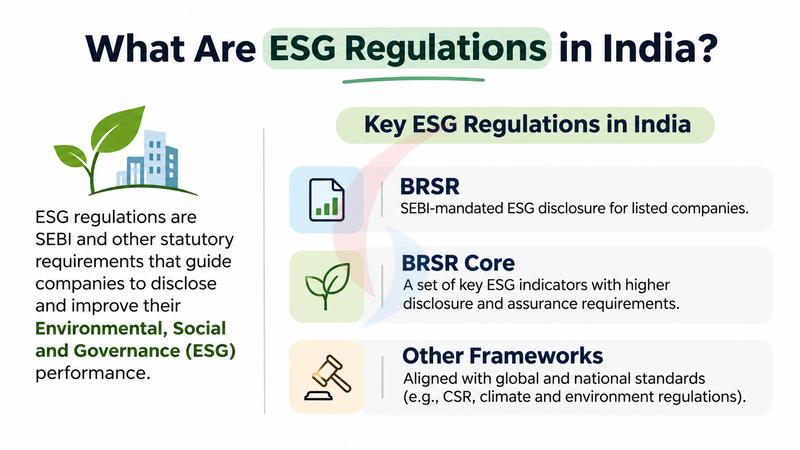
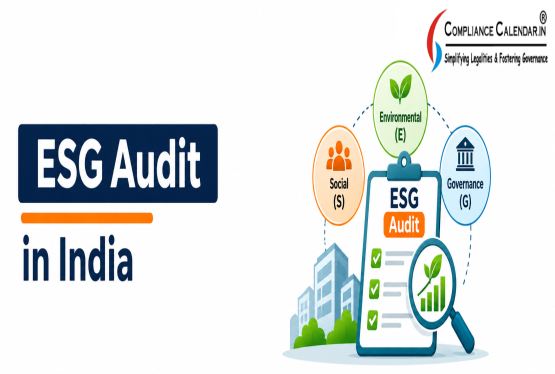
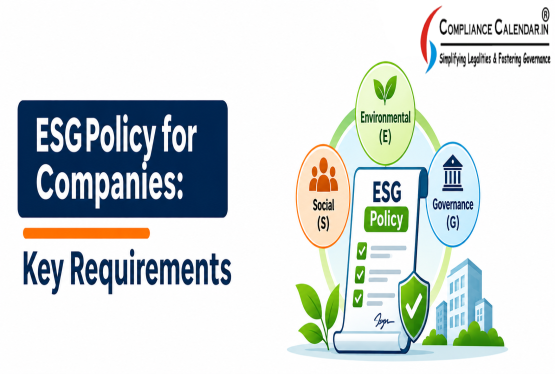
The environmental component covers pollution control, energy consumption, water management, waste disposal and resource conservation. Social responsibilities include employee welfare, workplace safety, wages, human rights and customer protection. Governance concerns board accountability, ethical conduct, transparency, statutory disclosures and responsible decision-making.
For example, a chemical manufacturer may need pollution control permissions and hazardous waste authorisations, while a listed technology company may have mandatory sustainability reporting obligations under SEBI regulations. Both businesses must comply with the corporate and employment laws applicable to their operations.
Businesses looking for a broader understanding can read ESG Compliance in India: Laws, Rules and Requirements.
Are ESG Regulations Mandatory for All Companies in India?
Not every Indian company has the same ESG obligations. Applicability depends on factors such as listing status, market capitalisation, industry, turnover, workforce size and business activities.
Under Regulation 34(2)(f) of the SEBI (Listing Obligations and Disclosure Requirements) Regulations, 2015, the top 1,000 listed entities by market capitalisation are required to prepare a Business Responsibility and Sustainability Report (BRSR), subject to the applicable provisions.
However, private limited companies, unlisted public companies, MSMEs and startups are not automatically required to file SEBI BRSR. They must still comply with environmental, labour, company law and other requirements relevant to their business activities.
ESG Regulations Applicability Table
|
Company Category |
Main ESG Requirements |
|
Top 1,000 listed entities |
Mandatory BRSR reporting under SEBI LODR, subject to applicable provisions |
|
Other listed companies |
Applicable SEBI governance requirements; BRSR generally voluntary |
|
Unlisted public companies |
Applicable company law, CSR, environmental and labour obligations |
|
Private limited companies |
Applicable environmental, social and corporate governance laws |
|
MSMEs and startups |
Applicable operational laws and possible investor or customer ESG requirements |
For example, a small packaging manufacturer may not need to prepare BRSR. However, if its operations generate regulated plastic waste or require pollution control permissions, those obligations remain legally enforceable.
Major ESG Laws and Regulations Applicable in India
Indian ESG compliance is governed by multiple laws rather than one comprehensive statute. Companies must determine which regulations apply to their operations and reporting obligations.
|
Law or Regulation |
Relevant Provisions |
ESG Compliance Requirement |
|
Regulation 34(2)(f) |
Mandatory BRSR for covered listed entities |
|
|
Sections 134, 135, 166 and 177 |
Board disclosures, CSR, directors' duties and governance |
|
|
Sections 3, 5 and applicable rules |
Environmental standards, directions and pollution-related compliance |
|
|
Applicable consent provisions |
Water and air pollution permissions and compliance |
|
|
Applicable EPR and waste rules |
Waste handling, recycling, registration and producer responsibilities |
|
|
Applicable provisions and rules |
Wages, industrial relations, social security and workplace safety |
|
|
Provisions according to phased commencement |
Personal data protection and governance obligations |
|
|
Chapter IVA and applicable provisions |
Regulation of ESG Rating Providers |
Each regulation serves a different purpose. Companies should not assume that completing ESG reporting replaces the need to obtain environmental permissions, comply with employment laws or fulfil corporate governance obligations.
SEBI ESG Regulations and BRSR Reporting Requirements
SEBI regulates sustainability reporting for specified listed entities under Regulation 34(2)(f) of the SEBI LODR Regulations, 2015.
|
Particulars |
BRSR Requirements |
|---|---|
|
Regulatory Authority |
SEBI |
|
Legal Provision |
Regulation 34(2)(f), SEBI LODR Regulations |
|
Applicability |
Top 1,000 listed entities by market capitalisation |
|
Mandatory From |
FY 2022–23 |
|
Reporting Principles |
Nine NGRBC principles |
|
Section A |
Company and business information |
|
Section B |
ESG policies and governance practices |
|
Section C |
Environmental, social and governance performance |
Example: A listed automobile company reports energy consumption, water usage, emissions and employee safety details.
For more information, read BRSR Reporting: Applicability, Format and Due Dates.
BRSR Core Requirements Under SEBI Regulations
BRSR Core is a selected set of sustainability Key Performance Indicators (KPIs) introduced through SEBI's July 12, 2023 circular. It covers nine ESG attributes, including greenhouse gas emissions, water consumption, energy footprint, waste management, employee wellbeing, gender diversity, inclusive development, fairness in customer and supplier dealings, and business transparency.
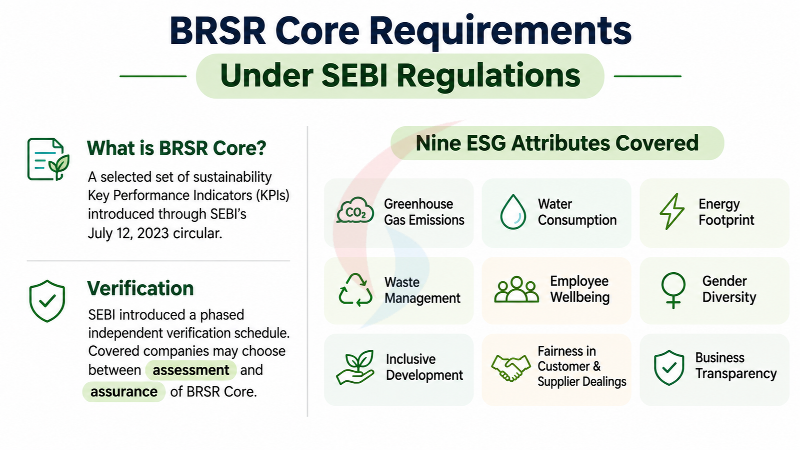
SEBI introduced a phased independent verification schedule for these disclosures. Under the amended provisions, covered companies may choose between assessment and assurance of BRSR Core.
BRSR Core Applicability Timeline
|
Financial Year |
Listed Entities Covered |
|
FY 2023–24 |
Top 150 |
|
FY 2024–25 |
Top 250 |
|
FY 2025–26 |
Top 500 |
|
FY 2026–27 |
Top 1,000 |
For FY 2026–27, the phased requirement extends to the top 1,000 listed entities, subject to the applicable market capitalisation and transition provisions.
The verification provider must possess relevant expertise and satisfy independence and conflict-of-interest requirements.
For a detailed explanation of the indicators, read BRSR Core: Requirements and Key Indicators.
Environmental Regulations for Companies in India
Environmental compliance is an important part of ESG responsibilities, particularly for manufacturing, construction, chemical, packaging and waste management businesses.
|
Environmental Law / Regulation |
Key Compliance Requirements |
Applicability |
|---|---|---|
|
Environmental standards, pollution prevention and compliance with applicable regulations. |
Industries with environmental impacts |
|
|
Consent to Establish (CTE), Consent to Operate (CTO), where applicable, and wastewater management. |
Industries generating regulated wastewater |
|
|
Applicable pollution control consents and emission standards. |
Industries causing air pollution |
|
|
EPR registration, plastic waste management and applicable recycling obligations. |
Plastic packaging producers, importers and brand owners |
|
|
EPR registration, recycling targets and prescribed reporting. |
Covered electronics producers, manufacturers, recyclers and refurbishers |
|
|
EPR registration, collection and recycling obligations. |
Battery producers and other regulated entities |
Example: A textile dyeing unit may require pollution control permissions, wastewater treatment facilities and compliance with prescribed discharge standards.
Corporate Governance Requirements Under the Companies Act, 2013
The Companies Act, 2013 contains several provisions that support responsible corporate governance and social responsibility.
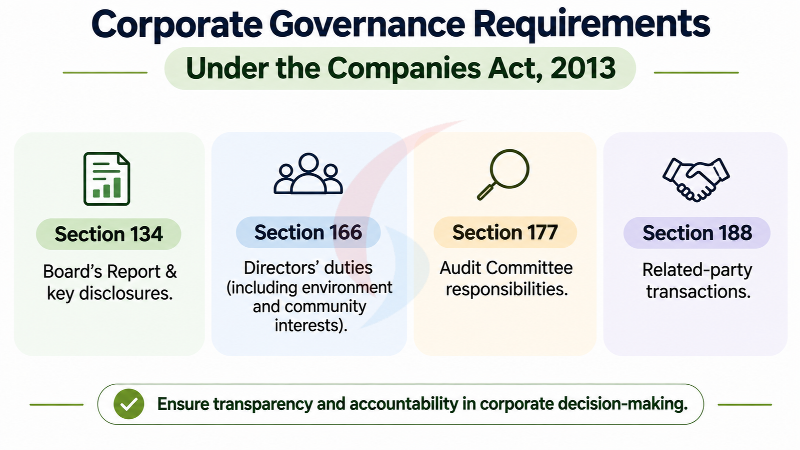
Section 134 governs the Board's Report and relevant corporate disclosures. Section 166 outlines directors' duties, including acting in good faith in the interests of the company, employees, shareholders, community and environmental protection.
Section 177 regulates Audit Committee responsibilities for companies to which it applies, while Section 188 governs specified related-party transactions. These provisions help ensure transparency and accountability in corporate decision-making.
CSR Requirements Under Section 135
Section 135 applies to companies meeting any of the prescribed financial thresholds during the immediately preceding financial year.
|
CSR Applicability Criteria |
Prescribed Threshold |
|
Net Worth |
Rs 500 crore or more |
|
Turnover |
Rs 1,000 crore or more |
|
Net Profit |
Rs 5 crore or more |
Covered companies must comply with the applicable CSR governance, spending and reporting requirements. Generally, the prescribed CSR expenditure is at least 2% of the average net profits calculated in accordance with the statutory provisions. CSR and ESG are related but different. CSR focuses on prescribed social responsibility obligations, while ESG considers a company's wider environmental, social and governance performance.
A company may spend Rs 50 lakh on education projects but still face environmental or workplace safety violations. CSR expenditure does not automatically establish satisfactory ESG compliance.
For more information, refer to ESG Reporting in India: Applicability and Requirements.
Social Responsibilities Under Indian Labour Laws
The social component of ESG focuses on employee welfare, workplace safety, fair wages, social security and responsible employment practices.
|
Applicable Law |
Key Requirements |
ESG Compliance Focus |
|---|---|---|
|
Minimum wages, timely payment and equal remuneration provisions. |
Fair wages and employee rights |
|
|
Industrial disputes, employment relations and worker representation. |
Fair employment practices |
|
|
Social security benefits, including applicable PF, ESI and gratuity requirements. |
Employee welfare and financial security |
|
|
Occupational Safety, Health and Working Conditions Code, 2020 |
Workplace safety, health standards and working conditions. |
Employee health and safety |
|
Prevention and redressal of workplace sexual harassment, including Internal Committee requirements where applicable. |
Safe and inclusive workplaces |
Important Note: The four Labour Codes came into effect from November 21, 2025, subject to notified provisions, transitional arrangements and applicable Central and State rules.
ESG Ratings and Corporate Sustainability Assessments
ESG ratings are used to evaluate companies against selected environmental, social and governance criteria. However, an ESG rating is not the same as statutory ESG reporting or a government certification that a company is fully compliant. SEBI introduced a regulatory structure for ESG Rating Providers (ERPs) through amendments to the SEBI (Credit Rating Agencies) Regulations, 1999.
The regulations govern eligible ESG Rating Providers, their registration, activities, transparency and other prescribed obligations.
In July 2025, SEBI issued a Master Circular consolidating regulatory requirements for ESG Rating Providers. Companies should understand that different rating providers may use different methodologies, so ratings should be interpreted alongside the underlying disclosures.
Official Reference: SEBI Master Circular for ESG Rating Providers, July 11, 2025.
Latest ESG Regulatory Updates in India for 2026
Several developments are important for companies reviewing ESG compliance in November 2026.
|
Regulatory Development |
Latest Position |
Impact on Companies |
|
BRSR Core Verification |
Assessment or assurance permitted under SEBI's March 28, 2025 amendments |
Greater flexibility in verification |
|
FY 2026–27 BRSR Core |
Phased verification extends to the top 1,000 listed entities |
Wider listed-company coverage |
|
Value Chain ESG Disclosures |
Voluntary for the top 250 listed entities from FY 2025–26 |
Reduced mandatory supply chain reporting |
|
Green Credit Reporting |
Voluntary leadership indicator under BRSR Principle 6 |
Additional environmental disclosure |
|
SEBI LODR Master Circular |
Updated January 30, 2026 |
Consolidated listed-entity compliance guidance |
|
Labour Codes |
Implemented from November 21, 2025, subject to applicable provisions |
Updated employment and safety compliance |
|
Data Protection Rules |
DPDP Rules, 2025 with phased commencement |
Preparation for additional data governance obligations |
The SEBI Circular dated March 28, 2025 is particularly important for BRSR Core assessment, assurance and voluntary value chain reporting.
Companies should also note that the Digital Personal Data Protection Act, 2023 and the Digital Personal Data Protection Rules, 2025 have phased commencement provisions. Therefore, not every substantive data protection obligation was fully operational in November 2026. Businesses should prepare for provisions taking effect on their notified dates.
Case Study: How ESG Compliance Helped a Manufacturing Company
Consider a fictional company, GreenLine Packaging Pvt. Ltd., operating two manufacturing facilities in Maharashtra. The business had annual revenue of Rs 120 crore and supplied packaging materials to large consumer goods companies.
Although the company was profitable, one major customer requested environmental and employee safety information as part of a supplier review. Management discovered that electricity data, waste disposal records and employee training documents were maintained separately.
The company introduced monthly energy monitoring, organised waste management documentation and improved employee safety recordkeeping.
|
Key Area |
Problem Identified |
Improvement |
|
Energy Usage |
High electricity consumption |
Reduced annual consumption from 15 lakh to 13.5 lakh units |
|
Waste Management |
Inconsistent waste records |
Improved waste tracking and documentation |
|
Employee Safety |
Incomplete training records |
Introduced standardised safety registers |
|
Business Compliance |
Scattered ESG information |
Improved internal monitoring and reporting |
At an illustrative electricity tariff of Rs 8 per unit, a reduction of 1.5 lakh units would represent potential annual savings of Rs 12 lakh.
The company was not automatically required to file BRSR because it was unlisted. However, the exercise helped it respond to customer information requests and strengthen its operational controls.
This fictional example shows that ESG compliance can support business efficiency and customer confidence even where mandatory SEBI sustainability reporting does not apply.
How Can Companies Ensure ESG Compliance in India?
Companies should begin by identifying the environmental, social and governance laws applicable to their business. A manufacturing company may require pollution control permissions, while a listed company may have additional BRSR and corporate governance disclosures.
The next step involves reviewing internal records, statutory permissions, employee policies, financial disclosures and relevant operational data. Management should identify responsibility for each compliance area and establish a regular review process.
For listed entities, the compliance team should verify the applicable BRSR requirements and BRSR Core assessment or assurance obligations. Companies should also maintain supporting records to substantiate their sustainability disclosures.
Where non-compliance is identified, corrective action should be taken according to the relevant legal requirements. An ESG report does not replace statutory permits, required filings or regulatory approvals.
How Compliance Calendar LLP Can Help with ESG Regulations
Understanding ESG Regulations for Companies in India can be challenging because the relevant requirements are spread across several laws and regulatory authorities.
Compliance Calendar LLP provides professional support relating to ESG advisory, corporate compliance and regulatory requirements. Businesses can seek assistance in understanding applicable laws, identifying documentation requirements and organising relevant compliance processes.
Companies can explore ESG Advisory and Consultation Services and ESG Compliance Services for guidance on sustainability and regulatory obligations.
For professional assistance, contact Compliance Calendar LLP at 9988424211 or info@ccoffice.in
Frequently Asked Questions (FAQ'S)
Q1. What are ESG Regulations in India?
Ans. ESG Regulations refer to the laws and disclosure requirements concerning environmental protection, social responsibilities and corporate governance. They arise from SEBI regulations, the Companies Act, environmental legislation, labour laws and other applicable requirements.
Q2. Is ESG compliance mandatory for all companies in India?
Ans. Not every company must file a mandatory ESG report. However, businesses must comply with the environmental, employment, company law and other statutory obligations applicable to their operations.
Q3. Which companies must prepare BRSR in India?
Ans. The top 1,000 listed entities by market capitalization are required to prepare BRSR under Regulation 34(2)(f) of the SEBI LODR Regulations, subject to applicable provisions and transition requirements.
Q4. What is BRSR Core under SEBI regulations?
Ans. BRSR Core is a subset of BRSR containing selected sustainability indicators under nine ESG attributes. Independent assessment or assurance applies to covered listed entities under the prescribed implementation schedule.
Q5. Is ESG reporting mandatory for private limited companies?
Ans. Private limited companies are generally not required to file SEBI BRSR solely because of their incorporation status. However, they must follow applicable environmental, labour, governance and other legal requirements.
Q6. What is the difference between ESG and CSR?
Ans. CSR concerns prescribed corporate social responsibility obligations under Section 135 of the Companies Act, 2013. ESG covers wider environmental performance, employee and stakeholder responsibilities, and governance practices.
Q7. What are the main environmental laws applicable to companies?
Ans. Important laws include the Environment (Protection) Act, 1986, Water Act, 1974, Air Act, 1981 and applicable waste management rules. Requirements depend on the company's industry and operations.
Q8. Are ESG value chain disclosures mandatory in 2026?
Ans. Under SEBI's March 28, 2025 amendments, value chain ESG disclosures are voluntary for the top 250 listed entities from FY 2025–26. Related assessment or assurance is voluntary from FY 2026–27.
Q9. What happens if a company violates ESG-related laws?
Ans. Consequences depend on the applicable statute. Violations may lead to regulatory notices, penalties, enforcement proceedings or other action under SEBI, environmental, labour or company law provisions.
Q10. How can a company improve ESG compliance?
Ans. A company should identify applicable laws, maintain statutory records, monitor environmental and employee-related performance, review governance policies and complete required disclosures. Regular compliance reviews can help identify risks early.
Article last updated on : 21 Nov 2026.













































































_learn_crop10_thumb.jpg)