


Imagine an investor planning to acquire a manufacturing company in Gujarat for Rs 75 crore. The company's financial statements look attractive, its customer base is growing, and management expects the transaction to close without difficulty. However, during the review, the investor discovers that one factory has an expired pollution control consent, several workplace safety records are incomplete, and waste disposal documents are missing.
Suddenly, the proposed investment carries risks that were not visible in the financial statements. The buyer may face unexpected compliance expenses, regulatory proceedings or operational disruptions. This is why ESG Due Diligence in India has become an important part of investment decisions, mergers, acquisitions and corporate risk management.
ESG Due Diligence examines a company's Environmental, Social and Governance practices to identify legal violations, operational weaknesses and sustainability-related risks. In India, this process involves reviewing requirements under the Companies Act, 2013, SEBI regulations, environmental legislation, labour laws and other applicable statutes.
What Is ESG Due Diligence?
ESG Due Diligence is a structured review of a company's environmental responsibilities, social practices and corporate governance arrangements. Its purpose is to determine whether the business complies with applicable laws, maintains reliable records and has systems to identify and manage ESG-related risks.
Unlike financial due diligence, which focuses on revenue, profitability, liabilities and financial records, ESG due diligence examines matters such as pollution control permissions, employee safety, waste management, human rights, business ethics and corporate transparency.
For example, a company may earn Rs 20 crore annually but face environmental enforcement proceedings because it has failed to comply with wastewater discharge requirements. Financial performance alone would not fully explain the potential risk.
Importantly, ESG due diligence is not one universal statutory audit compulsory for every Indian company. Its scope depends on applicable laws, the company's operations, investor requirements and the nature of the proposed transaction.
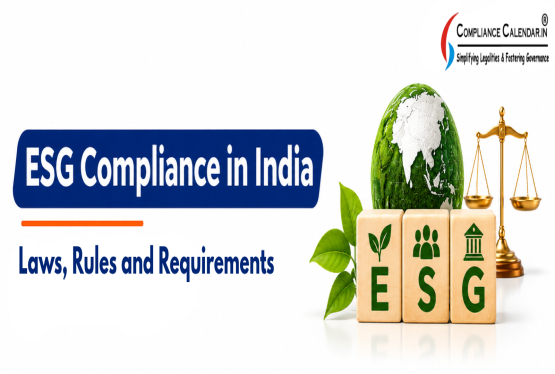
Interested in learning can also read ESG Compliance in India: Laws, Rules and Requirements.
Why Is ESG Due Diligence Important for Indian Companies?
ESG due diligence helps businesses identify regulatory and operational problems before they become expensive disputes. It is especially useful during mergers, acquisitions, fundraising, overseas investment, supplier onboarding and major commercial agreements.
An investor acquiring a chemical manufacturing company, for example, would want to examine pollution control permissions, hazardous waste records and environmental notices before finalising the purchase price. Similarly, a foreign customer sourcing products from India may review employment conditions, worker safety and supply chain practices.
The process can also reveal opportunities for improvement. Excessive electricity consumption, poor waste segregation or weak internal controls may increase operating expenses even when no immediate legal violation exists.
For startups and growing businesses, proper ESG documentation can support investor discussions and demonstrate that management understands its legal and operational responsibilities.
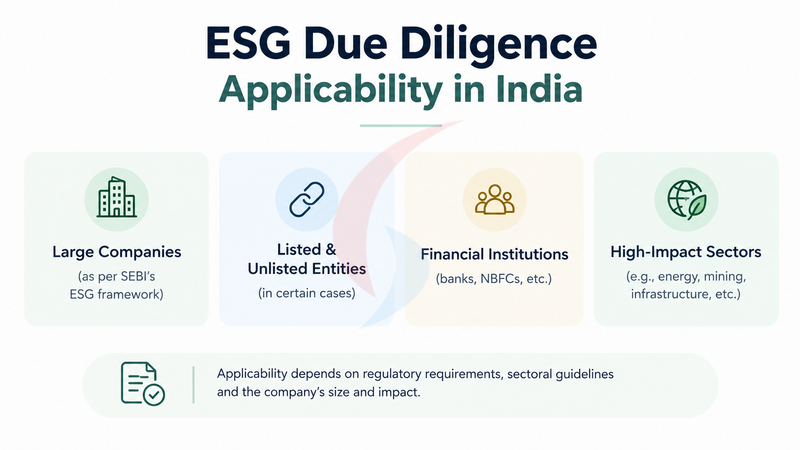
ESG Due Diligence Applicability in India
ESG due diligence requirements vary depending on the company's industry, listing status, operations and contractual commitments. Although no single law requires every company to undertake the same ESG due diligence exercise, several statutes impose obligations that must be examined.
|
Company Category |
ESG Due Diligence Requirements |
|
Listed Companies |
Review SEBI disclosures, BRSR applicability, governance and relevant statutory compliance. |
|
Manufacturing Companies |
Examine environmental permissions, waste disposal, employee safety and operational compliance. |
|
Review applicable company law, environmental, labour and contractual obligations. |
|
|
Identify business-specific ESG risks and investor or customer requirements. |
|
|
Companies Undergoing M&A |
Examine environmental liabilities, employee obligations, governance risks and regulatory proceedings. |
|
Exporters and Suppliers |
Review relevant customer sustainability requirements and applicable Indian laws. |
For example, an unlisted packaging company may not need to file BRSR with SEBI. However, it may still require pollution control permissions and EPR registration, depending on its activities and responsibilities under the applicable rules.
Legal Framework Governing ESG Due Diligence in India
India does not have a single comprehensive ESG Due Diligence Act. Instead, the review must consider several laws covering corporate governance, environmental protection, employee welfare and sustainability disclosures.
|
Law / Regulation |
Relevant Provisions |
Due Diligence Focus |
|
Regulation 34(2)(f) and applicable governance provisions |
BRSR disclosures and listed-entity compliance |
|
|
Sections 134, 135, 166, 177 and 188 |
Board reporting, CSR, directors' duties and related-party transactions |
|
|
Sections 3 and 5, and applicable rules |
Environmental standards and regulatory directions |
|
|
Applicable pollution-control consent provisions |
Environmental permissions and compliance |
|
|
Applicable EPR and waste management provisions |
Waste handling, recycling and reporting |
|
|
Applicable notified provisions and rules |
Wages, workplace safety and social security |
|
|
Sections 4, 9, 19 and applicable rules |
Workplace harassment prevention and grievance redressal |
|
|
Provisions according to phased commencement |
Personal data governance and security |
The exact checklist must be adapted to the company's business activities. A food manufacturer, technology company and hazardous waste recycler will not have identical compliance obligations.
Environmental Due Diligence Checklist for Indian Companies
Environmental due diligence examines whether the business has the approvals, operating systems and supporting records required under applicable environmental legislation.
The review should begin with identifying the company's factories, warehouses, production processes, pollution sources and waste streams. The reviewer should then examine applicable environmental clearances, Consent to Establish (CTE), Consent to Operate (CTO) and other permissions issued by the relevant authorities.
Waste management deserves particular attention. Companies covered by plastic, e-waste, battery or hazardous waste rules may have registration, authorisation, collection, recycling or Extended Producer Responsibility (EPR) obligations.
Environmental Due Diligence Checklist
|
Compliance Area |
Documents / Records to Verify |
|
Pollution Control |
CTE, CTO and applicable consent conditions |
|
Environmental Clearance |
Environmental clearance documents, where required |
|
Water Management |
Water consumption records and wastewater testing reports |
|
Air Emissions |
Monitoring reports and prescribed emission records |
|
Waste Management |
Waste authorisations, disposal records and authorised recycler details |
|
EPR Compliance |
Applicable EPR registration, certificates and returns |
|
Environmental Proceedings |
Notices, orders, inspection reports and pending proceedings |
For example, a textile dyeing company may have valid corporate registrations but lack adequate wastewater treatment arrangements. Such a problem may create significant compliance risks even if the company has consistently reported profits.
Official references are available through the Central Pollution Control Board and the Ministry of Environment, Forest and Climate Change.
Social Due Diligence: Employee Welfare and Labour Compliance
The social component of ESG due diligence examines how a company treats its employees, workers, customers and other affected stakeholders.
A review should cover employment contracts, wage payments, working hours, social security contributions, occupational safety, grievance mechanisms and applicable workplace policies. Where contractors or outsourced workers are engaged, the company should also examine the obligations arising from those arrangements.
India's four Labour Codes were brought into effect from November 21, 2025, subject to notified provisions, transitional arrangements and applicable Central and State rules. Companies should therefore examine both the current legal requirements and the implementation position relevant to their establishments.
Social Due Diligence Checklist
|
Compliance Area |
Documents to Review |
|
Employment Records |
Appointment letters, worker registers and employment policies |
|
Wages and Benefits |
Payroll, wage registers and relevant payment records |
|
Social Security |
Applicable PF, ESI and gratuity records |
|
Workplace Safety |
Safety registers, training records and incident reports |
|
POSH Compliance |
Internal Committee records, policies and prescribed reports |
|
Grievance Redressal |
Employee complaint procedures and records |
|
Contract Workers |
Contractor agreements and applicable compliance documents |
For example, a factory employing 300 workers may have a workplace safety policy but incomplete training registers. ESG due diligence would identify whether the company can demonstrate compliance through reliable records rather than merely relying on written policies.
Corporate Governance Due Diligence Under the Companies Act, 2013
Corporate governance due diligence examines how a company is managed, how decisions are approved and whether required statutory records are properly maintained.
Under Section 166 of the Companies Act, 2013, directors must perform their statutory duties, including acting in good faith in the interests of the company, its employees, shareholders, community and environmental protection.
Section 134 governs Board's Report disclosures, while Section 135 deals with CSR obligations for eligible companies. Sections 177 and 188 address Audit Committee-related matters and specified related-party transactions, respectively.
A governance review should examine Board and committee minutes, statutory registers, annual filings, related-party transaction approvals, conflict-of-interest declarations and applicable whistleblower arrangements.
A company may have strong environmental policies but poor governance if transactions involving directors or related parties are conducted without the prescribed approvals or disclosures.
Interested in learning can also read ESG Regulations for Companies in India for a broader explanation of statutory responsibilities.
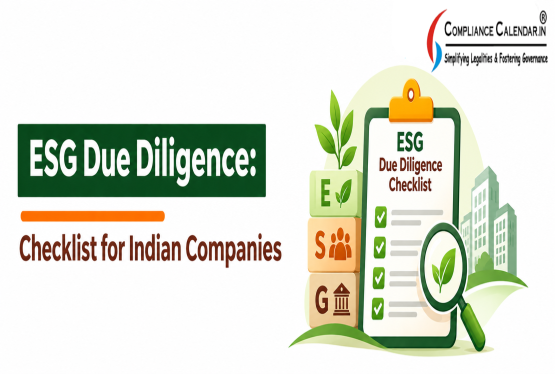
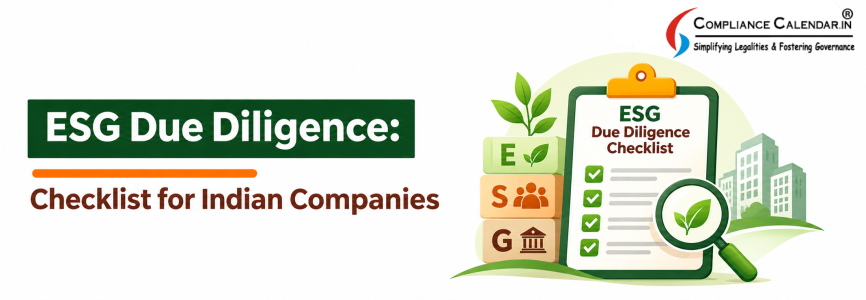
ESG Due Diligence Checklist for Indian Companies
A practical ESG due diligence exercise should identify legal requirements, examine documentary evidence and classify findings according to their seriousness.
|
ESG Area |
Key Verification Points |
Risk if Non-Compliant |
|
Environmental Permissions |
Pollution control consents and clearances |
Regulatory action or operational restrictions |
|
Waste and EPR Compliance |
Registration, authorisations and recycling records |
Environmental proceedings and compliance liabilities |
|
Employee Welfare |
Wages, social security and employment records |
Labour disputes and statutory liabilities |
|
Workplace Safety |
Safety measures, training and incident reporting |
Accidents, enforcement action and operational disruption |
|
Corporate Governance |
Board approvals, statutory filings and related-party transactions |
Governance disputes and regulatory penalties |
|
ESG Reporting |
BRSR, BRSR Core and applicable verification |
SEBI disclosure non-compliance |
|
Data Protection |
Personal data handling, security and applicable legal obligations |
Data-related regulatory and reputational risks |
|
Pending Litigation |
Environmental, labour and corporate legal proceedings |
Financial liabilities and transaction risks |
The checklist is a starting point, not a substitute for a legal review of the company's particular operations, permits and regulatory status.
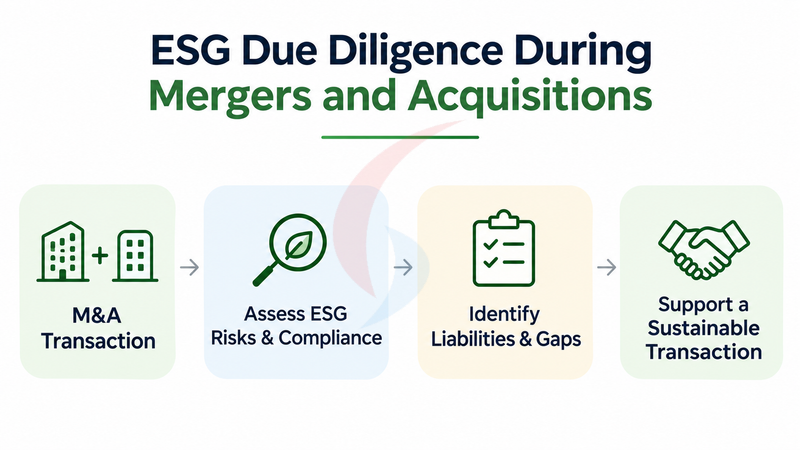
ESG Due Diligence During Mergers and Acquisitions
ESG due diligence helps buyers identify environmental, social and governance risks before acquiring a company. These findings may affect the transaction value, contractual terms and post-acquisition responsibilities.
|
Key Area |
Due Diligence Requirements |
Potential Impact |
|---|---|---|
|
Environmental Compliance |
Review pollution control approvals, hazardous waste records and environmental liabilities. |
Regulatory penalties or compliance costs |
|
Employee and Labour Compliance |
Examine employee safety, labour disputes and statutory obligations. |
Employment claims and legal liabilities |
|
Corporate Governance |
Check regulatory notices, board approvals and governance practices. |
Legal disputes and transaction risks |
|
Transaction Valuation |
Assess identified ESG risks and potential financial exposure. |
Changes in purchase price or deal terms |
|
Legal Protection |
Review warranties, indemnities and conditions precedent. |
Protection against identified risks |
|
Post-Acquisition Compliance |
Identify corrective actions and applicable ongoing obligations. |
Improved regulatory compliance after acquisition |
Important Note: ESG due diligence does not automatically eliminate or transfer legal liabilities. The buyer's responsibilities depend on the transaction structure, applicable laws and contractual arrangements.
Case Study: ESG Due Diligence Before a Rs 75 Crore Acquisition
Consider the fictional example of GreenLine Chemicals Pvt. Ltd., a manufacturing company proposed to be acquired for Rs 75 crore. During the preliminary financial review, the business appeared profitable and operationally stable.
However, the buyer's ESG due diligence identified several issues that required attention before the transaction could proceed.
|
Review Area |
Findings |
Corrective Action |
|
Environmental Compliance |
One pollution consent required renewal. |
Initiated renewal and reviewed operating conditions. |
|
Employee Safety |
Incomplete safety training records. |
Introduced standardised documentation. |
|
Waste Management |
Missing disposal records for certain periods. |
Reconciled records with authorised vendors. |
|
Corporate Governance |
Certain related-party approvals required review. |
Conducted legal and secretarial verification. |
The parties agreed to address the identified issues through appropriate corrective measures and transaction documentation before completion.
This fictional example shows how ESG due diligence can reveal risks that financial statements alone may not identify. It also demonstrates why conducting the review before signing or completing an acquisition can be commercially valuable.
SEBI BRSR and BRSR Core Requirements in ESG Due Diligence
For listed companies, ESG due diligence should include a review of applicable SEBI sustainability reporting requirements.
Under Regulation 34(2)(f) of the SEBI LODR Regulations, the top 1,000 listed entities by market capitalisation are required to prepare BRSR, subject to the applicable provisions.
BRSR Core contains selected sustainability indicators covering nine ESG attributes. For FY 2026–27, the phased independent assessment or assurance requirement extends to the top 1,000 listed entities.
During due diligence, reviewers should examine whether the company has filed the prescribed disclosures, followed applicable measurement standards, retained supporting records and obtained independent verification wherever required.
Interested in learning can also read BRSR Core: Requirements and Key Indicators and BRSR Reporting: Applicability, Format and Due Dates.
Latest ESG Due Diligence Regulatory Updates in 2026
The legal position in November 2026 reflects important developments relating to sustainability reporting, workplace compliance and data protection.
|
Regulatory Update |
Important Requirement |
|
SEBI BRSR Core |
Assessment or assurance is permitted under the March 28, 2025 amendments. |
|
FY 2026–27 Applicability |
BRSR Core verification extends to the top 1,000 listed entities. |
|
Value Chain ESG Disclosures |
Voluntary for the top 250 listed entities from FY 2025–26. |
|
Labour Codes |
Applicable provisions commenced from November 21, 2025, subject to relevant rules and transitions. |
|
Data Protection |
DPDP Act and Rules have phased commencement requirements. |
|
ESG Rating Providers |
SEBI regulates eligible ESG Rating Providers under the applicable Credit Rating Agencies Regulations. |
Under SEBI's March 28, 2025 amendments, independent verification of BRSR Core may take the form of assessment or assurance. Value chain ESG disclosures are voluntary for the top 250 listed entities from FY 2025–26, with related assessment or assurance voluntary from FY 2026–27.
The Digital Personal Data Protection Act, 2023 and Rules, 2025 also deserve attention during due diligence. However, companies must distinguish provisions already in force from obligations scheduled to commence later. Not all substantive DPDP obligations were operative in November 2026.
Step-by-Step ESG Due Diligence Process in India
ESG due diligence should begin with understanding the company's business operations, regulatory obligations and the purpose of the review.
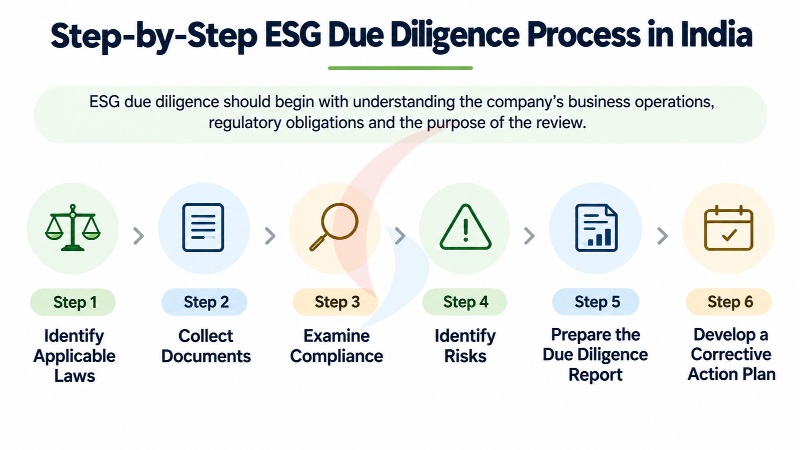
Step 1 – Identify Applicable Laws: Determine which environmental, labour, governance and SEBI reporting requirements apply to the business.
Step 2 – Collect Documents: Obtain statutory permissions, compliance returns, employment records, ESG reports, corporate records and relevant policies.
Step 3 – Examine Compliance: Compare the company's documented practices with applicable statutory requirements and regulatory conditions.
Step 4 – Identify Risks: Classify findings according to their seriousness, including immediate legal violations, potential financial liabilities and operational weaknesses.
Step 5 – Prepare the Due Diligence Report: Record the findings, supporting evidence, unresolved questions and recommended corrective actions.
Step 6 – Develop a Corrective Action Plan: Assign responsibilities and target dates for addressing identified issues.
Depending on the transaction and risk profile, the review may also require site inspections, environmental testing, employee interviews or specialist technical assessments.
Why Choose Compliance Calendar LLP for ESG Due Diligence?
ESG Due Diligence in India involves reviewing multiple legal requirements relating to corporate governance, environmental compliance, labour obligations and sustainability disclosures.
Compliance Calendar LLP provides professional assistance with corporate compliance, ESG advisory and regulatory requirements. Businesses can seek guidance in identifying applicable obligations, reviewing statutory documentation, assessing compliance gaps and coordinating corrective action requirements.
For professional assistance, contact Compliance Calendar LLP at 9988424211 or email info@ccoffice.in
Frequently Asked Questions (FAQ’S)
Q1. What is ESG Due Diligence in India?
Ans. ESG Due Diligence is the process of reviewing a company's environmental responsibilities, social practices and corporate governance arrangements. It helps identify legal, operational and sustainability-related risks.
Q2. Is ESG Due Diligence mandatory for all Indian companies?
Ans. No. India does not have a single law requiring every company to undertake the same ESG due diligence exercise. However, companies must comply with applicable environmental, labour, governance and SEBI regulations.
Q3. What documents are required for ESG Due Diligence?
Ans. Common documents include pollution control permissions, waste management records, employment registers, safety reports, statutory filings, Board resolutions, ESG disclosures and records of relevant regulatory proceedings.
Q4. What is environmental due diligence?
Ans. Environmental due diligence examines the company's environmental permissions, waste disposal practices, pollution control measures, resource consumption and compliance with applicable environmental legislation.
Q5. Is ESG Due Diligence required during mergers and acquisitions?
Ans. ESG due diligence is not universally mandatory for every acquisition. However, it is an important risk assessment exercise and may be required by investors, lenders or contractual arrangements.
Q6. What is the difference between ESG Due Diligence and ESG Audit?
Ans. ESG due diligence generally examines legal and operational risks for a specific business decision or transaction. An ESG audit evaluates specified systems, disclosures or performance against defined criteria. Their scope may overlap.
Q7. What is the role of SEBI in ESG Due Diligence?
Ans. SEBI regulates mandatory BRSR disclosures for covered listed entities and prescribes BRSR Core requirements. ESG due diligence of such entities should examine the applicable disclosures and verification obligations.
Q8. Is ESG Due Diligence necessary for startups and MSMEs?
Ans. It is not automatically a universal statutory requirement. However, startups and MSMEs may conduct ESG due diligence to identify compliance risks, respond to investor requests and meet customer expectations.
Q9. What are the major ESG risks for manufacturing companies?
Ans. Common risks include expired pollution control permissions, improper waste disposal, unsafe working conditions, incomplete labour records, regulatory proceedings and weak corporate governance arrangements.
Q10. How can a company improve its ESG Due Diligence readiness?
Ans. A company should maintain updated statutory permissions, organise compliance records, monitor employee safety, review governance practices and periodically identify environmental, social and governance risks.
Article last updated on : 21 Nov 2026.









































































_learn_crop10_thumb.jpg)