


Imagine a growing technology startup in Bengaluru that has just completed a successful funding round. The founders want to reward their employees for staying with the company during its difficult early years. However, instead of offering large salary increments, they decide to introduce an Employee Stock Option Plan (ESOP). Under this arrangement, selected employees will get an opportunity to purchase company shares at a fixed price after completing a certain period of employment.
The employees are excited because they may benefit financially if the company's value increases. The founders are also happy because ESOPs can help retain talented professionals without requiring an immediate cash payment. But when the finance team begins preparing the annual financial statements, an important question arises: If the company has not paid anything in cash, does it still need to record an expense?
The answer is generally yes. Under Indian Accounting Standard (Ind AS) 102, Share-based Payment, companies must recognise the cost of employee services received in exchange for share-based awards. This means that even when employees receive stock options instead of cash, the company may need to record employee compensation expenses in its financial statements.
ESOP Accounting under Ind AS 102 is particularly important for startups, private limited companies and established businesses that use share-based incentives to attract and retain employees. Understanding the accounting treatment helps companies maintain accurate financial records, explain employee compensation costs to investors and avoid errors during statutory audits. This article explains how ESOP accounting works in India, how companies calculate the expense, what happens when employees resign, and how the accounting treatment changes when options are exercised or cancelled.
What Is ESOP Accounting under Ind AS 102?
ESOP accounting refers to the process of recognising, measuring and reporting employee compensation provided through stock options or other share-based arrangements. Instead of receiving their entire compensation in cash, employees may receive an opportunity to acquire ownership in the company after satisfying specified conditions. Ind AS 102, titled Share-based Payment, provides accounting requirements for transactions in which an entity receives goods or services in exchange for equity instruments or amounts linked to the value of its equity instruments. Employee stock options are among the most common examples of such transactions.
For a typical equity-settled employee stock option arrangement, the company determines the fair value of the options at the grant date and recognises the related employee compensation expense over the vesting period. The corresponding amount is generally credited to an appropriate equity reserve. Consider a company that grants stock options to an experienced software engineer. The engineer must remain employed for three years before becoming eligible to exercise those options. Although the company does not immediately transfer shares or make a cash payment, it receives employee services throughout those three years. Ind AS 102 requires the company to account for those services because stock options represent a form of employee compensation. The standard therefore prevents companies from overlooking share-based employee benefits simply because the compensation does not involve an immediate cash outflow. The official accounting standard can be accessed through the Ministry of Corporate Affairs (MCA).
Importance of ESOP Accounting for Indian Startups
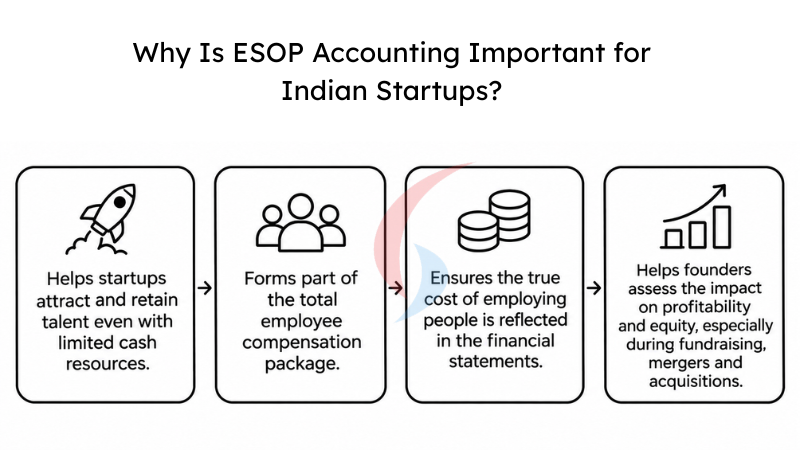
Startups frequently operate with limited financial resources, especially during their initial years. They may not be able to offer the same salaries as established businesses, but they can provide employees with an opportunity to participate in the company's future growth through stock options.
For example, a startup may offer a senior employee an annual salary of Rs 18 lakh along with stock options that could become valuable if the business performs well. From the employee's perspective, these options create a potential financial reward. From the company's perspective, they form part of the total compensation package. ESOP accounting becomes important because investors and auditors need to understand the actual cost of employing people. If a company records salaries but ignores the value of stock options granted to employees, its reported employee compensation expenses may be understated. Proper accounting also helps founders understand how ESOP grants affect profitability and equity. It supports financial reporting during fundraising, mergers, acquisitions and financial due diligence.
Companies planning to introduce employee ownership programmes can also read ESOP Valuation in India: Methods and Compliance, which explains the valuation requirements associated with employee stock options.
Legal and Accounting Requirements for ESOPs in India
The accounting treatment of ESOPs should not be confused with the legal process of creating and issuing employee stock options. Both are important, but they serve different purposes.
Section 62(1)(b) of the Companies Act, 2013 permits companies to issue shares to employees under an employee stock option scheme, subject to the applicable conditions and approvals. For unlisted companies, Rule 12 of the Companies (Share Capital and Debentures) Rules, 2014 governs important requirements relating to employee eligibility, shareholder approval, vesting conditions, disclosures and maintenance of records.
Companies must also consider the applicable accounting standards when preparing financial statements. Section 133 of the Companies Act, 2013 provides the statutory basis for accounting standards prescribed by the Central Government. Companies that are required or permitted to prepare financial statements under Ind AS must apply Ind AS 102 to relevant share-based payment transactions.
However, Ind AS 102 does not automatically apply to every Indian private limited company. Companies outside the Ind AS applicability requirements generally follow the accounting standards and ICAI guidance applicable to them. Therefore, businesses should first confirm their financial reporting requirements before selecting an ESOP accounting policy. Listed companies must additionally consider the SEBI (Share Based Employee Benefits and Sweat Equity) Regulations, 2021, wherever applicable. Relevant official portals include the Ministry of Corporate Affairs, Securities and Exchange Board of India and Institute of Chartered Accountants of India.
For the legal implementation process, readers can refer to ESOPs Compliance Checklist and Procedure under the Companies Act, 2013.
Different Types of Share-Based Payments under Ind AS 102
Ind AS 102 covers different forms of share-based payment arrangements. The accounting treatment depends mainly on whether the company settles the award through equity instruments, cash or an arrangement containing features of both.
|
Type |
Meaning |
Accounting Treatment |
|---|---|---|
|
Equity-Settled |
Employees receive shares or equity instruments |
Expense recognised with a corresponding increase in equity |
|
Cash-Settled |
Employees receive cash linked to share value |
Expense recognised with a corresponding liability |
|
Choice of Settlement |
Cash or equity settlement options exist |
Classification depends on contractual terms and obligations |
In an equity-settled arrangement, the company generally recognises an employee compensation expense using the grant-date fair value of the options. For a cash-settled arrangement, the company recognises a liability that is remeasured at fair value until settlement.
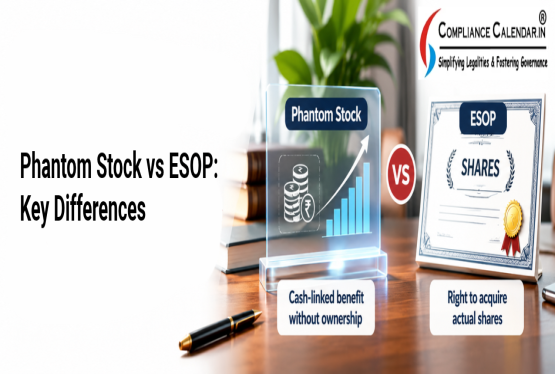
For example, a company may offer employees a cash bonus linked to the appreciation in its share price rather than actual shares. Such arrangements are often called share appreciation rights or phantom stock plans. Where the arrangement qualifies as cash-settled under Ind AS 102, changes in the liability's fair value affect the financial statements.
Readers can understand the practical differences through Phantom Stock vs ESOP: Key Differences.
Important Terms Used in ESOP Accounting
Before understanding journal entries, it is useful to know the meaning of certain terms commonly used in employee stock option schemes.
|
Term |
Simple Meaning |
|---|---|
|
Grant Date |
Date on which the company and employee have a shared understanding of the award, subject to the applicable grant-date requirements |
|
Vesting Period |
Period during which the employee must satisfy specified conditions to earn the options |
|
Exercise Price |
Amount paid by an employee to acquire each share |
|
Fair Value |
Estimated value of the stock option determined using an appropriate valuation method |
|
Exercise Date |
Date on which the employee exercises the option |
|
Forfeiture |
Loss of options because the required vesting conditions are not satisfied |
|
Expiry |
Options cease to be exercisable after the permitted period |
For example, a company may grant an employee 2,000 options with an exercise price of Rs 100 per share. The options may vest after three years and remain exercisable for another two years. The employee can decide whether to exercise the options after vesting, subject to the scheme's terms.
It is important to understand that the exercise price and the fair value of an option are different concepts. The exercise price is what the employee pays for each share, while the fair value of the option considers several factors, including the underlying share price, expected volatility and the time available to exercise the option.
How Is ESOP Expense Calculated under Ind AS 102?
One of the most important requirements under Ind AS 102 is determining the amount of employee compensation expense that should be recognised in the financial statements. For a typical equity-settled ESOP with a service-based vesting condition, the company calculates the expense using the grant-date fair value of each option, the estimated number of options expected to vest and the portion of the vesting period completed.
The basic formula is:
Cumulative ESOP Expense = Number of Options Expected to Vest × Grant-Date Fair Value per Option × Proportion of Vesting Period Completed
The expense recognised during a particular financial year is generally calculated by deducting the cumulative expense already recognised in previous periods from the revised cumulative expense at the current reporting date.
Journal Entries for ESOP Accounting under Ind AS 102
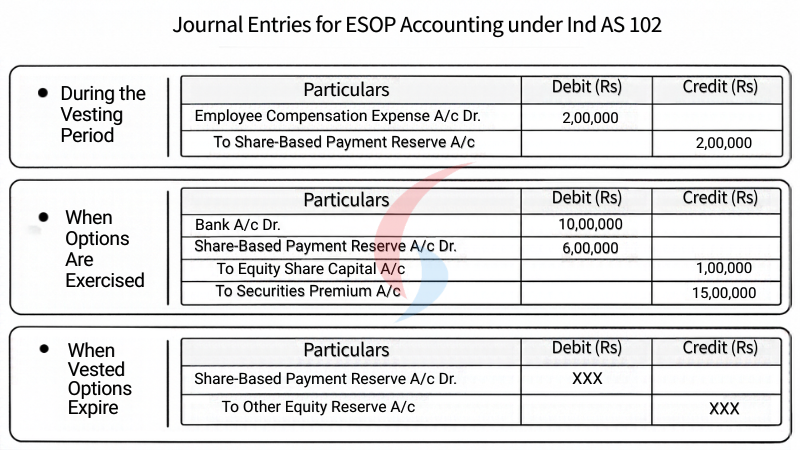
Proper journal entries are necessary to reflect ESOP expenses in the financial statements. The entries depend on the nature of the arrangement and whether the options have vested, been exercised or expired.
1. Journal Entry During the Vesting Period
Using the example of ABC Technologies, the company recognises an annual employee compensation expense of Rs 2,00,000.
|
Particulars |
Debit (Rs) |
Credit (Rs) |
|---|---|---|
|
Employee Compensation Expense A/c Dr. |
2,00,000 |
|
|
To Share-Based Payment Reserve A/c |
2,00,000 |
This entry recognises the employee services received during the financial year and increases the equity reserve associated with the ESOP arrangement.
2. Journal Entry When Employees Exercise Their Options
Suppose all 10,000 options eventually vest and are exercised. Employees pay an exercise price of Rs 100 per share, resulting in a total payment of Rs 10,00,000.
Assume that each share has a face value of Rs 10 and that the accumulated share-based payment reserve is Rs 6,00,000. A simplified entry, assuming the reserve is transferred into the share issue accounts upon exercise, would be:
|
Particulars |
Debit (Rs) |
Credit (Rs) |
|---|---|---|
|
Bank A/c Dr. |
10,00,000 |
|
|
Share-Based Payment Reserve A/c Dr. |
6,00,000 |
|
|
To Equity Share Capital A/c |
1,00,000 |
|
|
To Securities Premium A/c |
15,00,000 |
The bank account reflects the money received from employees, while the accumulated share-based payment reserve is transferred within equity. The exact presentation depends on the company's equity accounting policy and applicable statutory requirements.
3. Journal Entry When Vested Options Expire
If vested stock options expire without being exercised, the accounting treatment differs from forfeiture before vesting. Generally, the company does not reverse the employee compensation expense already recognised merely because vested equity-settled options are not exercised. The balance may instead be transferred between appropriate equity reserves, subject to the company's accounting policy.
For example:
|
Particulars |
Debit (Rs) |
Credit (Rs) |
|---|---|---|
|
Share-Based Payment Reserve A/c Dr. |
XXX |
|
|
To Other Equity Reserve A/c |
XXX |
These journal entries are illustrative and should be adapted to the actual ESOP scheme, share capital structure and financial reporting requirements.
ESOP Fair Value Calculation and Valuation Methods
Determining the fair value of stock options is one of the most technical parts of ESOP accounting. Unlike listed shares, employee stock options may not have an observable market price. Therefore, companies often use accepted financial valuation models to estimate their value. Commonly used option valuation methods include the Black-Scholes model and binomial option pricing models. The appropriate method depends on the characteristics of the options, available information and relevant accounting requirements.
A valuation exercise typically considers the underlying share price, exercise price, expected volatility, expected option life, expected dividends and the risk-free interest rate. For unlisted companies, determining the underlying share value may require an additional valuation exercise.
For example, a startup may have recently raised funds at a valuation of Rs 100 crore. This does not automatically mean that every employee stock option should be valued using a simple division of Rs 100 crore by the number of shares. Differences in share classes, investor rights, exercise restrictions and other assumptions can materially affect the valuation.
Companies should also distinguish between option valuation for financial reporting and share valuation for income-tax purposes. The methods, valuation dates and professional requirements may differ.
The detailed process is explained in ESOP Valuation in India: Methods and Compliance.
What Happens to ESOP Accounting When Employees Resign?
Employee resignation is a common situation that affects ESOP accounting, particularly in growing companies where staff turnover can be frequent. Suppose a company grants 5,000 options to an employee, subject to a three-year service condition. If the employee resigns after completing only one year and the unvested options are forfeited, the company must consider the effect of the forfeiture on its recognised employee compensation expense.
Under Ind AS 102, service conditions and other non-market vesting conditions generally affect the number of options expected to vest. Therefore, companies update their vesting estimates when employees leave or when expected forfeitures change.
If options fail to vest because the employee does not satisfy the required service condition, the cumulative expense associated with those forfeited options is adjusted. However, options that have already vested are treated differently. If those options subsequently expire without exercise, the recognised equity-settled compensation expense is generally not reversed. This distinction is important because companies sometimes incorrectly treat every expired or forfeited option in the same way.
For a broader explanation, read ESOPs on Resignation, Termination and Death.
Accounting Treatment of ESOP Modifications and Cancellations
Companies may change ESOP terms after the original grant. For example, a startup experiencing financial difficulties may reduce the exercise price to make stock options more attractive to employees. Another company may extend the exercise period or change certain vesting conditions. Under Ind AS 102, modifications that increase the fair value of an equity-settled award generally require recognition of the incremental fair value in addition to the original grant-date fair value, subject to the applicable requirements.
Where a modification reduces the fair value or is otherwise disadvantageous to employees, the company generally continues to recognise the original grant-date compensation cost, subject to the standard's detailed rules. Cancellation during the vesting period also requires special attention. In many circumstances, cancellation is treated as an acceleration of vesting, meaning the company must immediately recognise the amount that otherwise would have been recognised over the remaining vesting period. These accounting consequences can be significant. A decision that appears simple from an employee retention perspective may create an immediate impact on the company's reported expenses. Before changing an ESOP scheme, companies should therefore evaluate both the legal requirements and the financial reporting implications.
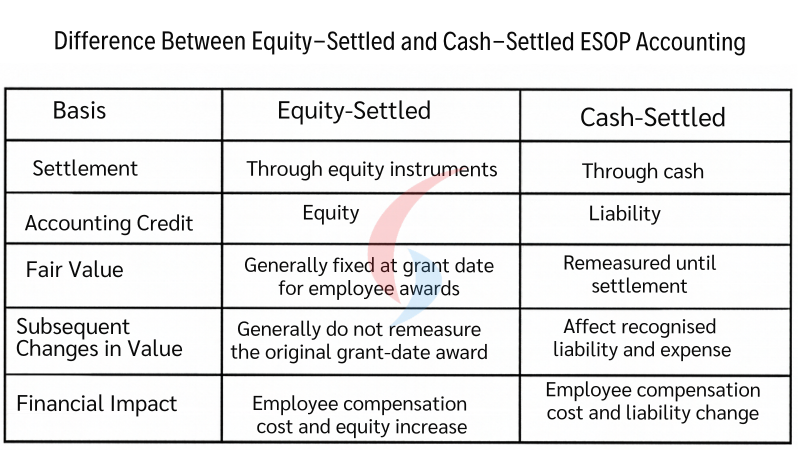
Equity-Settled vs Cash-Settled ESOPs: Key Accounting Differences
Although equity-settled and cash-settled arrangements may appear similar from an employee's perspective, their accounting treatment can be substantially different.
|
Basis |
Equity-Settled |
Cash-Settled |
|---|---|---|
|
Settlement |
Through equity instruments |
Through cash |
|
Accounting Credit |
Equity |
Liability |
|
Fair Value |
Generally fixed at grant date for employee awards |
Remeasured until settlement |
|
Subsequent Changes in Value |
Generally do not remeasure the original grant-date award |
Affect recognised liability and expense |
|
Financial Impact |
Employee compensation cost and equity increase |
Employee compensation cost and liability change |
Consider two companies that offer share-linked rewards to their employees. The first company promises actual shares after employees complete three years of service. The second promises a cash amount equal to the increase in the value of a specified number of shares. Although both arrangements reward employees for the company's growth, the first may qualify as equity-settled while the second may qualify as cash-settled. The cash-settled arrangement requires the company to reassess its liability at each reporting date and at settlement. For this reason, companies should examine the actual terms of an employee incentive arrangement rather than relying only on whether it is described as an ESOP, phantom stock plan or share appreciation right.
How Does ESOP Accounting Affect Financial Statements?
ESOP accounting can influence several important financial indicators. The most visible impact is generally on employee compensation expenses, but the effects can also appear in equity, liabilities, earnings per share and financial statement disclosures. For equity-settled awards, the recognised expense generally reduces the company's reported profit, while the corresponding credit increases equity. This does not necessarily mean that cash has been paid during the vesting period.
For cash-settled awards, the company recognises a liability, and changes in its fair value can affect expenses until settlement. ESOP arrangements can also affect diluted earnings per share where the requirements of Ind AS 33 apply. Companies must separately evaluate the effect of potential ordinary shares on diluted earnings per share, rather than assuming that every granted option has the same effect. Ind AS 102 also contains disclosure requirements covering matters such as the nature and extent of share-based payment arrangements, how fair value was determined and the effect of share-based payments on profit or loss and financial position. These disclosures allow investors, shareholders and auditors to understand the company's employee share-based compensation arrangements more clearly.
ESOP Accounting and Taxation in India
ESOP accounting and ESOP taxation are related, but they are not identical. Companies should maintain a clear distinction between the expense recognised under accounting standards and the taxable benefit arising for employees. Under Ind AS 102, a typical equity-settled employee stock option is measured using its grant-date fair value, with the compensation expense recognised over the relevant vesting period. For employee income-tax purposes, the taxable salary perquisite generally arises when shares are allotted or transferred following exercise, based on the prescribed fair market value less the amount recovered from the employee. A subsequent sale of the shares can give rise to capital gains taxation.
For Tax Year 2026–27, the Income-tax Act, 2025 and applicable Income-tax Rules, 2026 must be considered. Earlier tax years remain governed by the relevant provisions of the Income-tax Act, 1961. Specific tax treatment, employer withholding obligations and any available deferral depend on the applicable law and circumstances. The amount recognised as an accounting expense should not automatically be treated as the employee's taxable perquisite or as an identical income-tax deduction for the employer.
For more information, read ESOP Taxation for Employees and Startups in India. Companies can also refer to the Income Tax Department for official tax information.
Common ESOP Accounting Mistakes Companies Should Avoid
Even companies with experienced finance teams may encounter difficulties while recording ESOP transactions. One frequent mistake is assuming that stock options create an expense only when employees exercise them. Under Ind AS 102, compensation expense is generally recognised as employee services are received during the vesting period. Another mistake is using the exercise price as the fair value of the option. The exercise price is the amount employees must pay to purchase shares, while the option's fair value considers additional financial assumptions and contractual features.
Companies may also fail to update estimates of options expected to vest when employees resign or performance conditions change. This can lead to inaccurate compensation expenses and equity balances. Incorrect treatment of modifications, cancellations and vested options that expire can create further financial reporting problems. Businesses should therefore maintain proper grant records, employee-wise option statements, valuation reports and supporting calculations. Regular coordination among the finance team, company secretary, auditors and valuation professionals can help ensure that ESOP transactions are recorded consistently and supported by appropriate documentation.
Why Choose Compliance Calendar LLP for ESOP Compliance?
Managing an employee stock option scheme involves more than preparing accounting entries. Companies must also consider legal approvals, scheme documentation, valuation requirements, statutory records, employee communications and financial reporting obligations. Compliance Calendar LLP assists businesses with company law compliance and related corporate advisory requirements, helping founders understand the legal and practical considerations involved in implementing employee incentive arrangements. Businesses planning to introduce an ESOP scheme or review an existing arrangement can seek professional support for the applicable compliance requirements, with accounting and valuation matters assessed by appropriately qualified professionals.
Companies can also explore related services such as Increase in Paid-Up Capital, where applicable to share issuances, and Startup India Registration.
For assistance with ESOP-related corporate compliance, contact Compliance Calendar LLP at +91 9988424211 or info@ccoffice.in
Why Choose Compliance Calendar LLP?
ESOP Accounting under Ind AS 102 helps companies recognise the financial cost of rewarding employees through share-based compensation. Although stock options may not involve an immediate cash payment, they represent valuable benefits provided in exchange for employee services and must be reflected appropriately in the financial statements.
For startups and growing businesses, understanding grant-date fair value, vesting conditions, employee resignations, modifications and accounting entries is essential for maintaining reliable financial records. Correct accounting also allows investors and management to understand employee compensation costs more accurately.
Companies that combine proper ESOP planning, reliable valuation, timely accounting and statutory compliance are better positioned to manage employee ownership programmes while maintaining transparency in their financial reporting.
Frequently Asked Questions (FAQs)
Q1. What is ESOP Accounting under Ind AS 102?
Ans. ESOP Accounting under Ind AS 102 refers to recognising and measuring employee compensation provided through stock options and other share-based arrangements. For typical equity-settled employee options, the company determines the grant-date fair value and recognises the expense over the applicable vesting period. The corresponding amount is generally recorded in equity.
Q2. Is Ind AS 102 applicable to all private limited companies?
Ans. No. Ind AS 102 applies to companies that prepare their financial statements under Indian Accounting Standards. Private limited companies outside the applicable Ind AS requirements generally follow the accounting standards and relevant ICAI guidance applicable to them. Companies should verify their reporting requirements before selecting an accounting treatment.
Q3. How is ESOP expense calculated under Ind AS 102?
Ans. For a typical service-based equity-settled award, the expense is calculated using the grant-date fair value per option, the number of options expected to vest and the proportion of the vesting period completed. Companies reassess estimates of non-market vesting conditions where required and recognise the appropriate cumulative expense at each reporting date.
Q4. Is ESOP expense recorded even when employees do not exercise their options?
Ans. Yes. For equity-settled awards, the company generally recognises employee compensation expenses as employees provide services during the vesting period. The accounting expense does not depend solely on whether the employee ultimately exercises the vested options. Failure to satisfy service or other relevant vesting conditions is treated separately.
Q5. What happens when an employee resigns before ESOP vesting?
Ans. If an employee resigns before satisfying the required service condition and the unvested options are forfeited, the company adjusts the cumulative expense associated with those options. The calculation depends on the scheme conditions, employee service period and applicable accounting rules. Vested options that expire without exercise are treated differently.
Q6. Which valuation methods are used for ESOP accounting?
Ans. The Black-Scholes model and binomial option pricing models are commonly used for estimating the fair value of employee stock options. The appropriate method depends on factors such as exercise price, expected volatility, expected option life, dividend expectations and share value. The selected method should reflect the relevant characteristics of the options.
Q7. What is the difference between ESOP accounting and ESOP taxation?
Ans. ESOP accounting determines how employee share-based compensation is recognised in the company's financial statements. ESOP taxation determines the employee's taxable benefit and the applicable tax consequences under income-tax law. The valuation dates, methods and amounts may differ because accounting and taxation serve different purposes.
Q8. Can a company change the exercise price after granting ESOPs?
Ans. A company may be able to modify the exercise price, subject to its ESOP scheme, applicable corporate approvals and regulatory requirements. However, a change in exercise price can affect the fair value of the award and may require additional compensation expense under Ind AS 102. Companies should assess both legal and accounting implications before making changes.
Q9. Does ESOP accounting affect the company's profit?
Ans. Yes. Employee compensation expenses recognised under Ind AS 102 generally reduce the company's reported profit. In an equity-settled arrangement, a corresponding amount is recognised in equity. In a cash-settled arrangement, the company generally recognises a liability, with subsequent fair value changes reflected according to the applicable accounting requirements.
Q10. Is a fresh ESOP valuation required every financial year?
Ans. Not necessarily. Typical equity-settled employee stock options are measured using grant-date fair value, and the original award is not generally remeasured each year merely because share prices change. Cash-settled arrangements generally require remeasurement at reporting dates and settlement. Separate tax valuations, new grants or modifications may create additional valuation requirements.
Article last updated on : 21 Nov 2026.













































































_learn_crop10_thumb.jpg)