


What Is Claims Assistance in Insurance Broking?
Claims assistance refers to the support an insurance broker provides to a policyholder when an insured event occurs and the customer seeks compensation under an insurance policy. The assistance may involve explaining the claim notification process, helping prepare documentation, forwarding claim-related information, coordinating with the insurer and communicating developments to the client.
For example, when Akansha's factory suffers fire damage, Rajesh can help her understand the policy requirements, submit the necessary information and follow up with the insurer regarding the claim. However, an insurance broker does not ordinarily possess the authority to approve or reject a claim. The insurer is responsible for evaluating the claim and making a decision under the insurance contract and applicable regulations.
Businesses operating under an Insurance Broker License must understand these duties as part of their continuing IRDAI compliance. Other insurance intermediaries, including entities holding a Corporate Agency License or Insurance Web Aggregator License, are governed by their respective regulatory provisions. An insurer that underwrites and settles claims operates under a separate Insurance Company Registration and regulatory structure.
For a detailed explanation of permitted broking activities, explore our Who Is a Direct Broker and What Are Their Functions?
Legal Provisions Governing Claims Assistance Duties of Insurance Brokers
Insurance brokers in India operate principally under the Insurance Act, 1938 and the IRDAI (Insurance Brokers) Regulations, 2018, as amended. The IRDAI (Protection of Policyholders' Interests, Operations and Allied Matters of Insurers) Regulations, 2024 also establish important obligations concerning claims handling and policyholder protection.
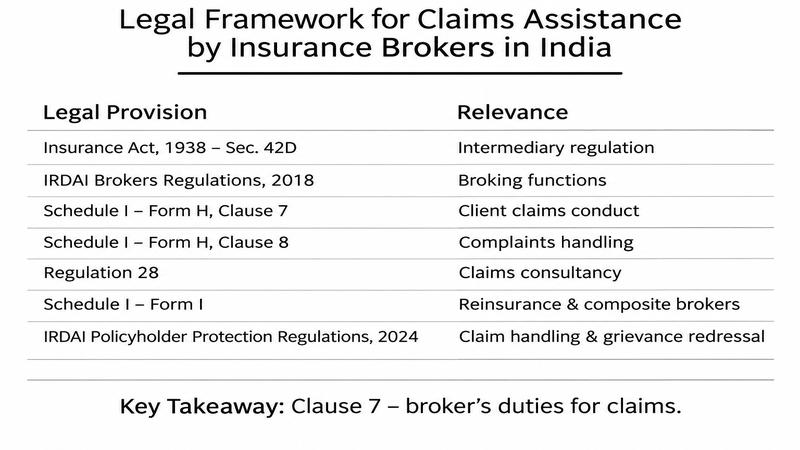
The most relevant provision is Clause 7 of Schedule I – Form H, which specifies the broker's duties when a client makes a claim. It covers timely notification, truthful disclosure, forwarding information and assisting the client in pursuing the claim. These requirements should be read with the applicable amendments and subsequent IRDAI directions.
Important Claims Assistance Duties Under Schedule I – Form H
The Code of Conduct places several specific responsibilities on insurance brokers when their clients experience an insured loss.
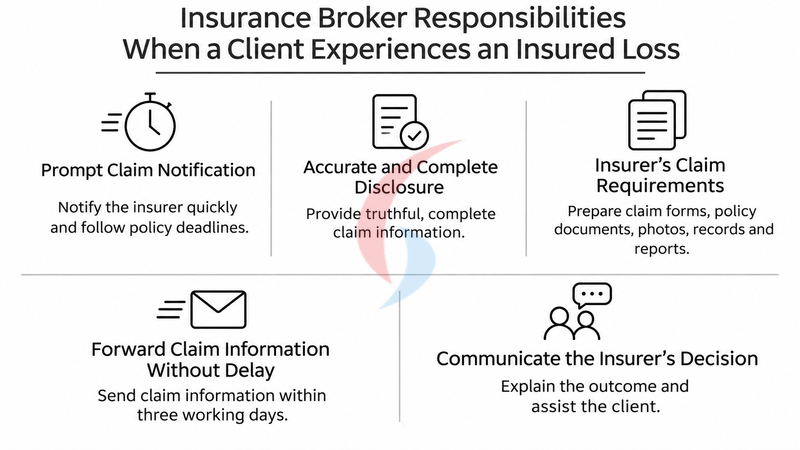
1. Explain the Importance of Prompt Claim Notification
Insurance brokers must explain that policyholders should notify their insurers promptly after an incident. Insurance policies may contain notification conditions and requirements for submitting documents within specified periods. For example, if Akansha waits several weeks before reporting the factory fire, the delay may create questions during claim assessment. Rajesh should explain the applicable notification requirements and help her communicate the incident without unnecessary delay.
2. Encourage Accurate and Complete Disclosure
Brokers must advise clients to provide truthful, fair and complete information relating to their claims. This includes material facts about the incident, damaged property and relevant circumstances. If Rajesh notices that Akansha has omitted important information about the factory's damaged machinery, he should request clarification. A broker should not help a customer submit misleading or fabricated information merely to increase the claim amount.
3. Explain the Insurer's Claim Requirements
Insurance brokers must promptly advise clients about the documentation and procedural requirements relevant to their claims. For a factory fire, these may include the claim form, policy documents, photographs, stock records, invoices and relevant incident reports. The exact documents depend on the type of policy and circumstances of loss.
4. Forward Claim Information Without Delay
One of the most important requirements under Schedule I – Form H is that the broker must forward information received from the client concerning a claim or an incident that may give rise to a claim without delay and, in any event, within three working days. This obligation applies to the broker's forwarding of information. It is not a universal deadline for the insurer to settle the claim.
5. Communicate the Insurer's Decision and Assist the Client
The broker must inform the client without delay about the insurer's claim decision or other relevant outcome. The broker must also provide reasonable assistance in pursuing the claim. If Akansha receives a request for additional documents or an explanation of deductions, Rajesh should help her understand the communication and coordinate the appropriate response.
For the professional responsibilities of authorised personnel, explore Qualified Persons in Insurance Broking
Step-by-Step Insurance Claim Assistance Process
An organised claims assistance process helps brokers protect customer interests and maintain accurate records.
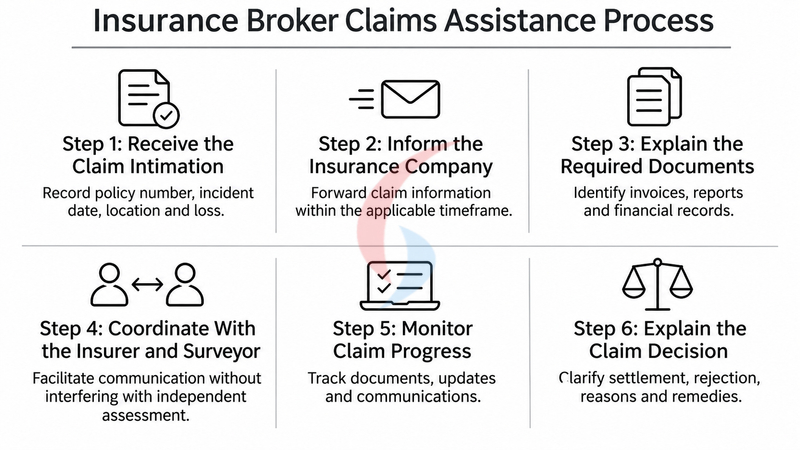
Step 1: Receive the Claim Intimation
The broker receives information about the accident, damage or insured event. The relevant policy number, date of incident, location and nature of loss should be recorded. The broker should explain the insurer's notification requirements and act promptly.
Step 2: Inform the Insurance Company
Claim-related information received from the client must be forwarded within the applicable regulatory timeframe. The broker should follow the insurer's claim notification procedure and preserve acknowledgements. Delays should be avoided because timely communication can be important for investigating the loss.
Step 3: Explain the Required Documents
The broker should identify the relevant documentation requirements based on the insurance policy and the insurer's instructions. Customers may need assistance understanding which invoices, reports or financial records support their claims. The broker should not encourage inaccurate declarations or unsupported loss calculations.
Step 4: Coordinate With the Insurer and Surveyor
Where applicable, the insurer may appoint a surveyor or loss assessor to examine the damage. The broker can facilitate communications and help the customer provide required information. However, the broker should not interfere with the surveyor's independent assessment.
Step 5: Monitor Claim Progress
The broker should follow up on outstanding documents, insurer communications and relevant developments. Customers should be informed about material updates and requests for clarification. All communications should be properly documented.
Step 6: Explain the Claim Decision
After the insurer communicates its decision, the broker should explain the outcome to the customer. If the claim is partially settled or rejected, the broker can help the customer understand the reasons and available remedies. The broker cannot independently overturn the insurer's decision.
To understand how client authorisation supports policy servicing, read our Insurance Broker Client Agreement and Mandate Letter
Documents Required for Insurance Claim Assistance
The necessary documents depend on the nature of the insurance policy and the event giving rise to the claim.
| Document | Purpose |
|---|---|
| Insurance Policy Copy | Establishes insurance coverage and applicable conditions |
| Claim Intimation | Records the reported incident |
| Claim Form | Provides information required for claim processing |
| Photographs or Videos | Helps establish the nature and extent of damage |
| Purchase Invoices | Supports the value or ownership of damaged property |
| Stock and Accounting Records | Helps determine relevant commercial losses |
| Fire Brigade or Police Report | Supports incident verification where applicable |
| Surveyor's Report | Records assessment by an appointed surveyor |
| Repair or Replacement Estimates | Supports assessment of repair or replacement costs |
| Bank Details | Facilitates payment where a claim is payable |
For example, Akansha's factory may need to provide machinery purchase invoices and stock records to support the claimed amount. The insurer may also request additional documents where justified by the circumstances and policy conditions. A broker should help the customer understand these requirements while avoiding unnecessary duplication and maintaining confidentiality.
Storytelling: Factory Fire Insurance Broker's Responsibilities
Akansha runs a manufacturing business in Faridabad. Her factory produces electrical components, employs nearly 80 workers and supplies products to customers across North India. To protect her business against unexpected losses, she purchased a fire and industrial insurance policy through an insurance broker named Rajesh.
For several months, everything went smoothly. Rajesh had helped Akansha compare insurance quotations, understand the coverage and purchase a policy suitable for her factory. However, one night, an electrical short circuit caused a fire in the storage area. Several machines were damaged, finished goods were destroyed and production stopped temporarily.
Akansha informed Rajesh the following morning. She was worried about the financial loss and did not know which documents the insurance company would require. She also wondered whether the insurer would appoint a surveyor and how long the settlement process might take.
Rajesh immediately explained the claim notification procedure, helped her communicate the incident to the insurer and advised her to preserve relevant evidence. He also coordinated with the insurance company's claims team and assisted with the required documents.
This situation highlights why Claims Assistance Duties of Insurance Brokers in India are important. An insurance broker's responsibilities do not necessarily end when a customer purchases a policy. Brokers have prescribed obligations concerning claim notification, communication, documentation and reasonable assistance in pursuing claims.
Difference Between Claims Assistance and Claims Consultancy
Insurance brokers must distinguish between ordinary assistance relating to policies they have arranged and separate claims consultancy services undertaken under Regulation 28. Claims assistance generally involves helping an existing client pursue a claim under a policy placed through the broker. Claims consultancy is a distinct regulated arrangement through which an insurance broker may provide consultancy concerning certain commercial general insurance claims, subject to prescribed conditions.
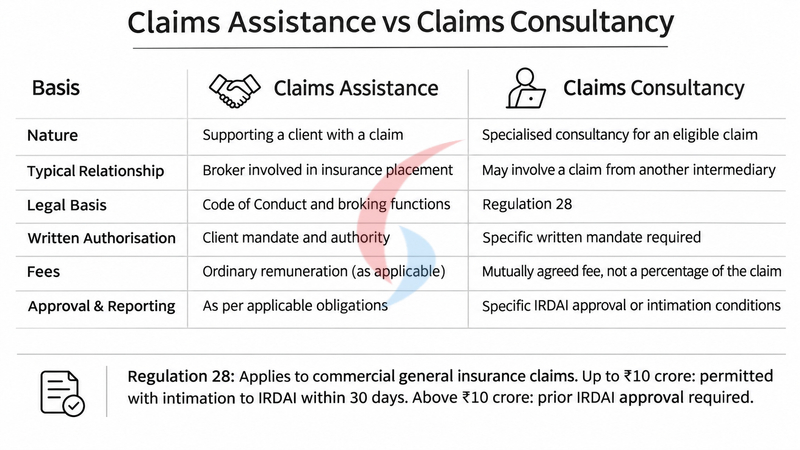
Under the published Regulation 28, separate claims consultancy is restricted to commercial lines of general insurance. For claims not exceeding Rs 10 crore, the regulation permits a qualifying consultancy arrangement where the claim does not arise from a policy placed by the same broker, with specified information to IRDAI within 30 days of acceptance. For claims exceeding Rs 10 crore, the published provision requires prior IRDAI approval. The broker must also obtain a written client mandate and cannot express the consultancy fee as a percentage of the claim. These are the published 2018 requirements and must be checked against subsequent amendments before accepting a consultancy engagement.
For professional service fees and remuneration conditions, explore our well explained article on Insurance Broker Commission and Remuneration Rules
Role of an Insurance Broker During Claim Rejection
A rejected insurance claim can create significant financial difficulties, particularly for small businesses. Suppose Akansha's insurer rejects part of her factory claim because certain damaged equipment falls outside the policy coverage. Rajesh should first help her understand the rejection letter and the policy provisions relied upon by the insurer. If Akansha believes relevant facts were overlooked, she may seek reconsideration through the insurer's grievance process. Rajesh can assist her in organising the relevant documentation and preparing an accurate explanation.
However, the broker should not promise that the claim will necessarily be approved. A claim's outcome depends on the insurance contract, supporting evidence, applicable law and the insurer's assessment. If the matter remains unresolved, the client may consider the available grievance redressal or legal remedies.
IRDAI Claim Settlement and Policyholder Protection Rules
The IRDAI (Protection of Policyholders' Interests, Operations and Allied Matters of Insurers) Regulations, 2024 strengthened requirements concerning customer service and claims handling. Insurers must follow applicable claims settlement procedures and communicate their decisions in accordance with the prescribed regulatory requirements. Claim processes must also take account of the obligations relating to documentation, fairness and policyholder protection.
A broker should understand these regulations so that customers receive appropriate guidance. However, obligations imposed directly on insurers should not automatically be described as statutory deadlines imposed on insurance brokers. For example, the period available to a broker for forwarding information under Schedule I – Form H is a different obligation from the timeframe applicable to insurer claim decisions. The applicable claim settlement requirements may vary between life, health, general and other insurance products.
For continuing customer service and compliance requirements, explore Insurance Broker Compliances in India
Insurance Broker Responsibilities in Claim Complaints
Insurance brokers must maintain suitable procedures for receiving and addressing client complaints. Schedule I – Form H requires brokers to accept complaints through permitted channels, maintain appropriate records and provide customers with information about the complaints-handling process. Where a customer is dissatisfied with the insurer's claim decision or grievance response, the customer may use the official IRDAI Bima Bharosa grievance portal.
Eligible policyholders may also approach the Council for Insurance Ombudsmen in accordance with the applicable jurisdiction and conditions. A broker can explain these options and help the customer organise relevant documents. However, the broker should not represent that filing a grievance guarantees claim approval. IRDAI's Bima Bharosa facility allows policyholders to register and monitor insurance grievances.Claims Assistance Duties of Direct, Reinsurance and Composite Brokers
Different insurance broker categories perform different functions, and their claims-related activities must remain within their authorised scope.
| Broker category | Claims-related function |
|---|---|
| Direct Insurance Broker | Assists customers with claims under direct insurance policies |
| Reinsurance Broker | Assists insurance company clients with reinsurance claims and settlements |
| Composite Insurance Broker | Performs permitted direct and reinsurance claims-related functions |
Direct brokers may assist policyholders by coordinating documentation and communicating with insurers. Reinsurance brokers perform specialised functions involving the insurance companies and reinsurers they serve. Schedule I – Form I also imposes additional conduct obligations on reinsurance and composite brokers, including arrangements involving claims and the handling of relevant insurance monies.
Record-Keeping Requirements for Insurance Claims
Insurance brokers should maintain adequate documentation supporting the claims assistance they provide. This helps demonstrate that client instructions were handled properly and relevant information was forwarded without unnecessary delay. Important records include claim notifications, correspondence, documents received, insurer acknowledgements, survey-related communications and the final claim decision.
For example, Rajesh should retain copies of the documents received from Akansha and evidence of when those documents were forwarded to the insurer. The records should be maintained in accordance with applicable IRDAI information-maintenance requirements and the broker's approved retention policies.
Common Mistakes Insurance Brokers Should Avoid
Insurance brokers sometimes delay forwarding client claim information or fail to explain important notification requirements. Such mistakes may complicate the claim process and raise regulatory concerns. Other problems arise when brokers promise guaranteed settlements, submit incomplete documents or fail to maintain records of communications with insurers. Brokers should also avoid undertaking separate claims consultancy without examining the applicable Regulation 28 conditions. Clear communication, accurate documentation and professional conduct remain essential throughout claims assistance.
Why Choose Compliance Calendar LLP?
Claims assistance is an important responsibility for businesses operating under an IRDAI-regulated insurance broker registration. Insurance brokerage companies must maintain suitable customer-service procedures, qualified personnel and regulatory documentation.
Compliance Calendar LLP assists businesses with insurance broker registration and related regulatory compliance. Our team helps organisations understand the applicable licensing, documentation and operational requirements.
For assistance with insurance broker registration and regulatory compliance, contact Compliance Calendar LLP at +91 9988424211 or info@ccoffice.in
Frequently Asked Questions (FAQs)
Q1. What are the claims assistance duties of an insurance broker?
Ans. Insurance brokers help clients understand claim procedures, provide documentation and communicate with insurers. They must forward relevant claim information promptly and provide reasonable assistance in pursuing claims. Their responsibilities are prescribed under the applicable IRDAI Code of Conduct.
Q2. Can an insurance broker settle an insurance claim?
Ans. An insurance broker can assist the customer during the claim process but does not ordinarily have authority to approve or reject claims. The insurance company evaluates claims under the policy and applicable law. Brokers may help clients understand settlement decisions and available remedies.
Q3. Within how many days must a broker forward claim information?
Ans. Under Clause 7 of Schedule I – Form H, brokers must forward relevant claim information without delay and, in any event, within three working days. This obligation concerns forwarding information received from the client. It is not the deadline for the insurer's final settlement.
Q4. Is a written mandate necessary for claims consultancy?
Ans. Yes, Regulation 28 requires a written client mandate for a separate claims consultancy engagement. The mandate authorises the broker to represent the client concerning the relevant claim. Ordinary claims assistance and separate claims consultancy should not be confused.
Q5. Can insurance brokers charge fees for claims consultancy?
Ans. The published Regulation 28 permits mutually agreed fees for qualifying claims consultancy services. However, the consultancy fee cannot be expressed as a percentage of the claim. Other applicable restrictions and conditions must also be satisfied.
Q6. Can a broker help when an insurance claim is rejected?
Ans. Yes, a broker may assist the client in understanding the rejection reasons and organising supporting documents. The customer may seek reconsideration through the insurer's grievance process. The broker cannot guarantee that the rejection will be reversed.
Q7. Are insurance brokers responsible for claim documentation?
Ans. Brokers must explain relevant claim requirements and provide reasonable assistance to clients. The policyholder remains responsible for submitting truthful information and supporting documents. Brokers should maintain records of documents received and communications forwarded.
Q8. Can an insurance broker assist with health insurance claims?
Ans. Yes, brokers can provide assistance relating to health insurance policies within their authorised functions. They may help customers understand claim procedures and communicate with insurers or relevant service providers. Claim decisions remain subject to the applicable insurance contract and regulations.
Q9. Where can a policyholder complain about an insurance claim?
Ans. A policyholder should first approach the insurer's grievance redressal mechanism. If the matter remains unresolved, the customer may use IRDAI's Bima Bharosa portal. Eligible complaints may also be submitted to the Insurance Ombudsman.
Q10. Is claims assistance mandatory for insurance brokers?
Ans. The IRDAI Insurance Brokers Regulations prescribe specific claims-related duties under Schedule I – Form H. These include timely forwarding of information, communication of insurer decisions and reasonable assistance to clients. Brokers must comply with these obligations while conducting their regulated business.
Article last updated on : 21 Nov 2026.













































































_learn_crop10_thumb.jpg)