


Foreign Direct Investment (FDI) has become an important source of funding for Indian businesses looking to expand internationally. While private limited companies are commonly associated with foreign investment, Limited Liability Partnerships (LLPs) can also receive investment from overseas investors under specific conditions. However, FDI Compliance in LLP and RBI Reporting involves different eligibility requirements, reporting forms, valuation rules and regulatory procedures compared to investment in Indian companies.
An LLP planning to accept foreign capital must examine the Foreign Exchange Management Act, 1999 (FEMA), the Foreign Exchange Management (Non-Debt Instruments) Rules, 2019 and applicable RBI reporting regulations. Not every LLP is eligible to receive FDI, even when its business activities are otherwise legally permitted in India. This article explains the complete FDI compliance process for LLPs in India, including foreign investment eligibility, capital contribution, RBI FIRMS portal reporting, Forms LLP(I) and LLP(II), valuation requirements, annual filings and the practical challenges businesses may face in 2026.
Compliance Calendar LLP provides professional guidance on RBI FEMA Compliance, foreign investment documentation, FEMA Due Diligence and regulatory reporting. Our team assists businesses with reviewing investment structures, preparing supporting records, coordinating with AD Banks and addressing reporting-related queries
What Is FDI in a Limited Liability Partnership?
FDI in an LLP refers to eligible investment made by a person resident outside India in an Indian Limited Liability Partnership through capital contribution or other permitted arrangements relating to profit-sharing interests. An LLP is a separate legal entity formed under the Limited Liability Partnership Act, 2008. It combines certain features of a partnership with limited liability protection for its partners. Unlike a company, an LLP does not ordinarily issue equity shares. Consequently, foreign investment in an LLP is structured around its capital contribution and profit-sharing arrangements.
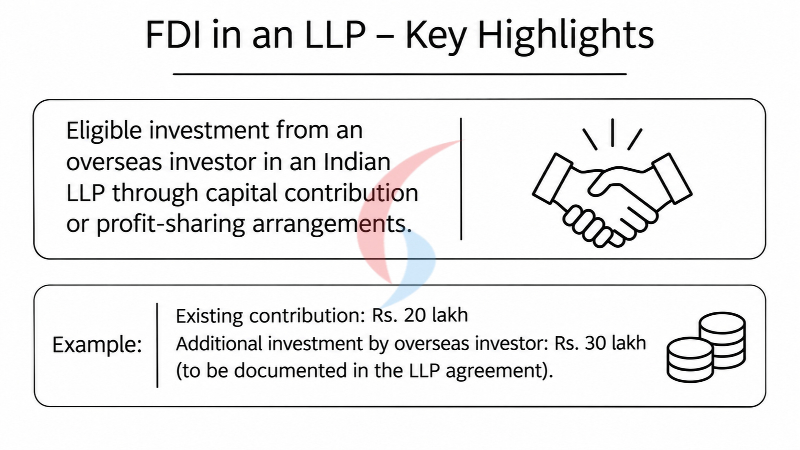
For example, suppose an Indian LLP has an existing capital contribution of Rs. 20 lakh and an eligible overseas investor contributes Rs. 30 lakh as additional capital. The investment must be evaluated under the applicable foreign investment rules, and the commercial arrangement must be properly documented. The investor's capital contribution and agreed profit share should be reflected in the LLP agreement and relevant statutory records.
Legal Governing FDI Compliance in LLP
Foreign investment in LLPs is governed by several interconnected laws and regulations.
| Legal Provision | Key Requirements |
| FEMA, 1999 | Regulates foreign exchange and cross-border investments. |
| FEMA Non-Debt Instruments Rules, 2019 | Governs FDI eligibility, sectoral restrictions and capital contributions in LLPs. |
| FEMA Reporting Regulations, 2019 | Prescribes foreign investment reporting forms and requirements. |
| LLP Act, 2008 | Governs LLP incorporation, partners and statutory compliance. |
These regulations operate together. An LLP cannot rely only on its incorporation documents or commercial agreement to establish FEMA compliance.
Foreign investment in LLPs requires compliance with FEMA regulations, sectoral conditions and RBI reporting requirements. Read our guide on FEMA Compliance 2026: Latest Rules and Updates to understand the broader regulatory framework.
Eligibility for FDI in LLP
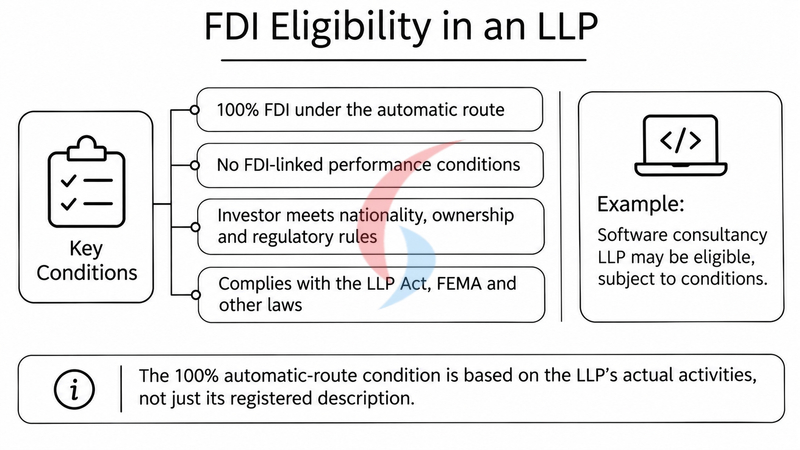
One of the most important conditions is that foreign investment is not permitted in every business sector merely because the business is organised as an LLP. Under Schedule VI of the Non-Debt Instruments Rules, el.igible foreign persons and entities may contribute to an Indian LLP operating in sectors where:
-
100% foreign investment is permitted under the automatic route.
-
No FDI-linked performance conditions apply.
-
The investor satisfies the applicable nationality, ownership and regulatory restrictions.
-
The investment complies with the LLP Act, FEMA and other relevant laws
Certain investors, including persons covered by specified restrictions and Foreign Portfolio Investors or Foreign Venture Capital Investors acting in those capacities, do not qualify under the general Schedule VI permission.
For example, an LLP providing ordinary software consultancy services may be eligible for foreign investment after confirming its actual activities and applicable sectoral conditions. In contrast, an LLP operating in a sector subject to FDI-linked performance requirements cannot assume that the same automatic-route permission applies.
Important: The 100% automatic-route condition must be assessed with reference to the LLP's actual activities, not merely its registered business description.
Before accepting foreign investment, LLPs should verify investor eligibility, sectoral restrictions, valuation and transaction documentation. Our article on FEMA Due Diligence: Process, Checklist and Compliance explains how businesses can identify potential compliance gaps.
Storytelling: How Foreign Investment Created an Unexpected Compliance Challenge
Rohan and Meera started Bridge Solutions LLP, a technology consulting business in Bengaluru. After two years of successful operations, they received an investment offer of Rs. 80 lakh from a Singapore-based investor to expand their business.
The founders were excited and planned to accept the funds immediately. However, their compliance consultant informed them that foreign investment in LLPs is permitted only in sectors allowing 100% FDI under the automatic route without FDI-linked performance conditions.
After verifying the LLP's eligibility, preparing the required documents and completing the investment formalities, the founders received the funds through their AD Bank. They then completed the applicable Form LLP(I) reporting on the RBI FIRMS portal within the prescribed timeline.
Key Takeaway: Receiving foreign investment is not enough. LLPs must verify FDI eligibility and complete the applicable FEMA and RBI reporting requirements to avoid compliance difficulties.
Can a Foreign Individual Become a Partner in an Indian LLP?
Yes. An eligible person resident outside India may become a partner in an Indian LLP by making a permitted investment, subject to the applicable FEMA and LLP requirements. The foreign investor may be an individual or an eligible overseas entity.
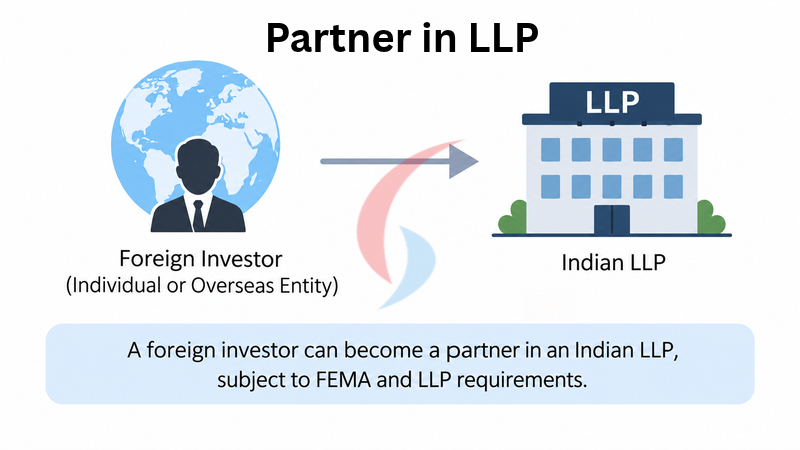
However, several issues must be considered before admitting a foreign partner. These include the person's FEMA residential status, applicable country-specific restrictions, source of investment funds, proposed capital contribution and agreed profit-sharing rights. The LLP must also ensure that its designated partner requirements are satisfied under the LLP Act.
For example, an Indian LLP cannot assume that an overseas investor automatically qualifies as a resident designated partner merely because the investor frequently visits India. The requirements of the LLP Act and the FEMA definition of residence must be examined independently.
Capital Contribution and Profit-Sharing Rules for Foreign Investors
Foreign investment in an LLP is generally made through eligible capital contribution. The agreement may also provide the foreign investor with an agreed share of profits. However, capital contribution and profit share are not necessarily the same percentage.
For example, suppose an Indian LLP has two existing partners and admits an eligible foreign investor contributing Rs. 40 lakh. The partners may agree on a particular profit-sharing ratio based on commercial negotiations, subject to applicable laws and fair valuation requirements.
A higher capital contribution does not automatically establish a proportionate profit share unless the LLP agreement provides accordingly. Schedule VI also recognises investment by way of profit share as reinvestment of earnings. The nature of any acquisition or transfer of profit-sharing rights must therefore be carefully examined before determining the reporting requirements. All arrangements should be supported by appropriate agreements and accounting records.
Valuation Requirements for FDI in LLP
Valuation is an important part of determining the permissible price for foreign investment in an LLP. RBI's foreign investment framework refers to fair pricing based on internationally accepted valuation norms adopted according to market practice. A Valuation Certificate may be issued by an appropriately qualified Chartered Accountant, practising Cost Accountant or approved valuer, in accordance with the applicable requirements.
For an investment involving a resident transferring an LLP interest to a non-resident, the consideration generally must not be below the applicable fair price. In the opposite direction, the relevant ceiling pricing principle generally applies. Consider an example where an Indian resident partner proposes to transfer an LLP interest valued at Rs. 25 lakh to a foreign investor. The transaction must be evaluated against the applicable pricing rules rather than using an arbitrary value agreed between the parties. Valuation documentation supports the commercial arrangement and helps the AD Bank examine the transaction during RBI reporting.
Proper valuation helps establish fair pricing for capital contribution and profit-sharing transactions involving foreign investors. Learn more about the Need for a Valuation Report under FEMA Law and its importance in foreign investment compliance.
RBI Reporting Requirements for Foreign Investment in LLP
RBI reporting is one of the most important responsibilities following foreign investment in an LLP. Unlike a private limited company, which generally reports eligible equity issuance through Form FC-GPR, an LLP uses the specific forms prescribed for its capital contribution and profit-sharing transactions.
| RBI Reporting Form | Purpose | Filing Deadline |
|---|---|---|
| Form LLP(I) | Receipt of consideration for capital contribution or acquisition of profit share | Within 30 days from receipt of consideration |
| Form LLP(II) | Transfer or disinvestment of capital contribution or profit share between resident and non-resident | Within 60 days from receipt of funds |
| FLA Return | Annual reporting of qualifying outstanding foreign liabilities and assets | 15 July each year |
These timelines are supported by RBI's reporting regulations and regulatory returns list.
Foreign investment reporting is an important compliance requirement for Indian entities receiving capital from overseas investors. Explore our guide on RBI FEMA/FDI Reporting: EMF, SMF Filing, FC-TRS and FLA Return for an overview of the reporting
Process for FDI Reporting in LLP through RBI FIRMS Portal
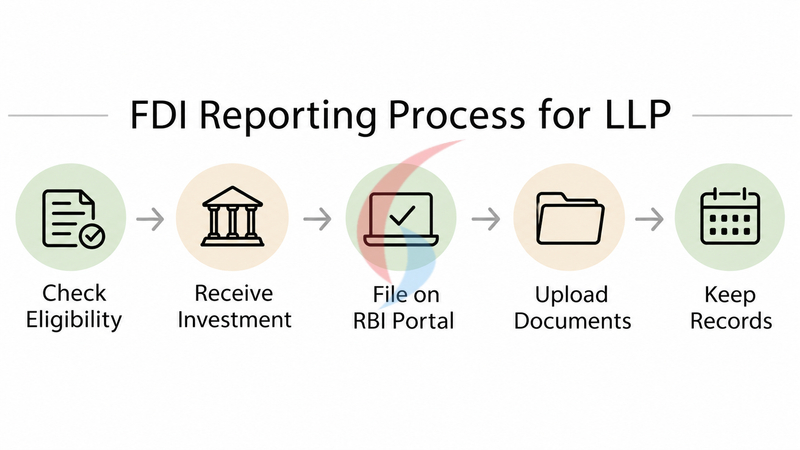
Step 1: Verify Foreign Investment Eligibility
Check whether the LLP operates in a sector allowing 100% FDI under the automatic route without FDI-linked performance conditions. Verify the foreign investor's eligibility and applicable requirements under Schedule VI of the FEMA Non-Debt Instruments Rules, 2019.
Step 2: Prepare Investment Documents
Collect the LLP agreement, investor details, capital contribution documents and required approvals. Ensure that valuation requirements are satisfied and necessary amendments to the LLP agreement and statutory filings are completed.
Step 3: Receive Investment Through a Permitted Banking Channel
Receive foreign investment through an Authorised Dealer (AD) Category-I Bank or another permitted route. Obtain the necessary inward remittance documents and ensure compliance with RBI regulations, including the applicable January 2025 amendments.
Step 4: Register or Update the Entity Master
Access the RBI FIRMS Portal and register or update the LLP's Entity Master details. Complete the required Entity User and Business User registration before submitting the applicable foreign investment return.
Step 5: Complete Form LLP(I) or LLP(II)
Select Form LLP(I) for reporting eligible capital contribution or profit-sharing investment and Form LLP(II) for applicable transfers. Enter the investor information, investment amount, remittance details and other required particulars accurately.
Step 6: Upload Documents and Submit
Upload the prescribed investment documents, valuation certificate and relevant bank records through the RBI FIRMS portal. Submit the application for AD Bank verification and respond to any clarification or correction requests.
Step 7: Maintain Records and Monitor Ongoing Compliance
Maintain copies of RBI filings, remittance records, valuation certificates and updated LLP agreements. Monitor future changes in capital contribution, profit-sharing arrangements and applicable annual FLA Return filing requirements.
Incorrect Entity Master details or inconsistent investment information can create difficulties during RBI reporting. Our guide on Correcting Errors in RBI Entity Master and SMF explains common discrepancies and the relevant correction process.
Documents Required for FDI Compliance in LLP
The AD Bank and compliance professional may require the following documents, depending on the investment structure.
| Document | Purpose |
|---|---|
| LLP incorporation certificate and LLPIN | Establish legal existence |
| LLP agreement and supplementary agreement | Verify capital and profit-sharing arrangements |
| PAN and KYC documents | Establish LLP and investor identity |
| Foreign investor incorporation or identity documents | Verify investor eligibility |
| Bank remittance advice and FIRC/FIRA, as applicable | Establish receipt of investment |
| Valuation certificate | Support pricing compliance |
| Partner consent or resolution | Evidence approval of the transaction |
| Applicable MCA filing acknowledgements | Establish statutory changes |
| Relevant declarations | Support regulatory verification |
The bank may request additional documents relating to ownership, control, investment source or transaction structure.
Downstream Investment by an LLP Having FDI
Downstream investment occurs when an Indian entity with foreign investment invests in another Indian entity. An LLP with foreign investment may undertake eligible downstream investment, but additional restrictions apply. The applicable framework permits downstream investment by an LLP that is not owned and controlled by resident Indian citizens, or that is owned or controlled by persons resident outside India, into an Indian company operating in a sector where 100% FDI is permitted under the automatic route without FDI-linked performance conditions.
Indirect foreign investment in an LLP is also subject to relevant conditions. The investing LLP should examine ownership and control, sector eligibility, downstream investment reporting and other applicable requirements before completing the transaction.
Can a Company Having FDI Be Converted into an LLP?
Yes, an Indian company with foreign investment may be converted into an LLP under the automatic route where the relevant conditions are satisfied. The business must operate in a sector where 100% FDI is permitted under the automatic route and no FDI-linked performance conditions apply.
The conversion must also comply with the LLP Act and applicable corporate law procedures. For example, a wholly foreign-owned Indian software consultancy company may examine conversion into an LLP if its business activities and ownership arrangement satisfy the applicable conditions. However, companies should not treat conversion as a way to avoid sectoral restrictions or outstanding FEMA obligations.
Common FDI Compliance Mistakes Made by LLPs
One frequent mistake is assuming that all LLPs can receive foreign investment. Another is treating capital contribution as equivalent to a company share issuance and attempting to use Form FC-GPR instead of Form LLP(I). Some LLPs receive funds before establishing the investor's eligibility, documenting valuation or confirming the appropriate remittance classification. Others complete their initial investment reporting but overlook subsequent LLP(II) requirements when partners transfer their interests.
Annual FLA reporting is another area where errors arise, particularly when businesses assume that submitting Form 11 and Form 8 under the LLP Act satisfies every annual compliance obligation. Delayed or inaccurate reporting may attract a Late Submission Fee or require further regulatory action, depending on the nature of the contravention. For this reason, maintaining an internal compliance calendar and retaining investment records is especially useful for LLPs with foreign partners.
Delayed reporting and certain foreign exchange violations may require additional compliance action under FEMA. Explore our guide on FEMA Compounding Rules 2024: Key Amendments for the framework governing eligible contraventions.
Why Choose Compliance Calendar LLP?
Managing foreign investment in an LLP requires an understanding of FEMA regulations, sectoral eligibility, valuation requirements, banking documentation and RBI reporting procedures.
Whether an LLP is receiving its first overseas capital contribution or transferring existing partner interests to a non-resident investor, proper compliance planning can help reduce documentation errors and avoid preventable filing delays.
For assistance, businesses can contact Compliance Calendar LLP at +91 9988424211 or info@ccoffice.in
Frequently Asked Questions (FAQs)
1. Is FDI allowed in an LLP in India?
Yes, Foreign Direct Investment (FDI) is permitted in Indian LLPs operating in sectors where 100% FDI is allowed under the automatic route. The sector must not have any FDI-linked performance conditions. The LLP must also comply with applicable FEMA regulations, RBI guidelines and other investment restrictions.
2. Which RBI form is required for initial FDI in an LLP?
Form LLP(I) is required when an Indian LLP receives foreign investment towards capital contribution or acquisition of profit-sharing interests. The form is submitted through the RBI FIRMS portal under the Single Master Form (SMF) system. The LLP must provide relevant investor details, remittance information and supporting documents.
3. What is the deadline for filing Form LLP(I)?
Form LLP(I) must generally be filed within 30 days from the date of receiving foreign investment consideration. The LLP should ensure that the required documents and remittance details are available before filing. Delayed reporting may attract a Late Submission Fee under the applicable RBI regulations.
4. What is Form LLP(II)?
Form LLP(II) is used to report applicable transfers or disinvestment of capital contribution or profit-sharing interests between residents and non-residents. Such transactions must comply with FEMA pricing, eligibility and documentation requirements. The reporting must generally be completed within 60 days from the date of receipt of funds.
5. Is Form FC-GPR applicable to LLPs?
No, Form FC-GPR is generally applicable to Indian companies issuing equity instruments to foreign investors. LLPs do not issue equity shares in the same manner as companies. Therefore, foreign investment in LLPs is reported through Form LLP(I) or Form LLP(II), depending on the transaction.
6. Is a valuation certificate necessary for FDI in LLP?
Applicable FEMA pricing rules require LLP capital contribution and profit-sharing interests to be valued using internationally accepted valuation principles. The valuation must be supported by a qualified professional as prescribed under the regulations. Proper valuation helps establish compliance with investment pricing requirements and supports AD Bank verification.
7. Can an NRI become a partner in an LLP?
Yes, a Non-Resident Indian (NRI) can become a partner in an Indian LLP, subject to applicable FEMA regulations and investment conditions. The permitted investment route depends on factors such as repatriation rights, sectoral eligibility and the investor's status. Certain NRI and OCI investments on a non-repatriation basis are governed by separate provisions.
8. Is the FLA Return mandatory for LLPs having foreign investment?
An LLP with reportable outstanding foreign liabilities or foreign assets must generally submit the Annual Return on Foreign Liabilities and Assets FLA Return. The return is ordinarily due by 15 July each year through the RBI FLAIR portal. The filing requirement depends on the LLP's foreign investment position and applicable RBI reporting conditions.
9. What happens if an LLP misses an RBI reporting deadline?
Failure to submit the required RBI reporting forms within the prescribed timeline may result in a Late Submission Fee (LSF). Certain contraventions may also require additional regulatory compliance or compounding under FEMA. LLPs should address reporting delays promptly and coordinate with their Authorised Dealer Bank.
10. Can a foreign-owned company convert into an LLP?
Yes, a company having foreign investment may convert into an LLP if it satisfies the applicable FEMA and LLP Act requirements. Such conversion is generally permitted under the automatic route where 100% FDI is allowed without FDI-linked performance conditions. The company must also complete the prescribed conversion procedures, documentation and applicable regulatory filings.
Article last updated on : 23 Nov 2026.











































































_learn_crop10_thumb.jpg)