


The issuance of a PAN Card for Foreign Nationals and Body Corporate is an important part of India's tax identification system. A PAN helps the Income Tax Department identify taxpayers and enables applicants to complete transactions requiring tax identification. Foreign applicants must understand the appropriate application form, eligibility conditions, documentary requirements and verification procedures. For overseas companies planning to invest or establish business operations in India, PAN registration may also form part of broader regulatory preparations involving FEMA Compliance, FEMA Due Diligence and RBI FEMA Compliance. These requirements help businesses manage foreign investment documentation, cross-border transactions and applicable reporting obligations.
Importantly, the PAN application system changed on 1 April 2026. The earlier Form 49AA has been replaced by separate application forms for foreign individuals and foreign entities under the Income-tax Rules, 2026. This article explains the current legal requirements, application process, documentation, fees and common challenges involved in obtaining a PAN for foreign citizens and overseas body corporates in India.
What Is a PAN Card and Why Is It Important for Foreign Applicants?
A Permanent Account Number is a unique ten-character alphanumeric identifier issued by the Income Tax Department of India. It is used to identify taxpayers and connect their relevant tax and financial records. PAN is not restricted to Indian citizens. A foreign national or an overseas body corporate may also require PAN when undertaking activities that create Indian tax obligations or involve transactions for which quoting PAN is prescribed.
For example, a German citizen receiving taxable employment income in India may require PAN for income tax reporting and tax deduction purposes. Similarly, a Singapore-based company receiving taxable income from an Indian business arrangement may need PAN depending on the applicable provisions. However, PAN does not establish Indian citizenship, residential status or permission to conduct business in India. It is a tax identification number, and obtaining it does not automatically create an Indian tax liability.
PAN application services have undergone significant changes to improve taxpayer identification and digital processing in India. Readers can explore our article on PAN 2.0: Transforming Taxpayer Services in the Digital Era to understand the broader modernisation of PAN services.
Legal Provisions Governing PAN Issuance in India
The legal requirements for PAN allotment are governed by the Income-tax Act, 2025 and the Income-tax Rules, 2026, effective from 1 April 2026. Section 262 of the Income-tax Act, 2025 deals with Permanent Account Numbers, while Rule 158 of the Income-tax Rules, 2026 prescribes relevant application procedures and supporting documents.
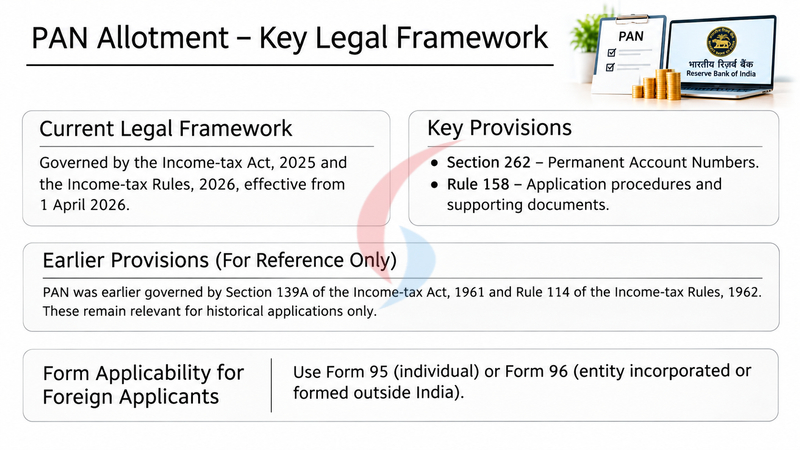
Earlier, PAN applications were governed by Section 139A of the Income-tax Act, 1961 and Rule 114 of the Income-tax Rules, 1962. These earlier provisions remain relevant when examining historical applications but should not be presented as the operative form requirements for new applications in November 2026. The Income Tax Department has confirmed the revised application forms and their applicability to Indian and foreign applicants
| Applicant Category | Earlier Form | Applicable Form from 1 April 2026 |
|---|---|---|
| Indian citizen | Form 49A | Form 93 |
| Indian company or entity | Form 49A | Form 94 |
| Foreign national | Form 49AA | Form 95 |
| Foreign body corporate or foreign entity | Form 49AA | Form 96 |
Foreign applicants should therefore use Form 95 or Form 96, depending on whether the applicant is an individual or an entity incorporated or formed outside India.
Who Can Apply for PAN in India?
PAN applications are available to foreign nationals and foreign entities that require tax identification for their activities or transactions in India. Foreign individuals may include overseas employees, directors of Indian companies, investors, consultants, non-resident property owners and other persons with relevant Indian financial or tax obligations. Foreign body corporates may include companies incorporated outside India, overseas investment entities and other foreign organisations undertaking activities that require Indian PAN registration.
However, PAN is not automatically mandatory for every foreign director, shareholder or overseas company merely because of their foreign status. The requirement depends on the applicable tax provisions, transactions, reporting obligations and exemptions. A foreign company investing in an Indian business should therefore assess its PAN requirement separately from its FEMA, FDI and corporate law obligations.
Foreign companies operating or investing in India may also have corporate law obligations beyond PAN registration. Read our guide on Foreign Companies under the Companies Act, 2013 to understand their applicable registration and reporting requirements.
Storytelling: How a Singapore Company Faced a PAN Problem Before an Indian Business Transaction
Consider the fictional story of Daniel Wong, a Singapore-based entrepreneur who had built a successful technology consulting company, PacificBridge Solutions Pvt. Ltd. After working with international clients for several years, Daniel decided to expand the company's commercial activities into India. His business identified an opportunity to provide technology solutions to an Indian enterprise under a long-term agreement. The discussions progressed smoothly. The parties agreed on the commercial terms, payment milestones and service requirements.
However, during the documentation stage, the Indian company's finance department asked PacificBridge to provide its Indian PAN details for tax compliance purposes.
Daniel was confused.
His company was incorporated in Singapore, maintained its principal office there and already possessed a Singapore tax identification number. He initially believed that obtaining a separate Indian PAN would be unnecessary.
After consulting an Indian tax professional, Daniel learned that the company's PAN requirement needed to be examined in light of the proposed transaction, Indian tax obligations and applicable treaty provisions. The consultant also explained that Daniel's personal PAN and PacificBridge's corporate PAN were different matters. A PAN issued to Daniel would not replace the identification number required by his company.
The company decided to apply for PAN through the appropriate foreign-entity application process. It gathered its registration documents, verified its legal name and tax identification details, and arranged the necessary authorisation.
During document review, one problem emerged. The company's trading name appeared on certain documents, while its full registered legal name appeared on the incorporation certificate.
The consultant advised Daniel to use the exact registered legal name supported by the incorporation records. After correcting the documentation, PacificBridge submitted its application for processing. The experience helped Daniel understand that cross-border business expansion involves more than signing contracts. Even a basic tax identification requirement can affect the documentation and practical execution of international transactions.
Important: Foreign companies should examine their Indian PAN requirements before entering major business arrangements, rather than waiting until payment or tax documentation becomes urgent.
Documents Required for PAN Card for Foreign Nationals
Foreign citizens applying through Form 95 must provide prescribed supporting documents to establish their identity, date of birth and address. Under Rule 158 of the Income-tax Rules, 2026, accepted documents include several alternatives.
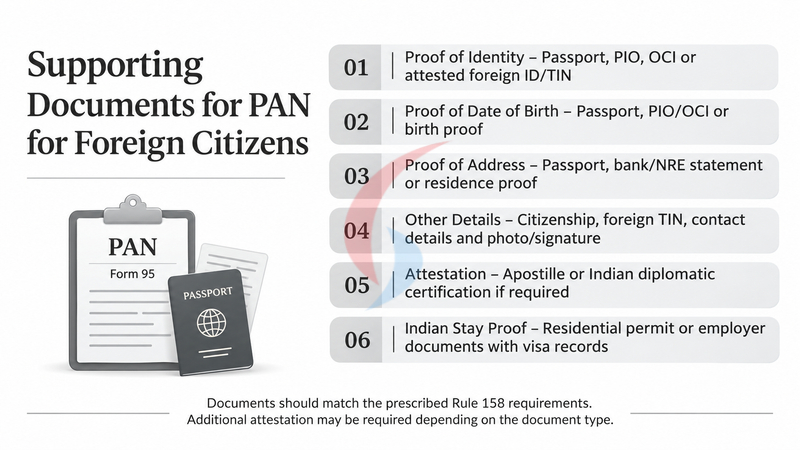
Where a foreign identification document requires attestation, an Apostille or prescribed Indian diplomatic certification may be necessary. The exact treatment depends on the document and the applicable requirements. Foreign nationals staying in India may also use specified Indian address evidence, such as qualifying residential permits or employer-issued address documentation supported by the prescribed visa and employment records. The Income Tax Department's official PAN guidance provides the recognised documentation categories for foreign applicants.
Understanding the legal distinction between a company and a body corporate can help foreign applicants identify their correct entity classification. Read our article on the Difference Between Company and Body Corporate for a clearer explanation.
Documents Required for PAN Card for Foreign Body Corporate
A foreign body corporate applying for a PAN Card in India must submit documents that establish its legal identity, registered address and incorporation details. Unlike foreign individuals, overseas companies are required to provide business registration documents instead of personal identity proofs. Proper documentation is important to avoid application rejection or unnecessary delays. The following documents are generally required for PAN Card issuance to a foreign body corporate:
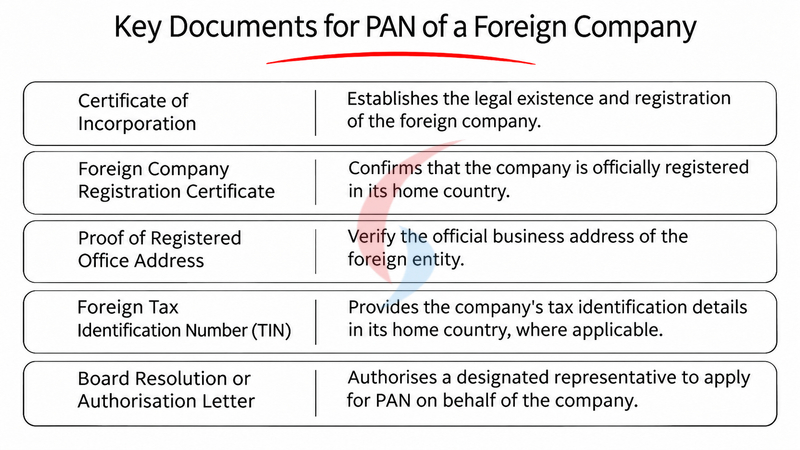
Foreign businesses establishing an Indian subsidiary must distinguish the tax identification and compliance responsibilities of the parent company and its Indian subsidiary. Learn more about Foreign Subsidiary Company/WOS Registration in India and the associated documentation requirements
Process for Issuance of PAN Card to Foreign Nationals and Body Corporate
The PAN application process can be completed through authorised PAN service providers, including Protean eGov Technologies Limited and UTIITSL. Applications may be submitted online or through designated service centres, as applicable.
Step 1: Identify the Correct PAN Application Form
The first step is to determine the applicant's legal category. A foreign citizen must generally select Form 95, while a foreign company or another entity formed outside India must select Form 96. Selecting the wrong form can result in processing difficulties because the identification fields and supporting document requirements differ between individual and non-individual applicants.
Step 2: Collect and Verify Supporting Documents
Applicants should gather their identification, address and tax registration documents before beginning the application. For foreign individuals, the name and date of birth should match the prescribed identity evidence. Foreign body corporates should ensure that the legal name matches their overseas incorporation records. Where documents require attestation or an Apostille, the authentication should be completed according to the applicable rules.
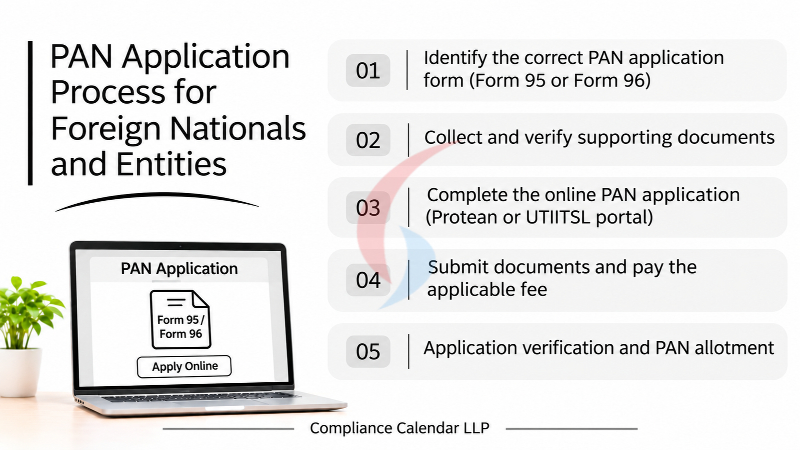
Step 3: Complete the Online PAN Application
The applicant can visit the Protean PAN Application Portal or the UTIITSL PAN Portal. The prescribed form must be completed with the applicant's legal particulars, address, nationality or country of incorporation, Tax Identification Number and other required information. Foreign applicants should also review the applicable Assessing Officer code and authorised representative fields.
Step 4: Submit Documents and Pay the Applicable Fee
After completing the application, the applicant must follow the selected provider's prescribed payment and submission process. Depending on the chosen submission method, this may involve sending signed acknowledgements and supporting documents or using an eligible electronic authentication method. Payment alone does not mean that PAN has been allotted. The application must undergo verification.
Step 5: Application Verification and PAN Allotment
The PAN processing system verifies the submitted information and supporting evidence. If the application contains incomplete information or documentary inconsistencies, clarification or resubmission may be required. Once the application is accepted and processed, PAN is allotted according to the prescribed procedure. Applicants can track their applications using the acknowledgement or reference number generated during submission.
PAN Application Fees for Foreign Nationals and Foreign Companies
The application charges depend on the selected service, submission method and whether a physical PAN card must be delivered within India or abroad. The Income Tax Department's 2026 guidance provides the following fee information:
| Service | Stated Fee |
|---|---|
| Physical PAN card dispatched to an Indian address | Rs. 107 |
| Physical PAN card dispatched outside India | Rs. 1,017 |
| Application submitted at a PAN centre | Rs. 72 |
| Eligible online paperless application | Rs. 66 |
The official guidance also refers to an e-PAN option without a physical card. These fee categories represent different service and submission arrangements and should not automatically be added together. Applicants should verify the final amount displayed by the service provider before payment.
PAN Mandatory for Every Foreign National and Body Corporate?
PAN requirements depend on the nature of the person's transactions, relevant statutory thresholds, tax filing obligations and applicable exemptions. For example, a foreign individual earning income chargeable to tax in India may require PAN for tax administration. A non-resident investing in Indian securities may also be subject to specific identification requirements, subject to relevant regulatory exceptions.
Foreign companies receiving payments from India should examine the Indian tax treatment of those payments, including whether withholding tax applies. Certain non-residents may benefit from specific PAN-related exceptions where the prescribed conditions are satisfied. In particular, applicable provisions may allow specified information and documentation to be furnished instead of PAN for particular transactions. Therefore, PAN should not be treated as universally compulsory merely because an individual or business is located outside India.
Foreign nationals appointed as directors in Indian companies may need to comply with additional identification and corporate governance requirements. Explore our detailed guide on Compliances under Companies Act in Case of Foreign Directors on Board
PAN Card, TDS and Double Taxation Avoidance Agreement
PAN becomes especially relevant when an overseas person receives payments from India that are subject to tax deduction at source. The applicable withholding tax rate depends on the nature of income, relevant Indian tax provisions and, where applicable, a Double Taxation Avoidance Agreement (DTAA). A foreign applicant may also need to provide a Tax Residency Certificate, Form 10F or other prescribed documents to claim applicable treaty benefits.
However, obtaining PAN does not automatically entitle a foreign taxpayer to a reduced treaty rate. Treaty eligibility must be established independently. Similarly, the absence of PAN does not invariably mean that the highest possible withholding rate applies. Special statutory provisions and exemptions may affect the result. Foreign companies should therefore examine PAN registration, withholding tax compliance and treaty documentation together rather than treating them as unrelated matters.
Payments made to foreign nationals and overseas companies may attract withholding tax obligations under Indian income tax law. Explore our article on Section 195 of the Income Tax Act: TDS on Payments to NRIs to understand the rules under the earlier statutory framework.
Common Reasons for Rejection or Delay in Foreign PAN Applications
PAN applications involving overseas documents can face difficulties when the information entered does not match the supporting records. One common issue is an inconsistency between an individual's passport name and the name entered in the application. Foreign entities may face similar problems when their legal name differs from their trading name. Applications may also be delayed because of incorrect address information, missing signatures, incomplete supporting documents or insufficient authentication of foreign records.
Another issue arises when applicants use outdated forms. Since the new PAN forms became applicable from 1 April 2026, foreign applicants should use Forms 95 and 96 instead of submitting fresh applications through the discontinued Form 49AA procedure. The Income Tax Department states that incomplete applications are treated as invalid, making document verification particularly important before submission.
Why Choose Compliance Calendar LLP?
Obtaining a PAN Card in India can be challenging for foreign nationals and overseas body corporates, particularly when dealing with documentation, Apostille requirements, identity verification and Indian income tax regulations. Compliance Calendar LLP provides professional assistance with PAN Card Registration for Foreign Nationals and Body Corporate, helping applicants understand eligibility requirements, prepare supporting documents and complete the application process accurately.
Our team assists foreign individuals, overseas companies, directors and international investors with PAN application documentation, Form 95 and Form 96 filing, and coordination with authorised PAN service providers. We also provide guidance on related Indian tax compliance requirements, including TDS, foreign investment documentation and applicable regulatory obligations. With a practical and compliance-focused approach, Compliance Calendar LLP helps foreign applicants navigate the PAN registration process efficiently while reducing avoidable documentation errors and processing delays.
Companies requiring professional assistance with purpose code correction, FEMA compliance or FDI reporting can contact Compliance Calendar LLP at +91 9988424211 or info@ccoffice.in
Frequently Asked Questions (FAQs)
Q1. Can a foreign national apply for a PAN Card in India?
Ans. Yes. Foreign nationals who require Indian PAN for applicable tax or financial transactions can apply using Form 95 under the Income-tax Rules, 2026. They must provide the prescribed identification, address and date-of-birth documents.
Q2. Which PAN application form applies to foreign companies in 2026?
Ans. Foreign companies and other entities incorporated or formed outside India generally use Form 96. This form replaced the relevant foreign-entity category previously covered by Form 49AA.
Q3. Is Aadhaar mandatory for foreign nationals applying for PAN?
Ans. Aadhaar is not universally mandatory for all foreign nationals. The applicable Aadhaar requirements depend on the applicant's status and relevant exemptions. Foreign individuals can submit the prescribed alternative documents where permitted.
Q4. Can a foreign company obtain PAN without establishing an office in India?
Ans. Yes. A foreign company may obtain PAN even without maintaining a physical office in India, provided it satisfies the applicable application requirements. The company must provide the prescribed overseas registration and address information.
Q5. Is a foreign Tax Identification Number required for PAN registration?
Ans. The Income Tax Department's 2026 PAN guidance states that a Tax Identification Number is mandatory for foreign individuals applying through Form 95 and foreign entities applying through Form 96. Applicants should provide accurate details of their overseas tax identification.
Q6. Can a foreign director obtain PAN without residing in India?
Ans. Yes. A foreign director may apply for Indian PAN while residing overseas if PAN is required for applicable transactions or tax obligations. The application must be supported by the prescribed identification and address documentation.
Q7. Is Apostille mandatory for every foreign PAN application?
Ans. Not for every document. Certain prescribed documents may be accepted without an Apostille, while other foreign-issued records require appropriate authentication. Applicants should examine the document-specific requirements under Rule 158.
Q8. How long does PAN issuance take for a foreign company?
Ans. There is no single guaranteed processing period for every foreign company. Processing depends on the application method, accuracy of submitted information, document verification and whether any clarification is requested.
Q9. Does obtaining PAN make a foreign company liable to pay tax in India?
Ans. No. Obtaining PAN does not independently establish an Indian tax liability. Taxability depends on applicable income-tax provisions, the nature of income, the company's business activities and relevant treaty provisions.
Q10. Can a foreign national apply for PAN online from another country?
Ans. Yes. Foreign nationals can initiate PAN applications through authorised online service providers while residing abroad. However, depending on the application method, physical supporting documents or authentication requirements may still apply.
Article last updated on : 23 Nov 2026.












































































_learn_crop10_thumb.jpg)