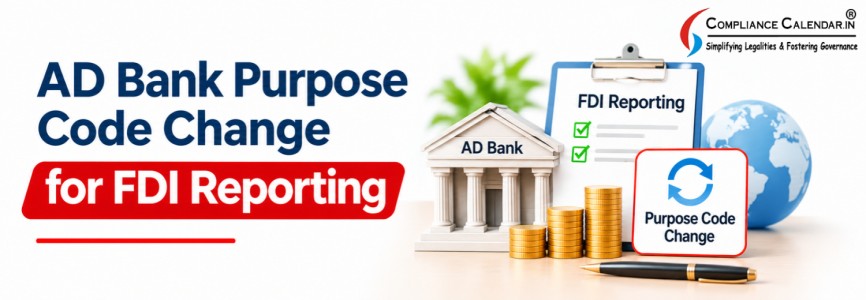



Are you facing difficulties in changing an incorrect purpose code with your AD Bank for FDI reporting and ensuring compliance with RBI regulations? Foreign Direct Investment (FDI) plays an important role in helping Indian businesses raise capital from overseas investors. However, receiving foreign investment is only the beginning of the compliance process. Companies must ensure that the inward remittance is correctly classified by their Authorised Dealer (AD) Bank to avoid reporting delays and regulatory complications. Understanding the correct purpose code and following the Reserve Bank of India (RBI) regulations is essential for ensuring accurate and timely FDI reporting.
One issue that companies sometimes face is an incorrect purpose code assigned to foreign funds received in their bank accounts. For example, an overseas investor may transfer money towards equity shares, but the inward remittance may be classified as a service receipt or another type of transaction. Such discrepancies can create difficulties when the company prepares its FDI reporting through the RBI FIRMS portal. In these situations, a change of purpose code with the AD Bank for FDI reporting may be required.
Companies receiving foreign investment in India must ensure proper documentation, accurate purpose code classification and timely compliance with RBI regulations. Professional assistance with FDI Reporting and FEMA Compliance can help businesses manage AD Bank coordination, FC-GPR filing, foreign remittance documentation and other regulatory requirements.
What Is a Purpose Code in Foreign Direct Investment?
A purpose code is a classification used by banks to identify the nature of an international financial transaction. Whenever an Indian company receives money from overseas, the authorised bank records the purpose of that remittance in accordance with RBI reporting requirements. Purpose codes help distinguish foreign investment receipts from payments for services, exports, loans and other transactions. For FDI involving equity investment, the relevant inward remittance classification is generally P0006.
| Purpose Code | Nature of Transaction |
| P0006 | Foreign Direct Investment in India in equity shares |
| P0007 | Foreign Direct Investment in India in debt instruments |
| P0012 | External Commercial Borrowings from non-residents with original maturity exceeding one year |
| P0099 | Other capital receipts not classified elsewhere |
| P1099 | Other service receipts not classified elsewhere |
These descriptions reflect RBI purpose-code classifications. Their applicability depends on the actual nature of the transaction, and a code referring to debt instruments does not automatically mean the instrument qualifies as permissible FDI under the Non-Debt Instruments Rules. For example, when a foreign investor sends Rs. 50 lakh to subscribe to equity shares of an Indian private limited company, the bank should generally classify the inward remittance under the appropriate FDI equity purpose code. If the remittance is recorded under an unrelated service code, the classification may need correction before or during the regulatory reporting process.
Understanding foreign investment reporting requirements is essential for companies receiving funds from overseas investors. Read our detailed guide on RBI FEMA/FDI Reporting: EMF, SMF Filing, FC-TRS and FLA Return for further guidance.
Why Is a Change of Purpose Code Required for FDI Reporting?
A change of purpose code becomes necessary when the classification recorded by the bank does not match the underlying economic and legal nature of the foreign transaction. Incorrect classification can occur because of incomplete remittance instructions, an error in the purpose declaration, insufficient documentation or a misunderstanding between the remitter and the receiving bank. When a company files Form FC-GPR through the RBI FIRMS portal, the AD Bank reviews the foreign investment transaction and relevant supporting documents.
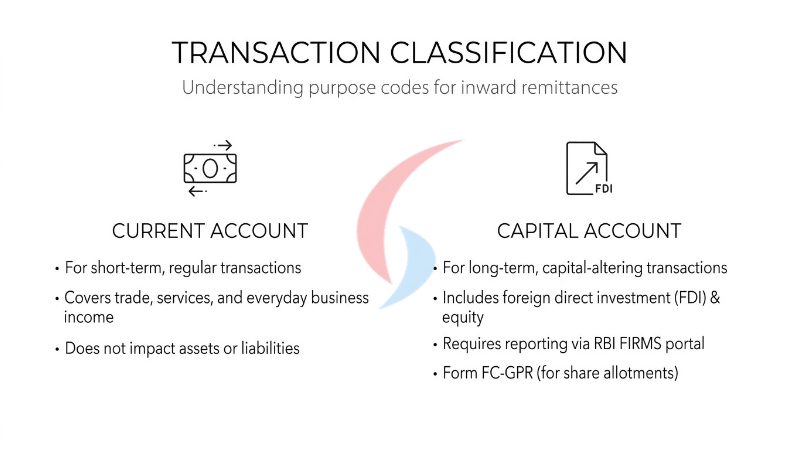
If the remittance records describe the funds as service income while the company is reporting them as equity investment, the bank may ask for clarification or correction. The purpose code is particularly important because it helps establish the distinction between a capital account transaction and a current account transaction.
However, changing a purpose code does not convert an otherwise ineligible transaction into valid FDI. The underlying transaction must independently satisfy the applicable FEMA rules, investment conditions and documentation requirements.
Companies receiving foreign investments must maintain accurate banking records and complete applicable regulatory filings. Explore our FEMA/RBI Compliance Checklist for Indian Companies with FDI to understand important compliance obligations.
Storytelling: How an Incorrect Purpose Code Delayed FDI Reporting
Imagine a Bengaluru-based startup preparing to expand its sustainable packaging business. After two years of hard work, the founders finally secured Rs. 75 lakh from a Singapore-based investor. The investment was a major achievement. The founders planned to purchase machinery, hire employees and increase production. Soon, the foreign funds arrived in their Indian bank account.
Everything seemed perfect until their compliance consultant discovered an unexpected problem. The Authorised Dealer (AD) Bank had classified the remittance as a general service receipt instead of foreign equity investment.
The founders were surprised. How could a simple banking classification create difficulties when the investment had already been received? Their consultant explained that an incorrect purpose code could delay share allotment documentation and FDI reporting.
The founders immediately approached their AD Bank and submitted the investment agreement, investor declaration, company documents and remittance details. After reviewing the documents, the bank corrected the classification, allowing the startup to proceed with share allotment and Form FC-GPR reporting, subject to statutory deadlines.
Key Takeaway: A small banking error can create significant compliance challenges. Businesses should verify the correct purpose code with their AD Bank before receiving foreign investment to avoid unnecessary delays.
Startups raising capital from international investors should understand investment documentation, banking requirements and statutory reporting before receiving funds. Explore Practical Insights for a Smooth FDI Journey.
When Should Companies Request a Purpose Code Change?
A company should consider approaching its AD Bank for a purpose code correction when the bank's recorded classification does not accurately reflect the underlying transaction. Common situations include:
- An overseas investor sends share subscription money, but the funds are recorded as service receipts.
- The inward remittance advice contains an incorrect transaction description.
- The company discovers a mismatch between the bank's remittance documents and its investment agreement.
- The AD Bank raises a clarification during Form FC-GPR scrutiny.
- An earlier purpose declaration contains a genuine error that requires documentary correction.
The first step is to establish the actual nature of the funds. A correction request should not be submitted merely to make the bank documents match a proposed filing if the transaction itself was originally for another purpose.
Documents Required for Change of Purpose Code with AD Bank
The exact documentation depends on the receiving bank, transaction value, investor details and reason for correction. Generally, the following documents may be required:
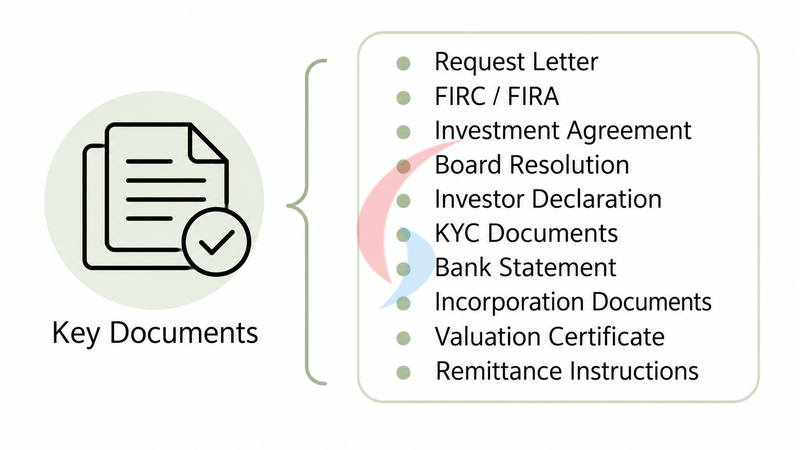
Additional documents may be requested where the remittance description conflicts with the investment agreement or where the bank requires further due diligence. Companies should ensure consistency between the amount received, the investor's identity, the transaction date and the proposed investment terms.
Proper documentation helps AD Banks verify foreign investment transactions and resolve reporting discrepancies. Learn more about the Documents for FDI Reporting in Case of Subscription to MOA
Process to Change Purpose Code with AD Bank for FDI Reporting
Changing the purpose code of an inward foreign remittance requires proper documentation and coordination with the Authorised Dealer (AD) Bank. The company must establish that the funds were genuinely received for foreign investment and that the original classification was incorrect. The following steps explain the process in detail.
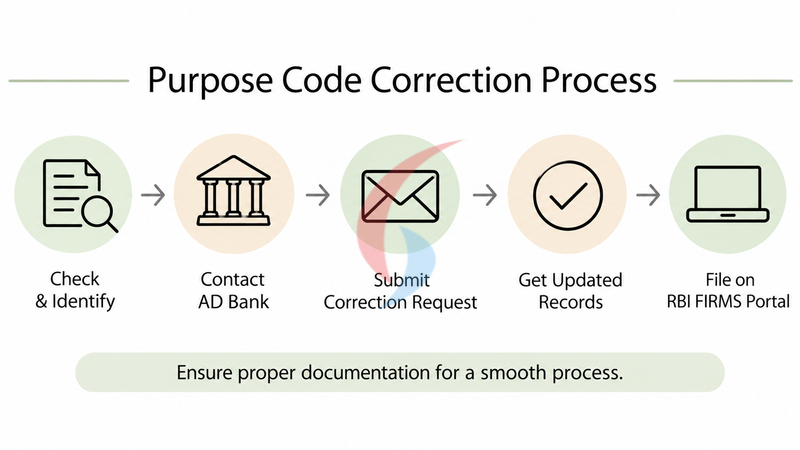
Step 1: Identify the Incorrect Purpose Code
The company should begin by reviewing the inward remittance advice, Foreign Inward Remittance Certificate (FIRC), if issued, and relevant bank records. These documents help identify the purpose code assigned when the foreign funds were received. If the transaction relates to equity investment but has been classified under a service receipt or another unrelated category, the company should document the discrepancy and verify the correct classification.
Step 2: Contact the Authorised Dealer (AD) Bank
After identifying the error, the company should approach the forex or foreign investment compliance department of its AD Bank. The authorised representative should explain the nature of the remittance, the incorrect purpose code and the reason a correction is required. The bank will provide information about its internal correction procedure and the documents necessary to review the request.
Step 3: Submit a Formal Purpose Code Correction Request
The company must prepare a formal application addressed to the AD Bank requesting correction of the purpose code. The letter should include the remittance amount, transaction date, Unique Transaction Reference (UTR) or SWIFT reference, existing purpose code and proposed correct purpose code. It should also explain why the original classification was incorrect and confirm the actual purpose of the foreign funds.
Step 4: Provide Supporting Documents
The AD Bank may request supporting documents to verify the foreign investment transaction. These generally include the share subscription agreement, investor declaration, inward remittance advice, bank statement, company incorporation documents and investor KYC records. Depending on the circumstances, a board resolution or valuation certificate may also be required. All submitted documents should consistently establish the genuine nature of the investment.
Step 5: Complete AD Bank Verification
After receiving the application and supporting documents, the AD Bank examines the transaction to determine whether the requested correction is justified. The bank may review the investor's identity, source and purpose of funds, investment agreement and applicable FEMA requirements. If any information is incomplete or inconsistent, the bank may request additional clarification before deciding whether the correction can be processed.
Step 6: Obtain Corrected Remittance Records
If the AD Bank is satisfied with the explanation and documentation, it may correct the purpose code in its internal records and make any necessary amendments to applicable regulatory reporting. The company should request written confirmation of the correction and obtain updated remittance documentation, where available. These records should be preserved for future FEMA compliance, audit and FDI reporting purposes.
Step 7: Proceed with FDI Reporting on RBI FIRMS Portal
After the remittance classification has been verified and any necessary correction completed, the company should proceed with the applicable FDI reporting through the RBI FIRMS portal. For an eligible issue of equity instruments, Form FC-GPR is generally required within 30 days of issuance. The company should ensure that the investment details, remittance records, share allotment documents and other supporting information are consistent. Any pending correction should be addressed promptly because it does not automatically extend the statutory filing deadline.
Important Note: The exact correction process may vary between AD Banks depending on their internal policies, transaction details and regulatory requirements. A purpose code correction must reflect the genuine underlying transaction and cannot independently convert a service receipt or other transaction into permissible FDI.
Companies handling incorrect foreign investment reporting details should also understand the available correction mechanisms. Read about the Modification Option for FC-GPR Filing on the FIRMS Portal
Role of AD Bank in FDI Purpose Code Correction
An Authorised Dealer Category-I Bank plays an important role in facilitating foreign exchange transactions and examining related regulatory compliance. The bank verifies the investor's identity, evaluates the transaction documents and considers whether the proposed classification is appropriate. The bank must also consider the applicable Foreign Direct Investment (FDI) Policy to ensure that the investment complies with the relevant sectoral conditions, entry routes and regulatory requirements. Where the bank has already submitted regulatory transaction information, it must determine whether an amendment is required in its own reporting systems.
The RBI's foreign exchange guidance recognises the responsibility of AD Banks to ensure compliance for foreign investments and handle applicable remittance documentation. The bank may also seek additional explanations or refuse a proposed correction if the evidence does not support the company's claim. Therefore, maintaining transparent communication with the AD Bank is essential throughout the process.
RBI FDI Reporting Requirements After Purpose Code Correction
Correcting an incorrect purpose code is only one aspect of foreign investment compliance. Companies must also meet the applicable investment, allotment and reporting requirements. The important timelines for a standard issue of equity instruments against inward foreign investment are:
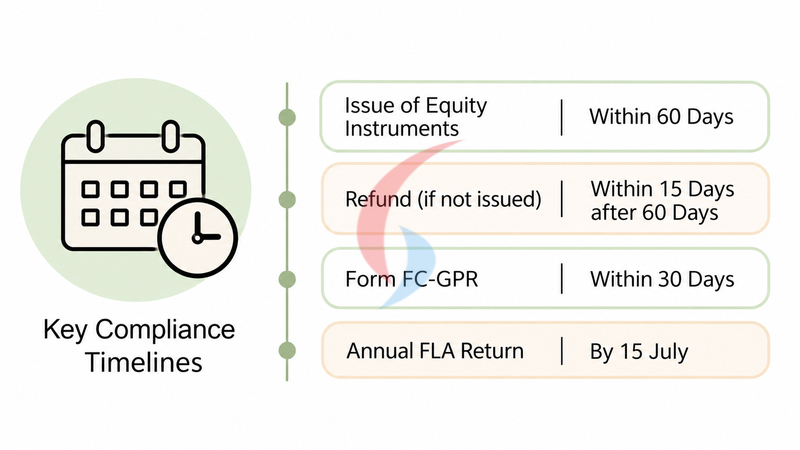
These requirements are prescribed under the applicable FEMA regulations. A delay in filing may attract a Late Submission Fee (LSF), subject to RBI rules. A pending purpose code correction does not automatically extend these deadlines. Companies should therefore address discrepancies immediately and coordinate their banking and statutory compliance activities. For detailed assistance, businesses can explore Compliance Calendar LLP for professional guidance on foreign investment and corporate regulatory requirements.
Share valuation is an important consideration when Indian companies issue equity instruments to foreign investors. Explore our guide on the Need for a Valuation Report Under FEMA Law
Common Challenges in Changing FDI Purpose Codes
Although a purpose code correction may appear to be an administrative process, several practical challenges can arise. A company may struggle to obtain revised confirmation from an overseas investor, particularly when the remittance was made several months earlier. Banks may require additional documents where the investment agreement is incomplete or differs from the transfer instructions. Another challenge arises when the remittance has already been reported under an incorrect category. Such cases may involve additional internal checks before the bank can amend its records.
Companies should also distinguish between a clerical correction and a genuine change in transaction purpose. A change from payment for services to equity investment is not merely a banking correction if the original commercial arrangement was actually for services. The underlying legal arrangement, tax treatment, investment permissions and FEMA requirements must be examined before requesting any reclassification.
Delays and reporting violations under FEMA can result in additional compliance requirements. Understand the Compounding Procedures for Form FC-GPR Violations under FEMA
Why Choose Compliance Calendar LLP?
Compliance Calendar LLP provides professional assistance to Indian companies dealing with foreign investment, FEMA compliance and RBI reporting requirements. Our team helps businesses identify incorrect purpose codes, prepare correction requests, organise supporting documents and coordinate with Authorised Dealer (AD) Banks. We focus on ensuring that inward remittance records are consistent with the actual investment transaction, helping companies minimise documentation errors and avoid unnecessary compliance difficulties.
Our services also cover FDI reporting, Form FC-GPR filing, RBI FIRMS portal compliance and related regulatory documentation. Whether you are a startup receiving your first foreign investment or an established company managing overseas funding, Compliance Calendar LLP offers practical guidance throughout the compliance process.
Companies requiring professional assistance with purpose code correction, FEMA compliance or FDI reporting can contact Compliance Calendar LLP at +91 9988424211 or info@ccoffice.in
Frequently Asked Questions (FAQs)
Q1. What is a change of purpose code for FDI reporting?
Ans. It is the process of requesting an AD Bank to correct the classification of an inward remittance when the recorded purpose does not reflect the genuine underlying transaction. The bank verifies supporting documents before accepting the correction.
Q2. Which purpose code is generally used for FDI equity investment?
Ans. P0006 is generally used for inward Foreign Direct Investment in equity shares. However, companies must ensure that the transaction qualifies under the applicable FEMA and FDI regulations before using this classification.
Q3. Can an AD Bank change the purpose code after receiving funds?
Ans. A bank may correct an earlier classification when the supporting documents establish a genuine error and the applicable reporting procedures permit the change. The decision depends on verification and the bank's internal requirements.
Q4. Is RBI approval required for every purpose code correction?
Ans. Not necessarily. Routine corrections may be handled through the AD Bank's prescribed procedures. However, transactions involving regulatory contraventions, disputed classifications or matters outside delegated authority may require additional regulatory examination.
Q5. What documents are required for FDI purpose code correction?
Ans. Common documents include a correction request letter, inward remittance details, investment agreement, investor declaration, KYC documents and bank statement. The AD Bank may request additional evidence depending on the transaction.
Q6. Can FDI reporting be completed with an incorrect purpose code?
Ans. An incorrect classification can create questions during the bank's review of the FDI reporting documents. Companies should clarify material inconsistencies with their AD Bank and ensure that the submitted information accurately reflects the transaction.
Q7. How much time does an AD Bank take to change the purpose code?
Ans. There is no universal processing period applicable to every bank and transaction. The time depends on document completeness, internal verification, the nature of the error and whether any regulatory reporting amendment is required.
Q8. Does changing the purpose code extend the FC-GPR filing deadline?
Ans. No. A purpose code correction does not automatically extend the statutory filing timeline. Form FC-GPR is generally required within 30 days of issuing equity instruments, and delayed reporting may attract an applicable Late Submission Fee.
Q9. Can service income be converted into FDI by changing the purpose code?
Ans. Not merely by changing the banking classification. A genuine service receipt and an equity investment are legally different transactions. Any proposed conversion or restructuring must independently satisfy applicable FEMA, tax and corporate law requirements.
Q10. How can companies avoid incorrect purpose codes in future FDI transactions?
Ans. Companies should provide clear investment instructions to overseas investors, coordinate with their AD Banks before receiving funds, prepare appropriate subscription documents and verify the remittance classification promptly after credit.
Article last updated on : 23 Nov 2026.





















































_learn_crop10_thumb.jpg)