


Imagine two friends starting a technology company in Bengaluru. One handles product development, while the other manages business operations and investments. After three years, their startup begins attracting investors, but both founders continue taking relatively modest salaries. They decide to reward themselves with Employee Stock Options (ESOPs) because they believe the company will become more valuable in the future.
However, when they discuss their plan with a Company Secretary, they discover something unexpected. Indian company law does not automatically allow every director or promoter to receive ESOPs. Their eligibility depends on their position, shareholding, promoter status and whether the business qualifies for the prescribed startup exemption. This is where understanding ESOPs for Directors and Promoters becomes important.
Employee Stock Option Plans are widely used by Indian companies to retain talent, reward long-term contributions and encourage employees to participate in business growth. However, the rules for directors and promoters are different from those applicable to ordinary employees. The Companies Act, 2013 and SEBI regulations prescribe specific eligibility conditions, restrictions and compliance requirements. This article explains ESOP eligibility for directors and promoters in India, including the 10% shareholding restriction, DPIIT-recognised startup exemptions, independent directors, listed company regulations, shareholder approvals and important developments applicable in 2026.
What Are ESOPs and Why Do Companies Offer Them to Directors?
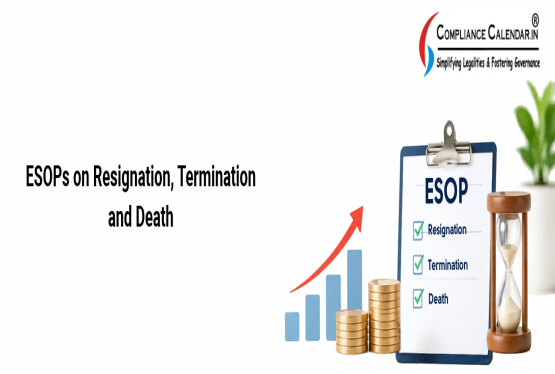
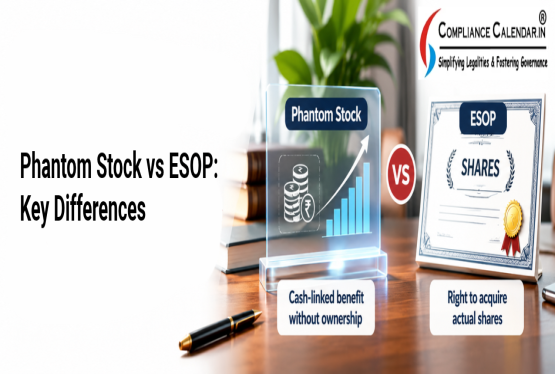
An Employee Stock Option Plan (ESOP) gives an eligible person the right to purchase shares of a company at a predetermined price after fulfilling certain conditions. These conditions generally include completing a specified period of service or achieving performance targets. The person is not immediately given ownership of the shares when options are granted. Ownership normally arises after the options vest, are exercised and the shares are issued.
For example, a company grants its executive director 5,000 stock options at an exercise price of Rs. 100 per share. After three years, the company's share value increases to Rs. 400. If the director exercises the options, the difference between the share value and exercise price represents a potential economic benefit of Rs. 15 lakh before considering applicable taxes, expenses and actual sale proceeds. The director must still consider whether the shares can be sold and whether the company provides any exit opportunity.
Companies use ESOPs because directors are often responsible for important business decisions, expansion plans, financial performance and long-term growth. Instead of paying only a higher salary or immediate bonus, companies may offer stock options to align eligible directors' financial interests with business performance. Nevertheless, an attractive compensation arrangement must also satisfy the legal requirements applicable to the recipient.
Legal Framework Governing ESOPs for Directors and Promoters in India
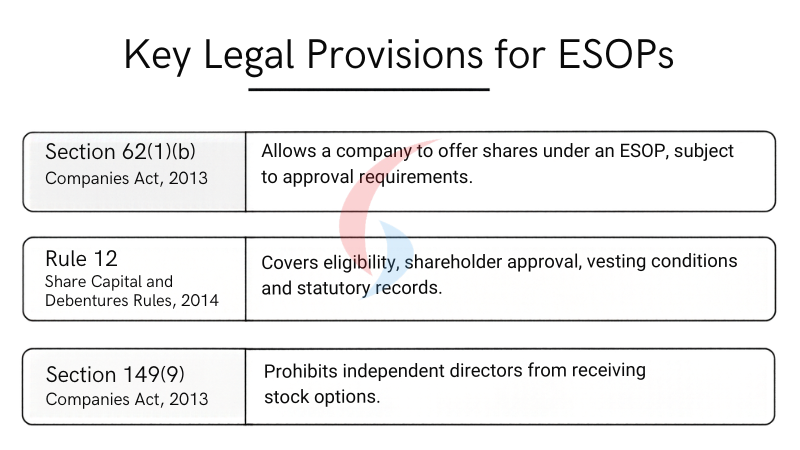
The primary legal provision governing ESOPs in unlisted Indian companies is Section 62(1)(b) of the Companies Act, 2013, read with Rule 12 of the Companies (Share Capital and Debentures) Rules, 2014. These provisions regulate employee stock option schemes, including eligibility, shareholder approval, vesting conditions, disclosures and maintenance of statutory records.
Section 62(1)(b) permits a company to offer shares to employees under an Employee Stock Option Scheme, subject to the applicable approval requirements. Rule 12 explains which employees and directors may participate and identifies persons who are ordinarily excluded. For listed companies, the SEBI (Share Based Employee Benefits and Sweat Equity) Regulations, 2021 provide an additional regulatory framework. Another important provision is Section 149(9) of the Companies Act, 2013, which prohibits independent directors from receiving stock options. Companies must therefore examine the recipient's actual legal designation instead of assuming that every individual serving on the Board can receive ESOP benefits. Businesses implementing a new scheme can explore ESOP Scheme Compliance to understand the documentation, approvals and statutory requirements involved.
Who Is Eligible to Receive ESOPs Under the Companies Act, 2013?
Rule 12 recognises certain categories of employees and directors as eligible participants in an Employee Stock Option Scheme. These include permanent employees working in India or outside India and directors of the company, whether whole-time or otherwise, except independent directors. Eligible employees and directors of the company's holding or subsidiary company may also be covered, subject to the applicable legal conditions and approvals.
However, being a director does not automatically establish ESOP eligibility. The company must separately examine whether the individual belongs to the promoter group or directly or indirectly holds more than 10% of the company's outstanding equity shares. A person may qualify based on their executive responsibilities but still become ineligible because of their ownership or promoter classification.
For example, suppose a private limited company appoints an experienced finance professional as an executive director. She does not belong to the promoter group and holds only 2% of the company's outstanding equity shares. Subject to the scheme and applicable requirements, she may be eligible for ESOPs. If she belongs to the promoter group, however, the ordinary exclusion may apply regardless of her relatively small shareholding.
Can Promoters Receive ESOPs in India?
Under the general provisions of Rule 12, promoters and persons belonging to the promoter group are excluded from the definition of eligible employees for ESOP purposes. This restriction applies even when the promoter actively works in the company and performs responsibilities similar to those of a full-time employee. Promoter status is therefore a separate eligibility concern.
Consider a founder who holds 6% of a private company's equity and acts as its Managing Director. Although the founder's ownership is below 10%, the promoter exclusion may prevent the company from granting ESOPs under the ordinary rules. The company cannot avoid this restriction simply by describing the founder as an employee or including the founder in the ESOP policy.
There is, however, an important exception for qualifying startups. The law provides a relaxation allowing certain startup companies to offer ESOPs to promoters and directors who would otherwise be restricted. This exemption is particularly relevant to early-stage businesses that wish to reward founders without making immediate cash payments.
ESOP Eligibility for Directors Holding More Than 10% Equity
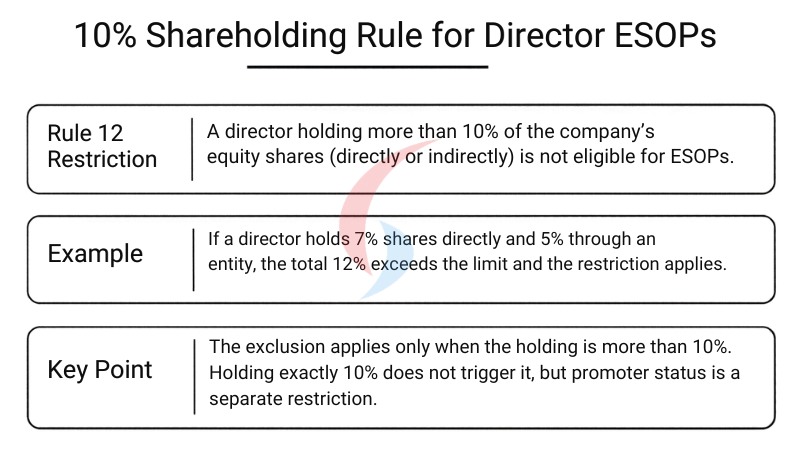
Rule 12 also excludes a director who, personally or through relatives or any body corporate, directly or indirectly holds more than 10% of the outstanding equity shares of the company. The restriction prevents companies from treating significant shareholder-directors in the same manner as ordinary employees for ESOP purposes, unless a specific exemption applies.
Suppose a director personally holds 7% of the company's shares, while another 5% is held through an entity in which the director has an attributable interest under the applicable legal test. If the director's relevant direct and indirect holding exceeds 10%, the ordinary eligibility restriction may apply. A company should therefore examine the complete ownership structure rather than checking only the shares registered in the director's own name.
The statutory wording refers to holdings of more than 10%. Consequently, holding exactly 10% does not, by itself, trigger this particular exclusion. Nevertheless, promoter status remains a separate restriction, and companies must review beneficial ownership, relatives' holdings and the applicable scheme conditions before issuing options.
DPIIT-Recognised Startup Exemption for Promoters and Directors
Recognising the importance of employee ownership for growing businesses, the government introduced a special relaxation for qualifying startups. Under the proviso to Rule 12, the usual exclusions relating to promoters and directors holding more than 10% do not apply to qualifying startup companies for up to ten years from the date of incorporation or registration.
For example, imagine a DPIIT-recognised startup incorporated in 2022. Its founder holds 35% of the company's equity and is actively involved in operations. Ordinarily, the founder would face restrictions under both the promoter exclusion and the 10% shareholding rule. However, the startup may be able to grant ESOPs to the founder during the prescribed exemption period, provided it meets the applicable startup definition and other legal requirements.
This relaxation does not mean that every newly incorporated company automatically qualifies. The entity must satisfy the startup-related conditions relevant to the exemption, and the company should verify its DPIIT recognition and applicable legal status before approving the grant. The government confirmed the availability of startup ESOP relaxations in a February 2026 parliamentary response.
Can Independent Directors Receive ESOPs?
Independent directors are not eligible to receive ESOPs under the ordinary Indian company law framework. Section 149(9) of the Companies Act, 2013 expressly prohibits independent directors from receiving stock options. The restriction is intended to protect independent judgement and prevent financial incentives from influencing their oversight responsibilities.
For instance, a listed company may wish to offer stock options to an independent director who has helped strengthen governance and regulatory compliance. Even if shareholders support the proposal, the company cannot grant ESOPs to that person while they are serving as an independent director. Shareholder approval does not override the statutory prohibition.
Independent directors may instead receive remuneration through legally permitted arrangements, such as sitting fees, reimbursement of expenses and profit-related commission, subject to the applicable provisions. Companies planning director remuneration should therefore distinguish between executive directors, non-executive directors and independent directors before designing an incentive scheme.
For more information on company-level approvals and ownership planning, read ESOP Pool in Startups: Creation and Dilution and ESOPs Compliance Checklist and Procedure under the Companies Act, 2013.
ESOPs for Directors in Listed Companies: SEBI Rules
Listed companies must comply with the SEBI (Share Based Employee Benefits and Sweat Equity) Regulations, 2021, as amended. These regulations govern various share-based employee benefit arrangements, including Employee Stock Option Schemes. They prescribe requirements relating to eligibility, compensation committees, shareholder approvals, disclosures, scheme administration and the treatment of options.
Under the usual SEBI eligibility framework, eligible directors may include whole-time and qualifying non-executive directors, but independent directors are excluded. Promoters, promoter-group members and directors crossing the prescribed shareholding threshold are generally subject to restrictions. Listed companies must also consider governance requirements and the potential impact of stock options on existing shareholders.
A significant development came through the SEBI (Share Based Employee Benefits and Sweat Equity) (Amendment) Regulations, 2025. New Regulation 9A allows an employee identified as a promoter or promoter-group member in an IPO draft offer document to continue holding or exercising previously granted share-based benefits, provided the grant occurred at least one year before filing the draft offer document and other applicable conditions are satisfied. This protects certain legally granted benefits when a company prepares for an IPO; it does not create unrestricted eligibility for fresh promoter ESOP grants.
Companies preparing for public listing can read ESOPs in Listed Companies: SEBI Regulations for a detailed explanation of listed-company obligations.
How Can a Company Grant ESOPs to Eligible Directors?
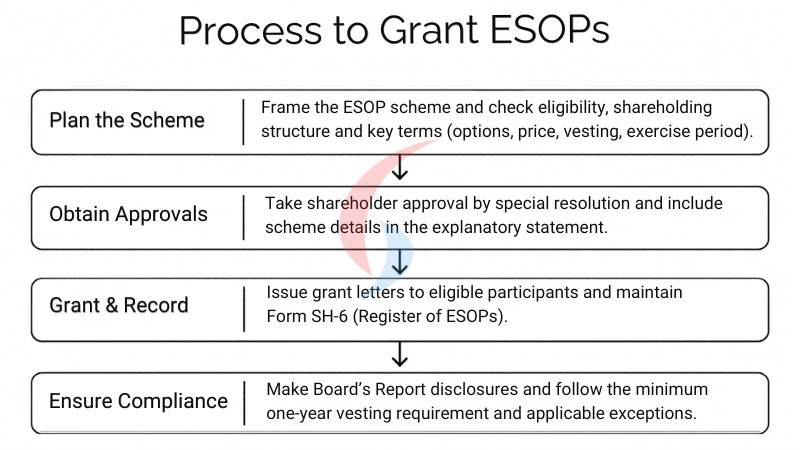
Before granting stock options, a company must establish a properly structured ESOP scheme and verify the eligibility of the proposed participants. The Board should examine the company's shareholding pattern, existing capital structure, director classifications and the commercial purpose of the proposed grants. The ESOP scheme should clearly specify the number of options, exercise price, vesting schedule, exercise period and circumstances in which options may lapse.
Under Section 62(1)(b) and Rule 12, unlisted companies ordinarily require shareholder approval through a special resolution, subject to applicable exemptions. The explanatory statement must disclose essential scheme information, including eligible employee categories, the appraisal process, valuation method and exercise conditions. Separate shareholder approval is required in certain situations, including specified grants to holding or subsidiary company employees and grants meeting the prescribed 1% threshold.
After obtaining the necessary approvals, the company issues grant letters to eligible participants and maintains its statutory records. It must ordinarily maintain the Register of Employee Stock Options in Form SH-6, make the required Board's Report disclosures and complete applicable filings. Companies should also examine the minimum one-year vesting requirement and relevant exceptions before finalising the grant schedule.
For professional assistance with scheme drafting, shareholder approvals and corporate records, businesses may consider ESOP Scheme Compliance Services.
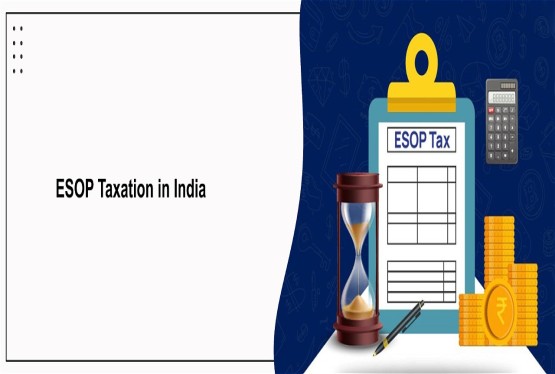
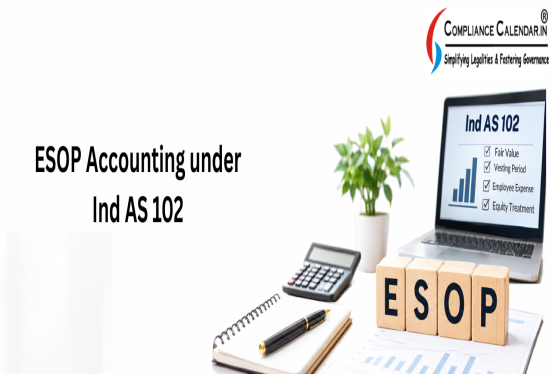
To understand financial reporting and tax obligations, explore ESOP Accounting under Ind AS 102 and ESOP Taxation for Employees and Startups in India.
ESOP Valuation, Taxation and Shareholding Dilution
ESOP valuation becomes important when a company grants stock options to directors. The exercise price represents the amount payable by the director to acquire shares, while fair market value helps determine the underlying economic benefit. These figures may differ significantly, particularly in startups where business valuations change following fundraising rounds.
For example, a director receives 2,000 options at an exercise price of Rs. 200 per share. When the options are exercised, the fair market value is Rs. 700 per share. The indicative difference is Rs. 10 lakh, which may have tax implications depending on the applicable provisions and the recipient's circumstances. The director should not confuse this valuation difference with money actually received from selling shares.
For Tax Year 2026–27 onwards, the Income-tax Act, 2025 and Income-tax Rules, 2026 govern the relevant ESOP tax treatment. Applicable perquisite valuation requirements, withholding obligations and subsequent capital gains rules must be examined separately. Companies must also consider the accounting treatment of stock options and potential dilution of existing shareholders when new equity shares are issued.
A properly prepared valuation helps companies justify financial assumptions and maintain accurate records. Businesses can explore Valuation Services and learn more through ESOP Valuation in India: Methods and Compliance.
Common Mistakes Companies Make While Granting ESOPs
One frequent mistake is assuming that a person automatically qualifies for ESOPs because they work full-time as a director. Companies sometimes overlook the individual's promoter status or ownership held through relatives and other entities. This can result in eligibility problems even when the ESOP scheme itself has received shareholder approval.
Another mistake is treating the startup exemption as a permanent permission. The special relief is subject to the prescribed period and legal conditions. A company that qualified earlier should verify its eligibility again before making fresh grants, particularly when its incorporation anniversary, business status or ownership structure has changed.
Companies may also overlook the effects of future fundraising, mergers, resignations and changes in management. An ESOP grant does not guarantee an immediate financial reward, and directors should understand the consequences of leaving the company before vesting or failing to exercise options within the permitted period.
Why Choose Compliance Calendar LLP?
ESOPs for Directors and Promoters can help companies reward leadership, retain important professionals and support long-term business growth. However, eligibility depends on more than the individual's designation. Under Indian law, promoter status, direct and indirect shareholding, independent director classification and the applicable startup exemption are important factors.
The Companies Act, 2013 and SEBI regulations establish separate requirements for unlisted and listed companies. The startup exemption provides flexibility to qualifying businesses, while the September 2025 SEBI amendment offers important relief for certain previously granted benefits during the IPO process. Companies should therefore verify eligibility, obtain proper approvals, maintain statutory records and assess valuation and taxation before granting options.
A carefully designed ESOP scheme can benefit both the business and its directors, but only when the commercial arrangement is supported by proper legal compliance.
Frequently Asked Questions (FAQs)
Q1. Can directors receive ESOPs in India?
Ans. Yes. Eligible whole-time and non-executive directors may receive ESOPs, subject to applicable restrictions relating to promoters, shareholding and the relevant company law or SEBI provisions.
Q2. Are promoters eligible for ESOPs?
Ans. Promoters are ordinarily excluded under Rule 12. However, qualifying startups can benefit from a specific exemption during the prescribed ten-year period.
Q3. Can a director holding more than 10% shares receive ESOPs?
Ans. The general rules restrict directors holding more than 10% directly or indirectly through the specified relationships or entities. Qualifying startups may be eligible for the statutory relaxation.
Q4. Can independent directors receive employee stock options?
Ans. No. Section 149(9) of the Companies Act, 2013 prohibits independent directors from receiving stock options.
Q5. Can a Managing Director receive ESOPs?
Ans. Yes, provided the Managing Director satisfies the applicable eligibility requirements and is not otherwise excluded under the relevant rules.
Q6. Can startup founders receive ESOPs?
Ans. Yes, a qualifying startup company may grant ESOPs to founders who are promoters under the prescribed exemption, subject to other legal conditions.
Q7. Is shareholder approval mandatory for ESOPs?
Ans. Shareholder approval is ordinarily required under Section 62(1)(b) and Rule 12, subject to applicable exemptions. Certain grants require additional approval.
Q8. Is there a minimum ESOP vesting period?
Ans. For unlisted companies governed by Rule 12, the ordinary minimum period is one year between grant and vesting, subject to prescribed exceptions.
Q9. Can promoters retain ESOPs when a company launches an IPO?
Ans. Under SEBI Regulation 9A, certain options or benefits granted at least one year before filing the IPO draft offer document may be retained or exercised, subject to its conditions.
Q10. Is ESOP valuation necessary for directors?
Ans. Companies must comply with applicable valuation, accounting and tax requirements. The appropriate valuation method and professional qualifications depend on the purpose.
Article last updated on : 23 Nov 2026.










































































_learn_crop10_thumb.jpg)