


Foreign Direct Investment (FDI) has become an important source of funding for Indian companies planning business expansion, technology development and international partnerships. However, receiving money from a foreign investor does not automatically complete the investment process. Companies must ensure that foreign remittances are correctly classified by their Authorised Dealer (AD) Bank and reported in accordance with Reserve Bank of India (RBI) regulations.
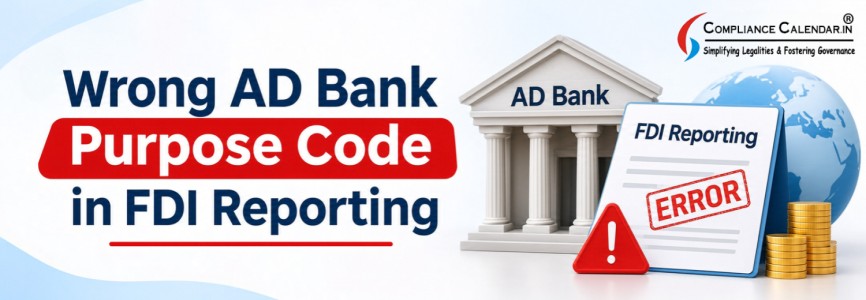
One common difficulty arises when a wrong purpose code is filed with the AD Bank in FDI reporting. For example, an Indian company may receive money from a Singapore-based investor towards equity shares, but the bank records the transaction as a service receipt instead of foreign investment. Although the funds have reached the company's account, this discrepancy may create difficulties during Form FC-GPR filing on the RBI FIRMS portal.
Such errors require timely attention because incorrect remittance classification can result in reporting queries, documentation mismatches and potential compliance delays. This article explains the meaning of a wrong purpose code, applicable FEMA regulations, the correction procedure, required documents, RBI reporting requirements and practical solutions available in 2026.
What Is a Purpose Code in FDI Reporting?
When an Indian company receives foreign investment, accurate classification of the inward remittance is essential for proper RBI FEMA Compliance. Filing a wrong purpose code with the AD Bank can create difficulties during Form FC-GPR Filing, delay foreign investment reporting and lead to additional queries from the bank. Companies must ensure that their remittance documents, investment agreements and banking records match the actual nature of the transaction. Professional assistance with RBI FEMA Compliance and FC-GPR FDI Reporting can help businesses correct reporting discrepancies and fulfil their foreign investment obligations under FEMA.
A purpose code is a classification used by banks to identify the nature of money received from or transferred outside India. The RBI prescribes purpose codes to distinguish transactions involving foreign investment, loans, export proceeds, services and other international payments.
When an Indian company receives share subscription money from a foreign investor, the AD Bank records the transaction under the appropriate foreign investment category. For equity investment, P0006 is generally the relevant inward remittance purpose code.
Common purpose codes include:
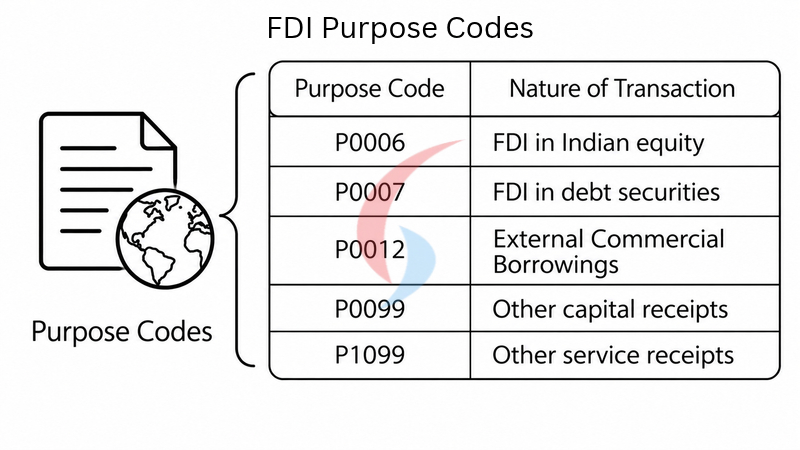
These codes represent different transaction categories. The correct code depends on the actual nature of the remittance, and classification alone does not establish whether an investment is legally permissible under FEMA.
What Happens When a Wrong Purpose Code Is Filed with an AD Bank?
When the AD Bank records an incorrect purpose code, its remittance information may not match the company's investment agreement, share allotment documents or proposed regulatory filing. Suppose an Indian company receives Rs. 60 lakh from an overseas investor for issuing equity shares. However, the bank classifies the remittance under P1099, which relates to other service receipts, instead of the applicable investment classification.
When the company subsequently submits Form FC-GPR, the AD Bank may question why the transaction is being reported as equity investment when the original banking records describe it as service income. The company may need to establish the genuine purpose of the payment and obtain appropriate corrections from its bank. An incorrect purpose code does not automatically invalidate genuine foreign investment, but the underlying transaction must independently comply with applicable law.
Companies facing incorrect remittance classification should understand the process for Change of Purpose Code with AD Bank for FDI Reporting. Proper documentation and timely communication with the AD Bank can help resolve discrepancies in foreign investment records.
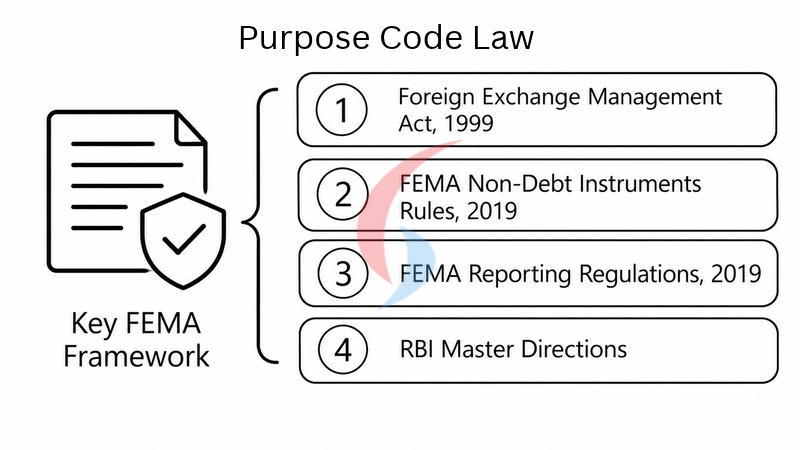
Legal Governing Purpose Code Correction
1. Foreign Exchange Management Act, 1999
The Foreign Exchange Management Act, 1999 establishes the legal framework governing foreign exchange transactions in India. Section 6 addresses capital account transactions, while Section 10 regulates authorised persons dealing in foreign exchange. Section 10(5) requires relevant declarations and information to satisfy the authorised person regarding the legality of the proposed transaction. Section 11 empowers RBI to issue directions to authorised persons. These provisions support the AD Bank's role in examining foreign investment remittances and verifying their supporting documents.
2. FEMA Non-Debt Instruments Rules, 2019
The Foreign Exchange Management (Non-Debt Instruments) Rules, 2019 regulate foreign investment in Indian equity instruments. These rules prescribe sectoral conditions, investment routes, eligible investors, pricing requirements and other restrictions. Correcting a banking purpose code cannot independently regularise an investment that violates applicable foreign investment conditions.
3. FEMA Reporting Regulations, 2019
The Foreign Exchange Management (Mode of Payment and Reporting of Non-Debt Instruments) Regulations, 2019 govern relevant foreign investment reporting requirements. The regulations prescribe Form FC-GPR reporting for qualifying equity issuances and other forms for specified transactions.
4. RBI Master Directions
RBI's Master Direction on Foreign Investment in India, updated up to 15 June 2026, and its Master Direction on Reporting under FEMA, updated on 1 October 2026, provide relevant operational and reporting guidance. Companies must examine these directions along with the applicable FEMA rules and regulations before submitting correction requests.
Companies receiving foreign investment must understand the requirements for RBI FEMA/FDI Reporting. Proper reporting through applicable RBI forms helps businesses maintain accurate records of foreign investment transactions.
Common Reasons for Filing the Wrong Purpose Code
Incorrect purpose code reporting generally results from communication gaps between the overseas investor, Indian company and banking institutions. An overseas investor may mention a general business payment instead of specifying share subscription money in the remittance instructions. Alternatively, an Indian company may select an incorrect classification while completing the bank's inward remittance declaration.
Errors can also occur when investment agreements are unavailable during bank verification or when bank personnel interpret incomplete transaction descriptions incorrectly. Another common situation involves multiple remittances from the same overseas entity. Some payments may relate to genuine services, while others represent capital investment. If these payments are not separately documented, incorrect classification becomes more likely.
Storytelling: How a Purpose Code Error Delayed Startup Funding
Consider a hypothetical Hyderabad-based technology startup that secured Rs. 80 lakh from a foreign investor to expand its software business. The investor transferred the money through an overseas bank, and the funds were successfully credited to the startup's Indian account. The founders began preparing documents for issuing equity shares.
During the compliance review, their Company Secretary discovered that the AD Bank had classified the payment as a service receipt rather than foreign equity investment. The startup contacted its bank and submitted the share subscription agreement, remittance reference, investor declaration and relevant corporate documents.
The bank reviewed the documents and requested additional confirmation from the overseas remitter. After verification, the bank accepted the correction request and arranged the necessary record amendments. The company then proceeded with its applicable FDI reporting requirements. This example demonstrates why reviewing the remittance classification immediately after receiving foreign investment can prevent unnecessary complications.
Process to Correct a Wrong Purpose Code with an AD Bank
Step 1: Identify the Incorrect Classification
The company should first examine the inward remittance advice, bank statement, original purpose declaration and Foreign Inward Remittance Certificate (FIRC), if issued. It must identify the existing purpose code and determine whether that classification accurately represents the transaction.
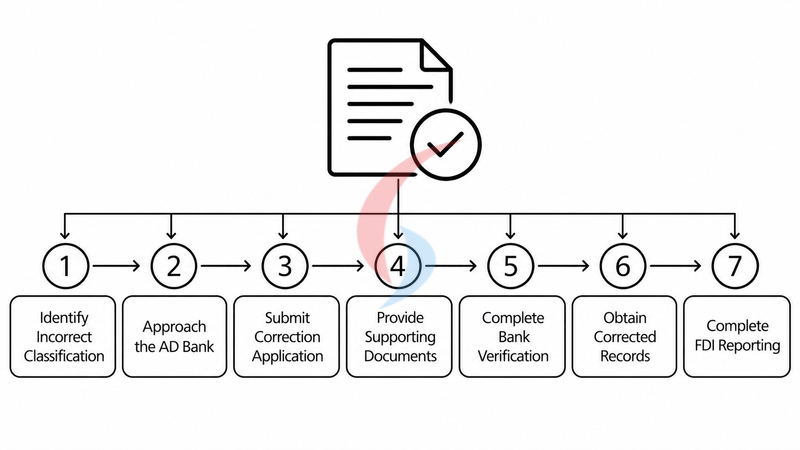
Step 2: Approach the AD Bank
The company should contact the foreign exchange or FDI compliance department of its Authorised Dealer Category-I Bank. The communication should clearly explain the discrepancy and request guidance regarding correction of the original transaction classification.
Step 3: Submit a Formal Correction Application
A written request should mention the remittance date, amount, investor details, SWIFT or UTR reference, existing purpose code and proposed correct classification. The application should explain the genuine transaction purpose and how the original error occurred.
Step 4: Submit Supporting Documents
The company should provide documents demonstrating that the remittance was genuinely intended for foreign investment. The bank may request additional investor declarations, corporate approvals or overseas banking confirmations.
Step 5: Complete Bank Verification
The AD Bank examines the transaction, investor identity, supporting documents and applicable regulatory requirements. If the proposed correction is justified, the bank may process the amendment under its applicable procedures.
Step 6: Obtain Corrected Banking Records
After approval, the company should request written confirmation and updated remittance documentation, where available. The bank may also need to correct applicable regulatory transaction reporting.
Step 7: Complete Applicable FDI Reporting
The company should ensure that its corrected remittance records align with the investment documents and relevant filing on the RBI FIRMS portal. For eligible equity issuances, Form FC-GPR is generally required within 30 days from the date of issue of equity instruments. The correction process does not automatically extend statutory reporting deadlines.
The RBI FIRMS portal provides facilities for submitting and reviewing foreign investment reporting forms. Companies can read about the Modification Option for FC-GPR Filing on FIRMS Portal to understand how reporting discrepancies may be addressed.
Documents Required for Wrong Purpose Code Correction
The exact documentation varies depending on the bank and transaction circumstances.
| Document | Purpose |
|---|---|
| Correction request letter | Explains the error |
| Inward remittance advice | Establishes payment details |
| FIRC/FIRA, if available | Supports receipt verification |
| Share subscription agreement | Establishes investment purpose |
| Investor declaration | Confirms intended remittance |
| Board resolution | Supports corporate approval |
| Bank statement | Confirms receipt of money |
| Investor KYC documents | Supports identity verification |
| Valuation certificate, if applicable | Supports pricing compliance |
The bank may additionally require original remittance instructions, investor correspondence or confirmations from the overseas remitting bank.
Proper documentation is essential when foreign investment is received against subscription to a company's Memorandum of Association. Businesses can refer to Documents for FDI Reporting in Case of Subscription to MOA to understand the supporting records generally required.
RBI FIRMS Portal Reporting After Purpose Code Correction
Once the transaction classification has been verified, the company must ensure compliance with the applicable foreign investment reporting requirements. For a standard issue of equity instruments against eligible foreign investment, relevant timelines generally include:
| Compliance Requirement | Applicable Timeline |
|---|---|
| Issue of equity instruments against consideration | Generally within 60 days of receipt |
| Form FC-GPR | Within 30 days of issue |
| Form FC-TRS, where applicable | Generally within 60 days of transfer or receipt/remittance of consideration, whichever is earlier |
| FLA Return, where applicable | Generally by 15 July annually |
These timelines are subject to the relevant transaction type and applicable regulations. The company must also verify investment eligibility, pricing, allotment records and sectoral conditions.
Foreign investment reporting requirements differ depending on whether the transaction involves issuing new equity instruments or transferring existing shares. Understanding the Difference Between FC-GPR Filing and FC-TRS Filing helps companies identify the applicable reporting form.
Can an Incorrect Purpose Code Lead to FEMA Penalties?
A wrong purpose code does not automatically result in a FEMA penalty. The legal consequences depend on whether the error is merely an administrative classification mistake or forms part of an actual regulatory contravention. Where the underlying foreign investment is permissible and correctly documented, an AD Bank may be able to resolve the classification discrepancy through its verification and correction procedures.
However, delayed mandatory reporting may attract the applicable Late Submission Fee (LSF). RBI's reporting-delay framework provides a mechanism for addressing specified delayed filings. Serious contraventions may require separate examination under FEMA, including Section 13 where applicable. A purpose code correction should therefore not be treated as an automatic waiver of reporting delays or other legal violations.
Can a Service Receipt Be Converted into FDI by Changing the Purpose Code?
A company cannot convert genuine service income into foreign investment merely by requesting a different banking purpose code. For example, if an overseas customer pays Rs. 20 lakh for software development services, the receipt cannot simply be reclassified as equity investment because the company subsequently decides to offer shares to that customer. Any proposed restructuring must independently comply with FEMA, tax requirements and applicable company law provisions. The important distinction is between correcting an original classification error and attempting to change the legal nature of an existing transaction.
Why Choose Compliance Calendar LLP?
Correcting a wrong purpose code in FDI reporting requires proper documentation, an understanding of FEMA regulations and effective coordination with the AD Bank. Even a small mistake in remittance classification can create difficulties during RBI FIRMS reporting and delay the completion of foreign investment compliance. At Compliance Calendar LLP, we assist Indian companies, startups and foreign investors in identifying such discrepancies and taking the necessary steps to resolve them.
Our team provides professional assistance in reviewing inward remittance records, preparing purpose code correction requests, coordinating with AD Banks and handling Form FC-GPR filing requirements. We also help businesses understand the applicable RBI guidelines, reporting deadlines and supporting documentation needed for foreign investment transactions. Whether the issue involves an incorrect FIRC, a mismatch in investment details or an AD Bank reporting query, we work towards providing practical and compliant solutions.
For assistance, businesses can contact Compliance Calendar LLP at +91 9988424211 or info@ccoffice.in
Frequently Asked Questions (FAQs)
1. What happens if the wrong purpose code is used for FDI?
If an incorrect purpose code is used, the AD Bank may raise queries regarding the nature of the foreign remittance. This can create difficulties during Form FC-GPR filing and other FDI reporting procedures. The company should submit supporting documents and request correction from the concerned AD Bank.
2. Which purpose code is generally applicable for FDI equity investment?
Purpose code P0006 is generally applicable when an Indian company receives foreign direct investment towards equity instruments. It helps banks classify the inward remittance as foreign equity investment. The company should confirm the correct classification with its AD Bank based on the actual transaction.
3. Can an AD Bank change the purpose code after receiving funds?
Yes, an AD Bank may correct an incorrectly recorded purpose code after verifying the genuine nature of the transaction. The company must submit a written request along with relevant investment and remittance documents. The correction is subject to the bank's internal procedures and applicable RBI guidelines.
4. Is RBI approval mandatory for every purpose code correction?
RBI approval is not necessarily required for every purpose code correction involving a genuine reporting error. The AD Bank may handle routine corrections after examining the supporting documents and transaction details. However, certain cases involving regulatory restrictions or unusual circumstances may require additional examination.
5. What documents are required for correction?
The company generally needs to submit a purpose code correction request, inward remittance advice and relevant investment documents. The AD Bank may also require an investor declaration, share subscription agreement, KYC documents and bank statements. Additional documents may be requested depending on the nature of the transaction.
6. Can Form FC-GPR be filed with an incorrect purpose code?
An incorrect purpose code may create discrepancies between the remittance records and the information provided in Form FC-GPR. The AD Bank may raise clarification requests or require supporting documents before verifying the filing. Companies should coordinate with their bank to correct such inconsistencies while ensuring timely regulatory reporting.
7. Does changing the purpose code extend the FC-GPR deadline?
No, correcting the purpose code does not automatically extend the statutory deadline for Form FC-GPR filing. Generally, Form FC-GPR must be filed within 30 days from the date of issue of equity instruments. Companies should address banking discrepancies promptly to avoid reporting delays and potential Late Submission Fees.
8. How long does purpose code correction take?
There is no fixed regulatory timeline applicable to every purpose code correction request. The processing period depends on the AD Bank's verification procedures, availability of supporting documents and transaction complexity. Cases requiring confirmation from the overseas remitting bank may take additional time.
9. Is a penalty automatically imposed for using the wrong purpose code?
No, an incorrect purpose code does not automatically result in a penalty under FEMA. The consequences depend on whether the mistake is a genuine classification error or involves delayed reporting or another regulatory contravention. Companies should correct the discrepancy promptly and independently review their applicable FEMA reporting obligations.
10. Can a foreign investor request the correction directly?
A foreign investor may provide clarification or supporting documents confirming the original purpose of the remittance. However, the Indian recipient company generally coordinates with its AD Bank to request correction of the banking records. The bank may also seek confirmation from the overseas remitting bank before processing the correction.
Article last updated on : 23 Nov 2026.