


Many people follow the stock market, study company performance and share their views on different shares. Some of them want to turn this interest into a profession by preparing research reports and providing stock-related research services to clients. However, providing research services as a business is not the same as sharing personal opinions about the market. It is a regulated activity in India.
The Securities and Exchange Board of India (SEBI) has made specific rules for people and businesses that want to work as Research Analysts. These rules cover education, NISM certification, business setup, deposit and other requirements. The good news is that a person does not always need a finance degree or a large company to enter this field. Individuals, sole proprietors, partnership firms and companies can apply if they meet the conditions that apply to them.
Who Is a SEBI-Registered Research Analyst?
A Research Analyst studies companies, shares, industries and other securities and prepares research reports or recommendations based on that study. The work may include checking a company's financial results, understanding its business, comparing it with other companies and studying the risks involved before making a research recommendation.
For example, a Research Analyst may study a listed company before preparing a report on its business performance and share value. The report should explain the facts, data and reasons behind the analysis. It should not be based only on personal guesses or market rumours. SEBI regulates this work because investors may use such reports when making decisions about their money.
For more information Kindly Visit : SEBI Research Analyst Registration
Who Is Eligible for SEBI Research Analyst Registration?
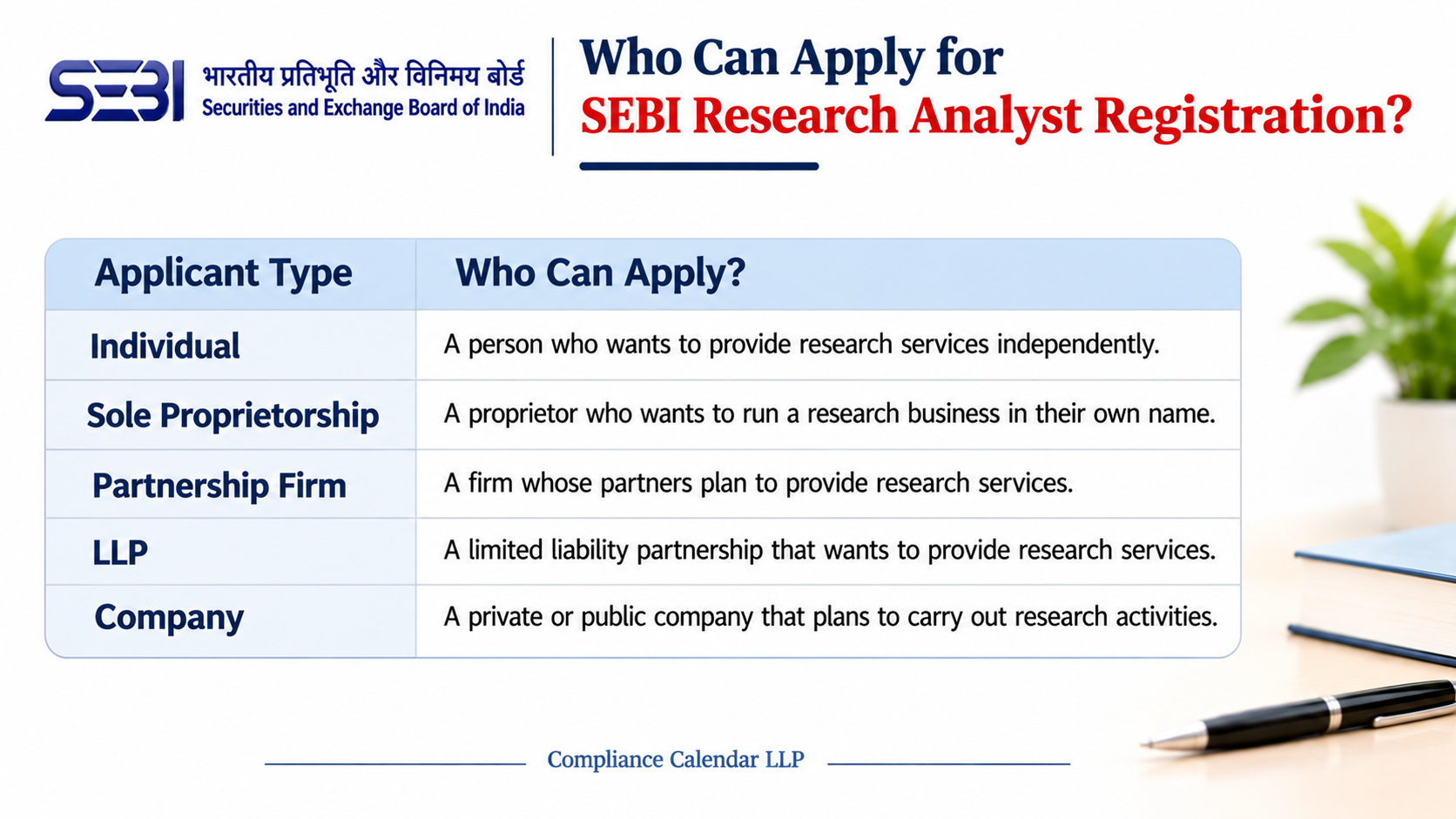
SEBI allows both individuals and business entities to apply for Research Analyst registration. This means you do not have to form a private limited company just to enter this field. The right option depends on whether you want to work independently or run a research business with other people.
|
Applicant Type |
Who Can Apply? |
|
Individual |
A person who wants to provide research services independently |
|
A proprietor who wants to run a research business in their own name |
|
|
A firm whose partners plan to provide research services |
|
|
A limited liability partnership that wants to provide research services |
|
|
Company |
A private or public company that plans to carry out research activities |
A person running a sole proprietorship can apply as an independent Research Analyst. SEBI has specifically clarified that a sole proprietor can make an application, but the proprietor must meet the eligibility conditions that apply to an individual.
A partnership firm, LLP or company can also apply, subject to the rules for that type of applicant. In these cases, the people responsible for research work must meet the relevant qualification and certification requirements. Simply registering a business with the Ministry of Corporate Affairs does not give it permission to provide regulated research services. The required SEBI registration is still necessary.
For detailed information Visit our article on : SEBI Research Analyst eligibility requirements
Educational Qualifications Required to Become a Research Analyst
Education is one of the main conditions for becoming a SEBI-Registered Research Analyst. Under the SEBI (Research Analysts) Regulations, a new individual applicant must meet one of the approved qualification routes. The revised requirements were introduced through the SEBI amendment dated 25 November 2025.
The main qualification routes are:
|
Qualification Route |
What Is Required? |
|
Graduate Degree |
A graduate degree or equivalent qualification from a recognised Indian or foreign university or institution, along with the relevant NISM certification |
|
CFA Charter |
A CFA Charter awarded by the CFA Institute, along with the relevant NISM certification |
|
NISM Post Graduate Program |
Completion of the Post Graduate Program in the Securities Market (Research Analysis) from NISM, or another NISM program specified by SEBI |
These options mean that a person does not necessarily need a degree in finance, commerce or economics. A graduate from another field may also qualify through the graduate-degree route, provided the person obtains the required NISM certification and meets the other SEBI conditions.
There is also a separate route for people who complete the specified NISM postgraduate program. Under SEBI's clarification, applicants using this route do not need to obtain the initial entry-level NISM certification required under the other qualification routes. However, they must still meet the applicable renewal certification requirements.
For Simple explanation visit : Documents required for SEBI Research Analyst Registration
What NISM Certification Is Required?
NISM stands for the National Institute of Securities Markets. It provides training and certification for people working in different areas of the securities market. For Research Analysts, the main entry-level certification is the NISM-Series-XV: Research Analyst Certification Examination.
The examination checks whether a person understands how to study companies and prepare research reports. It covers topics such as the Indian securities market, company analysis, financial statements, industry research, risk and return, share valuation and research report writing. NISM introduced a revised version of the Series XV examination from 20 January 2026. The current examination has 100 marks, including multiple-choice and case-based questions. Candidates need at least 60 marks to pass, and there is negative marking for incorrect answers.
The certificate is generally valid for three years. To continue meeting the certification requirement, the person must pass the relevant NISM renewal examination before the existing certificate expires. The required certification applies not only to independent applicants but also to the relevant people working with a registered research entity.
Can a Person Without a Finance Degree Become a Research Analyst?
Yes. A finance degree is not compulsory under the graduate-degree route introduced by the 2025 amendment. A person with a recognised graduate degree in engineering, science, arts, management or another field may also qualify, provided they complete the required NISM certification and meet the other conditions.
For example, Amit, who has completed a bachelor's degree in engineering. He has been working in a private company but has developed a strong interest in the stock market. Over the years, he has learned how to read company financial statements, compare business performance and study share prices. He now wants to start his own research business and prepare reports for clients.
Amit does not have to complete another degree in finance just because his graduation is in engineering. He may use the graduate-degree route, obtain the relevant NISM certification and meet the other SEBI requirements. He must also arrange the required deposit, have suitable facilities for research work and complete the registration process.
This means that people from different educational backgrounds can enter this profession. However, an interest in the stock market or passing the NISM examination alone does not give anyone permission to start providing regulated research services to clients.
Can a Sole Proprietor, LLP or Company Become a Research Analyst?
Yes. A person can apply as an individual or sole proprietor, while a group of people can choose a suitable business structure such as a partnership firm, LLP or company. The choice depends on how they plan to run their research business.
For a sole proprietorship, the proprietor must meet the individual eligibility conditions. In a partnership firm, the partners involved in providing research services must meet the applicable qualification and certification requirements. For an LLP or company, the principal officer and other relevant persons involved in research work must meet the conditions that apply to their roles.
For example, if two people want to start a research business together, they may consider a partnership firm or an LLP. If one person wants to work independently, applying as an individual or sole proprietor may be more suitable. In either case, the business structure does not replace the need for SEBI registration.
Can an Employee of a Research Company Become a Research Analyst?
Yes. A person can work as a Research Analyst in a company that already holds SEBI registration. In this situation, the company needs the SEBI registration, while the employees involved in research work must meet the required qualification and NISM certification conditions.
For example, a registered research company may employ several people to study companies and prepare reports. These employees do not need to obtain a separate SEBI registration certificate in their own names. However, they must follow the rules that apply to their work, including the required qualifications, certification and trading restrictions.
Not every employee of a research company has to obtain the Research Analyst certification. People doing only clerical, office or support work without a connection to research services and without client contact may fall outside the certification requirement. The actual duties of the employee matter.
Other Conditions to Become a SEBI-Registered Research Analyst
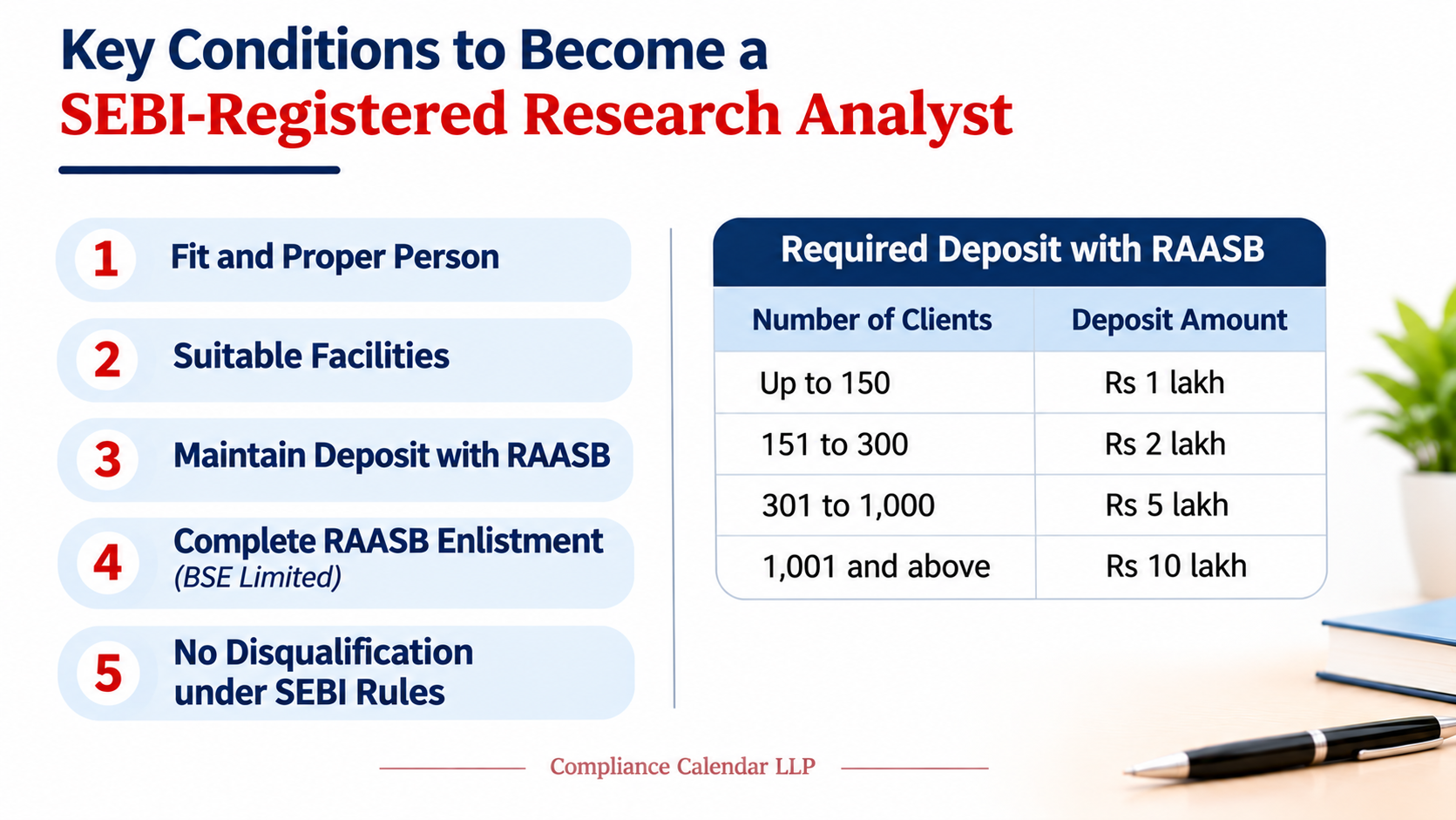
Having the right degree and NISM certificate is not enough. An applicant must also meet other conditions under SEBI rules. These requirements help ensure that the person or business can carry out research work properly and maintain the required records.
Getting the right degree and NISM certificate is only part of the process. SEBI also checks whether the applicant is ready to run research activities properly. For this, the applicant must have a good professional record, including honesty, reputation and financial standing. They must also have the basic setup to study companies and prepare research reports, such as a workplace, computer, access to financial data and a proper system for maintaining records.
Another important requirement is the deposit with the Research Analyst Administration and Supervisory Body (RAASB). The amount is linked to the number of clients handled by the Research Analyst during the previous financial year. A person handling more clients will need to maintain a higher deposit.
|
Number of Clients |
Required Deposit |
|
Up to 150 |
Rs 1 lakh |
|
151 to 300 |
Rs 2 lakh |
|
301 to 1,000 |
Rs 5 lakh |
|
1,001 and above |
Rs 10 lakh |
The deposit must be maintained in the permitted form and marked as a lien in favour of RAASB. This is a deposit requirement, not a minimum capital requirement for starting the business.
RAASB Enlistment: Applicants must complete the required enlistment with the recognised Research Analyst Administration and Supervisory Body. BSE Limited is currently recognised by SEBI for this role.No Disqualification: The applicant must not be disqualified under the applicable SEBI rules. The application may be examined for past regulatory action or other matters that affect the applicant's eligibility.
Learn how can we help here : SEBI Research Analyst Registration Consultant
Who Needs SEBI Registration to Provide Research Services?
A person or business that plans to provide research services covered by the SEBI Research Analysts Regulations must obtain the required registration, unless a specific exemption applies. This includes issuing research reports or providing research analysis on securities for consideration.
For example, a person who prepares paid reports on listed shares or gives buy, sell or hold recommendations based on research may fall within these rules. The same can apply to research services offered through a website or other online platform. Using technical analysis instead of company financial analysis does not automatically create an exemption.
However, not every discussion about the stock market requires Research Analyst registration. General comments about market trends, broad-based indices or economic conditions may fall outside the definition of a research report. SEBI has also listed certain other excluded communications in its regulations.
The important point is to understand the actual service being offered. A person should not assume that a service is exempt just because it is shared online, called an educational service or provided without charging a separate research fee. SEBI considers the nature of the activity and whether any direct or indirect benefit is received for it.
Difference Between a Research Analyst and an Investment Adviser
A Research Analyst and an Investment Adviser both work in the securities market, but their main responsibilities are different. A Research Analyst studies securities and prepares research reports or recommendations. An Investment Adviser provides investment advice based on a client's financial needs, goals and risk profile.
|
Basis |
Research Analyst |
Investment Adviser |
|
Main Work |
Studies securities and prepares research reports or recommendations |
Provides investment advice to clients |
|
Main Focus |
Company, stock and market research |
Client's financial goals and risk profile |
|
Applicable Rules |
SEBI Research Analysts Regulations, 2014 |
SEBI Investment Advisers Regulations, 2013 |
|
Registration |
Research Analyst registration |
Investment Adviser registration |
For example, a Research Analyst may prepare a report explaining a company's financial performance and the factors affecting its share price. An Investment Adviser may discuss a client's income, savings, financial goals and risk-taking ability before advising on investments. A person should understand the difference before choosing which registration to apply for.
You can also learn about the latest SEBI Research Analyst amendments here .
Steps to Get SEBI Research Analyst Registration
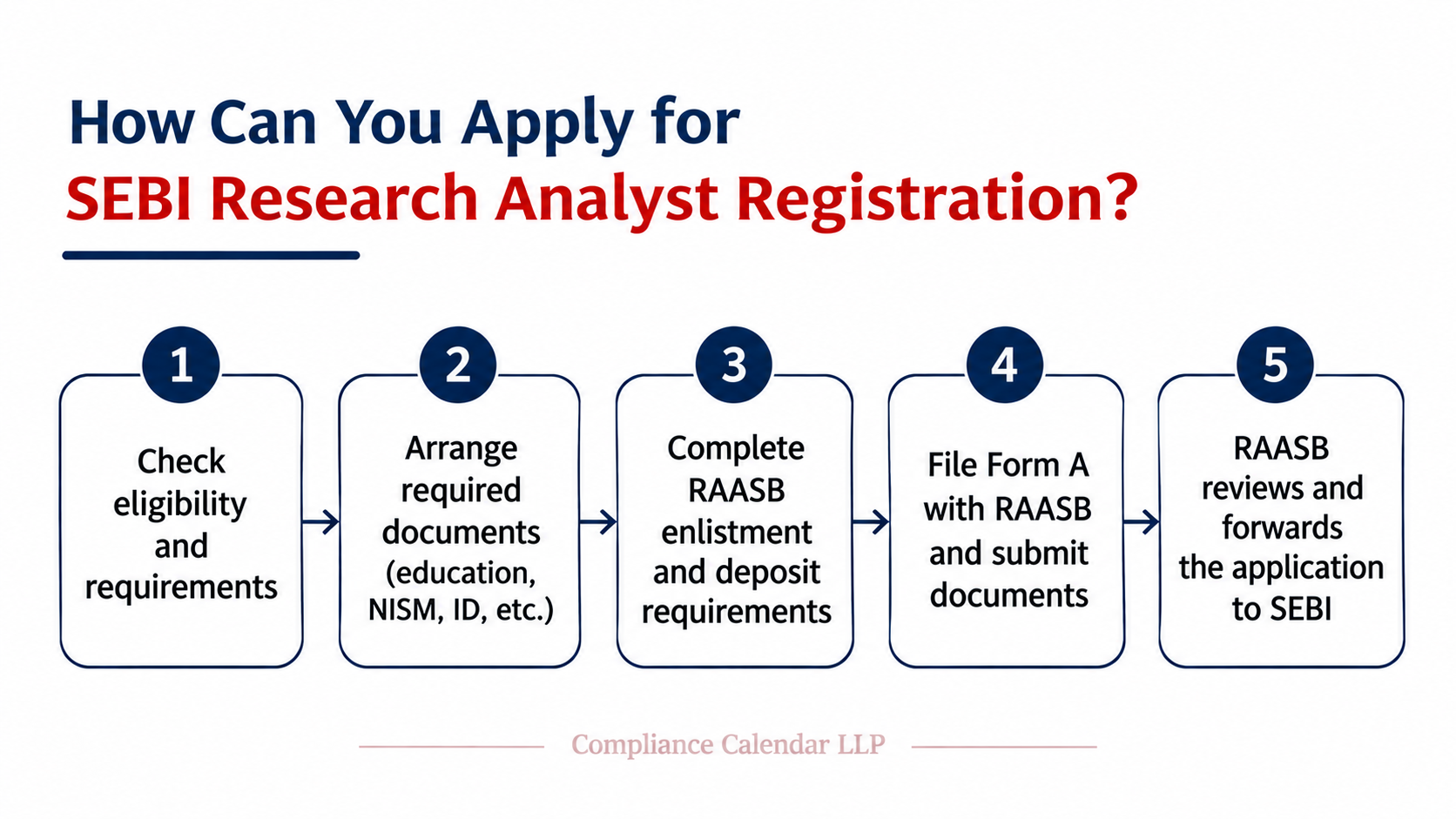
Once you know that you meet the eligibility conditions, you can begin the registration process. The application is made in Form A with the required supporting documents through the recognised Research Analyst Administration and Supervisory Body (RAASB). The body checks the application and recommends it to SEBI for a decision.
Before applying, the applicant should arrange the educational and NISM certificates, identity and address details, business documents where applicable, information about the people involved in research services and the required declarations about facilities. The applicant must also complete the RAASB enlistment and deposit requirements.
The application should be checked carefully before submission. Missing documents, incorrect details or gaps in the qualification records may lead to queries and delay the process. An applicant should also remember that registration must be obtained before starting activities that require it.
For detailed information , visit : SEBI Research Analyst registration process
How Can Compliance Calendar LLP Help with SEBI Research Analyst Registration?
Understanding the eligibility rules is the first step, but preparing an application also requires careful attention to documents, qualifications and other conditions. The requirements may differ depending on whether you are applying as an individual, sole proprietor, partnership firm, LLP or company.
Compliance Calendar LLP can help applicants understand the applicable requirements, organise the supporting documents, prepare the application and follow up during the registration process. Our team can also help you understand the difference between Research Analyst and Investment Adviser registration so that you can choose the correct route for your planned services.
If you are planning to start a research business or apply as an independent Research Analyst, you can contact Compliance Calendar for assistance at +91 9988424211 or info@ccoffice.in
Frequently Asked Questions (FAQs)
1. Who can become a SEBI-Registered Research Analyst?
An individual or eligible business entity can apply for Research Analyst registration if it meets the required education, NISM certification, deposit, infrastructure and other conditions under SEBI rules.
2. Is a finance degree compulsory to become a Research Analyst?
No. A person with a graduate degree in any discipline may qualify through the graduate-degree route, along with the required NISM certification and other conditions.
3. Can a sole proprietor apply for SEBI Research Analyst registration?
Yes. A sole proprietor can apply as an independent Research Analyst. The proprietor must meet the eligibility conditions that apply to an individual applicant.
4. Can a private limited company become a SEBI-Registered Research Analyst?
Yes. A private limited company can apply for registration if it meets the requirements for a non-individual applicant and ensures that the relevant people involved in research work meet their qualification and certification conditions.
5. Which NISM examination is required for a Research Analyst?
The relevant entry-level certification is the NISM-Series-XV: Research Analyst Certification Examination, subject to the applicable qualification route and SEBI rules.
6. Can an engineer or arts graduate become a Research Analyst?
Yes. A person with a recognised graduate degree in engineering, arts, science or another field may qualify through the graduate-degree route by obtaining the required NISM certification and meeting the other conditions.
7. Do employees of a registered Research Analyst need separate SEBI registration?
No. Employees working as Research Analysts for a registered research entity do not need separate SEBI registration in their own names. However, they must meet the applicable qualification and certification requirements.
8. Is there a minimum capital requirement for a Research Analyst?
SEBI does not prescribe a capital adequacy requirement for a Research Analyst. However, the applicant must maintain the required deposit with RAASB based on the number of clients.
9. How much deposit is required for Research Analyst registration?
The deposit ranges from Rs 1 lakh to Rs 10 lakh, depending on the number of clients handled during the previous financial year. For up to 150 clients, the required deposit is Rs 1 lakh.
10. Can I give paid stock recommendations after passing the NISM examination?
No. Passing the NISM examination alone does not give you permission to provide regulated research services. You must obtain the required SEBI registration before starting such activities.
Article last updated on : 21 Nov 2026.