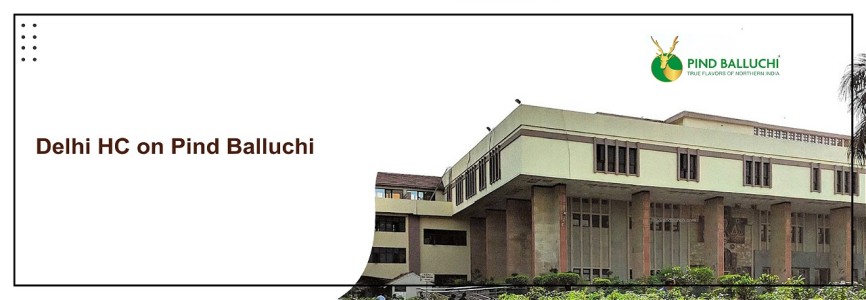



The Delhi High Court has reaffirmed India’s pro-arbitration approach by setting aside a Commercial Court order and referring a trademark infringement and passing-off dispute concerning the “Pind Balluchi” restaurant brand to arbitration. The ruling is significant because it clarifies (again) that, at the Section 8 referral stage, courts should not conduct a detailed “trial” on disputed facts like alleged forgery of the underlying agreement those questions are typically for the arbitral tribunal under the doctrine of kompetenz-kompetenz (tribunal’s power to rule on its own jurisdiction).
Case background in brief
-
The plaintiff (J.S. Hospitality Services Pvt. Ltd.) claimed it is the registered proprietor of the trademark “Pind Balluchi” in multiple classes including Class 43 (restaurant services), and alleged nationwide goodwill in the restaurant sector.
-
The defendant (Triom Hospitality) was running a restaurant in Dwarka, Delhi under the name “Pind Balluchi”. The plaintiff alleged this use was unauthorised, amounting to trademark infringement and passing off, misleading consumers into believing an association with the plaintiff’s chain.
-
The plaintiff filed a commercial suit seeking permanent injunction, mandatory injunction (surrender of branding materials), and consequential reliefs. An ad-interim injunction was granted restraining the defendant from using “Pind Balluchi.”
-
The defendant then moved an application under Section 8 of the Arbitration and Conciliation Act, 1996 (ACA), arguing that the dispute should be referred to arbitration based on an alleged MOU dated 22.06.2022 containing an arbitration clause.
Why the Commercial Court refused arbitration
The Commercial Court refused referral under Section 8 primarily on two tracks:
-
Execution denied / forgery alleged: The plaintiff denied signing the MOU and alleged it was forged/fabricated, pointing to surrounding circumstances and absence of the original document.
-
Non-signatory objection: The Commercial Court also held that even if the MOU were assumed genuine, the defendant firm was not a party/signatory, and therefore arbitration could not be compelled.
It effectively concluded that the matter required forensic/handwriting evidence, making it non-arbitrable at that stage.
Delhi High Court’s core holding: don’t decide merits at the Section 8 stage
The High Court disagreed with this approach and held that the Commercial Court went beyond the limited “prima facie” scrutiny permissible under Section 8. It noted that while the case may indeed need extensive evidence (including signature examination), that is precisely why the referral court should not conduct a deep merits inquiry at the referral stage.
The High Court emphasised that:
-
Section 8 review is meant to be limited and prima facie, used mainly to filter out matters that are ex-facie frivolous or clearly non-arbitrable.
-
Issues requiring substantive evaluation (like whether signatures are genuine, whether the agreement is forged, etc.) should ordinarily be left to the arbitral tribunal under Section 16 (kompetenz-kompetenz).
Fraud/forgery allegations do not automatically make a dispute non-arbitrable
A key part of the ruling is the Court’s reliance on the evolving Supreme Court jurisprudence that allegations of fraud/forgery, by themselves, do not oust arbitral jurisdiction when the dispute arises from a civil/commercial relationship.
In this case, the High Court observed that:
-
The parties had a pre-existing commercial relationship;
-
The MOU exists in writing;
-
Expert analysis of signatures had not yet been done;
-
The tribunal is competent to examine these issues substantively.
The Court also referenced the contemporary Supreme Court line that civil/commercial disputes arising out of contractual relationships are generally arbitrable, reinforced by Section 16 and the post-2015 legislative policy to minimise judicial interference at the referral stage.
Formal validity vs substantive validity: an important clarification
One of the most useful takeaways for practitioners is the Court’s discussion on what “validity” means under Section 8 at the prima facie stage.
The High Court indicated that:
-
At the referral stage, scrutiny of “validity” should be confined mainly to formal validity for example, whether there is an arbitration agreement in writing.
-
Questions of substantive validity (including disputed execution, disputed signatures, fraud/forgery allegations, and detailed evidentiary issues) belong to the arbitral tribunal’s domain under Section 16.
Non-signatories and consent: the Court rejects a “hyper-technical” bar
On the Commercial Court’s view that only signatories can be referred to arbitration, the High Court took a more modern approach: signature may not be mandatory where consent/intent can be inferred from conduct and the legal relationship.
Relying on the Supreme Court’s reasoning in the Cox and Kings line of cases (group of companies / non-signatory principles), the Court held it would be incorrect to reject arbitration purely on a hyper-technical “non-signatory” ground at this stage, especially given the pro-arbitration scheme of the ACA.
What happened finally?
The Delhi High Court:
-
Set aside the Commercial Court’s order dated 28.08.2024;
-
Allowed the Section 8 application;
-
Referred the parties to arbitration;
-
Held the civil suit to be not maintainable due to the arbitration referral; and
-
Directed parties to take steps for constitution/appointment of the arbitral tribunal as per law.
Relevant legal provisions (quick reference)
Arbitration & Conciliation Act, 1996
-
Section 8 – Power of a judicial authority to refer parties to arbitration where there is an arbitration agreement (referral stage scrutiny).
-
Section 16 – Kompetenz-kompetenz: arbitral tribunal’s power to rule on its own jurisdiction.
-
Section 37 – Appeal provisions (including appeal against refusal to refer under Section 8).
Trade Marks Act, 1999 (typically invoked in such suits)
While the High Court’s decision here is primarily on arbitral referral, the underlying suit was grounded in trademark infringement/passing off. The usual substantive provisions relevant to such disputes include:
-
Section 27(2) – Passing off remedy preserved even for unregistered marks (common law).
-
Section 28 – Rights conferred by registration (exclusive right to use).
-
Section 29 – Infringement of registered trademark.
-
Section 134/135 – Jurisdiction and reliefs (injunction, damages/accounts, delivery up, etc.).
Key case law principles applied (as reflected in the judgment)
From the judgment text, the Court relied on and discussed several Supreme Court principles on:
-
Limited prima facie review under Section 8, especially post-2015 amendments;
-
Formal validity vs substantive validity at referral stage;
-
Arbitrability despite fraud/forgery allegations when disputes arise out of civil/commercial relationships;
-
Non-signatory binding / consent-based approach (Cox and Kings principles).
Why this ruling matters for trademark & franchise/restaurant brand disputes
-
Arbitration can remain viable even in IP-labelled disputes when the conflict is rooted in a commercial contract (franchise, licence, MOU, assignment, business separation, etc.).
-
Courts should not “try” forgery at Section 8 stage if the matter needs evidence and expert examination, that often strengthens the case for tribunal determination under Section 16.
-
Non-signatory objections may not stop arbitration where intent/consent and commercial relationship can be shown, consistent with the modern pro-arbitration stance.
Frequently Asked Questions (FAQs)
Q1. Can trademark infringement and passing-off disputes be referred to arbitration in India?
Ans. Yes. Trademark disputes can be referred to arbitration when they arise out of a contractual or commercial relationship, such as a franchise agreement, licence, MOU, or business arrangement containing an arbitration clause. The Delhi High Court clarified that merely because a dispute involves trademark infringement or passing off does not automatically make it non-arbitrable.
Q2. Does alleging forgery or fraud in a contract bar arbitration?
Ans. No. Mere allegations of forgery, fraud, or fabricated documents do not automatically bar arbitration. Courts have consistently held that such allegations, when arising from a civil or commercial relationship, can be examined by the arbitral tribunal under Section 16 of the Arbitration and Conciliation Act, 1996.
Q3. What is the scope of court scrutiny under Section 8 of the Arbitration Act?
Ans. Under Section 8, the court’s role is limited to a prima facie examination of whether:
-
An arbitration agreement exists, and
-
The dispute is broadly covered by it
Courts should not conduct a detailed inquiry into disputed facts, evidence, or document authenticity at this stage.
Q4. Can an arbitral tribunal decide whether an agreement is forged?
Ans. Yes. Under the principle of kompetenz-kompetenz (Section 16), the arbitral tribunal has the authority to rule on its own jurisdiction, including issues relating to:
-
Validity of the arbitration agreement
-
Alleged forgery or fabrication
-
Disputed signatures and execution
Q5. Is a person who has not signed the arbitration agreement bound by arbitration?
Ans. In certain circumstances, yes. Courts recognise that non-signatories may be referred to arbitration if:
-
Their consent can be inferred from conduct, or
-
They are part of the same commercial transaction or group of companies
A strict insistence on signatures alone is no longer the governing test.
Q6. Does an interim injunction granted by a court prevent arbitration?
Ans. No. Grant of an interim or ad-interim injunction does not prevent the dispute from being referred to arbitration. Courts may grant temporary protection, but once a valid arbitration clause is found, the main dispute must proceed before the arbitral tribunal.
Q7. Are pure trademark rights disputes arbitrable?
Ans. Disputes involving statutory rights in rem (such as rectification or cancellation of trademarks) are generally non-arbitrable. However, disputes in personam, such as contractual misuse of a trademark, licensing conflicts, or passing-off claims between private parties, can be arbitrated.
Q8. What trademark law provisions are usually involved in such disputes?
Ans. In trademark infringement and passing-off suits, courts typically examine:
-
Section 27(2) – Common law remedy of passing off
-
Section 28 – Rights of a registered trademark proprietor
-
Section 29 – Infringement of registered trademark
-
Sections 134 & 135 – Jurisdiction and reliefs (injunctions, damages, delivery-up)
These provisions govern the merits, while arbitration determines the forum.
Q9. What is the key takeaway from the Pind Balluchi ruling?
Ans. The ruling reinforces India’s pro-arbitration stance. Courts should not convert a Section 8 application into a mini-trial. If the dispute arises from a commercial arrangement with an arbitration clause, complex factual issues must be decided by the arbitral tribunal, not the referral court.
Q10. How should businesses structure agreements involving brand use?
Ans. Businesses should:
-
Clearly define trademark ownership and usage rights
-
Include a well-drafted arbitration clause
-
Specify governing law, seat, and procedure
-
Maintain proper documentation and execution records


_(b)_of_the_Trademark_Act,_1999_(1)_crop10_thumb.jpg)


_crop10_thumb.jpg)


_crop10_thumb.jpg)
_crop10_thumb.jpg)


_crop10_thumb.jpg)


_crop10_thumb.jpg)


_crop10_thumb.jpg)


_crop10_thumb.jpg)


_crop10_thumb.jpg)


_crop10_thumb.jpg)


_crop10_thumb.jpg)


_crop10_thumb.jpg)


_crop10_thumb.jpg)








_crop10_thumb.jpg)



























































_crop10_thumb.jpeg)