



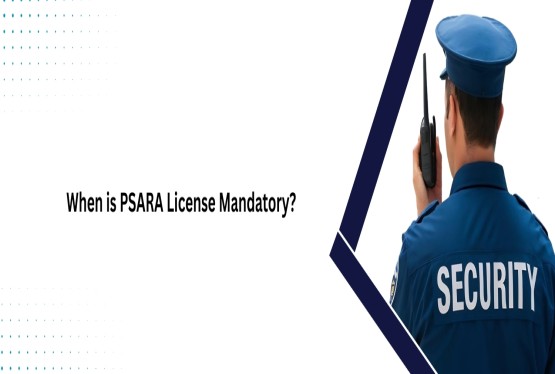
Running a private security agency in India is a serious business. You are not just providing guards to offices, malls, hospitals, factories, or societies you are also responsible for people’s safety and property. Because of this, the Government has made it compulsory to take a PSARA License under the Private Security Agencies (Regulation) Act, 2005 before starting operations.
Many people think that applying for PSARA is only about filling one form, but in reality, the documents play the most important role. If your papers are not complete or not properly arranged, your application can get delayed or rejected.
This article explains in simple and clear language all the documents required for a Private Limited Company to get a PSARA License.
What is a PSARA License?
PSARA License is a legal permission issued by the State Government that allows a company to run a private security agency. Without this license, providing security guards or manpower security services is illegal in India.
Whether you are supplying guards to housing societies, IT parks, warehouses, schools, hospitals, or factories, PSARA registration is compulsory.
Why Documents Matter in PSARA Application
The PSARA department checks whether:
-
Your company is genuine
-
Your directors are trustworthy
-
You have a proper office
-
You have trained guards
-
You follow labour laws
All this is verified through documents. Even one missing or wrong document can delay the approval.
Documents Checklist of PSARA License for a Private Limited Company
Below is the full list of documents that your company must submit:
Certificate of Incorporation (COI)
This is the proof that your company is legally registered with the Ministry of Corporate Affairs (MCA).
It shows:
-
Company name
-
CIN number
-
Date of incorporation
The PSARA authority uses this to confirm that your business is a valid Private Limited Company.
Memorandum of Association (MOA)
MOA tells what your company is allowed to do.
It must include security services or private security agency activities in the main objects.
If this line is missing, PSARA license will not be granted.
The department checks MOA to ensure your company is legally permitted to run a security agency.
Articles of Association (AOA)
AOA explains how the company will be managed internally.
It includes:
-
Rights of directors
-
Shareholding rules
-
Decision-making process
This document is needed to understand the management structure of the agency.]
Company PAN Card
This is the tax identity of the company.
PSARA authorities need PAN to:
-
Verify the company
-
Link financial and compliance records
Without PAN, no government license can be issued.
Directors’ Documents
For all directors of the company, the following are required:
-
Aadhaar Card
-
PAN Card
-
Mobile Number
-
Email ID
These are required for:
-
Police verification
-
Background check
-
Government record
All directors must be Indian citizens. Any criminal history or mismatch can create issues in approval.
GST Registration Certificate
GST registration proves that your company is registered as a service provider.
Since security services are taxable, GST is mandatory.
PSARA department uses this to check:
-
Business activity
-
Tax compliance
Even if your turnover is low, GST is compulsory for PSARA.
EPFO and ESIC Registration
This is very important.
Security guards are employees, so:
-
EPFO (Provident Fund)
-
ESIC (Health insurance)
are mandatory.
These certificates prove that your company follows labour laws and will give social security benefits to guards.
Without EPFO and ESIC, PSARA will not approve your application.
Shop & Establishment License
This license is taken from the local labour department.
It proves:
-
Your office exists
-
You are running a lawful business
It is used as official proof that your security agency is operating from a valid commercial place.
Office Premises Photographs
You need to provide:
-
Indoor photos
-
Outdoor photos
-
Front board showing company name
These photos prove that:
-
You have a physical office
-
It is properly branded
-
It is not a fake or temporary setup
PSARA department wants to see where your agency is operating from.
Guard Photographs in Proper Uniform
You must submit photos of security guards wearing:
-
Uniform
-
ID card
-
Proper appearance
This shows that:
-
You already have guards
-
They are properly trained and disciplined
-
You are ready to provide services
This builds confidence in your security setup.
MOU with a Registered Training Institute
PSARA law requires every security guard to be trained.
For this, your company must sign an MOU with a government-recognized training institute.
This document proves that:
-
Your guards will get proper training
-
You follow PSARA training rules
Without this MOU, PSARA license cannot be issued.
Office Address Proof
You must submit:
-
Rent Agreement
-
Electricity Bill
These two documents prove:
-
Your office location
-
Ownership or legal possession
The address must match with:
-
GST
-
Shop Act
-
PSARA application
Any mismatch may lead to rejection.
Why Accuracy in Documents is Important
PSARA department does not accept:
-
Wrong addresses
-
Old documents
-
Incomplete files
-
Mismatch in company name
All records must match across:
-
MCA
-
GST
-
EPFO
-
ESIC
-
Shop Act
-
PSARA form
One small mistake can delay your license by months.
Conclusion
Getting a PSARA License is not difficult if your documents are complete and correct. Most delays happen because companies submit wrong or incomplete papers.
If you have:
-
A registered Private Limited Company
-
Proper office
-
Trained guards
-
Labour registrations
-
And correct documents
Your PSARA license can be obtained smoothly.
FAQs
Q1. Is PSARA License mandatory for all security agencies in India?
Ans. Yes. Any company or firm that provides security guards, bouncers, watchmen, or manpower security services must obtain a PSARA License under the Private Security Agencies (Regulation) Act, 2005. Operating without it is illegal.
Q2. Can a newly incorporated Private Limited Company apply for PSARA License?
Ans. Yes. A newly registered company can apply, but it must first complete GST, EPFO, ESIC, and Shop & Establishment registration before submitting the PSARA application.
Q3. Can foreign nationals or NRIs be directors in a PSARA company?
Ans. No. Under PSARA rules, all directors of a private security agency must be Indian citizens. Companies with foreign directors are not eligible.
Q4. Is GST registration compulsory for PSARA License?
Ans. Yes. Since security services are taxable under GST, GST registration is mandatory for PSARA approval, even if the turnover is low.
Q5. Are EPFO and ESIC registration required even if guards are hired on contract?
Ans. Yes. Even if guards are hired through contracts, EPFO and ESIC registration is compulsory because security guards are treated as employees under labour laws.
Q6. Can PSARA License be applied without a physical office?
Ans. No. A proper office with address proof, photographs, and signage is mandatory. Virtual offices or residential addresses are not accepted for PSARA.
Q7. Is a training institute tie-up compulsory before applying for PSARA?
Ans. Yes. An MOU with a government-recognized security guard training institute is mandatory. Without this document, the PSARA application will not be processed.
Q8. How long does it take to get a PSARA License?
Ans. On average, it takes 45 to 90 days, depending on police verification, document accuracy, and the state authority’s processing time.
Q9. Is PSARA License valid all over India?
Ans. No. PSARA License is state-specific. If you want to operate in multiple states, you must apply separately in each state.
Q10. What happens if a security agency works without PSARA License?
Ans. Operating without PSARA can lead to heavy penalties, cancellation of contracts, sealing of office, and even criminal action under the PSARA Act.


_crop10_thumb.jpg)





_for_FY_2025-26_crop10_thumb.jpg)





_learn_crop10_thumb.jpg)


_Filing_Due_Dates_for_FY_2024-25_learn_crop10_thumb.jpeg)




_of_GST_Act_learn_crop10_thumb.jpg)


_Under_GST_learn_crop10_thumb.jpg)


_crop10_thumb.jpg)


_crop10_thumb.jpg)


_learn_crop10_thumb.jpg)


_of_the_Income_Tax_Act_learn_crop10_thumb.jpg)


_learn_crop10_thumb.jpg)


_learn_crop10_thumb.jpg)


_crop10_thumb.jpg)





_in_The_Income_Tax_Act,_1961_learn_crop10_thumb.jpg)


_learn_crop10_thumb.jpg)


_of_the_Income_Tax_Act_learn_crop10_thumb.jpg)

_Of_Income_Tax_Act_learn_crop10_thumb.jpg)


_learn_crop10_thumb.jpg)


_learn_crop10_thumb.jpg)
_crop10_thumb.jpg)




_learn_crop10_thumb.jpg)
_for_Import_and_Export_learn_crop10_thumb.jpg)


























_crop10_thumb.jpg)