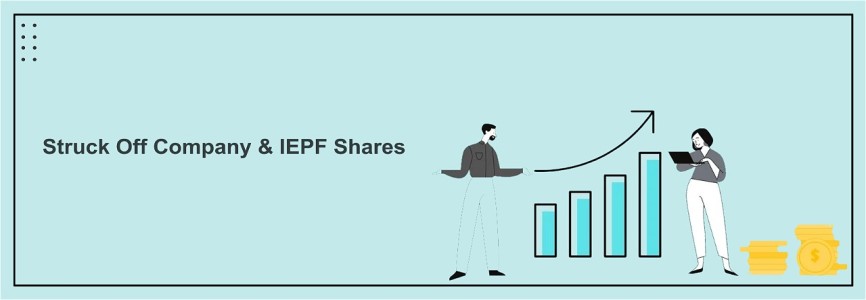



Many people find out about old shares of their parents or grandparents after a long time. When they learn that the company has been struck off or closed, they feel scared and confused, thinking the shares are gone forever. But there is no need to worry. If those shares were moved to the IEPF (Investor Education and Protection Fund), they can still be claimed. Even if the company does not exist today, the shares or their value are kept safely with the IEPF. Legal heirs still have the right to get these shares back by completing the IEPF process and submitting the required documents. The process may take some time, but the shares are not lost.
What Does Company Struck Off Mean?
A company is said to be struck off when its name is removed from the register of companies maintained by the Ministry of Corporate Affairs (MCA).
This usually happens when:
-
Company is Not Doing Business: When a company stops its operations and remains inactive for a long time, it may eventually be struck off by authorities.
-
Annual Filings Are Not Done for Years: If the company fails to file required returns and financial statements regularly, it is treated as non-compliant and may be removed.
-
Company Voluntarily Applies for Closure: Sometimes, the company itself applies to close its name when it no longer wants to continue operations.
-
MCA Removes Inactive Companies: The Ministry of Corporate Affairs (MCA) periodically removes companies that are inactive or not following legal requirements.
Once struck off:
-
Company legally stops existing: Once a company is struck off, it is treated as closed in the eyes of the law and no longer has a legal identity. Simply put, the company is considered “shut down” permanently.
-
Directors lose authority: After strike-off, directors no longer have the power to take decisions or act on behalf of the company. They cannot sign documents, represent the company, or manage any affairs.
-
No business activities can continue: The company cannot run its business, earn money, or enter into any new transactions
But shareholder rights do not automatically vanish.
What Is IEPF and Why Shares Go There?
IEPF stands for Investor Education and Protection Fund.
If shares or dividends remain unclaimed for 7 consecutive years, companies are required to:
-
Transfer unpaid dividends to IEPF: If dividends remain unclaimed for a prescribed period, the company is required to move that money to the IEPF for safe keeping.
-
Transfer shares to IEPF Demat Account: Along with unpaid dividends, the related shares are also transferred to a special IEPF Demat Account, from where legal heirs or rightful owners can later claim them.
IEPF acts like a safe locker:
-
Government holds the shares: The shares are kept safely with the Government through the IEPF until they are claimed.
-
Ownership remains with shareholders or legal heirs: Even after transfer to IEPF, the actual ownership does not change and continues to belong to the shareholder or their legal heirs.
-
Claims can be made anytime: There is no deadline to claim these shares, and rightful owners can apply for recovery whenever they come to know about them.
What If the Company is Struck Off but Shares are Already with IEPF?
This is a very common situation.If shares are already transferred to IEPF before the company was struck off, they can still be recovered. The status of the company does not affect the right of the shareholder or legal heir.
Why Shares with IEPF are Still Safe Even If Company is Struck Off
Once shares are transferred to IEPF:
-
They are no longer held by the company: Once transferred, the shares are not kept with the company anymore.
-
They are held by the government: The government, through the IEPF, safely holds these shares on behalf of the rightful owners.
-
The company’s existence becomes less important: Since the shares are with the IEPF, whether the company is active or struck off does not affect the claim process.
IEPF Authority has:
-
Complete record of shares: The IEPF keeps full and proper records of all shares transferred to it, including shareholder details.
-
Power to release shares: IEPF has the legal power to return the shares once a valid claim is approved.
-
Authority to transfer shares to claimants: After verification, IEPF can directly transfer the shares to the rightful shareholder or legal heir
So even if the company is struck off later, IEPF can still process the claim.
What If the Company Was Struck Off Before Transferring Shares to IEPF?
This is a more complicated situation.If:
-
The company is struck off: The company has been legally closed and no longer exists on official records.
-
Shares were never transferred to IEPF: In such cases, recovery of shares becomes difficult and may require revival of the company through legal process before the shares can be claimed.
Then:
-
IEPF cannot release shares directly: The IEPF cannot give back shares if they were never transferred to it.
-
Shares are still legally with the company: Since the company still legally owns the shares, they must be claimed through the company or its revival process before IEPF can release them.
In such cases:
-
The company may need to be restored: If the company is struck off, it might have to be legally revived to claim the shares.
-
Legal remedies may be required: In some cases, heirs may need to approach the court or follow other legal procedures to recover the shares.
Can Legal Heirs Claim Shares from IEPF if Company is Struck Off?
Yes. Legal heirs can claim shares from IEPF even if:
-
Company is struck off: The company has been legally closed and no longer exists.
-
Directors are not available: There are no active directors to manage or authorize any company matters.
-
Company office does not exist: The company’s registered office is no longer functional, making direct communication or claim through the company impossible
Because:
-
IEPF Authority takes over responsibility: Once shares or dividends are transferred, the IEPF becomes responsible for holding and safeguarding them.
-
Verification is done based on records: The IEPF checks all shareholder details and documents before releasing shares to the rightful owner or legal heir.
What Documents are Required in Such Cases?
The documents remain mostly the same:
-
Death certificate of shareholder: Proof that the original shareholder has passed away.
-
Legal heir certificate or succession certificate: Documents proving the claimant is the rightful heir.
-
KYC of claimant (PAN, Aadhaar, bank details): Identity and bank information of the person claiming the shares.
-
IEPF Form IEPF-5: Official form to apply for the release of shares from IEPF.
-
Indemnity bond and affidavit: Legal declarations ensuring the claim is genuine and protecting IEPF from future disputes.
The difference is:
-
Company verification may be limited: If the company is struck off, IEPF cannot fully verify records directly with it.
-
IEPF relies more on documents: In such cases, IEPF depends mainly on the submitted documents like death certificate, legal heir certificate, and KYC to process the claim.
How Verification Happens When Company Is Struck Off
Normally:
-
Company or RTA verifies the claim: The company itself or its Registrar & Transfer Agent (RTA) checks and confirms the claimant’s documents and entitlement before IEPF releases the shares.
If company is struck off:
-
RTA records are checked: The company’s Registrar & Transfer Agent records are examined to confirm share ownership.
-
IEPF internal data is verified: IEPF cross-checks its own records to ensure accuracy before processing the claim.
-
MCA records are relied upon: Ministry of Corporate Affairs (MCA) data is used to validate company and shareholder details.
The absence of the company does not block the process.
Role of Registrar & Transfer Agent (RTA)
Even if the company is struck off:
-
RTA may still have old shareholder data: Even if the company is struck off, the Registrar & Transfer Agent may retain historic records of shareholders.
-
RTA helps confirm folio details: They can verify the specific share folios and ownership details of the claimant.
-
RTA supports IEPF verification: Their records and confirmation help IEPF validate and approve the share claim.
RTAs play a key role in such recovery cases.
Step-by-Step Process to Recover Shares from IEPF When Company is Struck Off
Step 1: Confirm Shares Are with IEPF: Before starting the claim, check if the shares or unpaid dividends have already been transferred to IEPF. You can do this on the IEPF website using the shareholder’s name. This step ensures you’re claiming the right shares that are actually available with IEPF.
Step 2: Collect Share Details: Gather all the information about the shares, including the company name, folio number, and the exact number of shares. Accurate details help in smooth verification and prevent delays.
Step 3: Prepare Legal Documents: You’ll need documents proving your right to claim the shares. These usually include:
-
Death certificate of the original shareholder
-
Legal heir certificate or succession certificate
-
NOC (No Objection Certificate) if required by family members or co-heirs
Having these docu ments ready is crucial for IEPF to accept your claim.
Step 4: File IEPF-5 Form: This is the official claim form for shares and dividends held by IEPF. You must fill it online on the MCA portal, providing all the necessary details about the shareholder, legal heir, and shares. Accuracy here is very important to avoid rejections.
Step 5: Send Documents: After submitting the online form, send physical copies of all the supporting documents directly to the IEPF Authority. Do not send them to the company, especially if it’s struck off, because IEPF handles the claim independently.
Step 6: IEPF Verification: IEPF reviews all your documents and verifies the claim internally. They may cross-check with their records, MCA database, and RTA records to ensure the claim is genuine. This step can take time if the records are old or incomplete.
Step 7: Approval Order: Once everything is verified, IEPF issues an official approval order. This is a formal confirmation that your claim has been accepted and the shares are ready to be released.
Step 8: Shares Credited: Finally, the shares are transferred to your Demat account. If there are any unpaid dividends, they are also credited directly to your bank account. From this point, you officially own and can manage the recovered shares.
Do You Need to Restore the Company for IEPF Claim?
No, if shares are already with IEPF. Company restoration is required only when:
-
Shares are still with the company: If the shares were never transferred to IEPF, they remain legally with the company.
-
Not transferred to IEPF: In this case, IEPF cannot release the shares, and recovery must be done through the company or legal procedures.
If shares are already with IEPF:
-
Restoration is unnecessary: If the shares are already with IEPF, there’s no need to revive the struck-off company.
-
Claim can proceed normally: The legal heirs can directly apply to IEPF and recover the shares through the standard process.
What If Dividends are also Involved?
Dividends transferred to IEPF:
-
Are released along with shares: Any unpaid dividends are released at the same time as the shares.
-
Credited directly to the bank account: The dividend amount is transferred straight into the claimant’s bank account.
Company strike-off does not affect dividend recovery.
What Happens to Bonus or Rights Shares?
Bonus or rights shares:
-
Automatically follow original shares: Any benefits like bonus or rights shares linked to the original shares move along with them.
-
Are also released by IEPF: IEPF ensures these additional shares or benefits are released to the claimant as well.
Legal heirs get all corporate benefits.
Common Misunderstandings
-
Company closed means shares are gone: Wrong. If the shares are with IEPF, they remain safe and can be claimed.
-
Probate is compulsory: Not always. A legal heir certificate or NOC is often enough to claim the shares.
-
A court case is required: Usually not. Proper documents submitted to IEPF are enough to release the shares.
Challenges in Such Cases
-
Old records missing: Sometimes historical share records are incomplete or lost, making verification harder.
-
Name mismatch: Differences in spelling or name format can delay processing.
-
Inactive RTAs: If the Registrar & Transfer Agent is no longer active, confirming share details can take longer.
-
Longer verification time: Due to these issues, the IEPF verification process may take more time than usual.
These are procedural issues, not legal barriers.
Why Professional Help is Important
When company is struck off:
-
Process becomes technical: Claiming shares, especially from struck-off companies, involves legal and procedural steps.
-
Follow-ups are needed: Regular follow-ups may be required with IEPF to track the progress of the claim.
-
Documentation must be precise: All forms and supporting documents must be accurate and complete to avoid delays.
Professional support ensures:
-
Correct filing: Submitting accurate forms and documents ensures a smooth process.
-
Faster processing: Properly prepared claims are verified and approved more quickly by IEPF.
-
No unnecessary court steps: When documents are complete and correct, there’s usually no need for legal or court intervention.
How Compliance Calendar LLP Helps
Compliance Calendar LLP assists families by:
-
Tracing shares even in old or struck-off companies: Identifying unclaimed shares and verifying their details.
-
Preparing affidavits, indemnity bonds, and NOCs: Drafting all legal documents required for the claim.
-
Filing IEPF-5 correctly: Submitting the claim form accurately to avoid delays.
-
Coordinating with IEPF and RTAs: Liaising with authorities to ensure smooth verification.
-
Ensuring shares and dividends are recovered smoothly: Making sure both shares and unpaid dividends reach the rightful claimant without hassles.
We simplify a process that otherwise feels confusing and stressful.
Real-Life Situation Example
A person discovers that his father held shares in a company that closed 15 years ago. On checking, he finds that the shares were transferred to IEPF before closure.
Without restoring the company, he:
-
Filed IEPF-5: The claimant completed and submitted the official claim form.
-
Submitted legal heir documents: All required documents like death certificate and legal heir certificate were provided.
-
Received shares in his Demat account: The shares were successfully credited to the claimant’s account.
The company’s strike-off did not stop recovery.
Conclusion
Finding out that a company has been struck off can be scary, especially when your family’s hard-earned savings are involved. However, it is important to know that shares transferred to the IEPF are not lost, they are legally protected by the government. Even if the company no longer exists, the directors are not available, or the company offices are closed, legal heirs can still recover the shares and dividends from IEPF by submitting the right documents. With proper guidance, patience, and the correct process, families can get back what truly belongs to them. Compliance Calendar LLP supports families throughout this journey, helping them move from confusion to clarity and from worry to successful recovery.
Frequently Asked Questions (FAQs)
Q1. What does it mean when a company is struck off?
Ans. It means the company has been officially closed and removed from the MCA records, but this does not automatically cancel shareholder rights.
Q2. Are shares lost if the company is struck off?
Ans. No, shares are not lost if they were already transferred to the IEPF; they remain safely held by the government.
Q3. Can legal heirs claim shares from IEPF if the company no longer exists?
Ans. Yes, legal heirs can still recover shares and dividends from IEPF even if the company is struck off.
Q4. Is it necessary to restore the struck-off company to claim shares from IEPF?
Ans. No, company restoration is not required if the shares have already been transferred to IEPF.
Q5. What if the company was struck off before transferring shares to IEPF?
Ans. In such cases, the company may need to be restored or legal remedies may be required before claiming the shares.
Q6. Who verifies the claim when the company is struck off?
Ans. The IEPF Authority verifies the claim using its records, MCA data, and RTA information instead of company confirmation.
Q7. What documents are required to claim shares from IEPF in this case?
Ans. Key documents include the death certificate, legal heir or succession certificate, claimant’s KYC, and IEPF Form IEPF-5.
Q8. Can dividends also be recovered along with shares?
Ans. Yes, any unpaid dividends transferred to IEPF are released along with the shares and credited to the claimant’s bank account.
Q9. How long does the recovery process take when the company is struck off?
Ans. The process usually takes longer than normal cases and may take around 7 to 10 months, depending on verification.
Q10. How can Compliance Calendar LLP help in such cases?
Ans. Compliance Calendar LLP assists in tracing shares, preparing documents, filing IEPF claims, and following up to ensure smooth recovery.


_crop10_thumb.jpg)




_for_FY_2025-26_crop10_thumb.jpg)




_learn_crop10_thumb.jpg)


_Filing_Due_Dates_for_FY_2024-25_learn_crop10_thumb.jpeg)




_of_GST_Act_learn_crop10_thumb.jpg)


_Under_GST_learn_crop10_thumb.jpg)


_crop10_thumb.jpg)


_crop10_thumb.jpg)


_learn_crop10_thumb.jpg)


_of_the_Income_Tax_Act_learn_crop10_thumb.jpg)


_learn_crop10_thumb.jpg)


_learn_crop10_thumb.jpg)


_crop10_thumb.jpg)





_in_The_Income_Tax_Act,_1961_learn_crop10_thumb.jpg)


_learn_crop10_thumb.jpg)


_of_the_Income_Tax_Act_learn_crop10_thumb.jpg)

_Of_Income_Tax_Act_learn_crop10_thumb.jpg)


_learn_crop10_thumb.jpg)


_learn_crop10_thumb.jpg)
_crop10_thumb.jpg)



_learn_crop10_thumb.jpg)
_for_Import_and_Export_learn_crop10_thumb.jpg)


















_crop10_thumb.jpg)