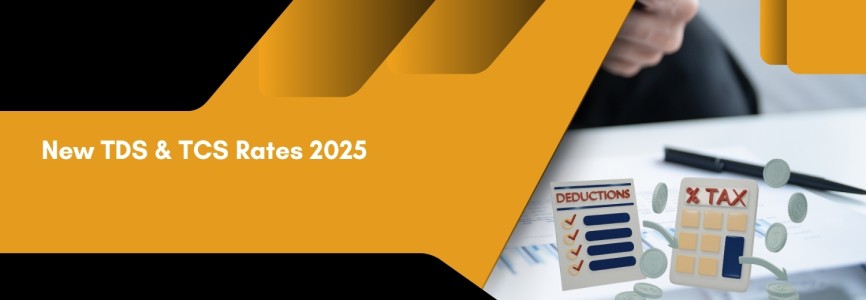



The Indian direct tax system is standing at a historic crossroads. With the official rollout of the Income Tax Act, 2025, the government has replaced the decades-old Income Tax Act of 1961 with a modernized, consolidated framework. Effective from April 1, 2026, this transition represents a fundamental shift in how Tax Deducted at Source (TDS) and Tax Collected at Source (TCS) are categorized, calculated, and reported.
For accountants, auditors, compliance professionals, and business owners, the "old" 194-series are now a thing of the past. They have been mapped into a streamlined "Table and Serial Number" architecture primarily housed under Sections 392, 393, and 394. If you want to learn about the changes in TDS/ TCS after enactment of Income Tax Act, 2025, please read the article till the end to stay updated.
The Structural Shift: New Logic for Withholding
The Income Tax Act, 2025 provides diductors a tiered structure:
-
Section 392 (Salary): A dedicated section for all employment-based remuneration.
-
Section 393 (Non-Salary Payments): A massive "Master Table" covering everything from rent and interest to professional fees and partner salary.
-
Section 394 (TCS): An expanded framework for tax collection at the source, especially targeting luxury consumption.
This table-driven approach uses Section Codes (4-digit identifiers) to ensure that the e-filing portal and accounting software can talk to each other without ambiguity.
Section 392: The New Salary Framework
Salary withholding is now unified under Section 392, utilizing Form 138 for reporting.
|
New Code |
Description |
Old Section |
Rate |
Form |
|
1001 |
Salary: Govt Employees (Non-Union) |
192 |
Slab |
138 |
|
1002 |
Salary: Non-Government Employees |
192 |
Slab |
138 |
|
1003 |
Salary: Union Govt Employees |
192 |
Slab |
138 |
Key Detail: While the slab rates remain dynamic based on the annual Finance Act, the administrative reporting is now strictly under Code 1002 for the private sector.
Section 393: Focused on Non-Salary TDS
This is the most important section for business operations. The 2025 Act has "rationalized" many rates, shifting the standard withholding from 5% down to 2% for many categories to enhance business liquidity.
A. Commission and Brokerage
-
Insurance Commission (Code 1005): The rate is now 2% for payments exceeding Rs.20,000 per annum.
-
General Commission/Brokerage (Code 1006): Reduced to 2% with a threshold of Rs.20,000 p.a. (previously 5% under 194H).
B. Rental Payments and Property
Rental TDS now distinguishes between commercial assets and residential property.
-
Plant & Machinery (Code 1008): Taxed at 2%.
-
Land & Building (Code 1009): Taxed at 10% for payments exceeding Rs.50,000 per month.
-
Individual/HUF Rent (Code 1007): For non-audit cases (Old 194-IB), the rate is 2% for rents above Rs.50,000/month, reported via Form 141.
C. Interest Income: The New Thresholds
To protect small savers, the thresholds for interest have been significantly bumped.
-
Bank/Post Office (Senior Citizens - Code 1020): Threshold of Rs.1,00,000 p.a. at a 10% rate.
-
Bank/Post Office (General - Code 1021): Threshold of Rs.50,000 p.a. at a 10% rate.
-
Interest on Securities (Code 1019): Threshold of Rs.10,000 p.a. at a 10% rate.
Example 1: Senior Citizen Interest Mr. Khanna, aged 65, earns Rs.85,000 as interest from his Fixed Deposits in FY 2026-27. Under the old regime, TDS would have been triggered after Rs.50,000. Under the new Section 393 (Code 1020), the threshold is Rs.1,00,000.
Result: No TDS will be deducted, saving Mr. Khanna from filing for a refund.
Professional and Technical Services: The 2% vs 10% Divide
A frequent area of confusion is the distinction between Technical (FTS) and Professional services under the new Section 393(1) Sl. 6(iii).
-
Fees for Technical Services (Code 1026): Includes non-professional technical fees, royalties on films, and call center operations.
-
Rate: 2%
-
Threshold: Rs.50,000 p.a.
-
Fees for Professional Services (Code 1027): Includes legal, medical, engineering, or architectural services.
-
Rate: 10%
-
Threshold: Rs.50,000 p.a.
-
Director’s Remuneration (Code 1028): Professional fees or commission paid to a director (other than salary).
-
Rate: 10%
-
Threshold: No threshold (TDS applies from the first rupee).
Spotlight: Payment to Partners (New Code 1067)
One of the most significant inclusions in the 2025 Act is the formalization of TDS on partner payments, previously known as Section 194T.
-
Applicability: Salary, remuneration, commission, bonus, or interest paid/credited to a partner of a firm.
-
Rate: 10%.
-
Threshold: Rs.20,000 per annum.
-
Form: Reported via Form 140 (for residents) or Form 144 (for non-residents).
Example 2: Partner Remuneration
"ABC & Co." is a partnership firm with two partners. Partner A is entitled to a monthly salary of Rs.15,000.
-
Annual Salary: Rs.1,80,000.
-
TDS Trigger: Since Rs.1.8L exceeds the Rs.20,000 threshold.
-
Calculation: 10% of Rs.1,80,000 = Rs.18,000 TDS to be deducted and deposited under Code 1067.
E-commerce and Perquisites (Section 393 Sl. 8)
-
E-commerce (Code 1035): The rate remains low at 0.10%.
-
Crucial Exemption: No TDS is deducted if the payment to an individual/HUF (with PAN/Aadhaar) does not exceed Rs.5,00,000.
-
Business Perquisites (Code 1033/1034): Benefits arising from business (Old 194R) are taxed at 10% if the value exceeds Rs.20,000 p.a.
Section 394: The TCS Revolution and Luxury Goods
The 2025 Act dramatically expands the scope of Tax Collection at Source (TCS) to capture high-value discretionary spending.
A. Traditional Goods (2% Rate)
The "standard" 2% TCS remains for industrial items:
-
Alcoholic Liquor (1068), Tendu Leaves (1069), Timber (1070), Scrap (1073), and Minerals/Coal (1074).
B. The Luxury List (1% Rate / Threshold > Rs.10 Lakh)
This is a new frontier for retailers. A 1% TCS applies under Code 1075-1085 for items exceeding Rs.10 Lakh in consideration:
-
Motor Vehicles (Code 1075).
-
Wrist Watches (Code 1076).
-
Art Pieces (Antiques, paintings, sculptures) (Code 1077).
-
Collectibles (Coins, stamps) (Code 1078).
-
Yachts, Helicopters, and Rowing Boats (Code 1079).
-
Luxury Lifestyle: Sunglasses (1080), Handbags/Purses (1081), Shoes (1082).
-
High-end Tech: Home Theatre Systems (1084).
-
Equine: Horses for racing or polo (1085).
Example 3: Luxury Watch Purchase An individual buys a premium Swiss watch worth Rs.12,00,000 from a boutique.
TDS/TCS Trigger: Since the consideration exceeds Rs.10 Lakh.
Code: 1076 (Section 394).
Collection: The boutique must collect 1% (Rs.12,000) from the buyer as TCS and report it on Form 143.
LRS Remittances and Overseas Packages
The TCS on foreign remittances (Old 206C(1G)) is now under Section 394(1) Sl. 7.
-
Education/Medical (Code 1086): 2% for amounts over Rs.10 Lakh p.a.
-
Other Purposes (Code 1087): 20% for amounts over Rs.10 Lakh p.a.
-
Overseas Tour Packages (Code 1088/1089): 2% up to threshold, 20% above threshold.
Compliance Roadmap: The New Forms
The 1961 Act’s 24Q and 26Q are replaced by a strictly numbered series:
-
Form 138: TDS on Salary (Section 392).
-
Form 140: Non-Salary TDS for Residents (Section 393).
-
Form 141: High-value property and individual rent (Sections 194IA/194IB equivalents).
-
Form 143: All TCS transactions (Section 394).
-
Form 144: Non-Salary TDS for Non-Residents.
Summary Comparison Table: 1961 Act vs. 2025 Act
|
Feature |
Income Tax Act, 1961 |
Income Tax Act, 2025 |
|
Primary Sections |
192 to 195 |
392 to 394 |
|
Coding Style |
Section-based (e.g., 194C) |
Code-based (e.g., 1023) |
|
Comm. Rate |
5% |
2% |
|
Partner TDS |
Not originally present (194T late) |
Codified in 393(3) |
|
Luxury TCS |
Limited to Vehicles/Jewelry |
Expanded to Watches, Art, etc. |
|
Forms |
24Q, 26Q, 27Q |
138, 140, 141, 143, 144 |
Conclusion: Preparing for the April 2026 Deadline
The Income Tax Act, 2025, is a significant step toward a data-driven tax ecosystem. While the consolidation into tables makes the law easier to read, it places a higher burden on accuracy in selecting the correct 4-digit code.
Key Action Items for Businesses:
-
ERP Migration: Work with IT to ensure your ERP recognizes Code 1027 for professional fees and Code 1026 for technical fees to avoid incorrect rate applications.
-
Vendor Master Audit: Update vendor classifications, especially for those in the 2% rationalization categories like commission and Technical Services.
-
Partner Deeds: Review partnership deeds to accommodate the 10% TDS on salary and interest under Code 1067.
-
TCS Registration: If your business deals in luxury goods (watches, art, etc.) exceeding Rs.10 Lakh, ensure you are registered to collect TCS under Section 394.
Frequently Asked Questions
Q1. When do these new TDS and TCS sections officially take effect?
Ans. The provisions of the Income Tax Act, 2025 are effective from April 1, 2026. This means all payments made or credited on or after this date must follow the new section codes (392, 393, and 394) and updated rates.
Q2. I heard there is a new TDS on payments to partners. What are the specifics?
Ans. Yes, this is one of the most significant changes. Under the new Section 393(3)[Sl.7] (formerly discussed as 194T), partnership firms must deduct tax on payments to partners:
-
Nature of Payment: Includes salary, remuneration, commission, bonus, or interest.
-
Rate: The TDS rate is 10%.
-
Threshold: It applies if the aggregate payment to a partner exceeds Rs.20,000 per annum.
-
Forms: These payments are reported using Form 140 for residents or Form 144 for non-residents.
Q3. What exactly qualifies as "Luxury Goods" for the new 1% TCS?
Ans. The 2025 Act has expanded the list of luxury items under Section 394 that require a 1% tax collection if the sale consideration exceeds Rs.10 Lakh. These include:
-
Wrist Watches and high-end Sunglasses.
-
Art Pieces (paintings, sculptures, antiques) and Collectibles (coins, stamps).
-
Yachts, rowing boats, canoes, or Helicopters.
-
Premium Handbags, purses, and luxury Shoes.
-
Home Theatre Systems and professional-grade Sportswear/Equipment (like golf kits).
-
Motor Vehicles (continuing the existing threshold).
Q4. Which forms should I use for filing TDS and TCS returns now?
Ans. The old "Q" series (like 24Q or 26Q) has been replaced by a more streamlined numbering system:
-
Form 138: For all Salary payments under Section 392.
-
Form 140: For most Domestic Non-Salary payments (like rent, interest, and professional fees).
-
Form 141: Specifically for Rent paid by individuals/HUFs and Property Transfers.
-
Form 143: The unified form for all Tax Collection at Source (TCS).
-
Form 144: For payments made to Non-Residents.
Q5. Have the rates for Technical and Professional services changed?
Ans. The Act now provides a clearer distinction under Section 393(1)[Sl.6]:
-
Fees for Technical Services (Non-Professional): This includes call centre operations and technical royalties, now rationalized at a lower rate of 2%.
-
Fees for Professional Services: Legal, medical, or engineering services remain at a 10% rate.
-
Threshold: Both categories generally share a threshold of Rs.50,000 per annum.
Q6. Are there any changes to TDS on Bank Interest?
Ans. To simplify life for savers, the thresholds have been adjusted under Section 393(1)[Sl.5(ii)]:
-
Senior Citizens: TDS is only deducted if interest from bank or post office deposits exceeds Rs.1,00,000 per annum.
-
Others: The threshold for non-senior citizens is Rs.50,000 per annum.
-
Rate: The rate remains constant at 10%.
Q7. Is there still a benefit for providing a PAN or Aadhaar card?
Ans. Absolutely. For instance, in E-commerce transactions (Section 393(1)[Sl.8(v)]), TDS is not deducted if the total payment to an individual or HUF does not exceed Rs.5,00,000, provided they have furnished their PAN or Aadhaar. If these are not provided, higher rates typically apply.


_crop10_thumb.jpg)




_for_FY_2025-26_crop10_thumb.jpg)




_learn_crop10_thumb.jpg)


_Filing_Due_Dates_for_FY_2024-25_learn_crop10_thumb.jpeg)




_of_GST_Act_learn_crop10_thumb.jpg)


_Under_GST_learn_crop10_thumb.jpg)


_crop10_thumb.jpg)


_crop10_thumb.jpg)


_learn_crop10_thumb.jpg)


_of_the_Income_Tax_Act_learn_crop10_thumb.jpg)


_learn_crop10_thumb.jpg)


_learn_crop10_thumb.jpg)


_crop10_thumb.jpg)





_in_The_Income_Tax_Act,_1961_learn_crop10_thumb.jpg)


_learn_crop10_thumb.jpg)


_of_the_Income_Tax_Act_learn_crop10_thumb.jpg)

_Of_Income_Tax_Act_learn_crop10_thumb.jpg)


_learn_crop10_thumb.jpg)


_learn_crop10_thumb.jpg)
_crop10_thumb.jpg)




_learn_crop10_thumb.jpg)
_for_Import_and_Export_learn_crop10_thumb.jpg)




















_crop10_thumb.jpg)